Administrator Duties in Probate: Key Steps for 2026
A loved one has died, and your family has asked you to handle the estate. You may have possession of the will, access to the home, and a growing stack of bills, but that doesn't mean you can collect property and divide it among relatives. In California, becoming an estate administrator means taking responsibility for property, creditors, taxes, records, court filings, and the interests of every beneficiary.
The role can feel especially difficult in Orange County and Los Angeles estates that include a home, rental property, business interests, or complicated family finances. Administrator duties are active legal responsibilities, not a short clerical checklist. The decisions you make while property remains in probate can affect its value, the estate's ability to pay valid claims, and your own exposure to personal liability.
Table of Contents
- Stepping Into the Role of Estate Administrator
- Immediate Responsibilities After Court Appointment
- Managing Creditors and Outstanding Debts
- Preserving and Managing Estate Assets
- Accounting, Compensation, and Court Oversight
- Common Pitfalls and Misconceptions to Avoid
- Seeking Professional Guidance for Your Estate
Stepping Into the Role of Estate Administrator
A typical appointment begins during an emotionally difficult period. Your parent, spouse, or another close relative has died, the family has located a will, and the court has appointed you as personal representative. Relatives may expect quick answers about the house, bank accounts, jewelry, or personal belongings. Creditors may continue sending bills. Meanwhile, you may still be grieving and trying to understand what the court expects from you.
California law places the administrator in a position of trust. The Alameda County Superior Court's explanation of estate administration describes the basic sequence clearly. A personal representative must marshal the estate's assets, pay debts, taxes, and other liabilities, and then distribute what remains to the people entitled to receive it.

Fiduciary responsibility changes the way you act
Your authority isn't personal ownership. You hold and manage estate property for the benefit of the estate and its beneficiaries. That fiduciary responsibility requires careful, even-handed conduct, particularly when family members disagree or one beneficiary wants immediate access to property.
In practical terms, you should separate your personal interests from estate decisions. Don't use estate funds to pay personal expenses, transfer property to yourself without proper authority, or favor one relative because that person is more demanding. Keep communications, receipts, valuations, and decisions in a form another person could understand later.
Practical rule: If you wouldn't feel comfortable explaining a payment or property decision to the probate judge and every beneficiary, pause before making it.
The role also requires judgment. An administrator may need to secure a vacant home, locate accounts, communicate with financial institutions, preserve business records, and coordinate with professionals. A family member who was organized in ordinary life can still become overwhelmed because probate combines legal deadlines with real-world property problems.
The safest starting point is to treat every asset and every payment as part of a formal administration. Open estate records, preserve documents, avoid informal distributions, and obtain legal advice before taking an action that could affect ownership, creditors, or the value of the estate.
Immediate Responsibilities After Court Appointment
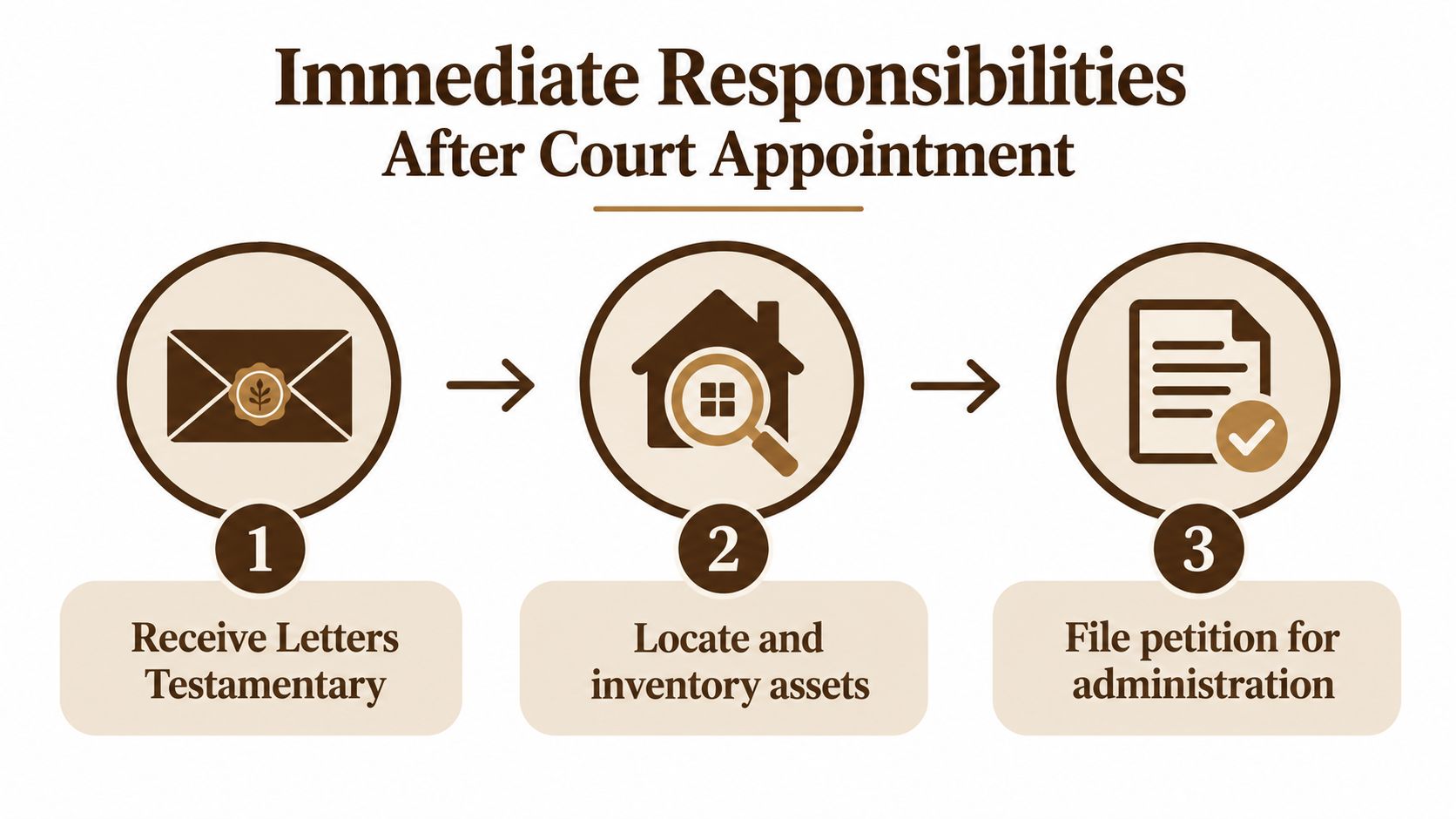
Once the court issues Letters Testamentary or Letters of Administration, your authority becomes formal, but so do your obligations. The first administrative tasks establish the record for everything that follows. Delays at this stage can complicate creditor notice, property management, and the eventual accounting.
Build the estate record immediately
Start by creating a working file for every known asset and liability. Gather deeds, loan statements, insurance policies, tax records, account statements, business documents, vehicle titles, digital account information, and correspondence. Record the condition of real property and personal property rather than relying on memory.
California probate procedure requires the personal representative to file an inventory and appraisal within four months after the letters are first issued. The California Probate Code requires each item to be listed separately and valued at its fair market value as of the decedent's date of death. If you later discover additional estate property, a supplemental inventory and appraisal must be filed within four months after that property is discovered.
The date-of-death valuation isn't a casual estimate. It may affect taxes, creditor decisions, disputes among beneficiaries, and the court's ability to evaluate your work. Real estate may require a qualified appraisal, while accounts and publicly traded assets may be documented through statements. Unique personal property may need specialized valuation.
Treat creditor notice as an early deadline
California probate materials also require the personal representative to mail a notice of administration to each known creditor within four months after appointment. The California Courts creditor notice form reflects the purpose of this process, which is to alert creditors so they can present claims under California law.
Don't assume that a creditor will find the probate case independently. Review the decedent's mail, records, tax files, loan documents, medical bills, and recurring payments. Preserve proof of every notice you send, including the recipient, address, date, method of delivery, and supporting documentation.
The immediate sequence is straightforward, but execution matters:
- Confirm authority: Keep certified copies of the court-issued letters available for banks, insurers, title companies, and other institutions.
- Locate property: Secure the residence and identify accounts, vehicles, business interests, personal property, and obligations.
- Document values: Obtain appropriate statements, appraisals, and title information for the inventory.
- Calendar filings: Track the inventory, creditor notices, tax filings, accountings, and court hearings in one reliable system.
- Preserve evidence: Keep an organized paper and digital trail for every decision, payment, notice, and conversation.
Before making substantial decisions, it helps to understand the court's expectations and the condition of the estate. This probate administration video provides additional context for the early process.
Managing Creditors and Outstanding Debts
Paying a relative's bills from an estate account may seem helpful, but an administrator can't just pay whoever sends the most urgent demand. Creditor management requires identification, notice, evaluation, and proper payment sequencing. Valid debts and administration expenses generally must be addressed before heirs receive distributions.
Begin with a complete search for known or reasonably ascertainable creditors. Look through the decedent's checkbook, email, mail, credit reports, tax returns, loan statements, medical records, leases, and business files. Ask whether the decedent had pending litigation, guarantees, co-signed obligations, or contracts that could create claims.
Review claims instead of accepting them automatically
A claim may be valid, invalid, overstated, secured, disputed, or subject to a legal deadline. The administrator's job isn't to approve every invoice. It is to evaluate the obligation, request supporting records, and object when a claim lacks a sufficient basis.
California's required notice to known creditors must be mailed within four months after appointment. Keep a creditor ledger showing the claim date, amount, supporting documents, response, decision, and payment status. If you reject or dispute a claim, preserve the reasons and consult counsel about the correct procedure rather than relying on a casual email.
A useful file may include:
- Notice records: Keep copies of mailed notices, delivery confirmation, returned mail, and follow-up correspondence.
- Claim support: Match invoices and demands to contracts, statements, medical records, loan documents, or other evidence.
- Payment approvals: Record who authorized each payment and why the estate had a legal obligation to pay it.
- Priority analysis: Separate valid debts, taxes, administration expenses, secured obligations, and disputed claims.
- Distribution holdback: Don't distribute property while significant liabilities remain unresolved unless the court and counsel have addressed the risk.
Paying beneficiaries early can create a problem that the estate can't easily reverse. If the estate later lacks funds for a valid creditor claim or tax obligation, the administrator may face a demand to restore money personally.
The practical trade-off is between speed and protection. Informal payment may calm a creditor temporarily, but it can create confusion about priority and documentation. A slower review with a complete record usually gives the estate a stronger position and reduces the risk of personal exposure.
Preserving and Managing Estate Assets
An Orange County home can lose value while relatives wait for probate to finish. A leak, vandalism, unpaid property taxes, lapsed insurance, or an unauthorized occupant may turn a manageable estate issue into a costly dispute. The administrator's responsibility continues after locating property. California law requires active management, protection, and preservation, especially when the estate includes real estate, a rental, a business, or another asset that cannot be sold immediately.

Real estate needs active stewardship
A vacant property should be inspected, secured, and checked regularly. Arrange prompt repairs for water intrusion or other hazards, confirm that insurance remains in force, and keep records of inspections, invoices, and decisions. If the estate owns a rental, the administrator must address rent collection, tenant communications, habitability concerns, repairs, and existing lease obligations. Ignoring those duties can reduce the property's value and expose the estate to avoidable claims.
Government guidance on estate administration and property responsibilities recognizes that an administrator may need to insure property, continue a business, sell property, collect delinquent rents and taxes, and perform contracts entered into by the decedent. These tasks require judgment rather than a passive hold. The administrator must preserve the asset while deciding whether continued operation, sale, or another course best serves the estate.
California authority describes a personal representative as having management and control of estate property, together with a duty to use ordinary care and diligence. That includes taking possession of property, collecting debts, receiving rents and profits, paying taxes, keeping buildings in repair, and taking reasonably necessary steps to protect and preserve assets. Each action should have a documented connection to the property's condition, the estate's obligations, or an eventual sale or distribution.
Decide when professional help is justified
Professional assistance can address risks that family members may not recognize. A property manager can stabilize a rental, a licensed contractor can document urgent repairs, an insurance professional can review coverage, and a qualified appraiser can support a valuation. Real estate counsel may be appropriate for a sale, title problem, contract dispute, or disagreement among co-owners.
Control costs by separating preservation expenses from optional upgrades. Obtain written estimates, approve only work the estate can justify, maintain appropriate insurance, and record how each decision protects value or supports a necessary transaction. A business also needs a documented review of continuity, sale, or orderly closure. These choices require attention throughout the administration, not only immediately after appointment.
Accounting, Compensation, and Court Oversight
A clean financial record can determine whether an estate administration withstands scrutiny. Beneficiaries and the court may need to see what the estate owned, what it received, what it paid, and why property or funds were distributed. Accurate records protect beneficiaries and give the administrator evidence against claims based on missing context.
Open a dedicated estate account. Never mix estate funds with personal money. Record each deposit and payment, keep invoices and receipts, and identify the asset, bill, or obligation connected to every transaction. Save bank statements and organize electronic files so the records can be produced promptly if the court or a beneficiary requests them.
Make the paper trail explain the decision
A bank statement proves that money moved. It does not explain the reason for the payment. Each significant transaction should connect to supporting material, such as a bill, court order, repair, tax obligation, creditor decision, or approved professional service.
The California Law Revision Commission's discussion of personal representative responsibilities describes the personal representative's responsibility to take possession of property, collect debts, receive rents and profits, and manage, protect, and preserve estate assets with ordinary care and diligence. In practice, that duty includes documenting why an expense or transfer served the estate rather than an individual beneficiary.
Court oversight can affect payments, attorney fees, personal representative compensation, sales, and distributions. Some actions require prior approval or compliance with specific probate procedures. Family agreement does not replace an order or authority the court has not granted. Obtain advice before acting if the appointment documents, the Probate Code, or a court order leaves room for doubt.
Compensation should remain transparent
California law may allow an administrator to receive compensation, but the payment should never look like an informal withdrawal. Record the work performed, the time involved when appropriate, and the legal basis for the amount. If court approval is required, submit the request through the proper probate process instead of paying first and explaining later.
A compensation request supported by clear records is easier to review and less likely to create conflict with beneficiaries.
Bond requirements depend on the estate's circumstances and the court's orders. A bond protects the estate if the administrator mismanages property or fails to perform required duties. Review the appointment documents carefully. A beneficiary's silence does not eliminate a bond requirement or excuse the administrator from keeping an accounting.
Common Pitfalls and Misconceptions to Avoid
The most dangerous misconception is that probate is passive. An administrator isn't merely waiting for the court to approve a distribution. The administrator must make decisions about property, creditor claims, records, insurance, taxes, and communication while the estate remains open.

Family agreement doesn't replace legal authority
Relatives may agree that one person should take the car or that a beneficiary should receive an advance from the estate. That agreement may not resolve creditor exposure, tax obligations, title requirements, or court approval. If the estate later cannot pay a valid claim, the administrator may have difficulty recovering property that was distributed informally.
The same problem arises when beneficiaries pressure the administrator to sell a home quickly. A fast sale may be appropriate, but the administrator still needs to consider authority, valuation, title, liens, repairs, insurance, marketing, and the interests of all beneficiaries. A family consensus can inform a decision, but it doesn't eliminate the fiduciary duty to act for the estate.
Records are part of the legal work
A missing receipt can make a legitimate expense look personal. An undocumented repair can look unnecessary. A cash payment can become impossible to verify. Maintain a consistent system for invoices, receipts, account statements, appraisals, notices, emails, text messages, and written explanations of major decisions.
Common failures include:
- Ignoring deadlines: Calendar every filing and notice requirement when the letters are issued, not when a problem appears.
- Using personal funds casually: Keep estate and personal accounts separate, and document any reimbursement.
- Distributing too early: Resolve or properly address creditor, tax, and administration obligations before transferring assets.
- Leaving property unattended: Keep homes secure, insured, maintained, and monitored while probate continues.
- Assuming court approval is optional: Ask counsel before selling property, paying compensation, settling disputes, or making significant distributions.
- Treating digital evidence as disposable: Preserve relevant emails, account access records, photographs, and electronic statements.
Official guidance emphasizes locating and notifying known or reasonably ascertainable creditors, objecting to improper claims, filing tax returns, and keeping accurate court accounts. The Florida Bar's consumer guidance on estate administration also illustrates the broader record-keeping and accountability concerns that arise when an administrator handles claims and distributions.
Seeking Professional Guidance for Your Estate
California probate combines court procedure with practical decisions about homes, rentals, debts, insurance, taxes, and family communication. A diligent administrator can still miss a filing deadline, misjudge a creditor claim, or make a property decision without the authority needed to protect the estate.
An experienced probate attorney can help identify assets, prepare the inventory, manage creditor notices, evaluate real estate issues, organize accountings, and determine when court approval is required. Counsel familiar with Orange County courts can also help families address disputes before a disagreement becomes a costly probate litigation matter.
Don't wait until a beneficiary objects or a creditor threatens suit. Early advice can help you set up the right records, protect estate property, and make informed decisions under California law.
Tanner Law advises families on California probate administration, including administrator duties, estate property issues, creditor concerns, and related real estate disputes. Schedule a free consultation by visiting Tanner Law to discuss the estate's deadlines, assets, and next practical steps.