Community Property vs Joint Tenancy in California
Over 85% of husband-and-wife deeds in California were recorded as joint tenancy, even though over 80% of those purchases were paid for with community funds. That means the way many couples funded their homes did not match the ownership form written on the deed.
That mismatch still creates problems for families in Orange County and Los Angeles. A deed is not just a closing document. It can determine who receives the property at death, whether the survivor must deal with probate, how much capital-gains exposure remains, and whether a later estate plan actually controls. California law specifically recognizes several ways for married couples to hold title, and the right choice depends on more than avoiding probate.
Table of Contents
- How California Title Choices Work for Married Couples
- Core Differences in Ownership and Survivorship
- Tax Basis Step-Up and Capital Gains Impact
- California Conveyancing Mechanics and Requirements
- Probate Implications and Transfer-on-Death Interactions
- Real-World Use Cases for Homeowners and Investors
- Choosing the Right Ownership Structure for Your Goals
How California Title Choices Work for Married Couples
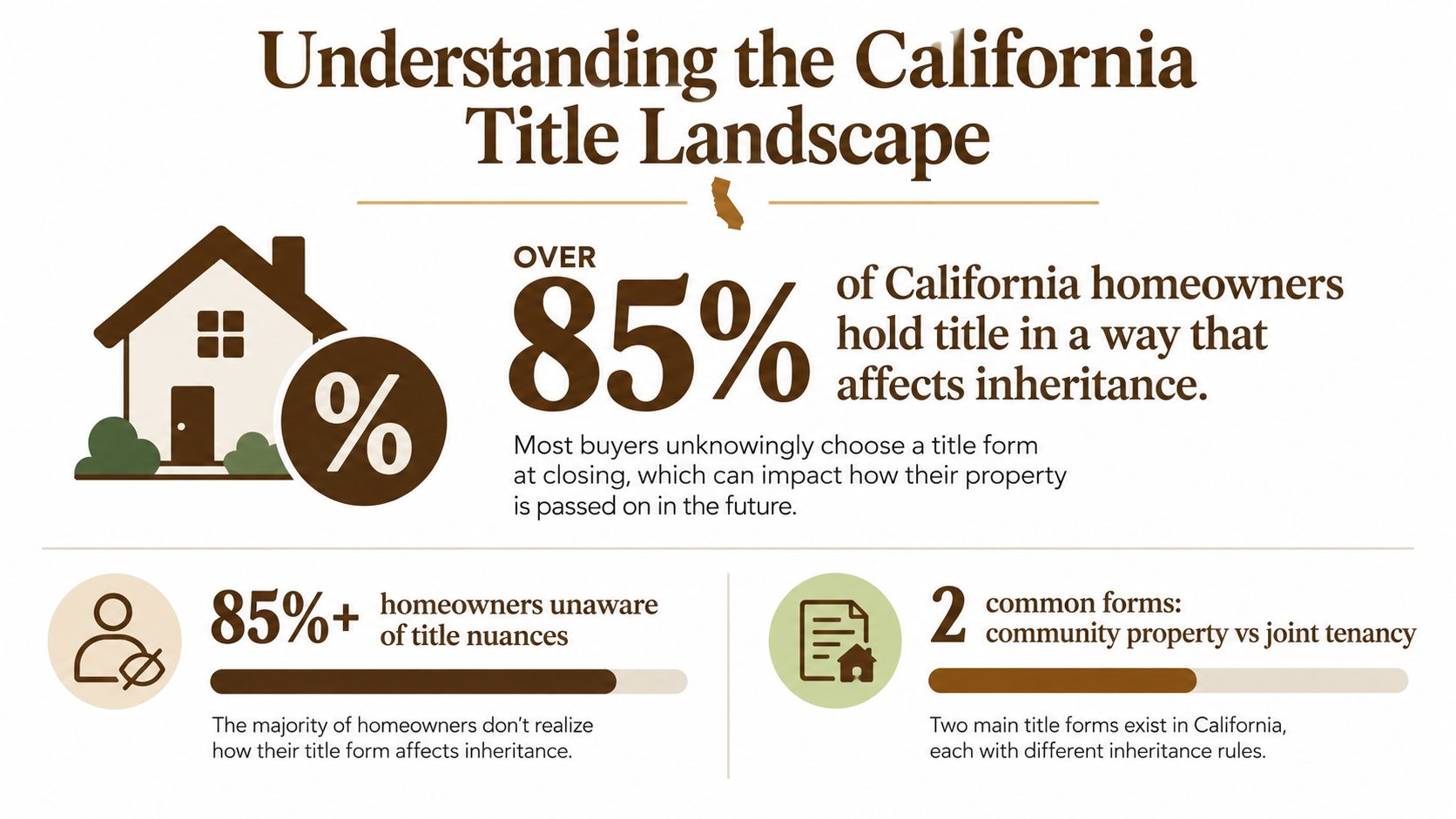
89.76% of title reports involving property vested in a husband, wife, or both showed joint tenancy, according to the California title-report review cited in the underlying legal materials. That figure describes recorded title, not necessarily how the purchase was funded or what the couple believed they were signing. The distinction matters because California treats marital property differently from property held through joint tenancy, as explained in IRS guidance discussing community property states and marital property treatment.
California is a community property state, yet many couples accepted joint-tenancy language during closing without examining its effect on inheritance, taxes, or later estate planning. The deed may reflect a convenient closing choice rather than a deliberate ownership plan.
Consider an Orange County couple who buys a home during marriage, pays the mortgage from earnings deposited into a joint household account, and signs closing documents naming them joint tenants. If one spouse later dies, the survivor may view the deed as a simple record of shared marital ownership. Legally, the title choice can produce different results from community property treatment, particularly when calculating tax basis or reviewing the couple's estate plan.
The title on the deed is only part of the story
California recognizes community property as a marital ownership system, but the vesting line does not answer every ownership question. Counsel must also examine the source of funds, when the property was acquired, any written marital agreement, transmutation documents, and the precise deed language. A separate-property contribution, refinancing, or later retitling can change the analysis.
The United States has 9 community property states, including California, Arizona, Idaho, Louisiana, Nevada, New Mexico, Texas, Washington, and Wisconsin. That broader context explains why federal tax treatment often enters the discussion, but California deeds and estate plans still require California statutes and case law.
| Issue | Community property | Joint tenancy |
|---|---|---|
| Basic ownership concept | Marital ownership generally associated with the community estate | Co-ownership with separate present interests |
| Death of one owner | Classic community property has no automatic survivorship | The surviving joint tenant generally receives the deceased owner's interest automatically |
| Probate at first death | May require administration unless survivorship or another estate-planning device applies | Survivorship generally avoids administration for that interest |
| Tax basis | Both halves can receive a full step-up at the first spouse's death | Generally only the decedent's half receives a new basis |
| Main planning concern | The deed must clearly address survivorship and estate administration | The title may sacrifice tax benefits and can affect later inheritance control |
For an Orange County title review, pull the grant deed vesting line and compare it with the escrow source-of-funds affidavit before recommending a retitle. The practical question is what the couple wants the property to do during marriage, at the first death, and after the survivor's death.
Core Differences in Ownership and Survivorship
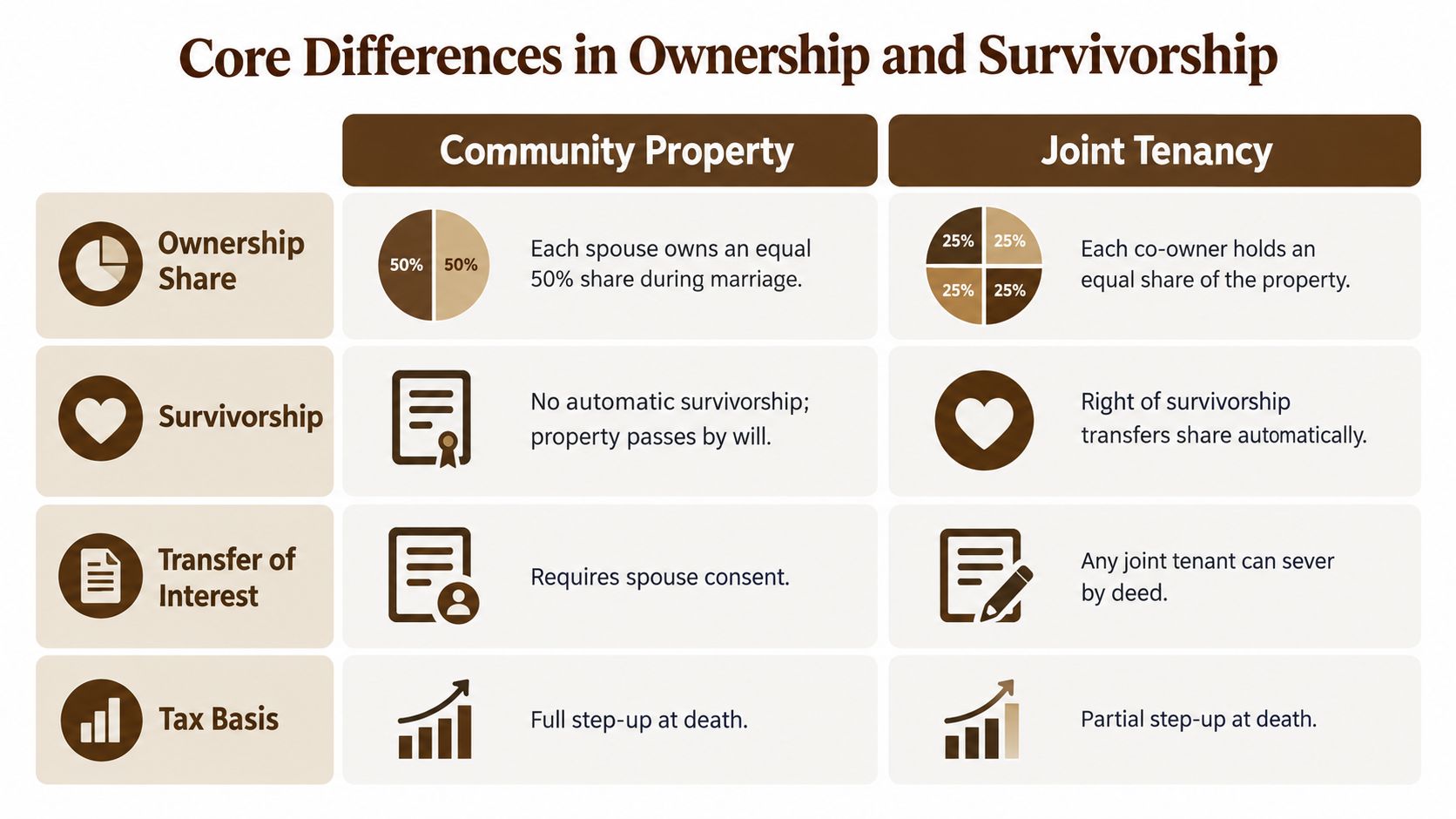
The central difference in community property vs joint tenancy is survivorship. Joint tenancy includes a right of survivorship. Classic community property does not automatically transfer the deceased spouse's share to the survivor. Instead, that share generally passes under the deceased spouse's estate plan or applicable succession law, as explained in scholarly materials comparing joint tenancy and community property.
That distinction affects control, probate, and family expectations. A surviving joint tenant typically takes the property automatically outside probate, while a spouse holding plain community property may need an estate administration process for the deceased spouse's interest unless a trust or another valid transfer mechanism applies.
Ownership during marriage
Joint tenancy gives each owner a present interest in the property. The ownership interests are generally treated as equal, and the survivorship feature becomes operative when one joint tenant dies. During life, however, the arrangement isn't immune from conflict. A joint tenant's interest may be affected by a creditor claim, a transfer, or a partition proceeding.
Community property reflects a marital ownership relationship rather than merely placing two names on title. That distinction can matter when one spouse claims the property is separate, when earnings were used to acquire the home, or when a couple later tries to change the property's character.
Survivorship and severance
A joint tenancy can be severed, but the practical result depends on the document, the parties, and the surrounding facts. A transfer by one joint tenant can alter the survivorship arrangement, and disputes often arise when a spouse signs a deed without understanding how it affects the other spouse's rights.
Plain community property has a different problem. It may accurately reflect the marital character of the property while failing to provide automatic survivorship. California law provides a hybrid option, community property with right of survivorship, but the deed must expressly create that form and the spouses must accept it in writing.
The tax distinction is often more important than the probate distinction: community property can provide a full basis step-up at the first spouse's death, while joint tenancy generally provides only a partial step-up.
The practical choice is not just “automatic inheritance or no automatic inheritance.” A couple must weigh survivorship against tax treatment, creditor exposure, the possibility of partition, and the family members who may inherit after the surviving spouse dies.
Tax Basis Step-Up and Capital Gains Impact
The tax basis issue is where community property often becomes structurally superior for married California owners. Under joint tenancy, only the deceased spouse's 50% share receives a new basis at death, while the survivor's original 50% share keeps its old basis. Under community property, both halves can receive a full step-up, potentially eliminating pre-death gain on the entire property, as described in this estate-planning presentation on basis treatment.
“Basis” is the tax starting point used to measure gain or loss. If a couple bought a property for a comparatively low amount and the property later appreciated substantially, the survivor may face significant taxable gain when selling. The basis adjustment at the first death can reset that starting point to the property's value at death, subject to applicable tax rules and proper characterization.
How the two outcomes differ
Assume a married couple owns a highly appreciated California home. If they hold it in joint tenancy, the surviving spouse generally receives a new basis for the deceased spouse's half, but the survivor's half retains its historic basis. A later sale can therefore leave built-in gain tied to the survivor's original interest.
If the same property qualifies as community property, both halves can receive a full step-up at the first spouse's death. That may eliminate pre-death appreciation from the basis calculation for the entire property, although the precise tax result still depends on federal law, state law, documentation, valuation, and the circumstances of the transfer.
| Ownership form | Basis result at first death | Practical consequence |
|---|---|---|
| Joint tenancy | New basis generally applies to the decedent's half | Historic gain can remain attached to the survivor's half |
| Community property | Both halves can receive a full step-up | Pre-death appreciation may be removed from the basis calculation |
| Community property with right of survivorship | Can combine survivorship with community-property basis treatment when properly created | May address both probate avoidance and basis planning |
Why this matters in Southern California
In Orange County and Los Angeles, families often hold homes for many years. They may also retain a former residence as a rental, transfer a property between generations, or keep an investment property until the first spouse dies. In those situations, the tax basis difference deserves attention before anyone signs a deed or retitles an asset.
A full step-up isn't automatic merely because a couple believes the property is community property. The deed, acquisition history, tracing evidence, agreements, and applicable law must support the characterization. A title review should therefore examine both the recorded instrument and the financial history behind it.
California Conveyancing Mechanics and Requirements
California law gives married couples a way to combine community-property treatment with survivorship, but the deed must be drafted correctly. California Civil Code section 682.1 provides that community property of spouses passes to the surviving spouse without administration when the transfer document expressly declares the property to be community property with right of survivorship and the grantees accept that designation in writing, as set out in California Civil Code section 682.1.
That wording matters. A deed that merely names the spouses or uses familiar joint-tenancy language may not accomplish the couple's intended tax and inheritance plan.

Draft the vesting language deliberately
A careful California title review should answer several questions:
- What does the current deed say? Don't rely on a closing statement, a tax bill, or memory. Obtain the recorded grant deed and review the vesting language.
- Was the property acquired during marriage? Timing alone may not resolve characterization, but it provides an important starting point.
- What funds paid for the acquisition and improvements? Separate-property contributions, marital earnings, refinancing, and tracing records can affect the analysis.
- Was there a written agreement changing the property's character? A prenuptial agreement, postnuptial agreement, or transmutation document may alter the result.
- Does the deed expressly create survivorship? Community property and community property with right of survivorship aren't interchangeable labels.
California's transmutation rules also limit informal changes. A written declaration must contain an express statement that the property's character or ownership is being changed. A joint-tenancy deed by itself isn't enough to change community property character under the California rule described in the California Supreme Court's discussion of transmutation requirements.
The right to survivorship under community property with right of survivorship may be terminated using procedures similar to joint-tenancy severance. That doesn't mean a couple should sign a corrective deed casually. Retitling can affect inheritance, tax treatment, creditors, refinancing, and the rights of children from a prior relationship.
Probate Implications and Transfer-on-Death Interactions
Many homeowners assume the deed is only one part of an estate plan. In practice, the deed can control the transfer of the property at death, especially when it contains a survivorship feature. California Probate Code section 5664 makes a revocable transfer-on-death deed ineffective when, at the owner's death, the property is already held in joint tenancy or as community property with right of survivorship. The California statute addressing revocable transfer-on-death deeds recognizes that the survivorship arrangement controls instead.
This creates a common planning trap. An owner may sign a transfer-on-death deed naming a child, then later hold the property in a form that transfers it automatically to a surviving spouse. At death, the survivorship provision can defeat the transfer-on-death deed, leaving the child with no interest under that document.
Mixed title creates difficult questions
A title history may contain several instruments, each signed at a different stage of a family's life. A couple may acquire a home as joint tenants, refinance it, sign an estate plan, execute a later deed, and then make a transfer-on-death designation. Those documents don't necessarily operate together as a single coordinated plan.
California also recognizes that a married couple taking title as joint tenants can still create a community-property issue when the surrounding documentation and tracing evidence point in that direction. Title is important, but it may not answer every characterization question.
Washington illustrates why attorneys must avoid treating survivorship and community-property concepts as identical. Washington law presumes that jointly titled interests held by spouses or domestic partners are community property in many respects, while treating survivorship separately, as provided in Washington's joint tenancy statute. California has its own rules, so Washington's approach isn't a substitute for California advice, but it shows why a deed's label and the underlying marital-property rules can operate on different tracks.
Before relying on a transfer-on-death deed, compare it with the grant deed, trust, will, beneficiary designations, and any marital-property agreement. A document that looks effective in isolation may be overridden by the title arrangement already in place.
Real-World Use Cases for Homeowners and Investors
A married couple holding a long-term California residence often has the strongest reason to examine community property treatment. If the home has appreciated substantially, the potential full basis step-up can matter more than the convenience of using a familiar joint-tenancy form. Community property with right of survivorship may offer a way to address survivorship while preserving the tax characteristics of community property, provided the deed satisfies California requirements.

An investor should examine more than the expected tax result. Joint tenancy gives each owner a present interest, and California courts explain that joint-tenancy interests are generally subject to partition and creditor claims during marriage, as discussed in California legal materials addressing joint-tenancy rights. If the relationship deteriorates, one owner may seek a division or sale of the property. If a creditor reaches an owner's interest, the family may face a dispute before either spouse dies.
Families with different inheritance goals
Joint tenancy can work when spouses want the survivor to take the property automatically and don't have a competing inheritance plan. It can work less well when one spouse has children from a prior relationship, wants to preserve a separate-property interest, or expects the survivor to distribute the property among several beneficiaries.
Plain community property may better reflect the marital ownership of a home, but it doesn't automatically solve probate. Community property with right of survivorship can address the first-death transfer, yet it still doesn't replace a complete estate plan for incapacity, the survivor's later death, or family conflict.
A family considering a retitling decision should ask:
- Who should receive the property after the first death?
- Who should control the property if the survivor becomes incapacitated?
- Should children from a prior relationship inherit a defined share?
- Is preserving basis more important than the simplicity of existing title?
- Could a creditor, partition claim, or divorce dispute affect the property?
For a visual overview of how the title choice affects married owners, review the embedded explanation below.
The best structure depends on the family's actual objectives. In many high-appreciation situations, community property deserves serious consideration because it can combine marital ownership with a more favorable basis result. That doesn't make it universally correct, particularly where separate-property claims, creditor concerns, or blended-family inheritance goals require a different plan.
Choosing the Right Ownership Structure for Your Goals
The most useful way to evaluate community property vs joint tenancy is to start with the family's objective rather than the form itself.
If probate avoidance at the first death is the priority, joint tenancy may accomplish that through survivorship. Community property with right of survivorship may also do so when the deed contains the required language and the spouses accept it in writing. Plain community property doesn't automatically provide the same result.
If capital-gains planning is central, community property generally deserves priority in the analysis because both halves can receive a full basis step-up at the first spouse's death. Joint tenancy generally provides a new basis only for the deceased spouse's half, leaving the survivor's historic basis in place.
If creditor exposure or a future ownership dispute is the concern, don't assume either label provides complete protection. Joint-tenancy interests can be subject to creditor claims and partition during marriage, and community-property characterization requires careful review of California law, the source of funds, and any marital agreements.
The question isn't merely which title avoids probate. It is whether the deed, tax characterization, and estate plan all point to the same result when someone dies.
A California attorney should review the recorded deed, acquisition and refinance documents, payment records, trust and will, transfer-on-death instruments, and any prenuptial or postnuptial agreement before a couple changes title. That review is especially important for homeowners and investors in Orange County and Los Angeles who hold appreciated real estate or have blended-family concerns.
Tanner Law reviews California title, survivorship, probate, and property-dispute issues and can help you determine whether your deed matches your estate-planning goals. Schedule a free consultation by visiting Tanner Law to discuss your property and next steps.