Trust Administration Attorney: Guide for Orange County
A trust administration attorney acts as a fiduciary guide, ensuring the settlor's wishes are followed legally and efficiently. Trust administration typically costs 0.5% to 1% of the estate value, compared with approximately 2% for probate.
A successor trustee may receive the appointment as a vote of confidence, then discover that the role involves far more than signing checks and transferring a house. You may need to interpret unfamiliar trust language, locate and value assets, communicate with beneficiaries, preserve records, meet California notice deadlines, and coordinate tax filings while grieving.
For families in Orange County and Los Angeles, the central question is whether a trust avoids probate. It's whether the trustee can administer the trust with enough discipline to avoid disputes, penalties, and personal exposure. A trust administration attorney provides a practical system for doing that under California law, serving as a guide to the trustee rather than waiting until a disagreement becomes litigation.
Table of Contents
- Why You Need a Trust Administration Attorney
- The Trust Administration Process Step by Step
- Fiduciary Duties and Common Legal Pitfalls
- California-Specific Requirements and Deadlines
- Costs and Fee Structures Explained
- How to Choose a Trust Administration Attorney
Why You Need a Trust Administration Attorney
A successor trustee often starts with a reasonable assumption: the trust document explains what to do, so following it should be straightforward. Then the trustee finds several bank accounts, a residence, investment statements, unpaid bills, family questions, and beneficiaries who want different answers. The trustee may also be expected to make decisions about repairs, sales, distributions, and expenses without knowing which actions require explanation or documentation.

The attorney's role is to turn that uncertainty into an orderly fiduciary process. That usually begins with reviewing the trust, identifying the people entitled to notice or information, confirming how assets are titled, and establishing a recordkeeping process before money moves. The attorney can also identify when a trust asset, real property transfer, beneficiary designation, or tax question needs help from a CPA, appraiser, financial institution, or title professional.
Guidance before conflict
The most effective trust administration work is preventive. A trustee who explains decisions, keeps trust funds separate, and provides appropriate information gives beneficiaries fewer reasons to assume that something is being hidden. A trustee who distributes property casually, pays personal expenses from a trust account, or refuses reasonable questions can create a conflict even when acting with good intentions.
Practical rule: If you wouldn't be comfortable explaining a transaction to every beneficiary and a judge, document the reason before completing it.
California trust administration also has a human dimension. Siblings may disagree about whether to sell a family home, how to value personal property, or when to make a distribution. An attorney can help the trustee distinguish a genuine legal requirement from a family preference, communicate the decision in neutral language, and preserve the trustee's impartiality.
The financial reason for professional help
Trusts are often used because they can transfer assets with less court involvement than probate. A nationwide survey cited by the American Academy of Estate Planning Attorneys cost comparison found average probate fees of about 2% of estate value, while trust administration expenses averaged 0.5% to 1%. On a $1 million estate, that comparison is approximately $20,000 in probate fees versus $5,000 to $10,000 for trust administration.
Those figures don't eliminate legal fees or guarantee a quick distribution. They do show why careful administration matters. The money saved by avoiding unnecessary court involvement can be undermined by poor notices, incomplete accounting, or a preventable dispute. For many families, hiring a trust administration attorney is less about handing over control and more about protecting the trustee while carrying out the settlor's plan.
The Trust Administration Process Step by Step
Trust administration follows a sequence, although the exact work depends on the trust terms, asset ownership, family circumstances, and tax issues. A clear file structure and written timeline help the successor trustee avoid treating urgent matters and routine matters as if they have the same priority.

-
Locate and review the trust document. Obtain the current trust, amendments, schedules, pour-over will, deeds, account statements, and other estate planning records. The attorney checks who serves as successor trustee, who receives notice, whether distributions are outright or continuing, and whether the document gives special instructions for real estate, businesses, or personal property.
-
Secure the immediate situation. Protect the residence, vehicles, accounts, digital records, and personal property from loss or unauthorized access. The trustee should avoid making informal distributions to family members before ownership and beneficiary rights are confirmed.
-
Notify the appropriate people. California notice duties can be deadline-sensitive. The trustee needs a reliable list of beneficiaries and heirs, correct addresses, and proof showing what was served and when. A trust administration attorney can prepare notices and maintain service records.
-
Inventory, value, and separate assets. Create a complete list of trust property, debts, income, expenses, gains, losses, and estimated values. Trust funds should be held separately from the trustee's personal funds. Real estate may require title review, valuation, insurance, maintenance, or sale planning.
-
Pay valid expenses and coordinate tax work. The trustee identifies enforceable debts and administration expenses, then coordinates the decedent's final Form 1040 and the trust's Form 1041 with tax professionals. The trustee must distinguish income from principal because that classification can affect both distributions and beneficiary tax reporting.
-
Distribute and close the trust. Before distributing, the trustee should confirm that notices are complete, taxes and expenses are addressed, reserves are appropriate, and the accounting supports the proposed payments. Final receipts, releases where appropriate, transfer documents, and closing records help establish what happened and when.
The attorney isn't a substitute for the trustee. The trustee still makes decisions required by the trust, but counsel can identify which decisions need consent, notice, valuation, or court involvement.
A short visual overview can help families understand the sequence, but it can't replace advice about a particular trust.
Fiduciary Duties and Common Legal Pitfalls
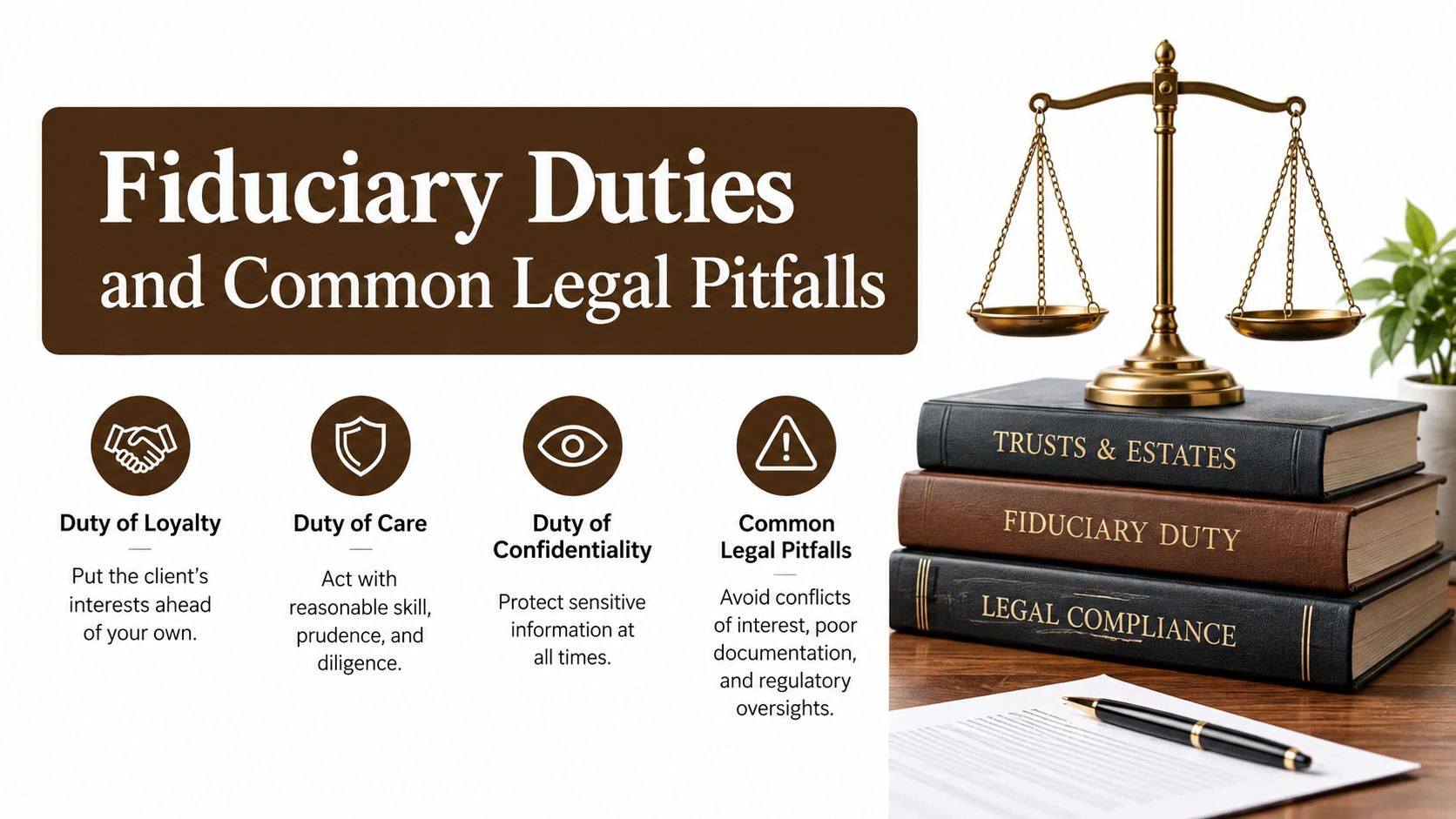
A trustee controls property for other people. That relationship creates fiduciary duties, meaning the trustee must put beneficiaries' interests and the trust's terms ahead of personal convenience. The most important duties are easier to understand through ordinary decisions than through legal definitions.
Loyalty requires clean decisions
The duty of loyalty means the trustee must act for the beneficiaries and avoid self-dealing. A trustee shouldn't purchase trust property at an informal discount, use trust funds to pay a personal obligation, or favor one beneficiary because of a family alliance. Even a transaction that appears financially reasonable can become difficult to defend if the trustee benefits personally and fails to disclose the conflict.
Prudence requires a documented process
The duty of prudence concerns how the trustee manages trust assets. It doesn't require perfect investment results. It requires thoughtful decisions, appropriate care, attention to risk, and records showing why an action made sense at the time.
Selling an asset without understanding its value, leaving property uninsured, ignoring needed repairs, or retaining a volatile investment without review can expose the trustee to criticism. The FDIC guidance on account administration emphasizes the practical controls that support responsible administration, including accurate accounts, fiduciary conduct, and separation of trust property from personal assets.
Impartiality protects different beneficiaries
The duty of impartiality matters when beneficiaries have competing interests. One beneficiary may want the house sold, while another wants to keep it. One may receive income from an investment, while another expects eventual principal. The trustee can't choose the outcome that creates the least family tension or favors the person who asks most forcefully.
A strong accounting package should track receipts, disbursements, gains, losses, asset values, and trustee compensation. That record helps beneficiaries understand the administration and gives the trustee evidence supporting distributions, fees, and investment decisions. Poor records create the opposite result. They make ordinary actions look suspicious and make it harder to defend against breach-of-fiduciary-duty claims.
A separate account is useful, but separation alone isn't enough. The trustee also needs transaction-level records that explain what came in, what went out, and why.
The attorney can establish a ledger, approval process, distribution protocol, and communication schedule at the beginning. That approach works better than reconstructing years of transactions after a beneficiary has demanded an accounting or filed a petition.
California-Specific Requirements and Deadlines
California trustees face duties that are easy to underestimate, particularly around beneficiary notice and information rights. A trustee administering a trust for a California family should treat the Probate Code as an operating manual, not as background reading to consult only after a dispute begins.
Notice under section 16061.7
California Probate Code section 16061.7 requires a successor trustee to serve written notice on trust beneficiaries and heirs within 60 days after the triggering event. If the trustee didn't previously know that someone was entitled to notice, the period runs within 60 days after learning of that person. The California Legislature's text of Probate Code section 16061.7 also describes the warning that a trust contest is generally barred more than 120 days after service of the notice, or 60 days after delivery of a copy of the trust terms during that 120-day period, whichever is later.
The practical issue isn't merely mailing a form. The trustee must identify recipients, use accurate addresses, include the required information, retain proof of service, and respond appropriately when a recipient requests the trust or related information. An incorrect or incomplete notice can prolong uncertainty and complicate later distribution planning.
Keeping beneficiaries reasonably informed
California Probate Code sections 16060 through 16064 impose a duty to keep beneficiaries reasonably informed about the trust and its administration. The Alameda County Superior Court explanation of California trust administration describes key information that may need to be provided, including the settlor's name, the trust date, the trustee's contact information, the administration address, and the right to request a copy of the trust.
“Reasonably informed” doesn't mean sending every internal email. It does mean providing meaningful information about material developments, answering proper questions, and avoiding silence when the trust's assets, timing, or distributions are changing. A written communication plan can reduce both confusion and accusations of concealment.
Tax coordination needs its own calendar
The fiduciary generally coordinates the decedent's final Form 1040 with the trust's Form 1041. For a calendar-year trust, Form 1041 is generally due April 15. For a fiscal-year trust, it is generally due on the 15th day of the fourth month after the fiscal year ends, as outlined in California trust administration tax guidance.
The trustee should involve a qualified tax professional early. Missed filings, incorrect fiduciary classification, and poor income-versus-principal allocations can create penalties and shift tax consequences to beneficiaries.
Costs and Fee Structures Explained
A trustee may receive a low initial quote and still face substantial expense once beneficiary questions, asset transfers, tax coordination, real estate, or an accounting dispute enters the file. Compare the work required, not only the billing label.
Trust administration often avoids the court process associated with probate, but it does not eliminate fiduciary work. Fees can rise when records are incomplete, assets are difficult to value, ownership is unclear, beneficiaries disagree, or the trust requires multiple distributions. The ranges discussed earlier are illustrative and vary by county, asset mix, and the trust's instructions.
What drives the final bill
Ask for a written scope that separates routine administration from events requiring additional work. Routine tasks may include collecting assets, preparing notices, coordinating with the tax professional, reviewing transactions, preparing an accounting, and documenting distributions. A contested accounting, real estate sale, title correction, or beneficiary dispute may require separate legal analysis and correspondence, regardless of whether the assets are held in a trust or handled through probate.
The fee model matters less than the scope definition. A flat fee with broad exclusions can be less predictable than hourly billing with regular status reports and a defined budget.
Common billing approaches
Hourly billing suits targeted advice, such as reviewing a proposed distribution, responding to a beneficiary request, or resolving a title issue. It offers flexibility, but costs may increase if communications or disputes expand.
Flat-fee administration can support budgeting when the assets and family relationships are relatively straightforward. The engagement should specify whether it covers notices, asset collection, accounting review, distribution documents, tax coordination, and closing work. It should also identify rates for excluded services.
Statutory or court-related compensation may apply in specific circumstances. California Probate Code section 15688 addresses compensation when a public guardian or public administrator serves as trustee of a trust providing for outright distribution of the entire trust estate. The fiduciary's and attorney's compensation is calculated like statutory probate compensation, based on asset value at appointment, with a $1,000 minimum for each, as described in California Probate Code section 15688.
Before signing, ask whether beneficiary communication, accounting preparation, revisions, and routine calls are included. A written scope makes cost comparisons more reliable and gives the trustee a way to identify extra work before it begins.
How to Choose a Trust Administration Attorney
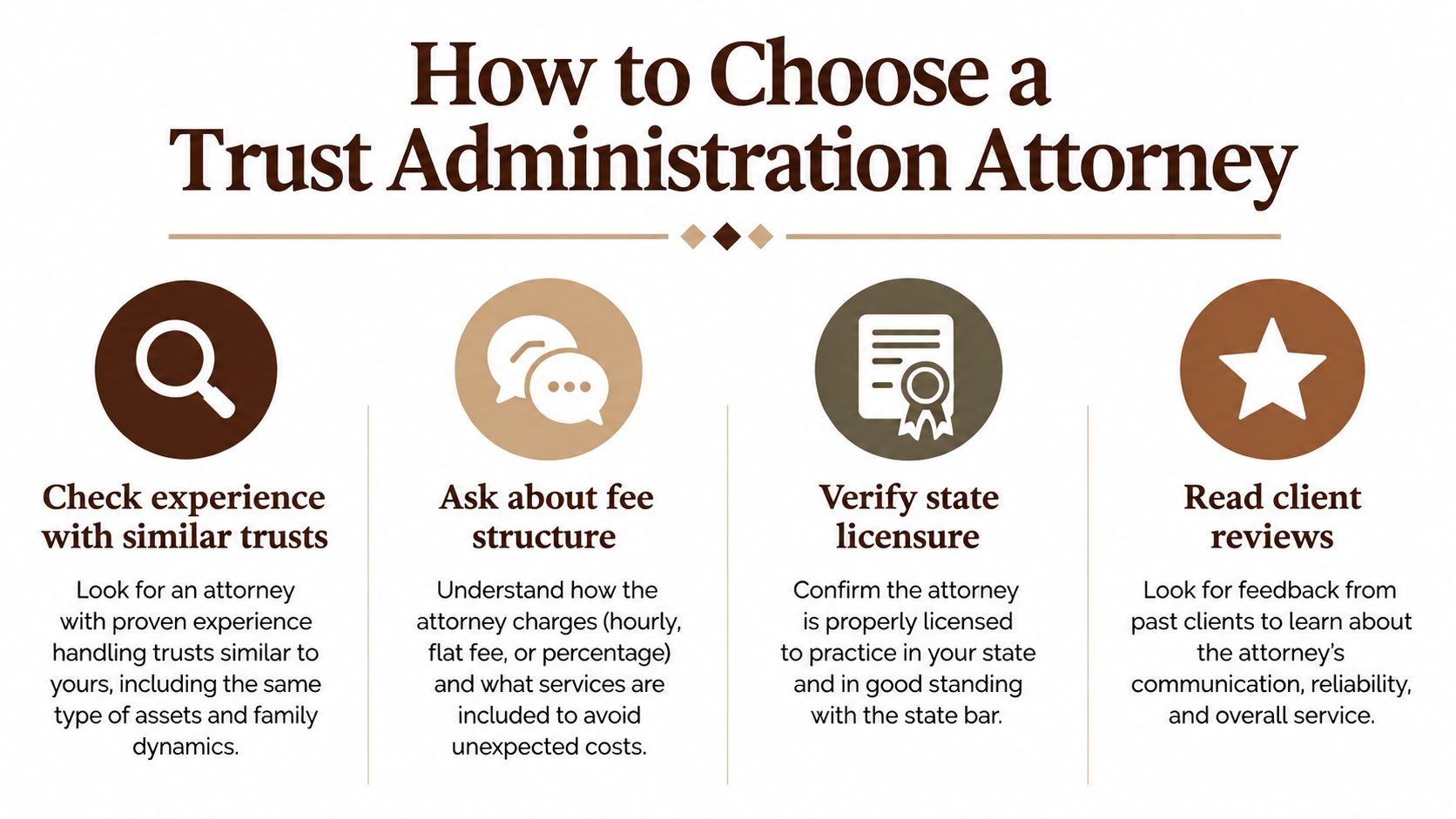
The right attorney should make the trustee's responsibilities clearer, not create another layer of uncertainty. Experience with estate planning alone may not tell you how counsel handles beneficiary reporting, real estate transfers, accountings, tax coordination, or a dispute that begins during administration.
Questions to ask before hiring
- Relevant experience: Ask whether the attorney regularly handles California trust administration involving homes, rental property, investment accounts, blended families, or contested beneficiary expectations.
- Communication plan: Ask how counsel will keep the trustee informed and help communicate with beneficiaries. A firm that treats beneficiary questions as an annoyance may increase conflict.
- Accounting method: Ask what records the firm expects, how transactions will be categorized, and who reviews the accounting before distributions.
- Deadline control: Ask how the office tracks the California notice period, tax dates, property deadlines, and document requests.
- Fee structure: Request a written explanation of hourly rates, flat-fee scope, retainers, extra work, litigation fees, and third-party expenses.
- Real estate capability: If the trust owns a home or other property, ask whether counsel can address title, sale, partition, quiet title, or related ownership issues, or whether a referral will be needed.
- Direct access: Confirm whether you'll speak with the attorney handling the matter or primarily with staff.
Warning signs
Be cautious when counsel promises a specific distribution outcome without reviewing the trust and asset titles, gives vague answers about fees, discourages appropriate beneficiary reporting, or treats accounting as an afterthought. A trustee also needs to know whether the attorney's role is advisory, administrative, litigation-focused, or some combination of those services.
Technology adds another selection issue. Recent industry coverage reports that legal professionals' use of general-purpose artificial intelligence for administrative tasks reached 69% in 2026, while adoption of legal-specific AI software reached 34%. The same trusts and estates industry coverage cites a projection that the trusts and estates services market could grow from $25.1 billion in 2024 to $49.8 billion by 2030. Those figures suggest changing workflows, not that software can replace fiduciary judgment.
Ask how the firm protects confidential information, verifies automated outputs, preserves original records, and ensures an attorney reviews notices, accountings, and distribution documents. Tanner Law provides probate and estate guidance alongside experience with property disputes, which can be relevant when trust administration involves ownership, title, or real estate disagreements. Compare that option with other California counsel based on fit, scope, communication, and cost.
Tanner Law offers practical guidance for trustees handling California trust administration, probate matters, and related real estate or ownership disputes. Visit Tanner Law to review the firm's services and schedule a free consultation about the notices, accounting concerns, property issues, or distribution decisions affecting your family.