Beneficiary Rights in a Trust: California Law Explained
You may already be in the middle of this. A parent or grandparent has died. Someone in the family tells you that you're a beneficiary of the trust. Then nothing happens. The trustee stops returning calls, gives vague answers, or says you'll get information “when the time is right.”
That situation is common in California trust disputes, especially when the trustee is also a sibling, step-parent, or another relative who thinks control of the assets gives them control of the process. It doesn't. California law gives beneficiaries real rights, and those rights can be enforced in Probate Court.
If you're trying to understand beneficiary rights in a trust under California law, the most important point is simple. You are not limited to waiting and hoping the trustee does the right thing. You can demand information, require an accounting, challenge improper conduct, and ask the court to step in when necessary.
Table of Contents
- Am I Being Kept in the Dark About My Trust
- Your Fundamental Rights as a California Beneficiary
- Understanding the Trustee's Legal Duties
- Common Trustee Breaches and Warning Signs
- How to Enforce Your Rights in California
- Key Timelines and California Probate Codes
- When to Contact a Trust Litigation Attorney
Am I Being Kept in the Dark About My Trust
A new client often comes in with the same story. They know a trust exists. They believe they are named in it. They may even know the trust holds a house in Orange County or Los Angeles. But the trustee keeps saying the administration is “not finished,” without providing the document, records, or a real explanation.
That leaves beneficiaries feeling trapped. They don't know what property exists, whether bills are being paid from trust funds, whether a home is being listed for sale, or whether one family member is getting favored treatment behind the scenes. The silence becomes part of the problem.

Why silence matters
A trustee's refusal to communicate isn't just rude. In California, it can interfere with your ability to protect yourself before assets are sold, distributed, or mishandled. Once trust money moves, recovering it is harder. Once real property is transferred, the dispute gets more expensive.
Beneficiaries usually don't lose leverage because they lack rights. They lose leverage because they wait too long to enforce them.
If you're dealing with a vague or unresponsive trustee, don't assume that delay is normal. Some delay is legitimate. Trustees may need time to gather records, secure property, deal with taxes, or evaluate creditor issues. But “be patient” is not a substitute for disclosure.
What beneficiaries should do first
Start by identifying the problem clearly:
- No trust document: You've been told you're a beneficiary, but no one will provide the trust or relevant portions of it.
- No financial transparency: You don't know what assets are in the trust, what expenses have been paid, or who has received distributions.
- Unexplained inactivity: Months pass with no updates, no timeline, and no reason for the delay.
- Property concerns: The trust owns a house, rental property, or investment asset, and you suspect the trustee is mishandling it.
Those facts usually point to one issue. You need information before you can decide whether the trustee is doing the job properly. That is where California beneficiary rights become practical, not theoretical. If this sounds like your situation, schedule a free consultation.
Your Fundamental Rights as a California Beneficiary
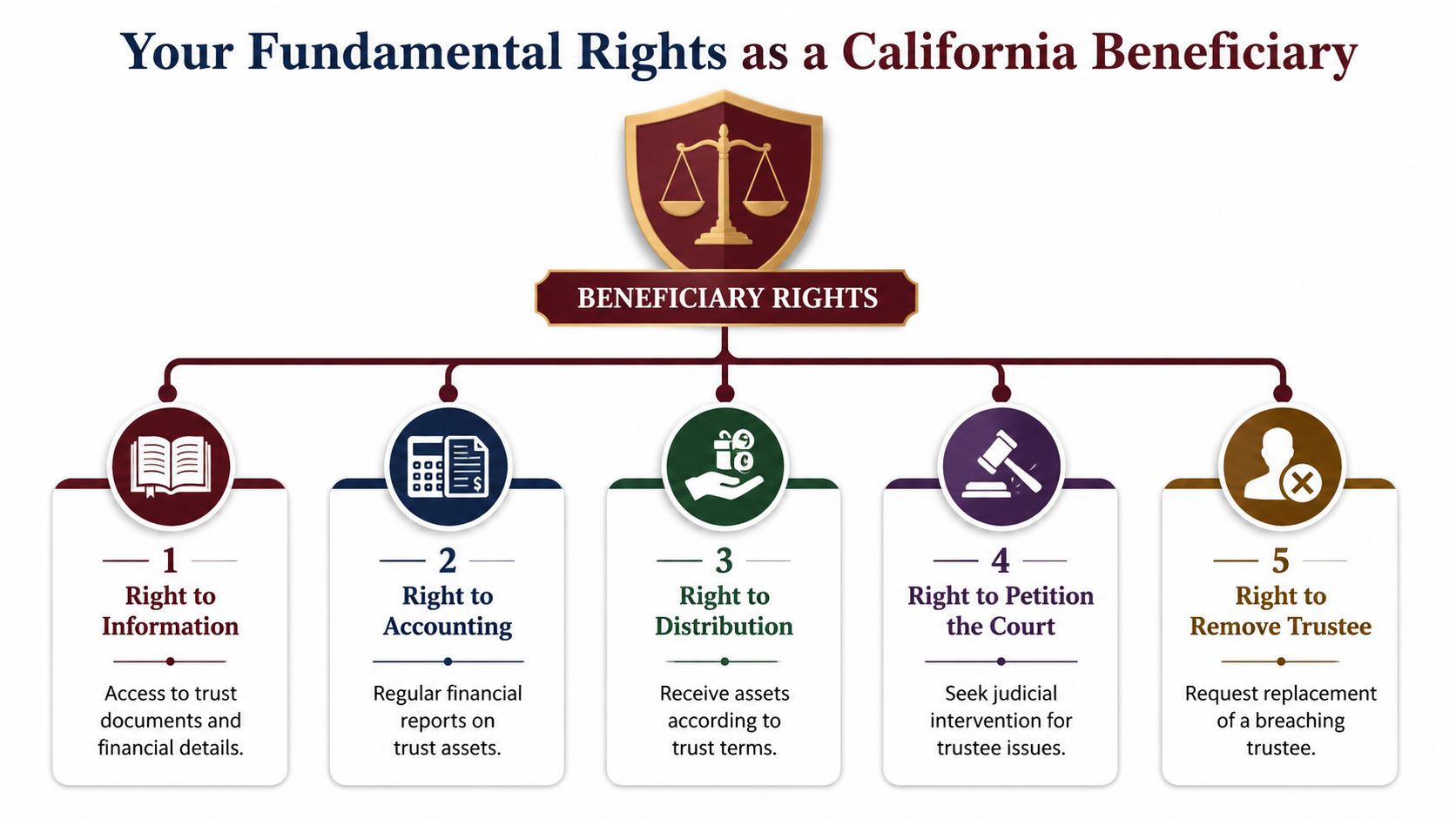
A beneficiary's rights matter most at the point where suspicion needs to become proof. In California trust disputes, three rights usually determine what happens next: the right to information, the right to an accounting, and the right to distributions under the trust's terms. If those rights are respected, administration tends to move. If they are blocked, the case often heads to Probate Court.
Near the start of a case, I look at these rights first because they shape the record. A beneficiary who has documents, dates, and accountings is in a far stronger position than a beneficiary who only knows something feels wrong. That difference affects settlement, court strategy, and how quickly a judge can act.
The right to information
California trustees have a duty to keep beneficiaries reasonably informed. Probate Code sections 16060 and 16061 are usually the starting point. In plain terms, that means a beneficiary is entitled to enough information to understand the trust, the beneficiary's interest, and what the trustee is doing with trust property.
In practice, this often starts with a simple question. Has the trustee provided the trust document, or at least the portions that affect your interest? If not, that is often the first issue to address, because everything else depends on the language of the trust.
If a trustee refuses to provide basic information after a reasonable written request, the next step is usually not another vague email exchange. The next step is to create a clear record, identify exactly what was requested, and prepare for a petition to compel the trustee to report or account under Probate Code section 17200. That procedure is where beneficiary rights become enforceable, not just theoretical.
This embedded video gives a useful overview before diving into enforcement:
The right to an accounting
An accounting is often the document that changes the case. Bank statements by themselves are rarely enough. A proper trust accounting should show receipts, disbursements, assets on hand, liabilities, trustee compensation, and the transactions that explain where the money went.
That matters because California Probate Court does not decide these cases based on family assumptions. Judges want records. A formal accounting gives the court something concrete to review if the trustee's conduct is challenged.
A useful accounting should answer questions like these:
- What assets are in the trust: cash, investment accounts, real property, business interests, or personal property
- What came into the trust: rent, sale proceeds, dividends, refunds, or other income
- What the trustee spent: taxes, insurance, repairs, legal fees, mortgage payments, or trustee fees
- What distributions were made: who received money or property, when they received it, and the authority for the payment
A trustee who delays or resists an accounting creates a separate problem. Sometimes the records are disorganized. Sometimes the trustee knows the numbers will raise hard questions. From a litigation standpoint, both situations matter.
The right to distributions
Beneficiaries are entitled to distributions the trust requires. That sounds obvious, but it often becomes the crux of many disputes. Some trusts call for prompt distribution after death and administration. Others keep assets in trust for years. Others give the trustee discretion over timing or amount.
The terms control.
If the trust requires a distribution after a triggering event, the trustee cannot hold it back because of family conflict, personal disagreement, or a desire to pressure one beneficiary into accepting less. A legitimate delay is different. Sale of real property, tax clearance, creditor issues, or unresolved title problems can justify waiting. The point is that the trustee needs a real legal or administrative reason, not a convenient excuse.
For many beneficiaries, the practical order is straightforward. First, confirm what the trust says. Second, demand the records that show whether the trustee followed it. Third, if the trustee still will not act, use Probate Code section 17200 to ask the court to compel action, order an accounting, instruct the trustee, suspend the trustee, or remove the trustee if the facts support it. That is how these rights are enforced in California.
Understanding the Trustee's Legal Duties
Beneficiary rights in a trust make more sense when you understand the trustee's role. A trustee is not just the person holding the checkbook or managing the family home. Under California law, the trustee is a fiduciary. That means the trustee must act for the benefit of the beneficiaries and according to the trust's terms.
Many trustees don't appreciate how strict that duty is. Family trustees often believe they can run the trust informally because they knew the person who created it. That mindset causes problems fast, especially when there is real estate involved.
Fiduciary duty means the trustee must put beneficiaries first
The duty of loyalty is the core obligation. The trustee cannot use trust property for personal advantage, cannot treat the trust as a personal account, and cannot make decisions that favor the trustee's own interests over the beneficiaries' interests.
That duty shows up in ordinary decisions:
- Selling property: The trustee should pursue a fair process and fair value, not a quiet sale to a friend or relative on favorable terms.
- Paying expenses: The trustee may pay legitimate trust expenses, but not personal bills disguised as administration costs.
- Handling family pressure: The trustee cannot side with one beneficiary because that person is more vocal, more local, or more aligned with the trustee.
A trustee also owes a duty of impartiality when there are multiple beneficiaries. Equal treatment does not always mean identical treatment, because trust terms vary. But a trustee cannot play favorites without authority in the document.
What prudence looks like in real trust administration
The duty of prudence requires the trustee to manage trust assets with care. That includes protecting property, maintaining adequate records, handling liquid assets responsibly, and making decisions a reasonable fiduciary would make under similar circumstances.
For a trust that owns California real estate, prudent administration often includes basic tasks such as securing the property, maintaining insurance, collecting rent if tenants are in place, preserving records, and avoiding avoidable losses. Doing nothing can be as damaging as doing the wrong thing.
Here are signs of proper administration:
- Documented decisions: The trustee can explain why money was spent or why a property decision was made.
- Separate records: Trust funds are tracked clearly and not mixed with personal money.
- Regular communication: Beneficiaries receive updates that are specific enough to evaluate the administration.
- Respect for the trust terms: The trustee follows the actual language of the instrument rather than personal opinions about what is “fair.”
A trustee doesn't get extra legal freedom because the dispute involves family.
When a beneficiary understands these duties, the dispute usually becomes clearer. The question stops being “Why is the trustee acting this way?” and becomes “Has the trustee violated a legal duty?” If you need help evaluating that question under California law, schedule a free consultation.
Common Trustee Breaches and Warning Signs
Most trust litigation does not begin with dramatic theft. It starts with conduct that people try to excuse. A trustee stops responding. A house sits vacant without explanation. Records never arrive. One beneficiary gets inside information while another is told to wait. By the time the full problem is visible, the trustee may have already made decisions that are difficult to undo.
Beneficiaries should pay attention to patterns, not isolated irritation. One missed call may mean nothing. A sustained refusal to provide records often means much more.
Conduct that should concern you
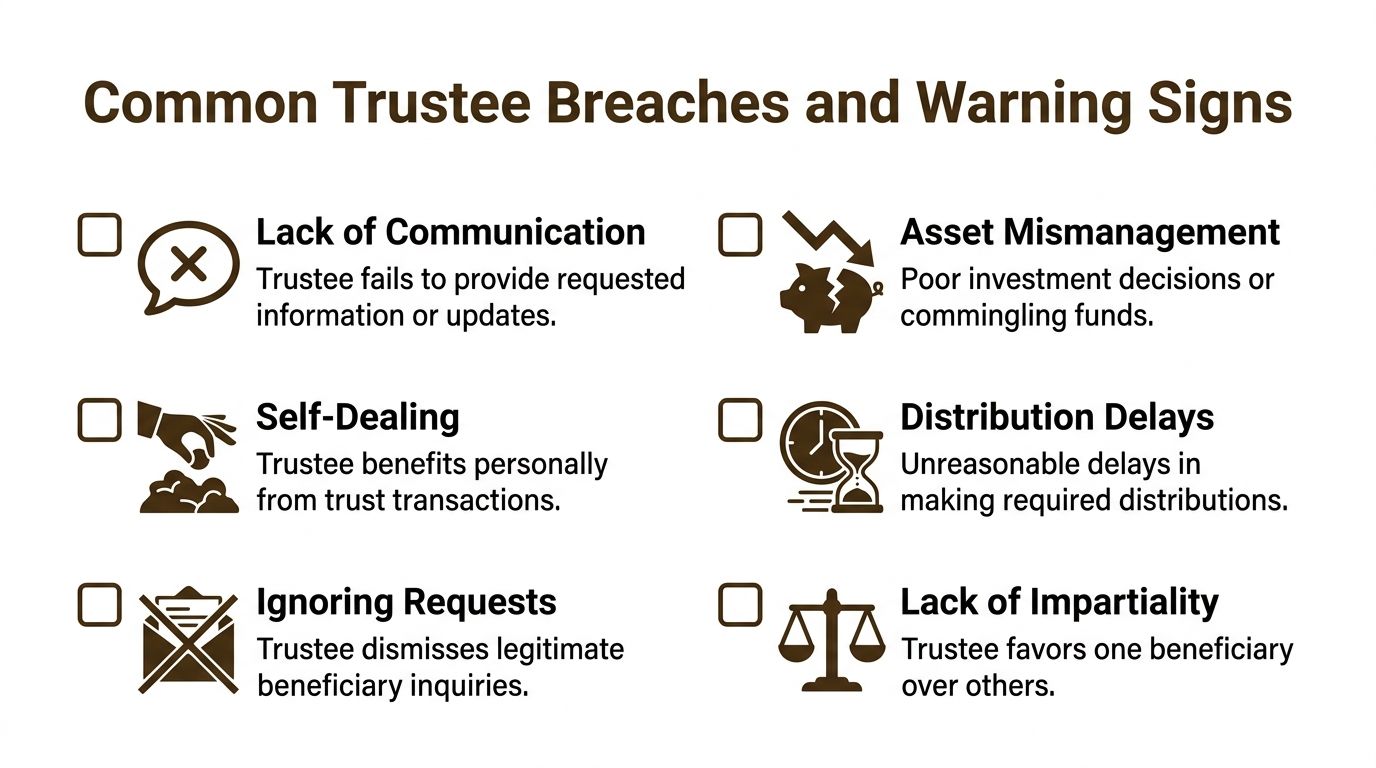
The most common breaches usually fall into a handful of categories.
- Lack of communication: The trustee ignores reasonable questions, provides only partial answers, or keeps promising records that never arrive.
- Self-dealing: The trustee uses trust property in a way that benefits the trustee personally. A common example is trying to buy trust real estate on favorable terms.
- Asset mismanagement: The trustee lets property deteriorate, fails to collect income, mishandles accounts, or makes decisions without records to support them.
- Improper delay: The trustee postpones distributions without a valid administrative reason.
- Excessive compensation or expenses: The trustee pays themselves too much or runs personal expenses through the trust.
Each of those problems can support court intervention when the facts are strong enough.
Red flags in family trust disputes
Consider how these issues show up in practice.
A trustee who lives near the decedent moves into a trust-owned house “temporarily” and pays no rent. Another trustee lists a property to a friend without exposing it properly to the market. A sibling trustee gives one beneficiary updates and access while freezing out another. Those are not just family conflicts. They may be evidence of breach.
The warning signs usually look like this:
| Warning sign | Why it matters |
|---|---|
| Trustee won't provide documents | You can't verify assets, expenses, or distributions |
| Trustee controls the property without explanation | Real estate can lose value or be transferred improperly |
| Trustee mixes personal and trust issues | Records become unreliable and self-dealing becomes easier |
| Trustee reacts defensively to basic requests | Transparency is often weakest where the conduct is worst |
A mistake beneficiaries make is arguing emotionally instead of building proof. Probate judges focus on documents, financial records, timelines, and trust language. Accusing the trustee of “being unfair” won't carry much weight unless you can connect that unfairness to a legal duty and actual conduct.
If you can describe the problem in records and dates, you are already in a stronger position.
If you recognize these warning signs in your own family trust matter, schedule a free consultation.
How to Enforce Your Rights in California
A common probate court scenario starts the same way. A beneficiary asks for the trust, an accounting, and basic backup records. The trustee stalls, sends partial information, or replies with excuses. At that point, the question is no longer whether something feels off. The question is what to file, when to file it, and what result the court can realistically order.
In California, enforcement usually works best in stages. Start by creating a written record. If that fails, use the Probate Court's petition process to force disclosure, freeze a bad transaction if necessary, and ask for a remedy that fits the misconduct. A judge will want specifics. Dates, requests, missing records, unexplained transactions, and the exact relief sought.
Start with a formal written demand
A formal demand letter often comes first because it serves two practical purposes. It gives the trustee one clear chance to comply without a court fight. It also creates an exhibit for your later petition if the trustee does not comply.
A good demand letter should state:
- What you are requesting: A copy of the trust, a current asset list, an accounting, supporting financial records, or an explanation of a specific transaction
- Why the trustee must respond: Your status as a beneficiary and the trustee's duties under California law
- A firm deadline: A reasonable date for production or a written response
- The next step: Notice that you will file a probate petition if the trustee does not comply
This step can solve the problem when the trustee is inexperienced, poorly organized, or relying on delay. It usually does not solve the problem when the trustee has taken trust property, favored one beneficiary over another, or is hiding self-dealing.
File the right probate petition
If the trustee still refuses to act, the next step is usually a petition under Probate Code section 17200. That statute is the workhorse of California trust litigation. It allows beneficiaries to bring disputes about internal trust affairs before the Probate Court, including requests to determine duties, compel action, review conduct, and remove a trustee.
In practice, beneficiaries often begin with a petition to compel information or an accounting. That is a strategic choice. The accounting and supporting records often become the evidence for the next phase of the case, whether that means surcharge, suspension, or removal.
California law also gives beneficiaries specific rights to information. Probate Code section 16060 requires the trustee to keep beneficiaries reasonably informed of the trust and its administration. Probate Code section 16061 gives beneficiaries the right, on reasonable request, to receive information from the trustee relating to the administration of the trust relevant to their interest. If an accounting is due and not provided, Probate Code section 16062 often becomes part of the enforcement analysis.
Here is how the usual court tools compare:
| Action | What It Is | When to Use It | Potential Outcome |
|---|---|---|---|
| Formal demand letter | Written demand for trust documents, an accounting, or transaction details | Early stage, before filing, when you need a clear paper trail | Compliance, narrowed issues, or stronger exhibits for court |
| Petition to compel information or accounting | Probate Court petition seeking an order for disclosure and financial reporting | Trustee ignores requests, produces partial records, or refuses transparency | Court order requiring records, an accounting, and sometimes deadlines for compliance |
| Petition to surcharge trustee | Request to hold the trustee personally liable for proven loss to the trust | Records show self-dealing, waste, improper distributions, or unauthorized expenses | Repayment, reduction of trustee compensation, or other monetary relief |
| Petition to remove or suspend trustee | Request to replace the trustee, temporarily or permanently | Repeated noncompliance, conflict of interest, hostility that impairs administration, dishonesty, or incapacity | Trustee removed or suspended, successor appointed, administration stabilized |
Ask for the remedy that matches the problem
Often, beneficiaries lose momentum. They know the trustee has acted badly, but they ask the court for relief that is either too vague or too aggressive for the evidence they have.
If the immediate problem is secrecy, compel information and an accounting first. If the records show money missing, then a surcharge claim becomes more concrete. If the trustee is about to sell a house to a friend, transfer funds, or make a one-sided distribution, emergency relief may be appropriate. In the right case, the court can suspend powers, restrain a transaction, or set the matter on a shortened schedule. The timing and requested remedy matter as much as the underlying complaint.
Judges in Orange County Probate Court usually respond better to a focused petition than to a petition that alleges every possible wrong at once. A narrower filing can be faster, cheaper, and more effective if your first goal is to get records and stop further damage.
Build the case the way the court will review it
Probate petitions are won with documents, not frustration. Attach the written demand, the trustee's response if there is one, relevant trust language, notices you received, financial statements, escrow information, emails, and a timeline that shows what happened and when. If there is real estate involved, include listing history, occupancy facts, rent issues, or transfer documents if you have them.
That record shapes settlement discussions too. A trustee who ignored informal complaints may respond very differently after being served with a petition supported by dates, exhibits, and clear Probate Code grounds.
Waiting without a plan usually helps the trustee, not the beneficiary. If the trustee is withholding information, missing deadlines, or putting trust assets at risk, the next step is to act before the facts get harder to trace.
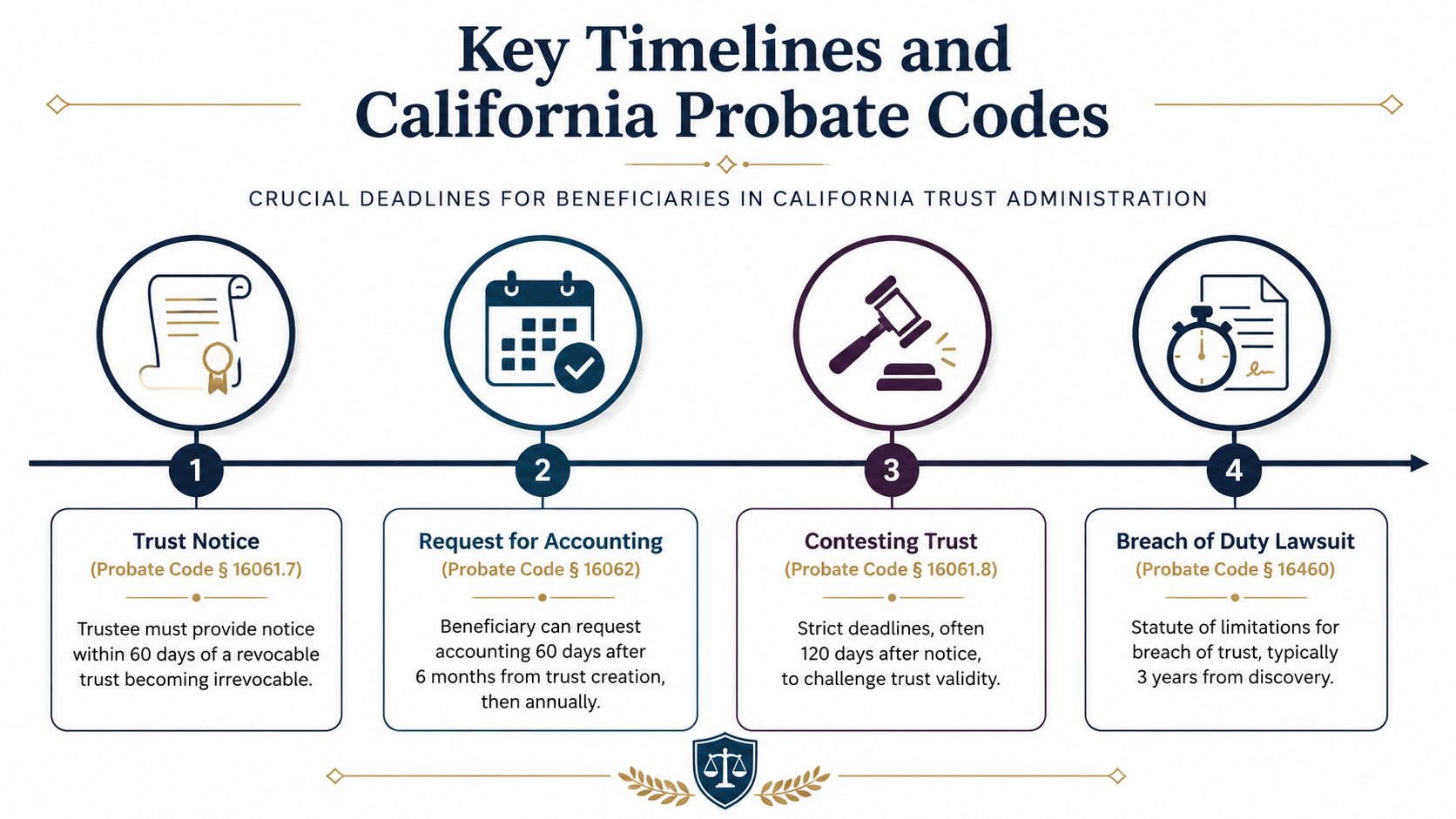
Key Timelines and California Probate Codes
In trust disputes, timing can matter as much as wrongdoing. Beneficiaries often assume they can sort things out later, after the family calms down or after the trustee finally becomes more cooperative. That assumption can cost you rights.
California law includes notice rules, disclosure obligations, and litigation deadlines that can change a case quickly once a trust becomes irrevocable.
The deadline that beneficiaries miss most often
One of the most important deadlines arises after the trustee sends the statutory notice following the trust becoming irrevocable, often after the settlor's death. When that notice is mailed, a person who wants to contest the trust's validity generally has only 120 days from the mailing date to file a lawsuit, according to California trust notice guidance describing the 120 day contest period.
That deadline matters because beneficiaries often spend too much time trying to negotiate informally while the clock runs. If your concern is not just administration but the validity of the trust itself, delay can permanently eliminate the claim.
Don't treat a statutory trust notice like routine mail. It may start the deadline to challenge the instrument.
The same source also notes a broader principle recognized in many states. Beneficiaries are entitled to meaningful disclosure and accounting so they can monitor administration, detect breaches, and challenge misconduct before assets are distributed or dissipated.
California code sections that matter in practice
For California beneficiaries, a few code sections come up repeatedly in real disputes:
- Probate Code section 16060: This is commonly cited for the trustee's duty to keep beneficiaries reasonably informed.
- Probate Code section 16061: This is commonly cited with the trustee's disclosure obligations in California practice materials.
- Probate Code section 16061.7: This is the statutory notice section practitioners focus on when a revocable trust becomes irrevocable and notice must be sent.
Those code references matter because they give your requests legal footing. A trustee may ignore a casual family email. A trustee tends to take a formal demand more seriously when it cites actual California probate authority and ties the request to specific relief in court if ignored.
A practical way to think about deadlines is this:
| Issue | Why timing matters |
|---|---|
| Contesting validity of the trust | Missing the notice-triggered deadline can end the claim |
| Demanding records early | Early records help preserve evidence and evaluate next steps |
| Monitoring administration | Delayed review can make tracing transactions harder |
| Challenging misconduct | The longer the delay, the more expensive the cleanup usually becomes |
If you have received a trust notice, suspect a late-disclosed problem, or are unsure whether a deadline has started, get the dates reviewed promptly. To discuss your timeline under California law, schedule a free consultation.
When to Contact a Trust Litigation Attorney
Some trust disputes can be resolved with a focused demand and prompt disclosure. Others require legal action from the start. The difficult part for most beneficiaries is knowing which type of case they have.
If the trustee is slow but cooperative, legal counsel may help structure the exchange and avoid a larger fight. If the trustee is evasive, conflicted, or moving assets, waiting can make the case worse.
Situations that call for immediate legal help
You should speak with a trust litigation attorney promptly if any of these facts are present:
- The trustee is also a beneficiary and won't provide records. That combination often raises concerns about favoritism and self-interest.
- The trust holds real estate and a sale is being discussed without transparency. Once a transaction closes, unwinding it can be far more difficult.
- The trustee is using trust funds in ways that don't make sense. Unclear reimbursements, unexplained expenses, and missing rental income need review.
- You received a statutory notice and have questions about the trust's validity. Deadlines in California can be short.
- Family pressure is replacing legal compliance. “Don't make this a problem” is not a legal answer to a proper beneficiary request.
What legal counsel changes
A good attorney does more than send a threatening letter. Counsel can identify the exact probate petition that fits the facts, frame the dispute in a way the court can act on, and push the matter toward records, rulings, and enforceable orders.
That matters in cases involving homes, rental property, or other hard assets. Real estate disputes often require a lawyer who understands both probate procedure and property issues. Title questions, occupancy disputes, maintenance problems, sale procedures, and valuation concerns can all intersect with trust litigation.
The right legal strategy can also keep a case narrow. Sometimes the immediate objective is not to remove the trustee on day one. It may be smarter to compel an accounting first, expose the records, and then decide whether surcharge, removal, or settlement makes the most sense.
If you believe a trustee is withholding information, mishandling trust assets, delaying distributions, or putting a California property at risk, don't guess about your rights. Schedule a free consultation with Tanner Law to discuss your options, your deadlines, and the best next step in your trust matter.