California Letter of Administration: A 2026 Guide
A parent dies. There's no clear will in the desk drawer, no organized binder of account statements, and no one in the family agrees on who should start calling the bank. Meanwhile, the mortgage still exists, property taxes don't pause, and the house in Orange County may need immediate attention.
That's where many California families find themselves. They aren't looking for legal theory. They want to know who has authority to act, how to protect the home, and what to do when a bank says, “We need court papers.”
A Letter of Administration is often that first key. In California probate, it's the court's way of authorizing someone to step in and handle the estate when there isn't a valid executor available. If you're dealing with a loved one's estate in Orange County or Los Angeles, understanding this document can turn a confusing situation into a manageable process.
Table of Contents
- Navigating Loss Your First Step in California Probate
- What Is a Letter of Administration in California
- Administrator vs Executor Understanding Probate Authority
- How to Get a Letter of Administration in Orange County
- California Probate Timelines and Costs Explained
- Common Probate Complications and Solutions
- When to Partner with an Experienced Probate Attorney
Navigating Loss Your First Step in California Probate
When someone dies without a workable estate plan, families often assume the next step is simple. It usually isn't. In California, no child, spouse, or sibling automatically gains authority to sell a house, close an account, or sign for the estate just because they're the closest relative.
That misunderstanding creates real problems. One family member may start collecting mail. Another may call the lender. Someone else may assure the rest of the family that they can “just handle it.” Then the bank freezes access, the title company refuses to discuss a transfer, and the county recorder won't recognize anyone's signature on behalf of the estate.
This is why the probate process matters. It gives the court a way to identify the proper person, bring interested heirs into the process, and create a legally recognized chain of authority. In California, that formal authority is especially important when the estate includes real estate, because homes in Orange County and Los Angeles often represent the estate's largest and most sensitive asset.
Probate isn't only about distributing property. It's also about proving who has the legal right to act before anyone touches the estate.
For many families, the most helpful mindset is this: don't treat the Letter of Administration as just another form. Treat it as the document that allows the rest of the estate process to function. Without it, you may have responsibility in a moral sense, but not authority in a legal one.
What Is a Letter of Administration in California
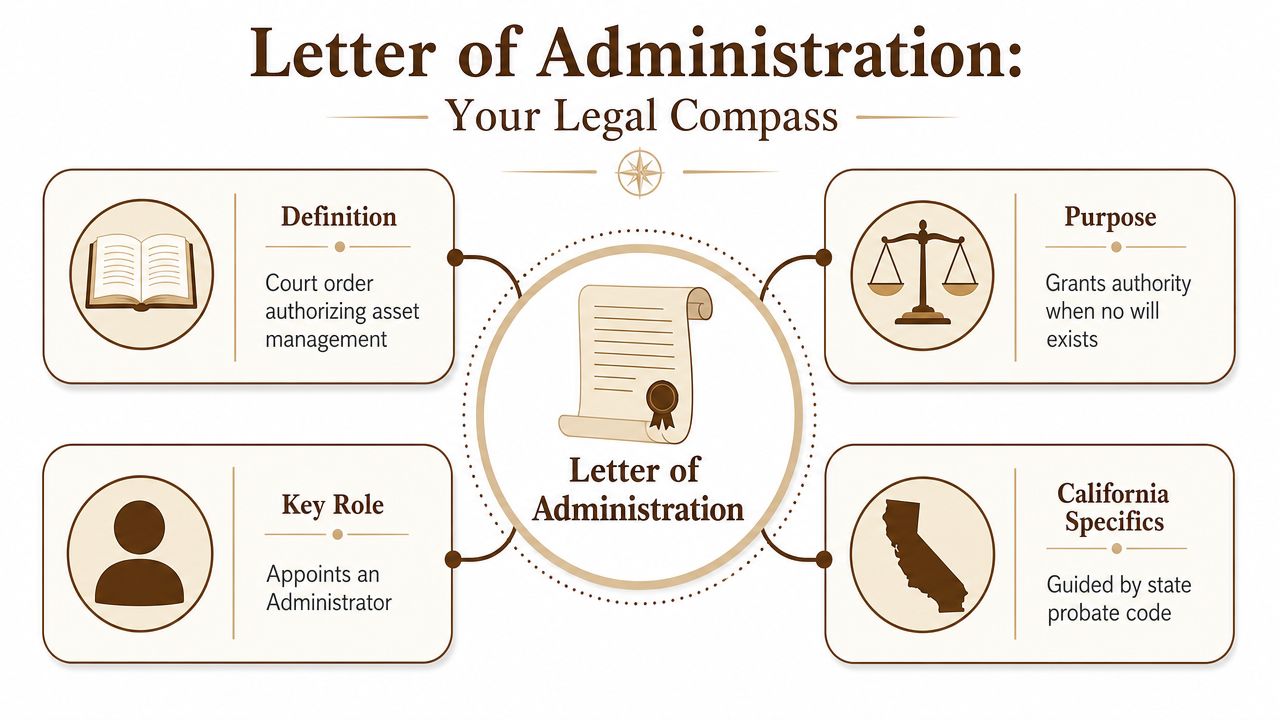
A Letter of Administration is a court-issued document that allows an appointed administrator to manage a deceased person's estate when there's no valid executor available. The process typically begins with a probate petition in the county where the person lived, and the document serves as official proof of authority when dealing with banks, brokerages, and other third parties, as explained by Finance Strategists' discussion of letters of administration.
Why this document matters right away
The easiest way to understand a Letter of Administration is to think of it as the court's authorization for someone to act in place of the person who died. It is not exactly a power of attorney, because a power of attorney ends at death. But for many families, that comparison helps. Once death occurs, prior personal authority ends, and only court-recognized authority can move the estate forward.
That point becomes very practical very quickly. If there's a bank account in the decedent's sole name, the bank will usually want court papers before discussing access. If there's a house that needs to be secured, insured, rented, refinanced, or sold, outside institutions usually want proof that the person signing has legal authority.
Practical rule: A photocopy often won't solve the problem. Some institutions require a recent certified copy of the Letter of Administration before they'll release assets or honor the administrator's instructions.
What authority the administrator receives
Once appointed, the administrator steps into a fiduciary role. That means the administrator must act for the estate and the rightful heirs, not for personal convenience or family politics.
In plain language, the administrator commonly handles tasks such as:
- Collecting estate assets so accounts, property, and records are brought under proper control
- Addressing bills and debts through the probate process rather than by informal family agreements
- Managing real property so a house or other parcel can be preserved, insured, and, when appropriate, transferred or sold
- Working with third parties like banks, title companies, and county offices that need proof of authority before they'll cooperate
In California, that authority is powerful, but it isn't unlimited. The administrator acts under court supervision and must follow probate rules. That's why getting the appointment right at the start matters so much.
Administrator vs Executor Understanding Probate Authority
Families often use the words “executor” and “administrator” as if they mean the same thing. In California probate, they don't. The distinction affects which court documents you need and how the estate moves forward.
A probate-court instrument becomes operative when a decedent dies intestate or when the named executor can't serve, and it turns an eligible applicant into a court-authorized administrator with authority to collect assets, settle debts, and distribute property under intestacy rules, as summarized by Cornell Law School's Wex entry on letters of administration.
The core difference
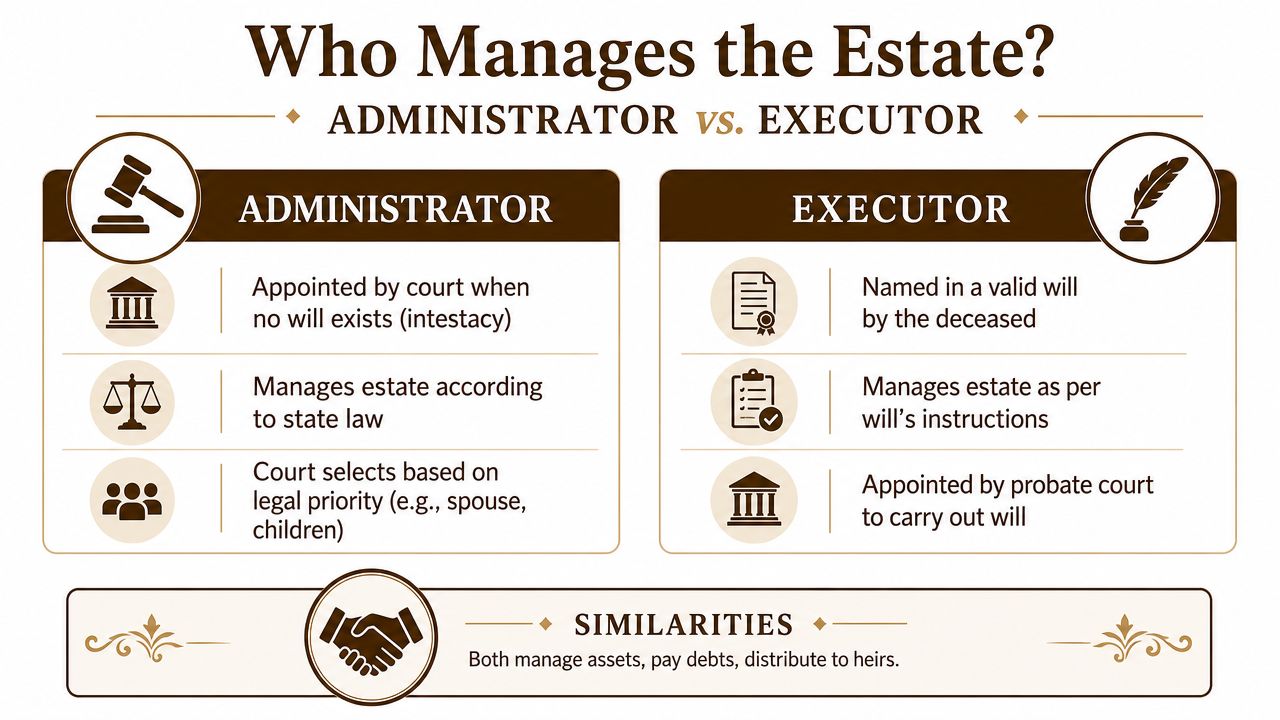
An executor is the person named in a valid will to carry out the will's instructions. A court typically confirms that authority through a different probate document.
An administrator is the person the court appoints when there is no valid executor available. That may happen because there was no will, the will doesn't name an executor who can serve, or the named executor is unable or unwilling to act.
This difference matters because families often walk into probate with the wrong vocabulary. They tell a bank, “I'm the executor,” but there is no court appointment yet. Or they assume the oldest child automatically becomes the decision-maker. California doesn't work that way. Authority comes from the court.
Side by side comparison
| Issue | Executor | Administrator |
|---|---|---|
| How the role begins | Named in a valid will | Appointed by the court |
| Typical estate situation | The decedent left a valid will with a workable nomination | The decedent died intestate, or the named executor can't serve |
| Source of practical authority | Court recognition of the will-based role | Court appointment under probate administration |
| Main job | Gather assets, handle debts, carry out the will | Gather assets, handle debts, distribute under California intestacy rules |
| Common family confusion | Relatives assume the will alone is enough | Relatives assume kinship alone is enough |
The overlap is also important. Both roles involve estate management. Both owe duties to the estate. Both deal with assets, debts, and eventual distribution. The difference is how the person gets authority and what legal framework controls the distribution.
If there's no valid executor available, the court doesn't leave the estate unmanaged. It appoints an administrator and issues the document that allows that person to act.
How to Get a Letter of Administration in Orange County
A common Orange County probate scenario starts like this. A parent dies, there is a house, the mortgage still needs attention, a bank account is frozen, and one child is trying to keep everything from falling apart. The family knows action is needed, but no one is sure what the court wants first.
That is the practical problem a Letter of Administration solves. It is the court-issued proof that lets an administrator step in and act for the estate. Until the court grants that authority, even a responsible family member can hit the same wall over and over with banks, title companies, and other institutions.
Start with the paperwork the court will expect
The Orange County Superior Court does not appoint an administrator based on family agreement alone. The judge needs a proper petition, supporting documents, and proof that the right people received notice. Probate works a lot like opening a formal file with a chain of custody. If a document is missing or the notice rules were not followed, the case can stall even when no one is arguing.
Families usually begin by gathering the core information needed to prepare the petition:
- Death certificate or other death records the court can rely on
- Basic asset information for real estate, bank accounts, vehicles, brokerage accounts, and other property
- Names and contact information for heirs so notice can be given correctly
- Initial California probate forms, often including the petition families refer to as Form DE-111
If the estate includes a home, gather the property address, deed information, mortgage statements, insurance information, and any facts about who is living there. Those details often become important sooner than families expect.
What filing actually sets in motion
Once the petition is filed in the proper court, the case enters a notice-and-review stage. The court is checking two things at once. First, is the proposed administrator legally appropriate? Second, has everyone with a possible interest in the estate been given a fair chance to respond?
That second part surprises many families. They are not asking for permission to take property for themselves. They are asking the court to appoint someone to manage the estate under court supervision. California treats that authority carefully.
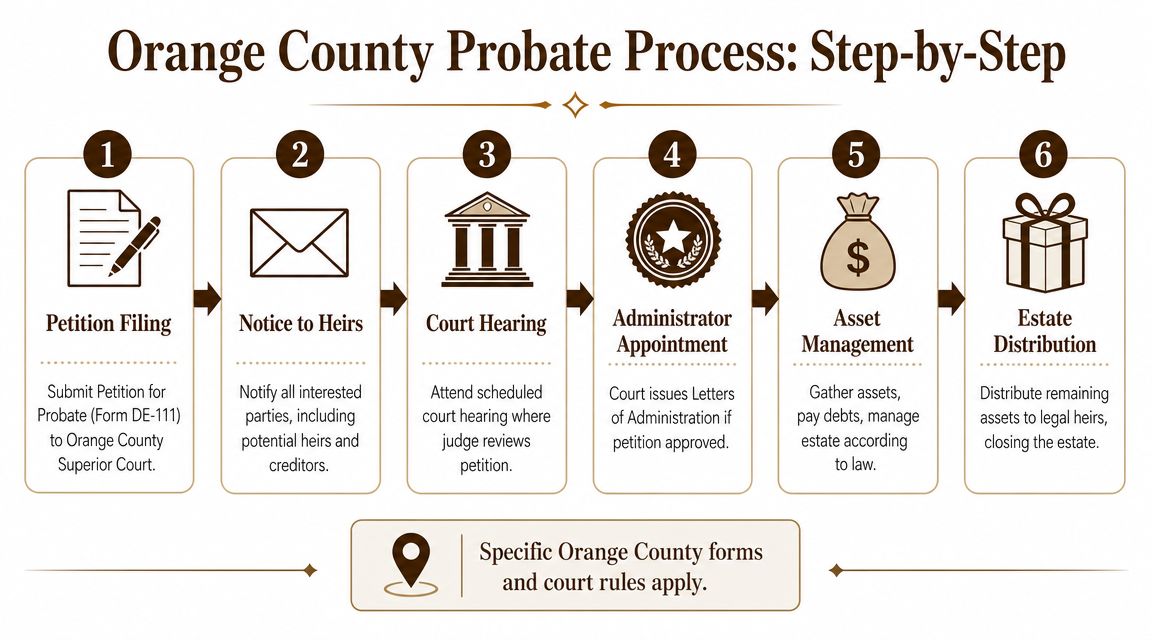
In plain terms, the process usually looks like this:
- File the petition in the correct court, usually the Orange County Superior Court probate division if the decedent lived in Orange County.
- Notify heirs and interested parties using the required probate notice procedures.
- Publish notice if required so the proceeding is publicly announced in the way the law requires.
- Go to the hearing if the court sets one, and address any problems the clerk or judge identified.
- Satisfy bond requirements if the court orders a probate bond before appointment.
- Receive the Letters of Administration once the court approves the appointment.
- Use that authority to begin estate administration, including collecting assets, dealing with creditors, and handling property issues.
A short video overview can also make the sequence easier to follow.
Where families often get stuck
The hardest part is often not the form itself. It is the friction around the form.
A bank may refuse to speak with a child who has a death certificate but no court appointment. An heir may delay signing paperwork. A hearing may be continued because notice was defective or a name was listed incorrectly. If there is real estate, the pressure increases. Insurance carriers, lenders, tenants, and title companies each want different pieces of information, and none of them are guided by the family's sense of urgency.
This is why probate can feel confusing even in an uncontested estate. The court process is one track. Real-world property and financial problems are another. The administrator has to keep both moving at the same time.
Real estate changes the urgency
A house in probate is not a passive asset. It can lose insurance coverage, suffer deferred maintenance, attract unauthorized occupants, or become the center of family conflict. In Orange County, where real estate value is often a major part of the estate, delays can create expensive problems quickly.
Letters of Administration often become the document that gets the property process unstuck. Title companies usually want court-recognized authority before they will move forward with a sale or transfer. Lenders may require proof of appointment before discussing account details. Even basic decisions, such as securing the home or coordinating access, become easier once the administrator can show official authority.
That is why legal help is often most useful at the beginning, before small paperwork problems grow into hearing delays or title issues. Tanner Law handles probate matters that overlap with California real estate, including the court appointment process, property transfer questions, and the practical steps needed to keep an estate from drifting while the case is pending.
California Probate Timelines and Costs Explained
Two questions come up in almost every consultation. How long will this take, and what will it cost? The honest California answer is that probate usually moves in stages, and the timing depends on the court, the paperwork, the assets, and whether disputes appear.
Why probate rarely moves quickly
Probate isn't a one-signature event. The court must review the filing, notice must be handled correctly, interested parties must have an opportunity to respond, and the administrator then has ongoing duties after appointment. If the estate includes real estate, title issues, vacant property problems, or multiple heirs, the timeline can stretch further.
Families often assume the case ends once the Letter of Administration is issued. In reality, that's the point at which the administrator gains authority to begin the larger estate work. The estate still has to be gathered, protected, administered, and eventually distributed under California law.
The court order opens the door. It doesn't finish the job.
What families should expect to pay
California probate costs usually include several categories rather than a single flat bill. Depending on the case, families may encounter:
- Court-related charges for filing and obtaining certified documents
- Bond costs if the court requires the administrator to post a probate bond
- Publication and notice expenses tied to formal probate notice requirements
- Appraisal and administration expenses if property or specialized assets need valuation or management
- Attorney's fees and representative compensation under California probate rules, where applicable
The exact total varies with the estate and the amount of work required. A straightforward estate with cooperative heirs is very different from an estate that includes a contested appointment, title problems, or a property that must be sold.
One important practical point is that probate costs often arise at different moments, not all at once. That can make budgeting harder for families already dealing with funeral expenses, mortgage payments, or upkeep on a home. A realistic plan is to identify likely expenses early, keep records carefully, and avoid informal shortcuts that create more expense later.
Common Probate Complications and Solutions
Some of the hardest probate problems begin after the court has already issued the paperwork. Families feel relief when the Letters of Administration arrive, then run into resistance from banks, brokerages, or title companies that still won't release the asset.

When the paperwork exists but the asset still won't move
That friction is common enough that it deserves attention. A frequent obstacle is what happens when a Letter of Administration exists but an institution still refuses to release assets because the certified copies are outdated, heir claims conflict, or the asset is titled in a trust rather than in the probate estate, as noted in this discussion of post-issuance problems involving letters of administration.
In practice, that means the right response depends on the reason for the refusal.
- Outdated certified copies often call for fresh court-certified documents, not an argument with the institution
- Conflicting heir claims may require clarification in the probate case before the institution will act
- Trust-owned assets may not belong in the probate estate at all, which means the administrator may be holding the wrong tool for that asset
- Real property concerns may involve title review, recorded documents, or additional probate authority before a transfer can happen
A bank's refusal doesn't always mean the bank is wrong. Sometimes it means the estate still has a missing document, a title issue, or an authority problem that probate alone hasn't solved.
Disputes and property problems
Another frequent complication involves family disagreement. One heir may object to the proposed administrator. Another may suspect missing assets. Others may disagree about whether to sell the family home, keep it, or let a relative stay there temporarily.
Those conflicts become more serious when the estate includes real estate. Occupancy questions, maintenance decisions, and sale timing can all affect value. If the house has title issues, liens, co-ownership complications, or competing stories about who should inherit it, the probate file may intersect with broader property litigation.
When that happens, the solution is usually not more informal conversation. It's a documented legal strategy. That may include correcting the court record, addressing notice problems, obtaining updated certified papers, coordinating with title professionals, or asking the court for specific relief.
When to Partner with an Experienced Probate Attorney
Some estates are simple enough that a family can begin gathering information on its own. Others carry enough risk that early legal help can prevent expensive mistakes. In California, that's especially true when the estate includes a home, multiple heirs, uncertain title, business interests, or anyone who's already challenging the appointment.
A probate attorney becomes particularly useful when you're facing questions like these:
- Does the estate include real estate in Orange County, Los Angeles, or another California county?
- Are heirs disagreeing about who should serve or what should happen to the property?
- Has a bank or title company refused to honor the court papers?
- Is there confusion about whether an asset belongs to the estate or to a trust?
- Do you need a clean path to sale, transfer, or distribution without creating new disputes?
Good probate guidance doesn't only help with forms. It helps align court procedure, property rights, and practical decision-making. That can protect the estate and reduce avoidable conflict at a time when families already have enough to carry.
If you're dealing with a loved one's estate in California and need help obtaining or using a Letter of Administration, schedule a free consultation with Tanner Law. You can discuss your probate situation, your real estate concerns, and the next practical step with an attorney who serves Orange County and Los Angeles families.