What Is an Intestate Estate? California Intestacy Law 2026
An intestate estate is the property left by someone who died without a valid will, and that property is distributed under state law rather than the family's personal preferences. This comes up often: 44% of adults had not effectively disposed of their estates through the planning methods studied, and another source says about two out of three Americans die without a will.
If you're reading this after a death in your family, you may be facing a stack of papers, a home that needs attention, worried relatives, and one pressing question: what happens now? In California, that answer depends on a mix of probate rules, family relationships, and a distinction that surprises many families the first time they hear it, the difference between community property, separate property, and assets that don't pass through intestacy at all.
That last point matters. Many people assume that if there's no will, then all property goes into one legal bucket and the court divides everything. That isn't how it works. Some assets pass outside probate altogether, while the intestate estate covers only the probate property that wasn't effectively transferred another way.
Grief makes legal decisions harder than they need to be. The good news is that intestacy is manageable once you understand the rules. California law provides a default system. It may not match what your loved one would have wanted, but it does create an order that the probate court can follow.
Table of Contents
- When a Loved One Dies Without a Will
- Defining an Intestate Estate Under California Law
- How California Law Distributes Intestate Property
- The Intestate Probate Process Step by Step
- Common Complications and Disputes in Intestacy
- Actionable Next Steps for Heirs and Homeowners
- How Tanner Law Can Help Your Family
When a Loved One Dies Without a Will
A common California probate story starts like this. A parent dies in Orange County or Los Angeles. The family knows there was talk of “getting the paperwork done,” but no one can find a signed will. One child has the house keys. Another is checking bank statements. A surviving spouse assumes everything will transfer automatically. Then someone asks whether the court has to be involved, and the room goes quiet.
That confusion is normal. Families are trying to grieve and solve practical problems at the same time. They may need access to a home, mail, vehicles, insurance information, and mortgage records before they even understand what “intestate” means.
Under probate law, a person who dies without a valid will dies intestate. That means California's default inheritance rules take over for the probate estate. The court doesn't ask what family members think is fair. It applies the legal order set by statute.
Many families are surprised to learn that the first question usually isn't “Who should get this?” It's “What property is actually part of the probate estate?”
This situation is also common. A Cornell Law School summary of intestate succession notes a national survey finding that 44% of adults had not effectively disposed of their estates through the planning instruments studied. That helps explain why probate courts see intestacy cases so often.
Why this feels more complicated in California
California adds an extra layer because property may be characterized as community or separate property. If the person who died was married, that classification can change who inherits and what passes through the estate.
For families, the practical questions usually come fast:
- Who has authority now: Until the court appoints a personal representative, family members usually don't have automatic authority to act for the estate.
- What happens to the home: Title, mortgage obligations, occupancy, and maintenance all need attention.
- Whether everyone inherits equally: In California, that depends on the family tree and on the kind of property involved.
If you're trying to understand what is an intestate estate, start with one simple idea. It does not mean the state takes everything. It means the law supplies a default plan because the deceased person didn't leave a valid will directing probate property elsewhere.
Defining an Intestate Estate Under California Law
The core definition
In plain language, an intestate estate is the probate estate of someone who died without a valid will. Instead of following written instructions left by the deceased, the court follows the inheritance rules set by the state.
“An intestate estate is the probate estate of a decedent who died without a valid will; distribution is controlled by the jurisdiction's intestacy statute rather than by personal instructions.” See Barnes Walker's legal glossary entry on intestate estates.
California follows that same basic principle, but California courts apply California law to property subject to a California probate proceeding. In practical terms, that means the judge identifies the probate assets, determines the legal heirs, appoints an administrator, and supervises distribution under the Probate Code.
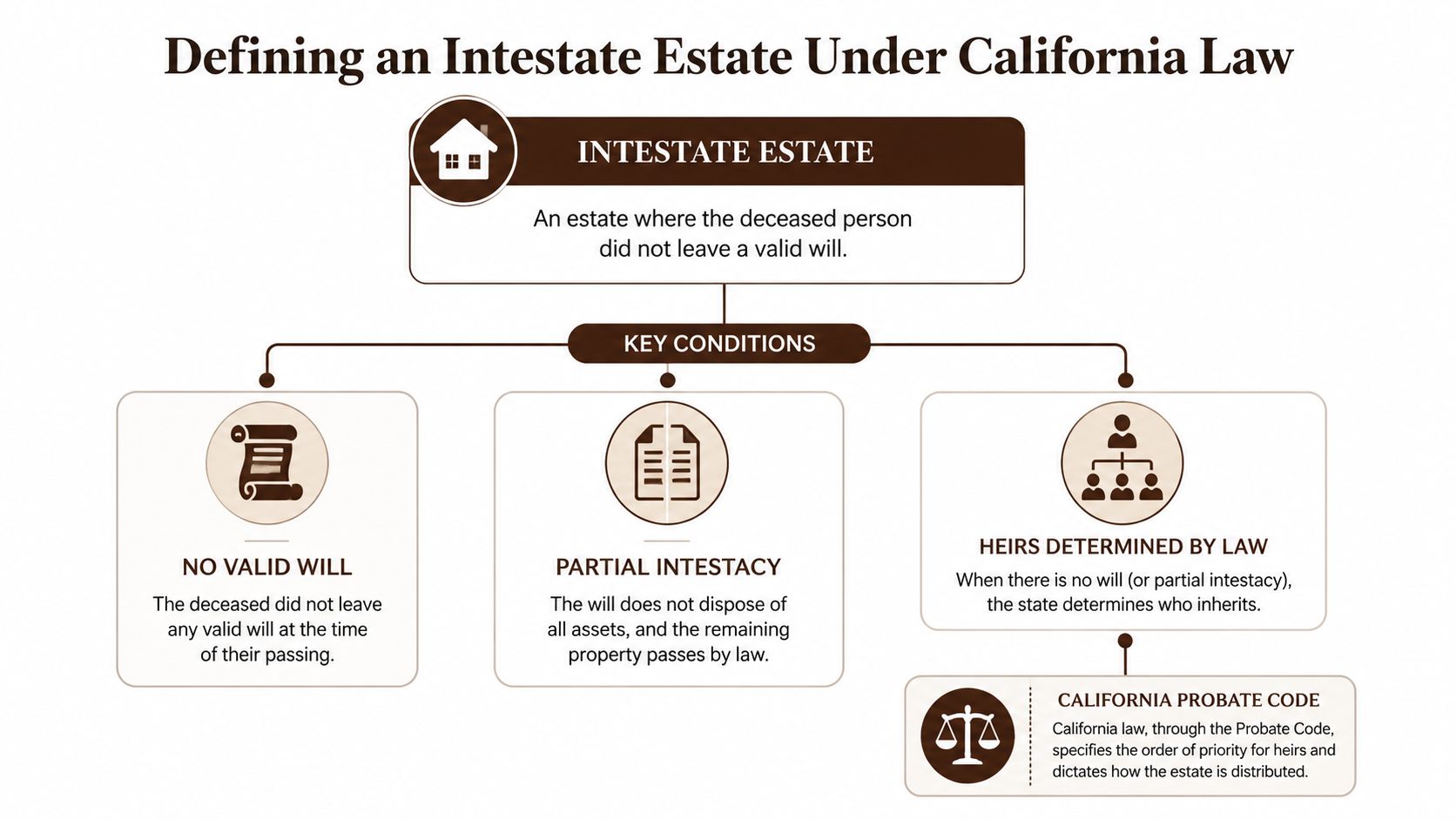
A few points usually clear up the biggest misunderstandings:
- No valid will means state rules apply: A handwritten note, an unsigned draft, or a conversation about “who gets what” usually isn't enough.
- The court appoints an administrator: In an intestate case, the estate is typically managed by an administrator rather than an executor named in a will.
- Heirs are determined by law: Spouse, children, parents, siblings, and more remote relatives may inherit depending on who survives the deceased.
What is not part of the intestate estate
At this stage, many articles stop too early, and families often make mistakes.
Not every asset a person owned becomes part of the intestate estate. A MetLife explanation of intestacy and probate transfers notes that jointly owned property, payable-on-death accounts, life insurance, retirement accounts with beneficiaries, and trust assets usually pass outside of probate.
That means the intestate estate may be smaller than the family expects.
Practical rule: Intestacy only controls property that is part of the probate estate and was not already directed somewhere else by title, beneficiary designation, or trust.
Examples help:
- A house in a living trust: Usually follows the trust terms, not intestacy.
- A bank account with a payable-on-death beneficiary: Usually goes to the named beneficiary.
- A retirement account with a valid beneficiary form: Usually passes under that designation.
- Property held jointly in a form that includes survivorship rights: Often passes directly to the surviving owner.
In California, the details matter. Title documents, beneficiary designations, and trust funding records often determine whether an asset belongs in probate at all. Families sometimes spend days arguing over “the estate” before sorting out which assets are even part of it.
That's why the best first question isn't only what is an intestate estate. It's also: which assets are inside it, and which ones pass another way?
How California Law Distributes Intestate Property
California intestacy functions like a default will written by statute. It doesn't ask what would have been most generous or most convenient. It asks who the legal heirs are, and what type of property is being distributed.
Community property and separate property
California is a community property state. That distinction matters immediately when a married person dies without a will.
In broad terms:
- Community property usually refers to property acquired during marriage that belongs to the marital community.
- Separate property usually refers to property owned before marriage, or property treated as separate under California law.
For many married families, community property is the first category to examine. Separate property often creates the tougher questions, especially in second marriages, blended families, and situations involving property acquired at different stages of life.
In California probate practice, some of the hardest inheritance disputes aren't about whether someone was loved. They're about whether an asset was community or separate property.
The chart below gives a simplified view of common California outcomes for separate property in an intestate estate. Actual cases may turn on facts that require document review, title review, and family-history review.
California intestate succession rules simplified
| If the Decedent Leaves… | Here's Who Inherits the Separate Property |
|---|---|
| A surviving spouse and no child, parent, sibling, or issue of a deceased sibling | The surviving spouse generally inherits all separate property |
| A surviving spouse and one child | The surviving spouse and the child share under California intestacy rules |
| A surviving spouse and more than one child | The surviving spouse and the children share under California intestacy rules |
| A surviving spouse and no children, but a parent or sibling line survives | The surviving spouse receives a share, and the remaining share goes to the other qualifying relatives under California law |
| No surviving spouse, but children | Children generally inherit |
| No surviving spouse or children, but parents | Parents generally inherit |
| No spouse, children, or parents, but siblings or more remote relatives | The estate passes down the statutory line of relatives |
This chart is simplified on purpose. California's actual rules can become more nuanced when there are descendants of a deceased child, half-siblings, adopted children, predeceased relatives with living descendants, or property located in multiple jurisdictions.
Assets outside probate still matter
Even when a family is focused on “who inherits,” the first legal task is still to identify what property is in the intestate estate at all. As noted earlier, nonprobate transfers can remove major assets from the intestacy calculation.
That can produce outcomes families don't expect. A surviving child may believe the house, life insurance, and all accounts are part of one estate to be divided. In reality, the house may pass by title, the insurance may go to a named beneficiary, and only a smaller group of probate assets may be divided under California intestacy law.
This is especially important for homeowners in Orange County and Los Angeles. A single residence may raise several separate questions at once:
- How title was held
- Whether there is a recorded deed affecting ownership
- Whether the property was community or separate
- Who is paying mortgage, tax, insurance, and maintenance costs during probate
If there's no will, California law decides the inheritance order for probate assets. But the actual answer to “who gets what” often starts with a property analysis, not a family vote.
The Intestate Probate Process Step by Step
When there's no will, the court process tends to feel impersonal at first. The family is mourning. The probate system wants forms, notices, inventories, and legal authority. That disconnect is frustrating, but the process is designed to answer one question after another in a set order.
A McCreary Law Office discussion of intestacy states that approximately two out of three Americans die without a will, meaning roughly 66% of deaths may result in distribution under intestacy rules unless another valid planning tool controls the transfer. So if this process feels unfamiliar, that doesn't mean your family is alone.
What the court does first
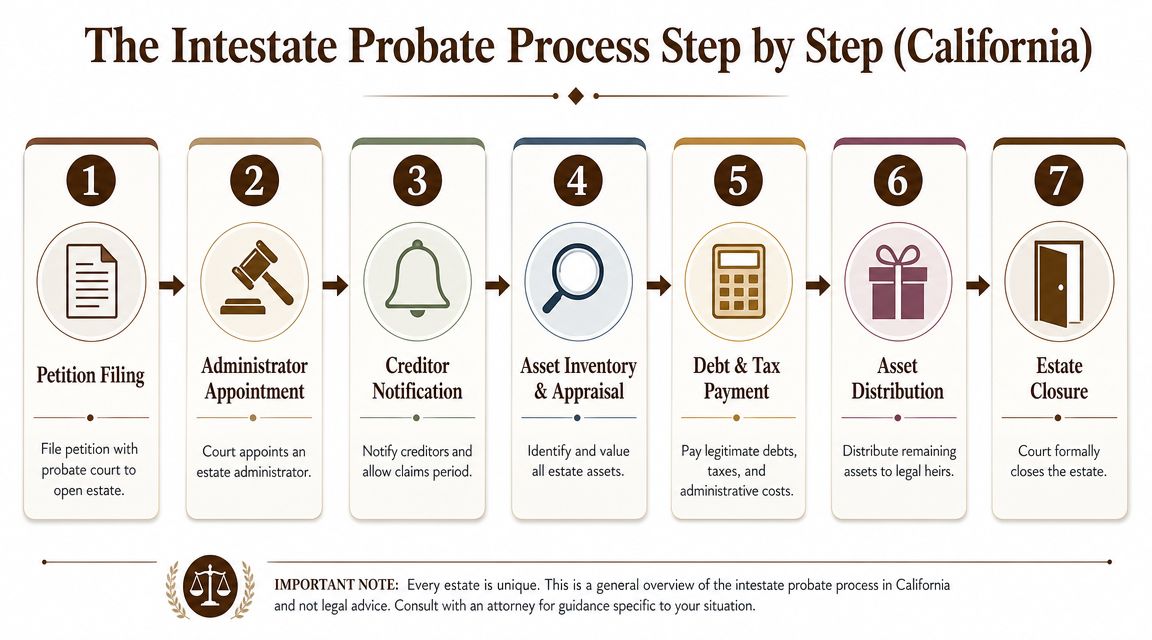
The opening stage usually includes these steps:
A petition is filed with the probate court.
Someone asks the court to open the estate and appoint an administrator.The court appoints an administrator.
This is the person who gathers assets, handles notices, pays proper claims, and later distributes what remains.Interested parties receive notice.
Heirs and other required parties must be notified that the probate case has been opened.
A short video can help if you want a visual overview of probate concepts before reading the rest of the process details.
What happens before heirs receive anything
Most families assume distribution is the main event. In reality, several important jobs come first.
Asset inventory and appraisal
The administrator identifies estate property, gathers records, and determines value. For real estate, that may involve deeds, mortgage statements, tax bills, occupancy issues, and insurance review.Creditor notice and claim handling
Valid debts and expenses of administration have to be addressed before heirs receive distributions.Tax and expense payment
The estate may need to pay taxes, court costs, and administrative expenses.Heir determination
If the family tree is disputed, the court may need additional information before approving final distribution.
The administrator's job isn't to do what one heir wants most. The job is to protect the estate and follow California law.
After that, the administrator typically seeks court approval to distribute the remaining probate assets to the legal heirs. Once distribution is complete and reporting requirements are satisfied, the court can close the estate.
Where delays usually happen
Probate delays often come from practical problems, not dramatic courtroom fights. Common examples include:
- Missing documents: no deed, no clear account records, or uncertainty about beneficiary designations
- Real estate problems: vacant property, deferred maintenance, disputed occupancy, or sale questions
- Family disagreements: conflict over who should serve as administrator or whether an asset belongs to the estate
- Heir uncertainty: unclear parentage, prior marriages, adopted children, or relatives who can't be located quickly
California probate can take time, especially when the estate includes real property. Families usually feel less overwhelmed once they understand that probate is not one hearing. It's a sequence of duties carried out under court supervision.
Common Complications and Disputes in Intestacy
Intestacy cases rarely become difficult because the definition is confusing. They become difficult because families and assets are complicated.

Family structure changes the legal outcome
A Maryland legal overview discussing modern intestacy issues notes that real disputes increasingly involve blended families, unmarried partners, and property in more than one jurisdiction, and that inheritance shares can change sharply depending on whether children are from a prior relationship or whether property is separate versus community. That observation matches what probate lawyers see in California, even though California applies its own statutes.
Consider a few familiar situations:
A man in Los Angeles dies married for the second time, with adult children from his first marriage. His current spouse assumes the home and all accounts pass to her. The children believe they inherit an immediate share. The answer may differ asset by asset depending on title, beneficiary designations, and whether the property is community or separate.
An unmarried long-term partner cared for the deceased for years and helped pay household expenses. The partner may expect to inherit, but intestacy law doesn't automatically follow emotional reality. Legal status and property records control.
A family discovers there may be a child from an earlier relationship. That issue can affect who qualifies as an heir and can delay the entire probate.
Grief often magnifies assumptions. Intestacy cases force the court to sort out legal relationships, not family expectations.
Real estate often creates the hardest problems
For California families, the home is often the biggest source of stress.
One heir may be living in the property. Another may want it sold quickly. A third may want to keep it in the family. Meanwhile, the estate still has to deal with insurance, taxes, utilities, mortgage payments, and physical upkeep.
Common flashpoints include:
- Possession disputes: Who has the right to stay in the home while probate is pending?
- Sale timing: Should the property be sold, rented, or held until distribution?
- Repair disagreements: Some heirs want to spend money preparing the property for sale, while others object.
- Title problems: Old deeds, refinancing history, and co-ownership questions can complicate probate administration.
When property sits in more than one state, another layer appears. California probate may not control every asset the same way, and additional proceedings may be needed elsewhere. Families often don't realize this until they find an out-of-state deed in a drawer or discover mineral, timeshare, or vacation property records later in the process.
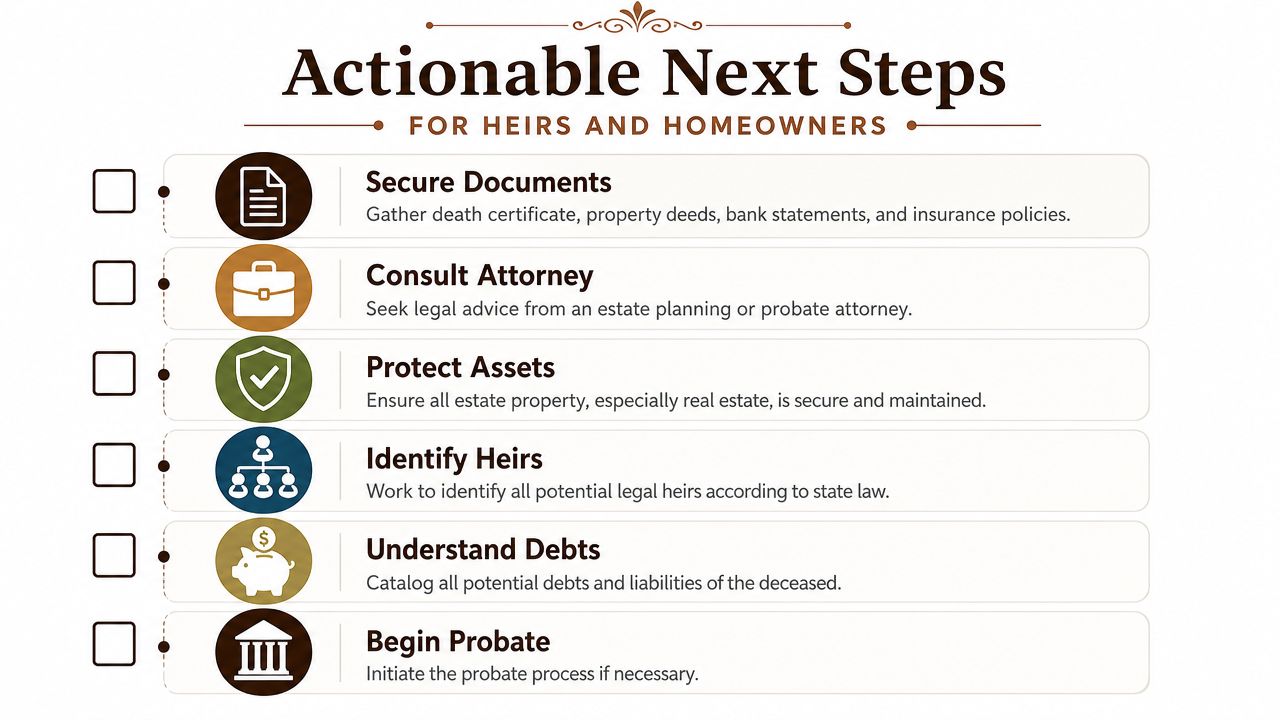
Actionable Next Steps for Heirs and Homeowners
When a loved one dies without a will, early decisions matter. The safest first moves are protective, organized, and conservative.
If you may be an heir
Secure the key documents.
Gather the death certificate, deeds, mortgage statements, bank records, insurance policies, tax mail, and any trust or beneficiary paperwork you can find.Protect the property.
Make sure the home is locked, insured, and maintained. Forward mail if appropriate, and keep records of urgent expenses tied to preservation of estate property.Don't distribute anything early.
Don't hand out vehicles, jewelry, cash, or personal property because “everyone agrees.” Informal distributions often create larger disputes later.Don't pay debts from your own pocket without legal advice.
Some obligations belong to the estate, not to family members personally.Identify all possible heirs before making assumptions.
Prior marriages, adopted children, and estranged relatives can matter under California law.
If you're unsure whether an asset belongs to the estate, pause before moving it, selling it, or transferring title.
If you own property and want to avoid this for your family
The most effective way to spare your family from a state-controlled distribution system is to create a valid estate plan. For many Californians, that means at least a will, and often a trust-based plan for real property and other major assets.
Review beneficiary designations as well. A strong plan isn't only about signing documents. It also means making sure title, trust funding, and beneficiary forms all work together so your family isn't left guessing.
How Tanner Law Can Help Your Family
An intestate estate can look simple on paper and become difficult very quickly in real life. California law decides who inherits probate assets. But before that question is answered, families often have to sort out title to real estate, determine whether property is community or separate, identify heirs, manage creditor issues, and work through probate court procedure in Orange County or Los Angeles.
Tanner Law helps families address those problems with clear, grounded advice. William T. Tanner brings the perspective of both an attorney and a licensed real estate broker, which is especially valuable when an intestate estate includes a home, co-owned property, or title concerns. The firm serves clients in Orange County and Los Angeles and focuses on practical, cost-conscious solutions that protect property rights and reduce unnecessary conflict.
If your family is facing probate after a loved one died without a will, getting reliable guidance early can prevent expensive mistakes and avoidable disputes.
If you need help understanding what is an intestate estate under California law, or you're dealing with probate, heirship, or real property issues after a death, contact Tanner Law to schedule a free consultation.