What Is Collections Debt: A California Guide for Families
Collections debt is an unpaid consumer bill that is seriously overdue and has been turned over to a third-party collector or debt buyer.
You might discover it while sorting a parent's mail after a death, checking your credit before buying a home, or opening a letter from a company you don't recognize. For families in Orange County and Los Angeles, the immediate question isn't just whether to pay. It's whether the claim is accurate, who legally owes it, and what California law allows the collector to do.
Table of Contents
- What Collections Debt Means in Plain English
- How an Unpaid Bill Reaches a Debt Collector
- Credit, Legal Exposure and California Time Limits
- Your Right to Validate and Dispute a Collection
- Medical Collections and Estate Debts Need Extra Care
- Get a Free Consultation Before You Respond
What Collections Debt Means in Plain English
An overdue credit card, hospital bill, utility balance, or phone account can become collections debt when the creditor escalates recovery to an outside business. Think of a school sending late notices before referring a matter to the principal's office. The underlying issue hasn't changed, but someone different now handles it.
Collections is a status, not a type of loan. A credit card describes how someone borrowed money. Collections describes what happened after an obligation went unpaid. This guide concerns nonmortgage consumer bills, not mortgage foreclosure.
In its historical national analysis, the Urban Institute's Delinquent Debt in America used a threshold of more than 180 days past due for reported collections and found approximately 77 million U.S. adults, about 35% of adults with a credit file, had a collections account. That definition isn't a universal legal waiting period requiring every creditor to delay referral.
Stages from late payment to collections
| Stage | Typical days past due | What it means |
|---|---|---|
| Missed payment | After the contractual due date | Balance is late; the creditor handles it directly with reminders |
| Late payment | 30–59 days | Often reported to credit bureaus as a late payment |
| Serious delinquency | Continued nonpayment after earlier delinquency stages | Creditor escalates contact and may charge off the account |
| Collections | More than 180 days under the Urban Institute definition | Account is transferred or sold to a collector or debt buyer |
These stages describe a progression, not a mandatory timetable for every account. A late bill doesn't automatically mean a collection agency owns it, and a creditor's warning that it may refer an account isn't the same as an actual referral.
For example, suppose a $1,200 hospital bill remains unpaid for seven months and the hospital sells it to a debt buyer. In that hypothetical, the hospital bill has become collections debt, but the sale doesn't establish that the amount is correct or that insurance was properly credited.
Practical rule: Check the latest statement and collection letter together. Identify whether the original creditor still handles the account or another business now claims payment.
How an Unpaid Bill Reaches a Debt Collector
The creditor and the collector may have different roles. Understanding that handoff helps you decide whom to contact and which records to request.
The process commonly follows the path illustrated below, although a creditor may outsource collection without first selling the account.
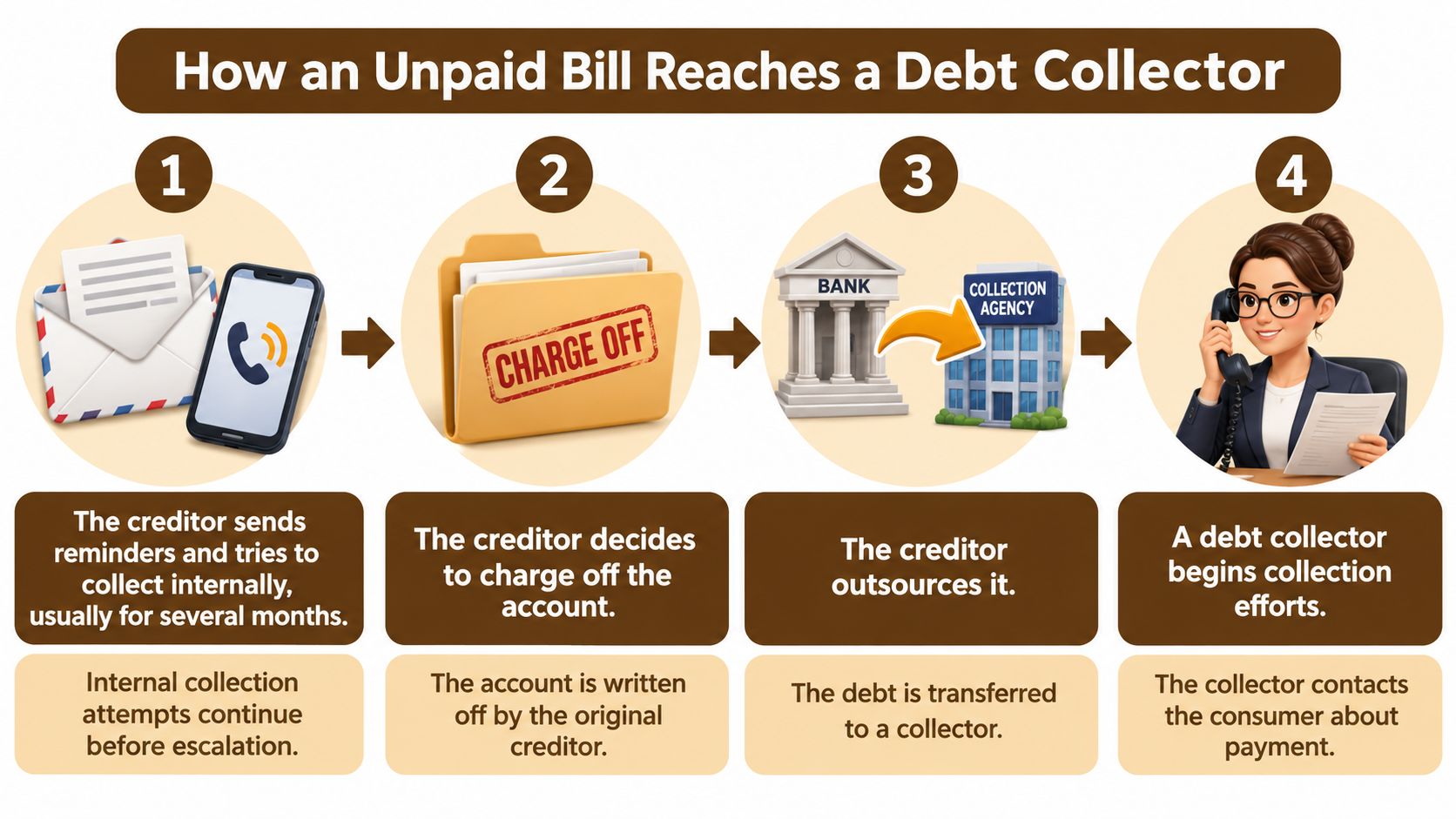
- The creditor seeks payment internally. Billing staff send reminders and attempt to resolve the overdue balance.
- The creditor chooses its next step. It may charge off the account, hire an outside collector, or sell it. A charge-off is an accounting action, not proof that the consumer no longer owes anything.
- An outside party becomes involved. A collection agency may collect for the owner, a debt buyer may purchase the account, or an attorney may pursue collection.
- The collector provides account information. Review the written notice rather than relying on a caller's description.
- Credit reporting may follow. Collectors must complete required communication steps before reporting an account.
Identify who owns the account
The Consumer Financial Protection Bureau's debt-collection glossary explains debt buyers and the federal Fair Debt Collection Practices Act, or FDCPA. That law generally addresses obligations arising from personal, family, or household transactions; business debts generally fall outside its coverage.
Ownership matters because the business calling you may not be the business entitled to receive payment. Ask whether it owns the account or collects for someone else, and request an explanation of the balance.
Suppose a credit card account is sold to a buyer and later resold. The original statements, transfer records connecting the owners, and account-level payment history help establish whether the current claimant has the right account and amount. A familiar creditor's name alone doesn't resolve those questions.
This video offers additional context for understanding collection contacts.
From the first letter, write down the sender's name, the original creditor, and the amount claimed. Keep the envelope and any account identifiers, but don't send sensitive financial information until you've independently verified the recipient.
Credit, Legal Exposure and California Time Limits
A collection account may disappear from a credit report while the debt remains legally disputed or collectible. Credit reporting and legal enforcement are separate questions, like two clocks measuring different things. Knowing which clock you are looking at helps prevent a reporting change from being mistaken for debt cancellation.
A lender uses credit-report information to assess whether your payment history meets its lending standards. In a collection lawsuit, the court considers whether the claimant can prove the obligation and whether the case was filed within the applicable deadline.
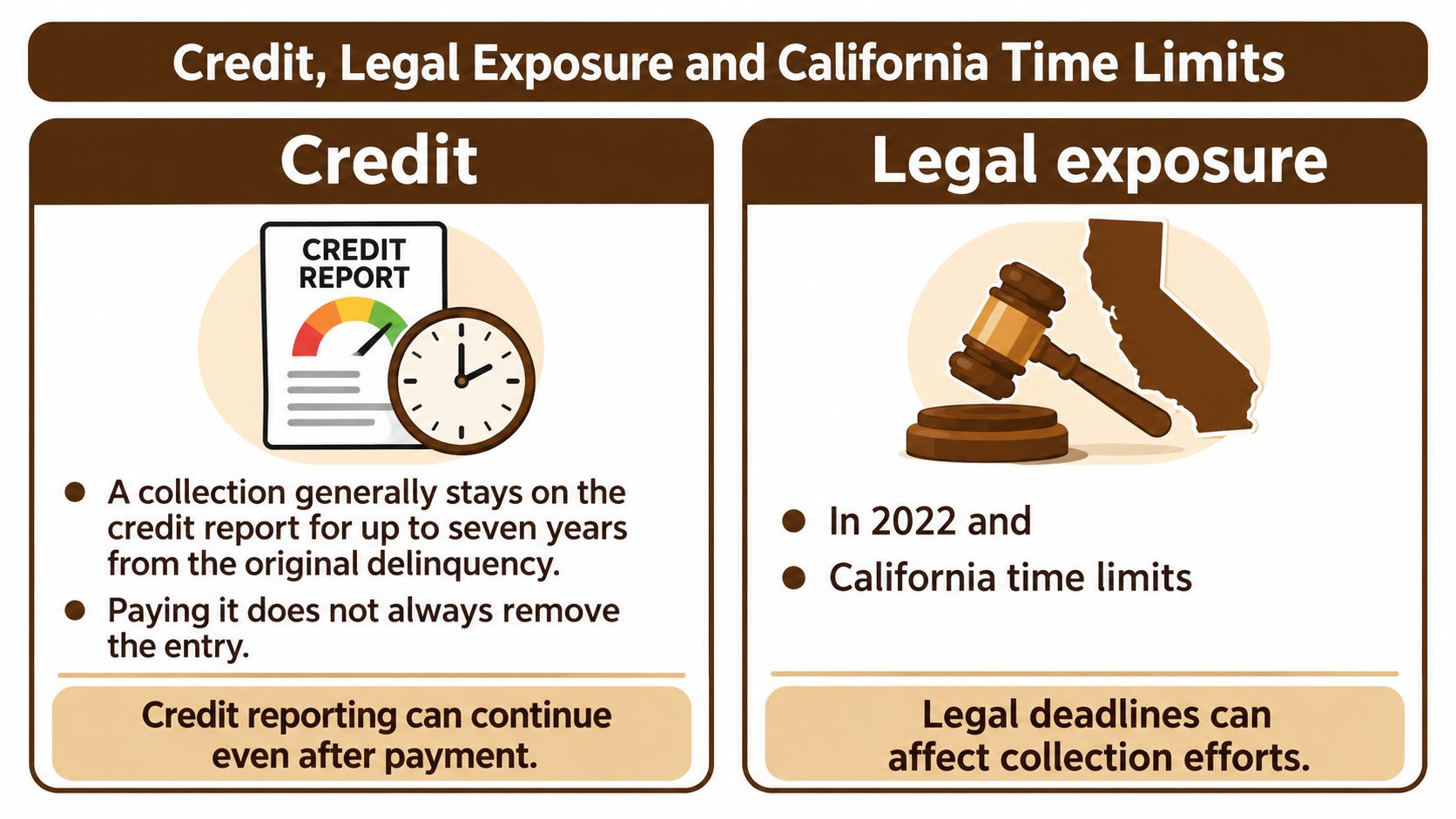
What a credit report does and doesn't establish
Negative collection information can generally remain on a credit report for seven years. The Federal Reserve Bank of New York's household-credit framework distinguishes delinquent accounts by how long they have aged and separates collections from severely derogatory accounts. For a collection, the reporting period generally traces back to the original delinquency, not the date a new collector bought the account.
Paying an accurate collection does not necessarily remove it from a report. Deleting an entry does not, by itself, cancel the obligation either. A credit-report dispute addresses the accuracy of information being furnished; it does not decide every legal defense to payment.
Medical reporting changes show why the distinction matters. A 2024 CFPB report on medical collections found that the share of U.S. consumers with medical collections on their credit records fell from about 14% in March 2022 to about 5% in June 2023. During that period, the major credit bureaus' changes included removing paid medical collections and medical collections under $500.
Those reporting policies do not automatically erase medical bills. If you discuss a settlement, clarify separately whether it changes the balance owed and what the collector will report.
California's deadline for filing suit
California's statute of limitations sets the period for filing a particular legal claim. California Courts' debt-lawsuit guidance gives a four-year period for claims based on a written contract, an account stated, or an open book account. It also warns that a payment after a period of inactivity can restart the limitations period.
The deadline depends on the claim and the account history, so the date on a collection letter is not enough to determine whether a lawsuit is timely. Review the payment record and the legal basis asserted by the claimant.
California time limits by debt type
| Debt type | Typical limitations period |
|---|---|
| Written contract, such as a credit card or loan | Generally four years |
| Account stated | Generally four years |
| Open book account | Generally four years |
| Oral agreement | Generally two years |
| Medical bill with a signed financial agreement | Generally four years if the claim is based on a written contract |
An account stated generally involves an asserted agreement about the balance owed. An open book account involves an ongoing record of charges and credits. The collector's label alone does not determine which claim applies. A medical bill's deadline can depend on whether the agreement and account facts support a written-contract claim.
Why a small payment can matter
Suppose, hypothetically, a credit card was last paid in 2020, and a collector requests a $200 good-faith payment in 2026. A payment could affect a limitations defense. Have a lawyer review a written acknowledgment or settlement document before signing, especially when the account may be old.
A $600 phone bill from 2019 and an $8,000 credit card balance from 2021 might both appear as collections but carry different enforcement risks. The amount and apparent age do not reveal whether later payments, agreements, or litigation changed the situation.
A collection entry isn't a court judgment, and a missing collection entry isn't a legal release.
A time-barred debt generally cannot support a timely collection lawsuit, although some collection contact may continue. If a creditor obtains a judgment, it may seek enforcement through further legal procedures, such as wage garnishment or a bank levy.
For a home purchase, probate administration, or property dispute, keep reporting dates separate from legal-enforcement dates. Check the collection entry and original delinquency information on your credit report. Before paying an old claim or using estate assets, get advice about whether the debt can still be enforced.
Your Right to Validate and Dispute a Collection
Start with documents, not a payment promise. The following steps help preserve your position while you determine whether the collector has identified the correct obligation.
- Compare the notice with your records. Check the creditor, account identifier, balance, payments, and whether the account belongs to you or the estate you represent.
- Dispute in writing within the validation period. Identify what you contest, keep a copy, and use a trackable delivery method.
- Request verification. Ask for the original creditor's information, an explanation of the balance, and relevant account documents. Verification isn't necessarily the same as receiving every document you request.
- Address unwanted contact separately. A written stop-contact request generally stops routine calls and letters, subject to limited notices.
- Challenge inaccurate reporting with the bureaus. A collector dispute doesn't substitute for a separate credit-report dispute.
The CFPB's explanation of debt-collection rights states that validation information generally must arrive in the initial communication or within five days afterward and explains the 30-day dispute period. The notice identifies the creditor, amount claimed, dispute rights, and response deadline.
Key collection rights and deadlines
| Action | Deadline | Why it matters |
|---|---|---|
| Collector's validation notice | In the first communication or within 5 days afterward | Confirms the creditor, amount, and dispute deadline |
| Written dispute of the debt | Within 30 days of receiving the validation notice | Requires verification before collection of the disputed debt resumes |
| Written request to stop contact | Any time | Generally stops routine contact, except permitted confirmations or notices |
| Credit bureau dispute | Any time while the entry is reported | Triggers investigation of the challenged information |
For example, suppose you mail a written dispute on day 25 after receiving a notice. Retaining the dated letter, mailing receipt, and delivery confirmation helps establish when and how you acted.
A phone conversation alone doesn't secure the same collection-pause protection as a timely written dispute. Use the notice's deadline and dispute instructions, and calendar them when it arrives.
California's Rosenthal Fair Debt Collection Practices Act adds state rules governing collection conduct alongside the federal FDCPA. Neither a dispute nor a stop-contact request replaces responding to court papers.
Medical Collections and Estate Debts Need Extra Care
A medical collection can involve several different problems. Choosing the right response requires identifying which one caused the balance.
- Provider billing error. Duplicate charges, missing credits, or an incorrect patient account.
- Insurance dispute. A claim denial, processing problem, or disagreement about coverage.
- Surprise billing. Charges potentially restricted by the federal No Surprises Act.
- Validation or reporting problem. An unsupported balance, wrong consumer, or inaccurate credit entry.
- California-law remedies. State protections that require analysis of the particular billing and collection conduct.
The CFPB's medical-debt guidance warns that collecting or reporting medical charges exceeding amounts allowed by the No Surprises Act may violate federal law. Dispute suspected violations in writing and preserve the supporting records rather than assuming negotiation is the only option.
When a parent's bill reaches an estate
Suppose a $2,300 hospital bill arrives after a parent's death, but the insurance explanation of benefits indicates that the insurer should have paid the disputed amount. The personal representative should compare the itemized bill, insurance determination, payments, and collection notice before treating the demand as an approved estate expense.
Don't assume that receiving a deceased relative's bill makes you personally responsible. Equally, don't assume that an apparently valid bill can be paid without considering California probate's creditor-claim procedures and deadlines.
Preserve the evidence: Keep bills, explanations of benefits, provider letters, payment records, and a dated call log in the estate's file.
A paid account, a removed credit entry, and a resolved insurance dispute can each affect different parts of the analysis. Confirm what remains owed and by whom before distributing estate assets or signing a personal payment agreement.
Get a Free Consultation Before You Respond
Delay is especially risky after service of a lawsuit, before paying an old account, or when a collector seeks payment from an estate or trust. Continued contact after a written dispute and possible surprise billing also warrant a focused legal review.
A California summons carries a response deadline. Missing it can lead to a default judgment, meaning the court may enter judgment without hearing your defenses. Send the summons and complaint to an attorney the day they arrive, and don't assume an ongoing dispute pauses the court case.
When to consult an attorney and what to bring
| Situation | Timing | What to bring |
|---|---|---|
| Served with lawsuit papers | Promptly, before the summons response deadline | Summons, complaint, and account statements |
| Debt older than four years | Before payment or written acknowledgment | Last statement, payment history, and last-activity records |
| Claim against an estate or trust | Before paying from estate assets | Death certificate, court papers, claim, and account records |
| Medical bill with possible surprise billing | Before payment or preparation of a substantive dispute | Explanation of benefits, itemized bill, and provider letters |
| Repeated contact after a written dispute | As soon as contact continues | Dispute letters, mailing receipts, messages, and call log |
You can organize records, identify unfamiliar charges, and preserve communications yourself. Legal assistance becomes particularly useful when deciding whether a claim is enforceable, drafting a court response, or determining an estate's obligations.
For Orange County and Los Angeles families, a consultation should examine the account history, validation notice, applicable time limit, credit entries, and any probate or trust issues. Bring the complete file, including documents that seem unfavorable, so counsel can assess the actual risks rather than an incomplete account.
Tanner Law offers a free initial consultation by phone or email for consumer debt and collection matters, including claims affecting California families and estates. Before paying, acknowledging, or ignoring a collection demand, visit Tanner Law to schedule a consultation and discuss your documents, deadlines, and next steps.