Quick Deed Transfer California Step by Step
You're at the kitchen table with a deed form, a surgery date circled on the calendar, or siblings who want a name changed on a house this week. Someone says a quick deed transfer in California is just a signature and a notary. Under California law, that's the dangerous part. A fast recording isn't a finished change of ownership. The county assessor, Proposition 19 deadlines, and probate authority decide whether the deed did what your family intended, and a rushed signature can create a tax bill or a title problem you didn't plan for.
Table of Contents
- Which California Deed Fits a Fast Transfer
- When Probate or a Trust Comes First
- Recording Steps and Fixes for Rejected Deeds
- Taxes and Reassessment After Recording
- Sign the Deed or Get a Review First
Which California Deed Fits a Fast Transfer
A Santa Ana parent wants a child added to title before surgery. In Long Beach, siblings want one name off a rental this week so they can refinance. Both families want speed, but they're not doing the same legal act, and the same form won't serve both well.
Under California law, a deed is a written conveyance of an interest in real property. Signing quickly doesn't create title the signer doesn't hold. Before you pick a form for a quick deed transfer in California, find out what the signer owns on the last recorded deed, then match the instrument to that interest.
| Path | What transfers | Protection | Use it when | Main risk |
|---|---|---|---|---|
| Quitclaim deed | Only the interest the grantor holds that day | No title warranties | Divorce release, removing a name, or a known fractional interest | Grantee may receive nothing if the signer is not on title |
| Grant deed | Grantor's present interest | Usual California covenants, including no prior conveyance of that interest | Sale or family transfer where the recipient should receive the grantor's title | Still not a title-insurance policy or a cure for a bad description |
| Trust transfer deed | Interest into or out of the named trust | Set by the deed and trust terms | Funding or restating a living trust | Wrong trustee, trust name, or omitted property clouds title |
| Personal representative's deed or court order | Interest the court or letters authorize | Court authority rather than a private warranty | Property still in a California probate estate | An heir's private deed can be unauthorized |
What a Quitclaim Actually Does
Many who say "quick deed" mean a quitclaim deed. The California Board of Equalization guide to ownership and deed recording explains that a quitclaim transfers only whatever ownership interest the grantor holds when the deed is executed, makes no promise that title is valid, complete, or free of liens, and doesn't transfer title the grantor acquires later. That's useful for releasing or clarifying a known interest. It doesn't prove the recipient now owns the property, and it doesn't eliminate competing claims.
Say the Long Beach rental is vested in three siblings, but a fourth sibling who was never on title signs a quitclaim to "give up" a share. That deed gives the others nothing they can bank on, because the signer had no recorded interest to release. The family still has to deal with the three owners who are on title.
When a Grant Deed or Another Instrument Fits Better
A grant deed is the ordinary California form when the recipient should receive the grantor's present title with the usual covenants, including that the grantor hasn't already conveyed that same interest to someone else. It's still not title insurance, and it won't fix a wrong legal description. But for a sale or a deliberate family transfer of a known interest, it gives the recipient more than a quitclaim's bare release.
A trust transfer deed serves a different job. It moves property into or out of a living trust, and it has to name the correct trustee and the correct trust. Get the trust name or date wrong, and you've clouded title instead of funding the trust.
Property still vested in someone who has died is different again. A relative's quitclaim doesn't substitute for a personal representative's deed or a court order issued with proper authority. If title is disputed, none of these private forms settles it. A quiet-title action may be the right tool.
Decision rule: Use a quitclaim to release a known interest, a grant deed when the recipient should take the grantor's present title with basic covenants, and neither when the signer isn't the vested owner.
Confirm the grantor's recorded interest in Orange County or Los Angeles records before anyone signs, even when everyone is family and everyone agrees the transfer is "just paperwork." Agreement doesn't create authority, and a recorded form doesn't create ownership.
When Probate or a Trust Comes First
A death in the family doesn't automatically call for a quitclaim deed. That's the assumption that causes the most damage in probate and trust files. In many California estates, recording a deed first is the wrong move, and sometimes no deed is needed at that stage at all.
Work through four branches before anyone signs. Where the property sits today controls who can act.

The Four Branches
- Property already in a living trust: The successor trustee follows the trust terms. A trustee's deed is generally used only when the trust calls for a transfer out to a beneficiary or buyer, not as a reflex on the day of death.
- Joint tenancy or community property with right of survivorship: The survivor usually clears title through an affidavit process confirming the death, rather than collecting deeds from heirs who never held the survivor's interest.
- Property in a court probate: The personal representative acts under court-issued letters. Telling the assessor about the death and changing title by distribution are two separate steps, and they don't always happen with a deed.
- No trust and no surviving joint tenant: An heir has no authority to deed the property until letters or another lawful route exist. Expecting to inherit isn't the same as holding title today.
What Probate Often Requires Instead of a Deed
California court guidance shows that in some estate administrations, a personal representative doesn't need to record a deed merely to change title to the decedent's real property, and may instead notify the county assessor using a Notice of Death of Real Property Owner and a Preliminary Change of Ownership Report, as the Alameda County Superior Court probate property transfer guidance describes. That same guidance framework notes inherited property may be appraised as of the owner's date of death rather than the later distribution date, and that a Change in Ownership Statement in probate should be filed before or when the inventory and appraisal are submitted.
Those details change the timing completely. A family that races to record a quitclaim weeks after a death may use the wrong valuation date, skip the assessor notice, and miss the filing tied to the inventory and appraisal. The deed looks fast. The tax record ends up wrong.
How a Premature Deed Creates a Second Problem
Say adult children in Orange County record a quitclaim among themselves while their parent's estate is still open, before the personal representative has authority to distribute the house. A title company later finds a deed signed by people who weren't yet the owners of record. Now the estate has its original title question plus an unauthorized instrument to clear, which can mean corrective documents or a court action.
An unauthorized or premature deed compounds a title defect. It doesn't resolve one.
Before signing anything after a death, answer three questions in order. Who has authority today? Is a deed even required? Which tax notice deadline applies? If you can't answer all three from documents in hand, a quick deed transfer in California isn't your next step. Getting the probate, trust, or survivorship route right first is what protects the transfer.
Recording Steps and Fixes for Rejected Deeds
Treat recording as a controlled workflow, not a trip to the notary. The recorder doesn't investigate whether your transfer is wise. The recorder screens the packet, and small mismatches come back rejected or, worse, get recorded with a defect inside.
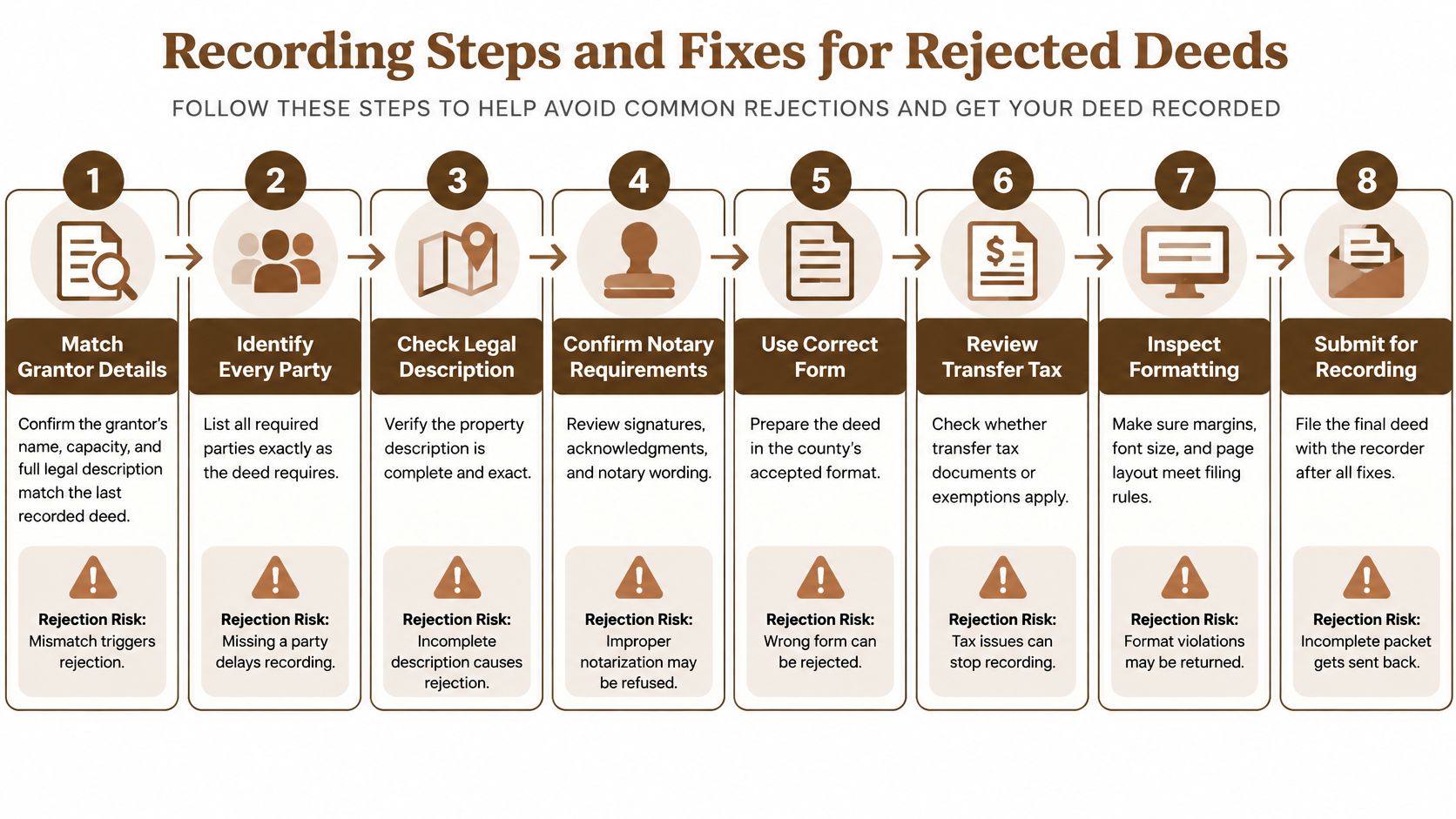
The visual below maps the sequence at a glance before the detailed steps.
The Eight Steps in Order
- Match the last recorded deed: Copy the grantor's name, capacity, and full legal description exactly as they appear in current vesting. A mismatched vesting name is a common rejection and can cloud title if it slips through.
- Identify every required signer: Include spouses where required, releasing joint tenants, the trustee, or a personal representative acting under letters. One missing signer can leave part of the interest behind.
- Write the granting clause and new vesting: State plainly who receives the interest and how, such as joint tenants or the trustee of a named trust. Vague vesting language invites disputes between co-owners later.
- Use the full legal description and parcel number: Don't rely on the street address alone. A missing assessor's parcel number or incomplete description can stall recording or describe the wrong land.
- Complete the transfer tax declaration: Fill in the documentary transfer tax declaration, and if you're claiming an exemption because no consideration was paid, cite the applicable statute. An exemption claim without the citation is a predictable rejection.
- Sign before a California notary: Every grantor signs, and the acknowledgment must match the signature block. A defective acknowledgment sends the packet back.
- Attach the ownership report and addresses: Include the Preliminary Change of Ownership Report, a return address, and the future tax mailing address. An omitted ownership-change form triggers delay and assessor follow-up.
- File and keep the conformed copy: Submit to the Orange County or Los Angeles County recorder in person, by mail, or by approved electronic recording. Keep the conformed copy with your trust or estate papers so the next person can trace what happened.
The short walkthrough below reinforces why each item in the packet matters before you submit it.
Why Recorders Send Packets Back
County screening commonly checks grantor and grantee names, the property description, the tax declaration, addresses, signatures, the acknowledgment, and the ownership-change form, and the Board of Equalization identifies seven core validity elements, covering writing, properly described parties, capacity, an identifiable property description, granting language, execution, and delivery and acceptance, as summarized in the Sonoma County Clerk-Recorder deed guidance. That guidance lists the usual speed-killers, including a mismatched vesting name, missing parcel number or legal description, incomplete tax declaration, defective acknowledgment, omitted ownership-change form, and an exemption claim without the statutory citation.
| Problem | What goes wrong | Fix first |
|---|---|---|
| Name does not match vesting | Rejection or a cloud on title | Copy the last recorded name and capacity |
| Signer is not on title | Quitclaim transfers nothing | Confirm the recorded owner before drafting |
| Street address used as the description | Land may not be identifiable | Use the full recorded legal description |
| No PCOR or parcel number | Delay or assessor follow-up | Include both in the recording packet |
| Exemption without a statute | Rejection or added fees | Cite the applicable California code section |
| Family home gifted without BOE-19-P | Proposition 19 relief can be lost | Plan occupancy, the exemption, and the claim |
| Heir signs during probate | Unauthorized or premature transfer | Get letters or use the assessor death notice instead |
Recording creates public notice. It doesn't cure fraud, a forged signature, lack of authority, or the wrong lot in the legal description. A recorded mistake usually needs a corrective instrument, and a disputed one can end up in litigation.
The Notice That Follows Recording
California is adding a safety net after recording. The statute at Government Code section 27297.7 requires each county, on or before January 1, 2027, to establish a recorder-notification program once its board of supervisors adopts the authorizing resolution. After adoption, the recorder must mail notice within 30 days after recording a deed, quitclaim deed, mortgage, or deed of trust to the parties who executed it at the tax-bill address, counties may add electronic notice and may require the parcel number, and a related fee is capped at mailing cost plus actual assistance costs of up to $7.
Use that 30-day window deliberately. When the notice arrives, confirm the deed matches what your family intended, signer by signer and parcel by parcel. If it doesn't, act immediately. That window exists so owners can catch forgery or an unintended gift early, while the trail is fresh.
Taxes and Reassessment After Recording
"No money changed hands" doesn't mean no tax event occurred. Families say this about gifts between parents, children, and siblings, and it's the most expensive misunderstanding in a quick deed transfer in California. Two separate systems respond to your recorded deed, and you need to plan for both before signing.
First, counties and some cities impose documentary transfer tax based on the local declaration you file at recording. Orange County and Los Angeles filers must use the correct local form, and a claimed exemption still needs the correct statutory citation. Writing "gift" or "no consideration" without the citation isn't enough.
Second, the county assessor reviews the recorded deed for a change in ownership. That review, not the recorder's stamp, decides your future property-tax bill.
| Transfer | Reassessment result | Form to file | Timing |
|---|---|---|---|
| Sale to an unrelated buyer | Generally full fair market value | PCOR and transfer-tax declaration | With recording |
| Gift of a 50 percent interest | Generally only that 50 percent | PCOR | With recording |
| Transfer between spouses | Often excluded from change in ownership | PCOR citing the interspousal exclusion | With recording |
| Parent-child family home under Prop 19 | Old value may be preserved only within the value cap | BOE-19-P plus homeowners' or veterans' exemption | Move in and file the exemption within one year; claim within three years or before a third-party transfer |
| Parent-child transfer of a non-home | Generally reassessed | PCOR | With recording |
How Proposition 13 Reassessment Works
The California State Board of Equalization change in ownership guidance explains that county assessors review recorded deeds to determine whether a change in ownership occurred, and under Proposition 13, a taxable change generally requires reassessment at current fair market value as of the transfer date instead of the prior factored base-year value. If market value is far above the old assessed value, which is common for long-held Orange County and Los Angeles homes, the tax bill rises with it.
Reassessment can also be proportional. If only 50% of a property is transferred, the assessor generally reassesses only that 50% interest and deducts the corresponding 50% from the prior base-year value. A deed moving a half interest to a child or co-owner therefore doesn't reset the whole property, but it doesn't leave taxes untouched either. Exclusions exist, so a recorded deed doesn't automatically mean full reassessment. The result depends on the ownership change and any exclusion you qualify for and claim.
Proposition 19 and the Family Home
For parent-child transfers, the rules narrowed sharply. The Board of Equalization Proposition 19 summary states that for transfers on or after February 16, 2021, the exclusion generally applies only to a family home that was the transferor's principal residence and becomes the transferee's principal residence, or to a qualifying family farm, with the transferee required to move in within one year and file for the homeowners' or disabled-veterans' exemption within one year. The claim is generally made on BOE-19-P and, for relief back to the transfer date, must be filed within three years of the transfer or before a transfer to a third party, whichever occurs first.
There's also a value ceiling. Board guidance in a 2025 letter to assessors on Proposition 19 explains the home's current market value must generally be no more than the transferor's factored base-year value plus $1 million, adjusted every other year for inflation, and relief is reduced rather than fully preserved above that threshold. A rental or vacation property gifted to a child generally doesn't keep the old taxable value at all.
Before you sign: Pull the current assessed value, get a realistic market value, and run the difference. That gap is your potential new tax base.
A quickly recorded deed without the occupancy steps, the exemption filing, and the BOE-19-P claim may not preserve the prior taxable value, even when the transfer itself qualifies. The deed is step one. The claim is what protects the tax treatment.
Sign the Deed or Get a Review First
Some deeds are simple, and you don't need to turn them into a project. Others look simple and aren't. Use this line to decide.
When You Can Usually Proceed
- The signer matches recorded vesting: The grantor's name and capacity are identical to the last deed, and the interest being moved is clear.
- The job is a simple release or trust funding: A spouse releasing an interest, or an owner transferring into their own living trust with the correct trustee and trust name.
- The paperwork copies the record: The legal description and parcel number come straight from the last recorded deed, and every grantor is available to sign before a notary.
- The tax side is identified: You've named the transfer-tax exemption and its statute, and you've confirmed whether reassessment or an exclusion applies.
When You Should Pause
- Someone has died: Authority may sit with a trustee, a surviving joint tenant, or a personal representative, and a deed may not be the first step.
- Co-owners disagree: A deed signed under pressure or without all owners can become a partition or quiet-title dispute.
- A lender or lien is involved: A quitclaim doesn't remove liens or loan obligations, and transferring title doesn't transfer the debt.
- You're counting on a low tax base: If keeping the Proposition 13 value is the point of the transfer, verify the exclusion and its deadlines before recording, not after.
- A prior deed looks wrong: Recording another deed on top of a defective one stacks problems instead of fixing them.
Those pause files are the ones that turn into quiet-title, partition, and probate litigation. A short review before signing costs far less than clearing title afterward.
Tanner Law is the Orange County practice of William T. Tanner, and it helps homeowners, heirs, trustees, and investors decide whether a deed, a trust transfer, a probate filing, or a court action fits the property and the family's goal. The office is at 1913 E. 17th Street, Suite 212, Santa Ana, CA 92705, and the practice serves clients in Orange County, Los Angeles, Riverside, and San Bernardino courts.
If your situation falls on the pause list, get the deed reviewed before anyone signs. Bring the last recorded deed, any trust documents, the parcel number, and a plain statement of what you want the transfer to accomplish. Those four items let a lawyer tell you quickly whether a quick deed transfer in California will work or whether another route protects you better.
A fast deed is worth doing only when the right person conveys the right interest and the tax paperwork is ready.
Don't let a one-page deed create a reassessment surprise or a title defect your family has to litigate later. Schedule a free consultation with Tanner Law before you sign, and bring your last deed, parcel number, and trust or probate papers so we can confirm who can transfer the property, which deed fits, and which California tax filings protect you.