What Is a Totten Trust? Avoid Probate in 2026
A Totten trust is a bank account set up to pass cash directly to a named beneficiary outside probate, while the account owner keeps 100% control during life. If you're trying to leave money to a child, grandchild, or other loved one without dragging that account through California probate, this is one of the simplest tools available.
A lot of families in Orange County and Los Angeles start with the same practical concern. They don't necessarily need a complicated estate plan for every asset they own, but they do want one account to transfer smoothly when they die. Maybe it's a savings account meant to help an adult child, or money set aside for a grandchild's education, or a reserve fund a surviving family member will need quickly.
That search for a simple solution often leads to the question, what is a Totten trust, and whether it's the same thing as a payable-on-death account. In California, the answer is a little more nuanced than many online articles suggest. The basic idea is simple. The legal details are where mistakes happen.
Table of Contents
- Introduction A Simple Way to Pass on Assets
- What Exactly Is a Totten Trust
- How a Totten Trust Operates From Setup to Payout
- Advantages and Disadvantages of a Totten Trust
- Totten Trust vs POD Accounts and Living Trusts
- California Specific Rules for Totten Trusts
- Common Pitfalls and When to Call an Attorney
Introduction A Simple Way to Pass on Assets
If you've watched a family member deal with probate in California, you already know why people look for alternatives. Probate can be slow, public, and frustrating, especially when the asset in question is just a bank account that everyone agrees should go to one person.
A Totten trust exists for that narrow but very real problem. It lets someone name a beneficiary on a bank account so the money can pass directly at death instead of waiting to move through the court process. For many families, that's appealing because it matches how they think about that account anyway. "This money is for my daughter," or "This is for my grandson when I'm gone."
In Orange County and Los Angeles, I often see people assume that if an account is "for" someone, that intention alone is enough. It isn't. California law cares about how the account is titled and what the bank records say. Good intentions help no one if the paperwork doesn't match.
A Totten trust is best understood as a simple transfer tool for cash in a bank account, not as a complete estate plan.
That distinction matters. A Totten trust can be useful, but it doesn't replace planning for a house, rental property, brokerage assets, blended families, or children who need protected distributions. It solves one problem well. It doesn't solve every problem.
If you're considering this route because you want a loved one to receive funds with less delay and less court involvement, it's worth looking carefully at your options under California law, then scheduling a free consultation for advice specific to your situation.
What Exactly Is a Totten Trust
A Totten trust works like a labeled envelope in your desk drawer. The money is still yours while you are alive. You can add to it, spend it, rename it, or get rid of the label altogether. If you die while that label is still in place, the person named on it is the one the bank is expected to pay.
In legal terms, a Totten trust is a revocable bank account arrangement usually titled something like "[depositor], in trust for [beneficiary]". The idea comes from Totten v. United States, the case that gave this kind of account its name, as summarized in Wikipedia's explanation of Totten trusts.

The word trust confuses many people. In a California estate planning office, that confusion comes up all the time. Clients hear "trust" and assume there must be a separate document with detailed instructions, backup trustees, and rules about when a child or grandchild can receive funds. A Totten trust usually does not do that. It is typically just a bank account with a beneficiary direction attached to that account.
That narrow function matters in California because people often use the terms Totten trust and POD account as if they mean exactly the same thing. In day-to-day banking, they often overlap. In practice, both are simple nonprobate transfer tools for deposit accounts. But the older "in trust for" label can make the arrangement sound more formal than it really is, and that misunderstanding leads families to expect protections the account does not provide.
Who plays which role
The roles are simple:
- Depositor or settlor: The person who opened and funded the account.
- Trustee: Usually the same person during life, because that person keeps control of the money.
- Beneficiary: The person named to receive what remains at death.
For families in Orange County and Los Angeles, the practical takeaway is straightforward. Naming a beneficiary on this kind of account does not give that person current access just because their name appears in the bank records. The beneficiary does not become a co-owner during your lifetime, and this arrangement does not operate like a joint account.
A short video can help if you're comparing this to other estate planning tools:
Practical rule: A Totten trust is useful for passing a specific cash account. If you want staged distributions, spendthrift protection, special needs planning, or instructions for several beneficiaries, you usually need a more detailed trust.
That is the clearest way to answer what is a Totten trust. It is a simple account-level transfer arrangement, and its simplicity is both its strength and its limit.
How a Totten Trust Operates From Setup to Payout
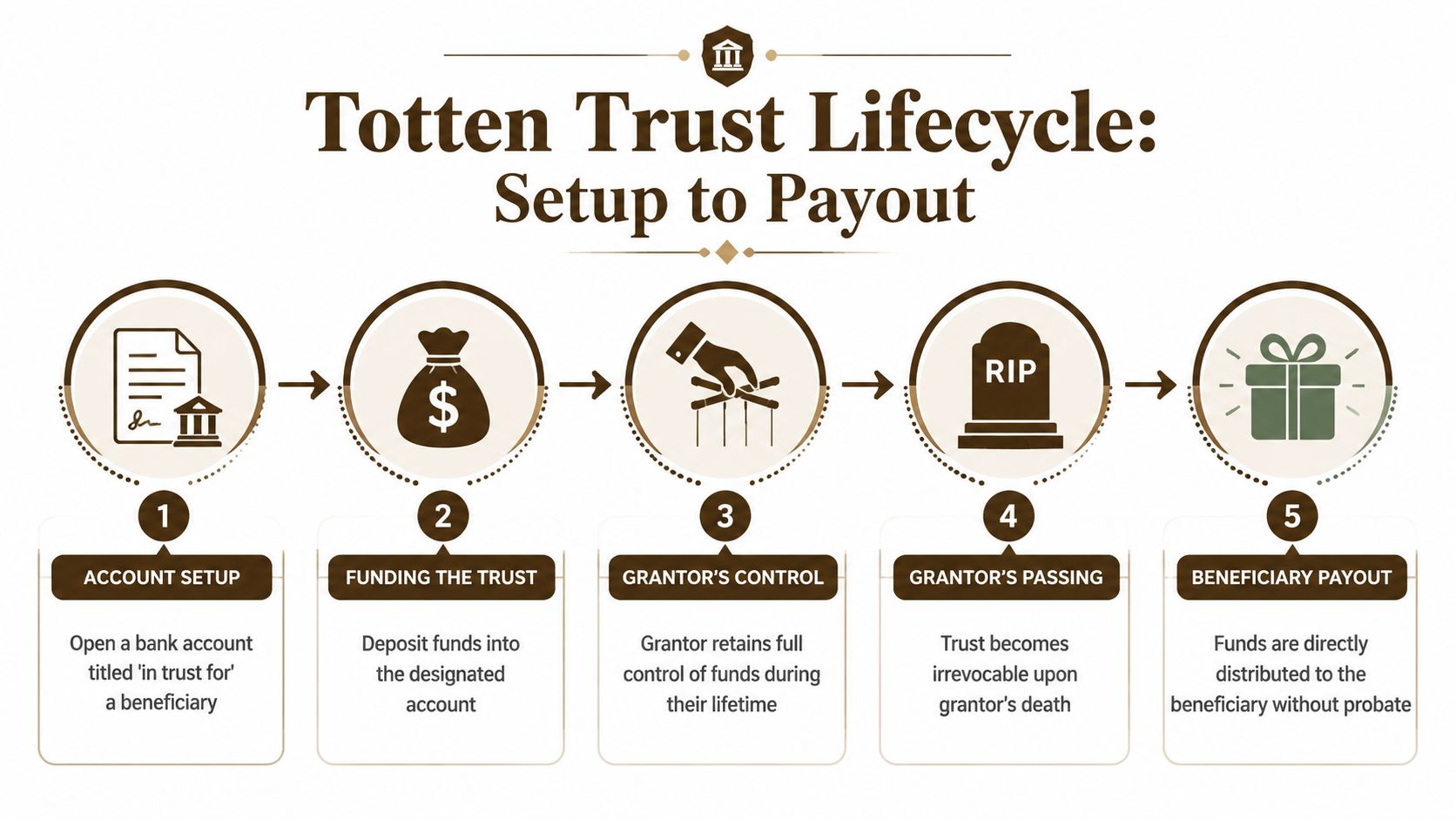
A Totten trust is easiest to understand by following its life cycle from the day the account is opened through the day the beneficiary receives the funds.
What setup usually looks like
Start with a common example. A mother in Los Angeles opens a savings account and titles it in trust for her adult son. She uses the bank's paperwork rather than hiring someone to draft a separate trust instrument. The account exists at the bank like any other deposit account, but the beneficiary designation changes what happens at death.
During her lifetime, she still controls the account completely. According to Western & Southern's discussion of Totten trusts, the beneficiary has zero legal interest while the depositor is alive, and the depositor retains 100% control over the funds for deposits, withdrawals, and personal use.
That means she can:
- Add money whenever she wants.
- Withdraw money for her own needs.
- Change the beneficiary if circumstances change.
- Close the account entirely if she decides the arrangement no longer fits.
This revocable nature is one of the account's biggest practical benefits. It gives the owner flexibility without requiring the beneficiary's permission.
What happens after death
When the owner dies, the account no longer operates like an ordinary personal account. At that point, the named beneficiary generally claims the funds by providing the bank with the required proof of death. For families, that often means faster access than waiting for a probate court to authorize distribution.
The bank account passes by its designation, not by whatever family members assumed would happen.
There is one California planning issue people often miss. If the named beneficiary dies before the depositor, the Totten trust is automatically revoked, and the funds stay part of the depositor's estate rather than passing to that beneficiary's heirs, as explained in this California-focused discussion of Totten trusts.
That single rule can create a major surprise. A grandparent may think, "If my daughter dies first, her children will step into her place." With a Totten trust, that assumption may be wrong if the account isn't updated.
The lifecycle in practical terms
| Stage | What it means for the owner | What it means for the beneficiary |
|---|---|---|
| Account creation | Owner signs bank paperwork | Beneficiary is named |
| Owner's lifetime | Owner keeps full control | No access to funds |
| Change of mind | Owner can revise or revoke | Beneficiary can't object |
| Beneficiary dies first | Owner must revisit plan | No automatic pass-through to heirs |
| Owner's death | Account direction takes effect | Beneficiary claims funds from bank |
If you're using one of these accounts in a broader California estate plan, make sure the designation still matches your family structure, then schedule a free consultation if you'd like help reviewing it.
Advantages and Disadvantages of a Totten Trust
A Totten trust works a lot like a labeled envelope at the bank. The owner keeps the envelope, can replace it, empty it, or tear up the label at any time. Only at death does the label matter. That makes the tool useful, but only for a narrow job.

For many California families, the biggest benefit is speed and simplicity. If a parent in Irvine or Long Beach wants one savings account to go directly to one child, a Totten trust can often accomplish that without making that account part of the probate process. The bank usually handles the payout through its own claim procedure, which is far easier than asking the probate court to supervise distribution of that account.
Control also stays with the depositor during life. The beneficiary does not get a present ownership interest, cannot demand withdrawals, and cannot block changes. That feature matters to older clients who want a simple transfer method without giving up access to their own money.
Privacy is another practical advantage. A probate file becomes a court record. A bank account paid under a Totten trust designation is usually handled outside that public process, which can reduce family friction and unwanted attention.
Those are real benefits. They just do not turn the account into a full estate plan.
The limits show up fast in California practice, especially when families use the word "trust" and assume this account works like a revocable living trust. It does not. A Totten trust covers the deposit account named on the bank's records. It does not control a house in Anaheim, a condo in Los Angeles, a brokerage account, or a family business. If those assets need direction, this tool leaves major gaps.
The account also does not give you much room for instructions. You generally cannot direct the bank to hold funds until a beneficiary reaches age 25, release money in stages, or restrict use to health or education expenses. A living trust can do that. A Totten trust usually cannot.
That difference matters for parents and grandparents.
If the intended beneficiary is a minor, the bank may not be able to hand the funds directly to that child in any practical way. The result may be delay, a blocked account, or the need for a court-supervised arrangement to manage the money. Families are often surprised by that because the setup felt so simple at the start.
There is also a California-specific caution that generic articles often miss. In everyday conversation, people treat Totten trusts and payable-on-death accounts as the same thing. The next section explains why that is not always true under California law. For this section, the practical point is simpler. If your goal is certainty and your family has any chance of conflict, a Totten trust may leave more room for dispute than you expected.
Other drawbacks deserve a clear look:
- It solves only one asset at a time: Each account has to be reviewed and titled correctly, and other assets still need their own plan.
- It does not protect the owner's money from the owner's creditors: The depositor still owns and controls the account during life.
- It can clash with the rest of the estate plan: A will may say one thing while the bank designation sends that account somewhere else.
- It has no backup design by default: If family circumstances change and the beneficiary designation is not updated, the outcome may no longer match the owner's wishes.
For a straightforward bank account transfer, a Totten trust can be a useful tool. For blended families, minor beneficiaries, unequal gifts among children, or estates with real property in Orange County or Los Angeles, it is usually too limited to carry the planning load by itself.
Totten Trust vs POD Accounts and Living Trusts
Often, generic articles oversimplify the issue. They treat a Totten trust and a POD account as interchangeable. In everyday conversation, people often use them that way. Under California law, though, the distinction can matter.
The California difference between Totten trusts and POD accounts
A standard POD account generally tells the bank, "When I die, pay this account to the named person." A Totten trust uses trust-style account language and carries a slightly different legal character.
That difference becomes important if there's a dispute after death. Under California law, a surviving payee's right in a POD account is absolute under Cal. Prob. Code § 5302(b), but a Totten trust beneficiary's right is only presumptive and can be overridden by "clear and convincing evidence of a different intent" under § 5302(c), as discussed in this California analysis comparing Totten trusts and POD accounts.
That is not a small technicality. It means a California Totten trust can be more vulnerable to an argument that the depositor intended something else.
For example, suppose a father titles an account in trust for one child, but later makes statements and estate documents suggesting he wanted that money split among several children. In a contested setting, the account wording may not end the discussion the way people expect.
If you're choosing between account labels at a California bank, the wording may affect how much certainty the beneficiary has later.
A revocable living trust sits in a different category. It is broader, more flexible, and usually better for families with real estate, layered distributions, privacy concerns across multiple assets, or a need to coordinate everything in one plan.
Comparison of California Estate Planning Tools
| Feature | Totten Trust | POD Account | Revocable Living Trust |
|---|---|---|---|
| Primary use | Transfer a bank account at death | Transfer a bank account at death | Hold and manage a broader set of assets |
| Asset scope | Depository account funds | Depository account funds | Can be used for broader asset planning, including assets beyond cash |
| Owner control during life | Owner keeps full control | Owner keeps control | Creator usually keeps control while alive if serving as trustee |
| Probate avoidance | Yes, for the account | Yes, for the account | Yes, for assets properly titled in the trust |
| Complexity | Low | Low | Higher |
| Separate trust document required | Not typically | Not typically | Yes |
| Post-death instructions | Very limited | Very limited | Can provide detailed instructions |
| California dispute nuance | Beneficiary right is presumptive | Surviving payee's right is absolute under cited statute | Governed by trust terms and broader trust law |
A practical way to choose is to ask what problem you're trying to solve.
- If the goal is one bank account to one adult beneficiary, a Totten trust may work.
- If the goal is straightforward bank transfer with stronger statutory finality, a POD account may deserve a closer look under California law.
- If the goal is coordinated planning for real estate, multiple beneficiaries, minors, remarriage, or long-term control, a revocable living trust is usually the better tool.
People searching what is a Totten trust are often really asking a bigger question: "What is the lightest estate planning tool that still protects my family?" In California, the right answer depends on your assets, your family dynamics, and whether simplicity creates clarity or risk.
California Specific Rules for Totten Trusts
California does not treat these accounts as vague informal arrangements. State law gives them a formal definition, and that matters when families in Orange County or Los Angeles try to rely on them after a death.

How California law defines the account
Under California Probate Code § 80, a Totten trust account is an account in the name of one or more parties as trustee for one or more beneficiaries, where the relationship is established solely by the form of the account and the deposit agreement with the financial institution. You can read that statutory definition directly in California Probate Code section 80.
That definition clears up a common misconception. In California, you don't need a separate, stand-alone trust instrument for a Totten trust to exist. The bank account form and deposit agreement are what create the arrangement.
This also explains why bank records matter so much. If the title is incomplete, outdated, or inconsistent with the depositor's actual wishes, litigation risk goes up.
Why local planning still matters
California-specific planning doesn't stop with the account title. Married couples, blended families, and homeowners often assume a beneficiary designation works in isolation. It doesn't. It sits beside community property concerns, other beneficiary designations, a will, and sometimes a living trust.
For families in Southern California, that creates practical questions:
- Is the account separate property or community property? That can affect expectations about who should receive it.
- Does the designation fit the rest of the estate plan? A mismatched account can undercut the balance a person intended.
- Will the account create tension among siblings or a surviving spouse? Simple tools can still lead to hard disputes.
California law makes Totten trusts easy to create, but that ease is exactly why families should be careful. Simplicity at the bank can create complexity later.
Another important point is that probate avoidance is not the same as complete legal immunity. People sometimes assume that because an asset bypasses probate, no one can ever challenge or reach it. That assumption is too broad. Good planning means understanding not only how an asset transfers, but also how it fits into the rest of the estate and family structure.
If you're relying on one of these accounts in California, the best time to review it is before a crisis, not after one.
Common Pitfalls and When to Call an Attorney
A Totten trust often looks simple at the bank counter. Then a family tries to apply that simple form to a remarriage, a child with special needs, a jointly owned account, or a plan that also includes a house in Orange County or Los Angeles. That is where mistakes start.
The hardest part for many families is that a bank designation feels like a full estate plan when it is really a narrow transfer tool. It works well for one account in the right situation. It does not sort out competing expectations, unclear ownership, or the larger question of how the rest of the estate should pass under California law.
Mistakes that cause family conflict
A common problem is an outdated beneficiary. Someone names a child years ago, then life changes. There is a divorce, a death, a new marriage, or a falling out. After death, the bank usually looks at the designation on file, not later conversations at the kitchen table.
Another problem is using the account as a shortcut for issues it cannot solve. A Totten trust can pass funds in a deposit account. It does not transfer a residence in Irvine, a rental property in Long Beach, or every financial account a person owns. Families are often surprised by how much is still left outside that one designation.
Convenience naming causes trouble too. A parent may name one child because that child lives nearby or helps with errands, with the unspoken hope that the child will divide the money later. That hope is not the same as a legal instruction. If the named beneficiary keeps the funds, the rest of the family may feel cheated, and litigation can follow.
A Totten trust also needs extra care in California because people often use the term loosely. At many banks, what a customer calls a Totten trust may function in practice like a payable on death designation. The result after death may look similar, but the account paperwork, bank procedures, and the way the designation fits with the rest of the estate plan are not always identical. That difference is easy to miss until a survivor is standing at the branch trying to collect funds.
The legal tool is simple. The family facts usually are not.
Warning signs you shouldn't ignore
- Blended families: A single beneficiary line rarely balances a current spouse and children from an earlier relationship in a fair, predictable way.
- Minor or vulnerable beneficiaries: Direct distribution can create the need for a guardian, custodianship, or other court involvement.
- Real estate or larger non-bank assets: A bank account designation does nothing for the house, rental property, or business interest.
- Unequal gifts: If your plan depends on one child receiving more, less, or only under certain conditions, a basic account designation is usually too blunt.
- Community property questions: In California, spouses may have competing rights or expectations about funds in an account, even if only one beneficiary is listed.
When a Totten trust isn't enough
For one bank account going to one competent adult beneficiary, this tool may be a good fit. It works like handing the bank a narrow instruction card that becomes effective at death. If your goals are broader, the tool starts to show its limits.
Families often need more structure when they want to coordinate several assets, protect a beneficiary from poor money management, provide for a surviving spouse while preserving an inheritance for children, or keep the overall plan consistent. Those are common facts in Southern California. They call for more than a bank form.
The timing matters too. Reviewing beneficiary designations before a health crisis is far easier than sorting out account ownership and intent after someone has died.
If you want help reviewing a Totten trust, a POD designation, or how those accounts fit with a California estate plan, contact Tanner Law for a free consultation. Families in Orange County and Los Angeles can get practical guidance before a small designation mistake turns into a larger dispute.