Estate Bank Account: A California Executor’s Guide
A lot of people reach this issue in the same way. A parent dies. The family is grieving. Then the mail starts arriving. Utility bills, a mortgage statement, a final medical invoice, maybe a refund check made out to the person who has died. Someone at the bank says the account is frozen. Someone else says, “You're the executor, so you handle it.” That's usually the moment the pressure sets in.
If you've been appointed, or expect to be appointed, as a personal representative in California, the estate bank account is one of the first practical tools that brings order to a difficult process. It gives you one place to receive estate money, one place to pay proper estate expenses, and one clean paper trail if the court or family members later ask what happened to the funds. For families in Orange County and Los Angeles, that separation matters early and often.
Table of Contents
- Your First Step as an Executor Navigating the Path Ahead
- What Is an Estate Bank Account
- When an Estate Account Is Required in California
- How to Open an Estate Bank Account Step by Step
- Managing the Account Permitted Uses and Prohibitions
- Common Pitfalls and How to Avoid Them
- Final Steps Closing the Account and Distributing Assets
Your First Step as an Executor Navigating the Path Ahead
A newly appointed executor in California often thinks the first job is paying bills quickly. Usually, it isn't. The first job is figuring out what authority you have, what assets are part of the probate estate, and how to handle money without exposing yourself to personal liability.
A common Orange County or Los Angeles scenario looks like this. A son or daughter has the death certificate. The parent's checking account is frozen. The family wants funeral costs reimbursed, the property tax bill is due, and there may be rent coming in from a house or duplex. Everyone wants movement. But moving too fast, especially by using your own checking account as a shortcut, can create avoidable problems with the probate court and with beneficiaries.
Practical rule: If money belongs to the estate, treat it as estate money from day one, even before the estate bank account is open.
That mindset matters because your role is fiduciary. In plain English, that means you're handling someone else's money under legal duties of care, honesty, and accurate record keeping. California probate administration is much easier when you build clean systems at the start rather than trying to reconstruct transactions months later from scattered receipts, Venmo transfers, and family text messages.
The estate bank account is the tool that makes that structure possible. It won't solve every probate issue, but it does solve one of the biggest early problems: where estate funds should go, and how estate expenses should be paid.
For many families, once that account is properly opened and used the right way, the rest of the administration becomes more manageable. You stop improvising. You start documenting. That shift protects the estate and it protects you.
What Is an Estate Bank Account
An estate bank account is a temporary bank account opened in the name of the estate, not in the decedent's personal name and not in your name. In practice, it usually functions like a checking account because the estate needs liquidity for bills, court costs, and other administration expenses.
The cleanest way to think about it is this: it's the estate's operating account. Money that belongs to the probate estate comes in. Approved estate expenses go out. That separation is not just tidy bookkeeping. It is part of proper probate administration.
According to this explanation of opening an executor estate bank account, an estate bank account is a mandatory temporary financial vehicle that requires an IRS-issued Employer Identification Number (EIN) to function, as the estate is legally treated as a separate entity distinct from the deceased individual.
Why the separation matters
Once a person dies, their personal accounts generally can't be used as if nothing changed. At the same time, you cannot step in and use your own account as a substitute. California law expects estate assets to be handled separately so there's a transparent record of what was received, what was paid, and what remains for heirs or beneficiaries.
That record becomes important in at least three situations:
- When the court asks for an accounting: You need a reliable ledger, not a memory.
- When beneficiaries ask questions: Clear statements reduce suspicion and conflict.
- When taxes or post-death income are involved: The estate needs its own tax identity.
A separate account does two jobs at once. It lets you pay legitimate estate expenses, and it lets you prove that you did.
What typically flows through the account
The estate bank account serves as the collection point for probate funds and the payment source for probate expenses. In real administration, that often includes:
| Estate money coming in | Estate money going out |
|---|---|
| Refunds payable to the estate | Court filing fees |
| Checks redirected from frozen individual accounts | Probate attorney fees |
| Sale proceeds from probate assets | Mortgage or property expenses tied to estate assets |
| Rent or other post-death income from probate property | Valid creditor claims and administration costs |
The account is temporary by design. It exists during administration and should stay open until the probate process is completed, the court-approved accounting is handled, and the remaining funds are distributed.
What it is not
It isn't a family convenience account. It isn't a place to “park” mixed funds. And it isn't interchangeable with a trust account, joint account, or beneficiary-designated account.
Those distinctions matter in California because not every asset belongs in probate, and not every asset should ever touch the estate bank account.
When an Estate Account Is Required in California
Whether you need an estate bank account depends on the path the asset takes under California law. Many executors assume every death requires one. That isn't true. The better question is whether the asset is part of the probate estate.
Formal probate usually means a separate account
If an asset is in the decedent's sole name and doesn't pass automatically to someone else, formal probate is often the reason you need an estate bank account. In California, a single-owner bank account with no beneficiary designation is generally part of the probate estate and remains frozen until authority is established through the court process. By contrast, accounts with a surviving joint owner with survivorship rights or a designated Payable-on-Death beneficiary pass outside probate upon presentation of a death certificate, as explained in this discussion of California bank accounts, beneficiaries, and probate transfers.
For a personal representative, that distinction has immediate consequences. If you're collecting funds from an account that is part of probate, you'll usually need a dedicated estate account to receive and manage those funds. If the account transfers automatically outside probate, that asset shouldn't be routed through the estate account at all.
When probate is avoided
Some assets never belong in the estate bank account because they bypass probate from the start.
That commonly includes:
- POD accounts: A Payable-on-Death designation sends the funds directly to the named beneficiary without court involvement. Texas Law Help's explanation of POD accounts states that POD funds bypass probate and do not require an estate account.
- Joint accounts with survivorship rights: The surviving owner usually becomes the owner automatically under California law.
- Trust assets: Property titled in a living trust is handled by the trustee under the trust terms, not by the personal representative through the probate estate.
One of the most common mistakes is assuming that because one account passes outside probate, every other asset does too. Estates often contain both probate and non-probate property.
That mixed-asset situation is where families get confused. A decedent may have one POD savings account, one individual checking account with no beneficiary, and a house held in trust. Those assets do not follow the same route, and they should not be handled as if they do.
California small estate option
California also has a simpler route for some estates. Under California small estate affidavit guidance summarized by Justia Answers, if an estate qualifies as a small estate with a total value under $184,500, described there as the 2025 threshold, successors can bypass formal probate by using an Affidavit for Collection of Personal Property, but they must wait at least 40 days after death before presenting the affidavit to the bank.
That option can spare a family from full probate, but it doesn't mean every bank handles the paperwork the same way. The affidavit process still requires care. The bank may want the death certificate, a copy of the will, notarization, or signatures from the proper successors.
A simple comparison helps:
| Situation | Estate bank account usually needed |
|---|---|
| Formal probate of sole-name assets | Yes |
| POD account with named beneficiary | No |
| Joint account with survivorship rights | No for that asset |
| Small estate affidavit collection in California | Often no formal probate account needed, depending on the bank and asset handling |
The point isn't to force every asset into one channel. The point is to use the correct channel for each asset.
How to Open an Estate Bank Account Step by Step
The biggest practical mistake executors make is going to the bank too early. In California, the bank usually isn't the first stop. The probate court is.
Start with the probate court, not the bank
If the estate requires formal probate, you need legal authority before a bank will usually let you open and control an estate account. In California, an executor cannot open or access an estate bank account until probate is initiated and the court issues the documents proving authority, often called Letters Testamentary or Letters of Administration, as described in this California probate overview on opening an estate account.
That sequence matters. A will by itself usually isn't enough for the bank. Family agreement isn't enough either. The bank wants court-backed authority because it is being asked to release or redirect money that belonged to a deceased customer.
A practical checklist looks like this:
- File the probate petition in the proper California court.
- Obtain appointment as personal representative once the court approves.
- Receive certified Letters Testamentary or Letters of Administration.
- Gather a certified death certificate.
- Apply for the estate's EIN.
- Take the full document package to the bank.
Before dealing with the bank, it helps to hear the process explained visually:
Get the EIN and prepare your bank package
The estate needs its own tax identification number. According to this California estate account rules overview, to open a California estate bank account, the executor must obtain an Employer Identification Number (EIN) from the IRS specifically for the estate, which functions as the estate's tax identification number distinct from the deceased's Social Security Number, and must present this EIN alongside the certified death certificate and the court document naming them as executor to the bank.
In practice, banks in Orange County and Los Angeles often ask for the same core items, even if their internal forms differ.
Bring these documents:
- Certified death certificate: Banks typically want a certified copy, not a photocopy.
- Court appointment papers: Letters Testamentary or Letters of Administration are usually the key document.
- EIN confirmation: This shows the estate's federal tax identity.
- Your government ID: The bank needs to verify the representative opening the account.
If the banker says they “just need the will,” stop and confirm the bank's probate procedure with a branch manager or estate services department. The wrong answer at the teller line can waste a week.
Choose a practical account setup
Most estate bank accounts are opened as checking accounts because the estate needs to write checks, deposit incoming funds, and maintain transaction visibility. A simple setup usually works best.
Ask the bank how it will title the account. A commonly used legal style is the estate name followed by your representative capacity. The goal is to make clear that the funds belong to the estate and that you are acting in a fiduciary role, not personally.
Then establish your recordkeeping system immediately. That can be as simple as:
- a dedicated folder for monthly statements
- a spreadsheet or ledger for each deposit and payment
- scanned invoices and receipts matched to each transaction
- notes showing why each payment was made
What works is boring consistency. What doesn't work is relying on memory and trying to rebuild the file at the end.
Managing the Account Permitted Uses and Prohibitions
Once the account is open, the central issue is discipline. The account has a narrow purpose. If you use it only for estate business and document everything, the administration is far easier to defend.
What the account should pay for
The estate bank account is for legitimate estate obligations and administration expenses. Depending on the facts, that can include funeral reimbursements if properly documented, court costs, attorney fees, taxes, mortgage payments tied to estate property, insurance, utilities necessary to preserve estate property, and approved creditor claims.
The safest practice is to make each payment traceable. Use checks, bank bill pay, or another method that leaves a clear record. If you receive estate funds, deposit them promptly into the estate account rather than holding them, endorsing them casually, or mixing them with other money.
A simple operating pattern helps:
| Good practice | Risky practice |
|---|---|
| Deposit probate funds into the estate account | Hold checks in a desk drawer |
| Pay estate bills from the estate account | Pay from your personal card and sort it out later |
| Keep invoices and receipts with each payment | Assume statements alone will tell the full story |
What you cannot do
The rule that causes the most trouble is commingling. According to this probate estate bank account discussion, placing personal funds into the estate account or estate funds into a personal account breaches fiduciary duty and can result in the court ordering the executor to reimburse the estate personally for losses and potentially disqualifying the executor from the role.
That means:
- Don't deposit estate money into your own account.
- Don't use the estate account to pay personal expenses.
- Don't treat reimbursements casually.
- Don't loan yourself money from the estate, even temporarily.
The probate court is much less concerned with your intentions than with your records. Good intentions do not fix bad accounting.
California executors sometimes believe a small shortcut is harmless if the family trusts them. That trust can disappear once money is involved. The better approach is formal, documented, and separate from the beginning.
Common Pitfalls and How to Avoid Them
The hardest estate account problems usually don't come from complex law. They come from wrong assumptions made in the first few weeks.
The asset classification mistake
A frequent error is treating all financial accounts as if they belong in probate. They don't. Some pass by beneficiary designation or survivorship. Others belong to a trust. Others are probate assets that need to be collected and managed by the personal representative.
That confusion is especially common with POD accounts. The problem is not just misunderstanding that a POD account avoids probate. The problem is thinking that one non-probate account means no estate account is needed for anything else. It may still be necessary for a sole-name account, a refund payable to the estate, rent from probate property, or sale proceeds from probate assets.
Use this quick screen before moving any money:
- Ask whose name is on the asset. Sole name, joint name, or trust name?
- Check for a beneficiary designation. A POD designation changes the path.
- Identify your role. Are you acting as executor, trustee, or successor by affidavit?
- Match the asset to the correct process. Probate, non-probate transfer, or small estate collection.
The administration mistakes that create trouble
Some errors have less to do with classification and more to do with execution.
Here are the ones I see most often in practice:
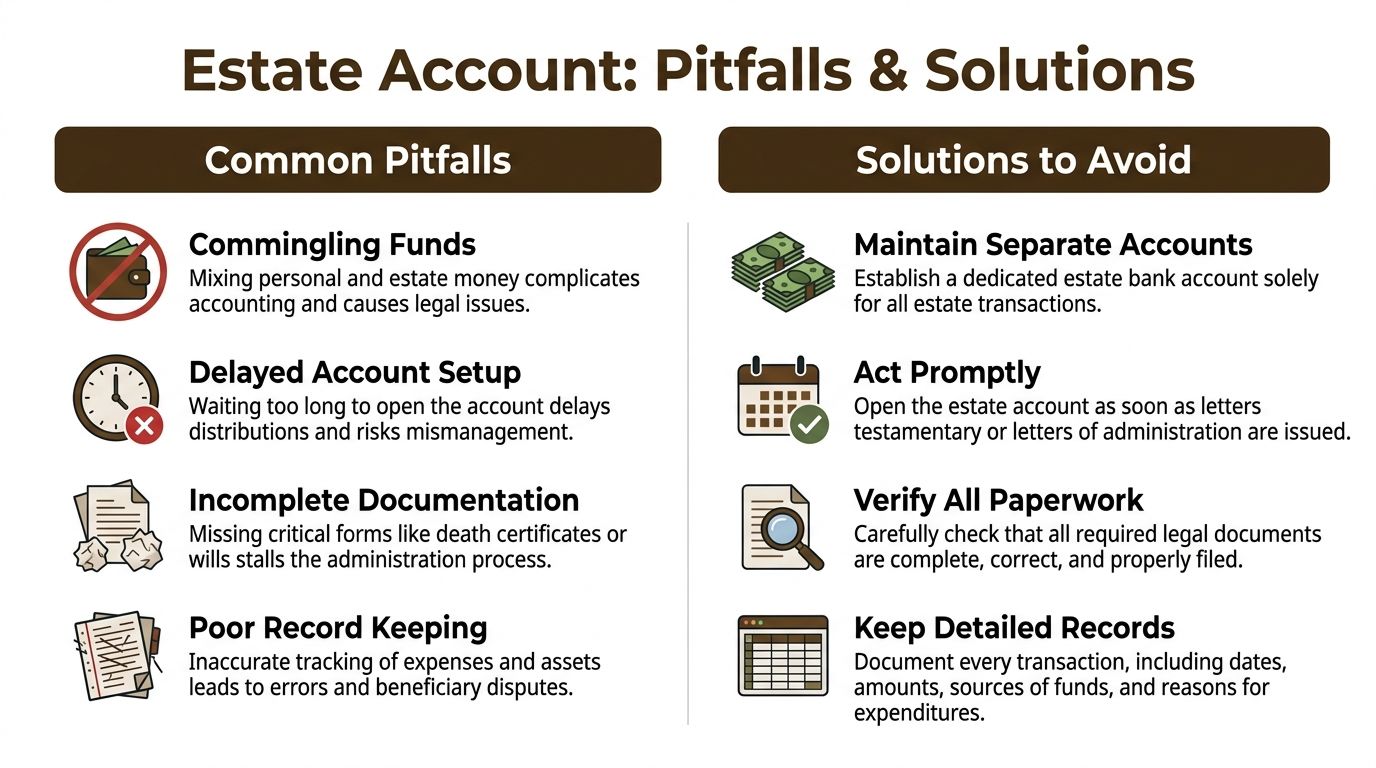
- Opening late: Bills accumulate, checks arrive, and the representative starts improvising instead of creating a clean process.
- Incomplete paperwork: The bank appointment gets delayed because the representative arrives without the Letters, the death certificate, or the EIN confirmation.
- Poor ledger habits: Months later, nobody can explain what a payment was for.
- Closing too soon: The representative distributes funds before all obligations are resolved.
A short prevention list is more useful than a lecture:
- Open the account promptly once authority and EIN are in hand.
- Keep every receipt, statement, and invoice.
- Don't distribute early just because family members are asking.
- Confirm which assets are probate assets before depositing anything.
Most executor disputes don't begin with theft. They begin with sloppiness that later looks suspicious.
That's why calm procedure matters more than speed.
Final Steps Closing the Account and Distributing Assets
The estate bank account should remain open until the administration is finished, not until it feels mostly finished. In California probate, that usually means the estate has collected the assets that belong in probate, paid proper expenses and claims, handled required filings, and prepared the final accounting for court approval where required.
The final stage is about proof. You need to show what came in, what went out, and what remains for distribution. If your account records have been clean from the start, this step is straightforward. If the records are incomplete, the end of the case becomes much harder than it needed to be.
After the court authorizes distribution, the remaining funds can be paid to the proper heirs or beneficiaries. Only after those payments clear and the balance is zero should the estate bank account be closed. That closure marks the end of a temporary account that existed for one purpose only: orderly administration of the probate estate.
Handled correctly, the account protects everyone involved. It protects estate assets from confusion, protects beneficiaries from uncertainty, and protects the personal representative from claims that money was mishandled.
If you're administering an estate in Orange County or Los Angeles and need practical guidance under California law, schedule a free consultation with Tanner Law. You can get clear advice on probate procedure, estate bank accounts, small estate options, and the steps needed to protect yourself while carrying out your duties as personal representative.