
What Is a Notice of Lis Pendens? California Guide 2026
A family in Orange County gets ready to close a sale. The buyer is approved. The moving boxes are packed. Then escrow reports a recorded notice of lis pendens. Suddenly, the deal stalls. The title company raises concerns. The lender hesitates. Everyone asks the same question: what now?
That same problem shows up in probate and trust disputes. An heir may be trying to transfer or sell inherited property, only to learn that a lawsuit has been tied to the home's title records. In Los Angeles and Orange County, this can turn a manageable real estate matter into an urgent legal problem.
If you're searching for what is a notice of lis pendens, the short answer is that it's a formal notice in the public record that a lawsuit involving real property is pending. In California, that simple filing can create immediate pressure because it warns the world that the property is in dispute. Even before a judge decides who's right, the notice can disrupt a sale, refinance, or estate administration.
For property owners, the hardest part is that a lis pendens often feels bigger than it sounds. It's just a notice on paper, but in practice it can stop ordinary transactions cold. The good news is that California law gives both filers and owners specific rules, procedures, and remedies. If the notice is proper, it serves a legitimate purpose. If it isn't, there may be a path to challenge and remove it.
If a lis pendens has appeared against your property in Orange County or Los Angeles, schedule a free consultation right away. Fast action matters.
Table of Contents
- Introduction A Sudden Cloud Over Your Property
- What a Notice of Lis Pendens Actually Is and Is Not
- The Immediate Effects on Your Property and Finances
- Recording a Lis Pendens in California and Orange County
- Common Scenarios Involving a Lis Pendens in California
- How to Challenge and Remove a Lis Pendens
- Your Next Steps for a Lis Pendens in Orange County
Introduction A Sudden Cloud Over Your Property
A recorded lis pendens usually enters the picture at the worst possible time. In practice, I often see people learn about it only after they've already made plans around the property. They're in escrow, trying to refinance, settling a probate estate, or dividing a family home after a dispute among heirs.
In California, especially in Orange County, that timing matters because local real estate transactions move quickly until a title problem appears. Once a lis pendens is found in the county records, the conversation changes. Buyers start asking whether they should walk away. Co-owners argue over who caused the problem. Executors and trustees worry that they can't carry out their duties without first resolving the court case.
Why this feels so disruptive
A lis pendens doesn't look dramatic on paper. It isn't a sheriff at the door or a lock on the house. It's a legal notice recorded against the property. But for a homeowner, trustee, heir, or seller, it can feel like someone hung a warning sign on the title itself.
A lis pendens often matters most before any judge has decided the underlying dispute.
That's why people tend to panic when they hear the phrase. They assume it means they've already lost. In many cases, that's not true. The notice says there is a lawsuit affecting the property. It doesn't by itself prove the other side will win.
Why California owners need a prompt response
California law has its own procedures for recording, serving, and challenging a lis pendens. Those procedures can give the filer an advantage, but they can also create opportunities for the owner if the notice is unsupported or defective. Waiting too long can make a bad situation harder to unwind, especially when a sale, loan, or probate deadline is already in motion.
If your property has been hit with a lis pendens in Orange County or Los Angeles, schedule a free consultation now. Early review can help you protect your title, timing, and negotiating position.
What a Notice of Lis Pendens Actually Is and Is Not
A good way to understand a notice of lis pendens is to think of it as a legal reservation placed in the public records. It tells the world that a court case is already tied to a specific parcel of real property. Anyone who deals with that property after the notice is recorded does so with that warning attached.
Cornell Law explains that lis pendens is Latin for “suit pending” and refers to a recorded notice giving constructive notice that real property is tied up in litigation. Cornell also explains that the notice is placed in the property's chain of title so third parties can discover pending claims, and that any interest acquired during the lawsuit is subject to the outcome of the case, as described in Cornell Law's lis pendens overview.

What it is
Under California practice, a lis pendens is a recorded notice tied to a pending lawsuit involving a real property claim. It's meant to warn buyers, lenders, and others that the litigation could affect title or possession. If you buy or lend against the property after the notice is recorded, you may take your interest subject to whatever the court ultimately decides.
That's why lawyers and title officers treat it seriously. The filing puts everyone on notice without waiting for a final judgment. It protects the claimant from having the property transferred away while the lawsuit is still pending.
What it is not
A lis pendens is not the same thing as a lien. It doesn't automatically mean someone is owed money from the property. It also doesn't mean the filer has already proven their claim. Recording a notice is not the same as winning the case.
It also doesn't automatically transfer ownership. The owner on title remains the owner unless and until some further legal ruling changes that status. In other words, a lis pendens is a warning signal in the records, not a final result.
Practical rule: Treat a lis pendens like a serious title problem, but don't assume it settles the dispute.
Why that distinction matters
For worried owners, this distinction is important because it separates the notice from the merits. A recorded notice can be very powerful in practice, but California courts can still review whether it was properly recorded and whether the underlying claim really supports it.
That's often where legal strategy begins. If the other side has a valid real property claim, the issue becomes how to resolve the underlying case. If they don't, the focus shifts to removing the notice as quickly as possible.
If you need clear advice about what a notice of lis pendens means under California law, schedule a free consultation today.
The Immediate Effects on Your Property and Finances
Most owners don't care about Latin terms. They care about whether they can still sell, borrow against, or insure the property. That's the core issue. A lis pendens can change all of that almost immediately.
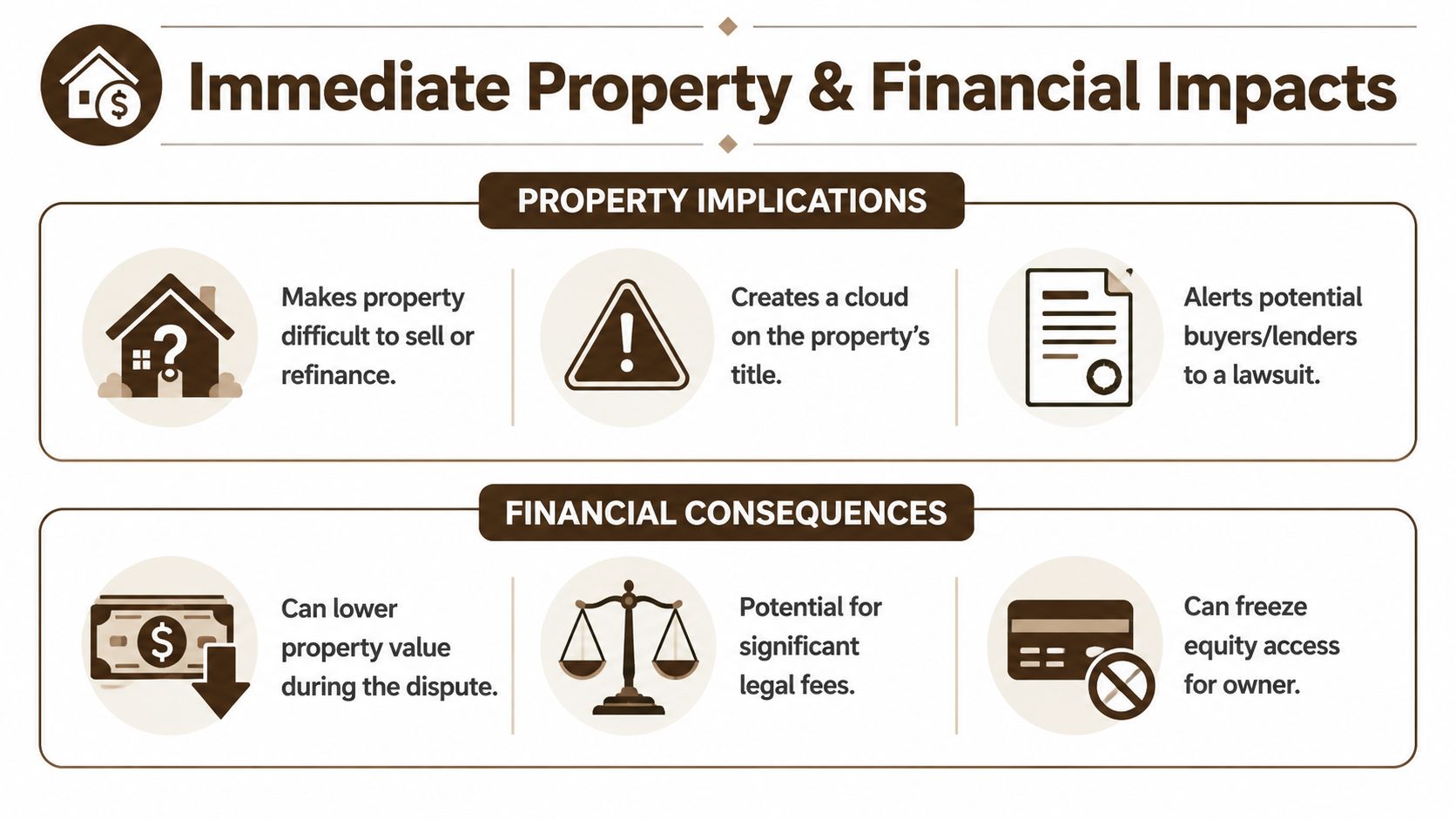
Neutral guidance explains that a recorded lis pendens can operate as a cloud on title, make sale or refinancing difficult, and delay title insurance until it is removed. It can materially freeze marketability even before anyone wins the case, as noted in Jimerson Birr's discussion of lis pendens and title impact.
What usually happens in a pending sale
In a California sale transaction, title and financing drive the timeline. If the title company sees a lis pendens, it may refuse to insure around the dispute. Without title insurance, most conventional buyers won't close. Even a cash buyer often backs away because they don't want to purchase a lawsuit along with the house.
That's why a lis pendens can stall escrow even though the owner still technically holds title. The legal right to sign a deed and the practical ability to close a deal are not the same thing.
What happens with refinancing and equity access
Refinancing usually gets blocked for the same reason. Lenders want predictable collateral. If a lawsuit could change ownership, possession, or another significant property interest, the lender may decide the risk is too high until the case is resolved or the notice is removed.
For families in probate or trust administration, that can create a second problem. They may need to refinance to pay taxes, equalize distributions, or preserve the property, but the lis pendens can cut off that option at the worst time.
The pressure points owners feel first
Owners usually feel the effects in a few specific ways:
- Escrow delay: Buyers and escrow officers stop moving forward until counsel reviews the title issue.
- Loan disruption: Refinance or purchase financing may be suspended.
- Insurance hesitation: Title insurance may be delayed or unavailable while the notice remains of record.
- Negotiation pressure: The other side gains an advantage because time is suddenly working against the owner.
In practical terms, a lis pendens can freeze the property's marketability long before the court decides who's right.
Why fast evaluation matters
Not every lis pendens is valid. But every recorded lis pendens should be treated as urgent. Delay can mean a lost buyer, a failed refinance, a probate administration bottleneck, or a deepening family dispute over who should fix the problem.
If a lis pendens is interfering with your sale, refinance, or estate matter in California, schedule a free consultation to assess your options promptly.
Recording a Lis Pendens in California and Orange County
California doesn't allow a lis pendens just because someone is angry about a deal. The filing has to be tied to a lawsuit that includes a real property claim. If the underlying case doesn't affect title to, or the right to possession of, real property, the notice may be vulnerable.
For owners, it helps to understand the filing path because procedural mistakes can matter. For claimants, it's a reminder that this tool must be used carefully.
The basic California sequence
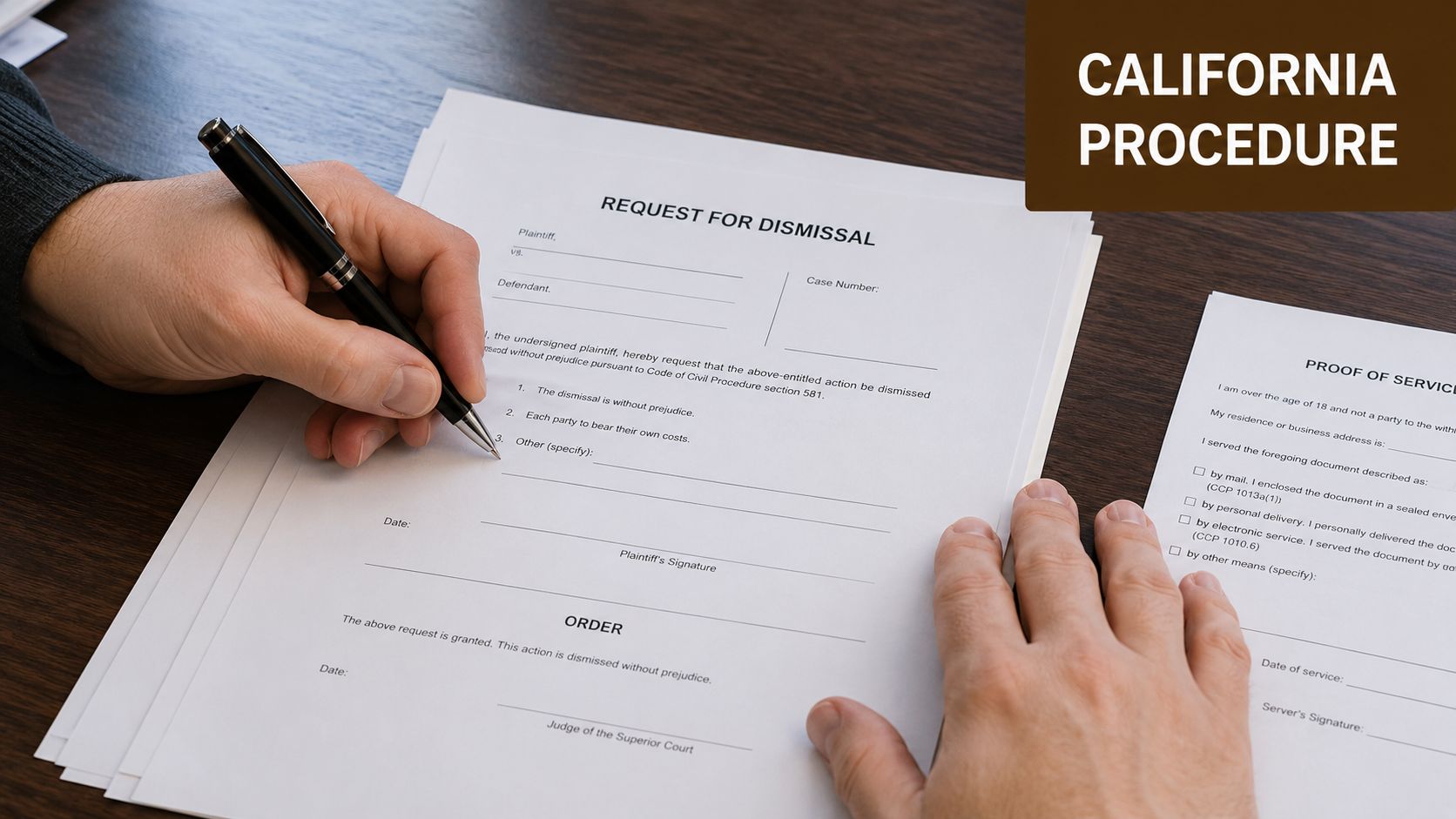
In broad terms, recording a lis pendens in California usually follows this order:
- A lawsuit is filed: The complaint must include a claim affecting real property, not just a request for money.
- The notice is prepared: The document must correctly identify the case and the property.
- Required service is completed: The parties and affected owners must be properly served under California procedure.
- The notice is recorded: It's recorded in the county where the property is located.
If the property is in Orange County, recording takes place through the Orange County Recorder's office because that county maintains the official public land records for property located there. Los Angeles property must be recorded in Los Angeles County, and the same location rule applies statewide.
Where problems often arise
Many disputes over lis pendens focus less on broad legal theory and more on execution. Common issues include a complaint that doesn't adequately support a real property claim, incorrect property identification, or service defects. In California, those details aren't paperwork trivia. They can determine whether the notice stands or falls.
A property owner should ask a lawyer to review both the recorded notice and the underlying complaint together. Looking at only one document can miss the underlying weakness.
A short checklist for owners
- Get the recorded copy: Pull the notice from the county recorder.
- Get the complaint: Read the actual court pleading, not just the notice.
- Check the property description: Recording errors can matter.
- Confirm service: Improper service may create grounds for relief.
Orange County practice point
Orange County real estate disputes often move alongside active escrows, trust administrations, and partition cases. That means timing isn't abstract. The value of a prompt review is often in preserving options before a transaction collapses or family members harden their positions.
If you're dealing with a recorded lis pendens in Orange County or Los Angeles, schedule a free consultation to review whether it was properly recorded and what can be done next.
Common Scenarios Involving a Lis Pendens in California
A lis pendens makes the most sense in cases where the lawsuit is about the property itself. In California practice, several recurring disputes fit that pattern. These are especially common in matters involving inherited homes, co-owned property, and broken real estate deals.
Quiet title and ownership disputes
A quiet title action asks the court to determine who holds valid title. This can happen after an allegedly forged deed, a recording mistake, or a long-running conflict over ownership. In that setting, a lis pendens is logical because the lawsuit directly concerns title.
For example, one sibling may claim a late parent's home was wrongfully transferred before death. If that claim is placed before the court, the filer may record a lis pendens to prevent the property from being sold before ownership is resolved.
Specific performance after a failed sale
California buyers sometimes sue for specific performance when they believe a seller improperly backed out of a signed purchase agreement. The buyer isn't merely asking for money. The buyer is asking the court to require the sale of that specific property.
That's a classic setting for a lis pendens because the claim targets the right to acquire the property itself. If no notice were recorded, the seller could try to transfer the property to someone else while the case is pending.
When the lawsuit seeks the property, not just compensation, a lis pendens is often the tool that keeps the dispute from being overtaken by a later transfer.
Probate and trust disputes over real estate
In probate and trust litigation, real property often becomes the center of family conflict. An heir, beneficiary, or competing fiduciary may claim that a home belongs in the estate, was wrongfully distributed, or is being transferred contrary to the decedent's wishes.
When the court dispute directly affects title or possession, a lis pendens may be used to stop the property from changing hands while the probate-related litigation moves forward. This is one reason inherited property in Orange County can become difficult to sell even when the family thought administration was nearly complete.
Partition between co-owners
Partition actions are another frequent California example. One co-owner wants the property sold or divided, while another refuses to cooperate. Because the lawsuit seeks a court-ordered resolution of ownership rights in the property, a lis pendens may be recorded to put outsiders on notice that the property is already the subject of litigation.
That can be frustrating for one co-owner who hoped to refinance or privately sell, but it also prevents the dispute from being complicated by a transfer during the case.
When Is a Lis Pendens Used in California
| Legal Action | Purpose of the Lis Pendens | Example Scenario |
|---|---|---|
| Quiet title | Warn third parties that ownership is in dispute | An heir alleges a deed was invalid and seeks a court ruling on title |
| Specific performance | Preserve the buyer's claimed right to purchase the property | A seller backs out after signing a purchase agreement |
| Probate or trust property dispute | Prevent transfer while the court decides whether the property belongs in an estate or trust matter | Family members dispute whether a home should be distributed or sold |
| Partition action | Notify the public that co-owners are litigating rights to sale or division | Two siblings inherit a house and disagree on whether to sell it |
If your situation resembles any of these California disputes, schedule a free consultation to determine whether a lis pendens is proper, or how to respond if one has already been recorded.
How to Challenge and Remove a Lis Pendens
For owners, the central question usually isn't academic. It's how to get the notice off the property record. In California, the main procedural tool is a motion to expunge. In plain English, that's a request asking the court to remove the lis pendens because it shouldn't remain recorded.
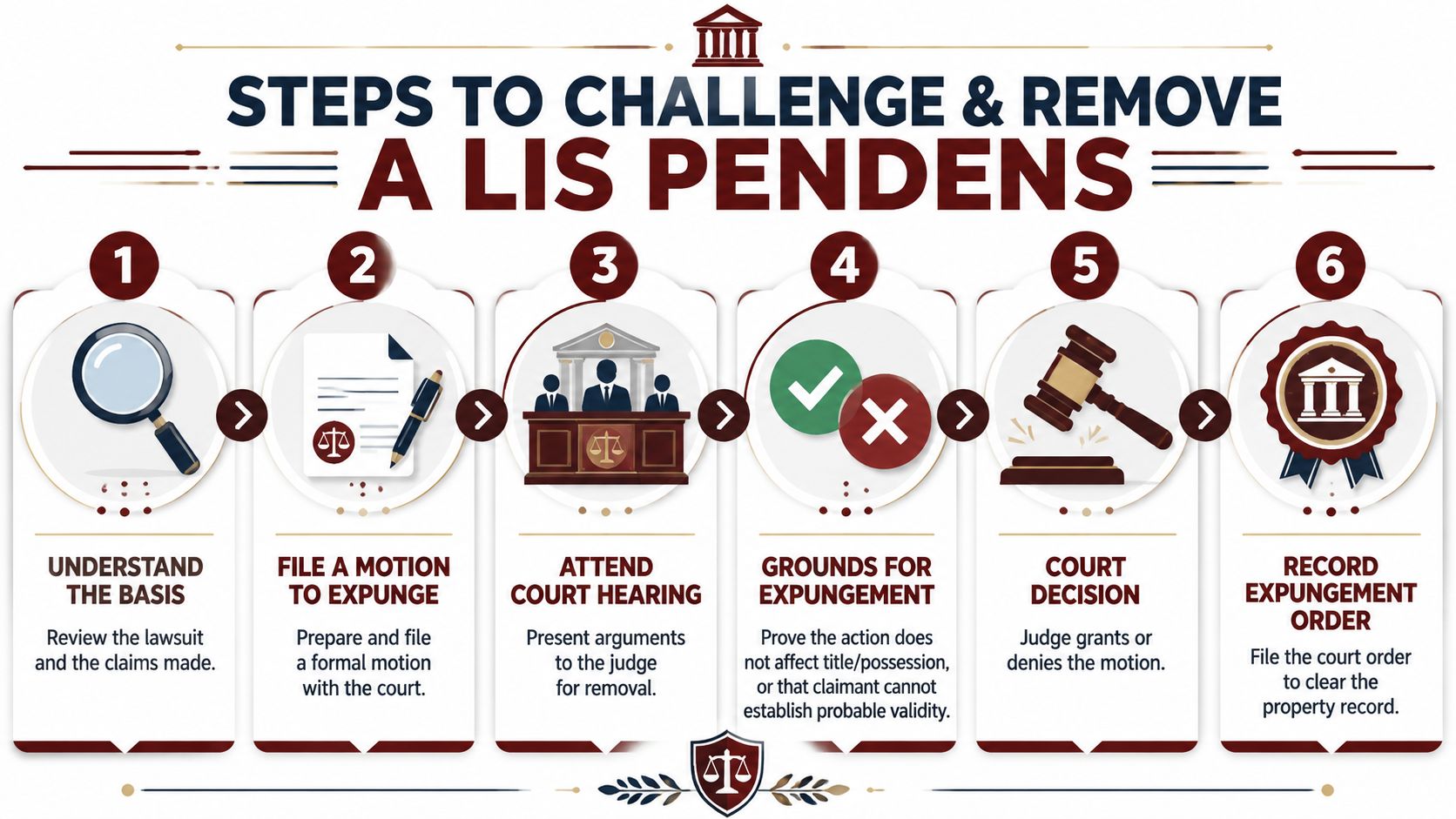
A short overview of the court process can help:
The two main paths to expungement
In California, the challenge usually focuses on one of two arguments.
First, the owner may argue that the lawsuit does not contain a true real property claim. If the case is really about money, business fallout, or some other dispute that doesn't directly affect title or possession, the lis pendens may not belong there.
Second, the owner may attack the claim on the merits by arguing that the claimant cannot show probable validity. That means the filer hasn't shown enough legal substance to justify keeping this cloud on title in place while the case continues.
Procedure matters too
A lis pendens can also be attacked for procedural reasons. Defects in service, recording, or the content of the notice can all become important. California judges often look closely at whether the party using this powerful tool followed the rules.
That's why owners shouldn't look only at the accusation itself. A weak filing may be vulnerable even before the broader lawsuit reaches trial.
One practical approach: review the complaint, the recorded notice, and proof of service as one package. Weakness in any one of those items can shape the expungement strategy.
The role of an undertaking
Sometimes the dispute is real, but the owner still needs a practical path forward. In some situations, the court may consider an undertaking, which is a bond or other security. The idea is to protect the claimant's potential rights while reducing the immediate harm caused by the recorded notice.
That isn't available or wise in every case. But in the right dispute, it can be part of a strategy to restore a transaction or reduce pressure while the litigation proceeds.
Settlement can remove the problem faster
Not every solution comes from a hearing. In many real estate disputes, negotiated resolution is the fastest way to obtain a withdrawal, release, or dismissal that clears the title record. That may involve correcting title, revising a transaction, settling a probate disagreement, or restructuring a co-ownership exit.
Owners should be careful, though. Paying to make a bad lis pendens disappear may solve today's escrow issue while creating tomorrow's legal regret. The smarter approach is to evaluate both bargaining power and legal footing before negotiating.
A practical response plan
- Move quickly: Delay gives the notice more time to disrupt your sale or refinance.
- Analyze the complaint: The underlying claim determines whether the notice belongs.
- Check for defects: Service and recording mistakes can matter.
- Consider settlement strategically: Resolution should fit the merits, not just the pressure.
If you need to challenge and remove a lis pendens in California, schedule a free consultation to evaluate expungement, negotiation, and court options.
Your Next Steps for a Lis Pendens in Orange County
A lis pendens is serious because it hits the part of real estate that owners depend on most: marketable title. In Orange County and Los Angeles, that can derail a sale, stall a refinance, complicate probate administration, or intensify a family property dispute.
If you're the property owner, don't ignore it and don't assume it's untouchable. Get the recorded notice, obtain the filed complaint, preserve any escrow or loan deadlines, and have California counsel evaluate whether the notice is legally supported and whether a motion to expunge makes sense.
If you're the person considering filing one, be careful. In California, a lis pendens is not a general pressure tactic. It should be used only when the lawsuit affects real property rights and the filing requirements have been handled correctly. A careless filing can create its own legal problems.
For many owners, the best next step is simple. Act before the title problem spreads into every other part of the case. Once a buyer walks away or a lender closes the file, the damage is harder to contain.
The right response depends on the actual claim, the court file, and the transaction timeline. That's especially true in local disputes involving inherited property, quiet title claims, partition actions, and broken purchase agreements in Orange County and Los Angeles.
If you're dealing with a notice of lis pendens, Tanner Law can help you assess the claim, protect your property rights, and move toward a practical solution under California law. Schedule a free consultation to discuss your options.