Grant Deed vs Quit Claim: A California Real Estate Guide
You may be dealing with this right now. Your parents want to add an adult child to title on the family home in Orange County. A spouse is coming off title after divorce. A trustee wants to move property as part of an estate plan. Someone says, “Just use a quitclaim. It's simple.”
That advice causes expensive problems in California.
The deed you sign controls far more than the transfer itself. It affects whether the person receiving the property gets legal protection, whether title insurance is workable, whether a future sale gets delayed, and whether a family dispute later turns into probate litigation or a quiet title lawsuit. In my view, most families underestimate this because both documents look deceptively routine on paper.
When clients ask about grant deed vs quit claim, they usually want a simple answer. Here it is. If this is a real sale or any transfer where title certainty matters, a grant deed is usually the right starting point. A quitclaim deed has narrow uses, and using it casually can create a title mess that costs far more to fix than it would have cost to handle correctly at the beginning.
Table of Contents
- Transferring Property in California Is Not a Simple Handshake
- The Protections of a California Grant Deed
- The Risks of a California Quitclaim Deed
- Grant Deed vs Quitclaim Deed A Side-by-Side Comparison
- Common Scenarios When to Use Each Deed
- Major Risks and How to Protect Your Title
- Making the Right Choice for Your California Property
Transferring Property in California Is Not a Simple Handshake
California real estate transfers often start with a family conversation at a kitchen table. “Let's put the kids on title.” “Let's move the house into the trust.” “Let's take my ex-spouse off the deed.” The goal sounds straightforward. The legal effect often isn't.
In Orange County and Los Angeles, the home is often the family's largest asset. That means the wrong deed doesn't just create paperwork problems. It can affect equity, refinancing, future sales, inheritance planning, and who bears the loss if a title defect appears later. A transfer that feels informal can leave a very formal legal scar on the property record.
I've seen families assume all deeds do the same thing. They don't. Under California law, a grant deed and a quitclaim deed serve different purposes and offer very different levels of protection. One gives the recipient meaningful legal assurances. The other gives only whatever interest the signer may have, if any.
Practical rule: If you'd be upset to learn later that title wasn't clean, don't treat the deed choice as a clerical detail.
This issue becomes even more important in probate and estate planning. A deed that was signed years earlier, often with good intentions, can complicate who owns what at death, whether title is marketable, and whether heirs have to clean up old transfer problems before they can sell or distribute property. Families often discover the problem only when money is on the line.
That's why the right question isn't “Which form is faster?” The right question is “Which deed protects the property interest we care about?”
The Protections of a California Grant Deed
A California family buys a home, records the deed, and assumes ownership is settled. Then a title problem surfaces years later, usually during a refinance, sale, divorce, or after a death. At that point, the right deed is no longer a paperwork detail. It determines whether the new owner has built-in legal claims or inherits a mess.
A grant deed is the standard deed in California for a reason. It gives the recipient legal protections that matter when real money is at stake. In a sale, and in many family transfers involving valuable property, that extra protection is usually the safer choice.
Why buyers and families prefer grant deeds
A California grant deed carries two implied covenants. As explained by Underwood Law's discussion of grant deed protections in California, the grantor is promising that the grantor has not already conveyed the same estate to someone else, and that the property is free from encumbrances created by the grantor, unless disclosed. If either promise is false, the grantee may have a claim against the grantor.
Those promises are not technical trivia. They can decide who pays to fix a title problem.
Here is what a grant deed gives the recipient:
- Protection against a prior transfer of the same interest: The signer is stating that the same ownership interest was not already conveyed away.
- Protection against undisclosed grantor-created encumbrances: The signer is stating that liens or other burdens created by that signer are not hiding in the chain of title.
- A legal remedy if those promises are broken: The recipient has more than frustration. The recipient may have a warranty-based claim.
That last point matters most. If title trouble appears after closing, after a parent dies, or after siblings start questioning ownership, legal rights built into the deed can make the difference between a direct claim and an expensive quiet title lawsuit with no clean target.
What those promises mean in real life
Say a parent transfers an Orange County rental property to one child. Years later, the family learns the parent had already signed another document affecting the same interest, or had placed a grantor-created lien on title that was never cleared. A grant deed does not erase the problem. It does give the child a stronger position to pursue the person who made the promises in the deed.
That is a financial protection, not just a legal one. Title defects can delay a sale, derail financing, increase escrow costs, trigger disputes among heirs, and force the family into litigation to clear the record. Once the original signer is gone or insolvent, recovery gets harder and the cost usually lands on the people who thought they already owned the property free and clear.
Grant deeds also work better with the practical realities of California transactions. Title companies, escrow officers, lenders, and future buyers are used to them. The document creates a cleaner record of what was transferred and what the grantor implicitly stood behind. That often matters later, when the property is sold, refinanced, or passed through an estate.
A short video summary may help if you want the concept in plain language before reading further.
A grant deed does not guarantee perfect title. It does put the recipient in a much stronger legal position if a grantor-created problem later surfaces.
My advice is simple. If the property has substantial equity, if the transfer could affect inheritance, or if you want future heirs to avoid cleaning up title in probate, start with a grant deed unless there is a specific reason to do otherwise. It is usually the better document for protecting California family wealth.
The Risks of a California Quitclaim Deed
A quitclaim deed is often described as simple. That's true. It's also why people misuse it.
The easiest way to understand a quitclaim deed is this: the grantor transfers whatever present interest the grantor has at that moment, and gives no warranties about title. If the grantor owns the whole property, that interest passes. If the grantor owns only part of it, only that part passes. If the grantor owns nothing, the grantee gets nothing. The deed still did what it said. It transferred whatever interest existed, if any.

A quitclaim transfers uncertainty
This is why I tell families to think of a quitclaim deed as an as-is transfer of title interest. Not as-is in the home inspection sense. As-is in the ownership sense. The signer makes no promise that title is valid, complete, insurable, or even real.
That matters because the person receiving a quitclaim deed bears the risk of defects. If a hidden title issue later surfaces, the quitclaim grantee generally doesn't have the same warranty-based claim against the grantor that exists with a grant deed. The legal protection just isn't built into the document.
Common problems that can become painful after a quitclaim transfer include:
- Unclear ownership history: A past transfer may not have conveyed what the family assumed it conveyed.
- Unexpected encumbrances: The property may carry issues that make later sale or refinance harder.
- Probate complications: Heirs may inherit not only property, but uncertainty about who owned what.
- Quiet title litigation risk: If the record becomes disputed, a court action may be needed to clean it up.
Why simple family transfers still need caution
Families often use quitclaim deeds because they trust each other. Trust is good. Title review is still necessary.
A divorcing spouse may use a quitclaim deed to relinquish an interest in the family residence. Parents may use one to transfer property to a child. A homeowner may use one to add or remove someone from title. Those are the settings where quitclaims commonly appear. But the family relationship doesn't eliminate preexisting title issues, recording problems, or future disputes among heirs.
The phrase “it's just within the family” has launched a lot of avoidable title disputes.
The primary danger is timing. Problems often stay hidden until years later, when someone dies, the property goes into escrow, or a lender asks questions nobody can answer from the recorded chain alone. At that point, the “simple” deed no longer feels simple.
Grant Deed vs Quitclaim Deed A Side-by-Side Comparison
When clients compare grant deed vs quit claim, they usually want the bottom line fast. Here it is in one table.
Quick comparison table
| Feature | Grant Deed | Quitclaim Deed |
|---|---|---|
| Legal protection for grantee | Higher protection | Low protection |
| Implied warranties | Yes | No |
| What is transferred | The property interest described, with implied covenants | Whatever present interest the grantor has, if any |
| Typical California use | Standard sale transactions | Limited relationship-based transfers |
| Title risk to recipient | Reduced by grantor's implied promises | Largely borne by recipient |
| Legal remedy against grantor for title defects tied to deed warranties | May exist | Generally not available on the same basis |
| Fit for ordinary arms-length sale | Strong fit | Poor fit |
| Title insurance compatibility | Better support | Often more difficult in practice |
The practical difference is legal recourse
The most important distinction isn't academic. It's whether the person receiving the property has any built-in protection if title turns out to be defective because of the grantor's actions.
California practice materials emphasize that these deed types are not interchangeable in legal effect. A grant deed carries implied promises that the grantor has not already transferred the property and that it is free of encumbrances created by the grantor, while a quitclaim deed transfers only whatever interest the grantor has at that moment and includes no warranties. That difference matters because a grantee under a quitclaim deed cannot sue the grantor for title defects the way a grantee may under a breached grant-deed warranty, as described in this California-focused explanation of grant deeds and quitclaim deeds.
That's the point families need to remember. A quitclaim deed isn't just “another way” to transfer property. It shifts risk onto the person receiving title.
Here's the practical takeaway in everyday terms:
- If you're buying property, a quitclaim deed is usually the wrong document.
- If you're selling property, offering only a quitclaim deed should raise questions.
- If you're transferring within a family, a quitclaim may be acceptable in the right setting, but only if you understand you are not getting title promises.
- If future probate, trust administration, or a later sale is likely, the record you create today matters more than the convenience you get today.
Bottom line: The grant deed protects the transfer. The quitclaim deed mainly records surrender of whatever interest the signer may have.
That is why California buyers, lenders, and title professionals generally prefer grant deeds in conventional transactions. The legal structure matches the financial reality. Real estate isn't casual. The deed shouldn't be either.
Common Scenarios When to Use Each Deed
A husband signs a quitclaim deed to “keep things simple” after a refinance. Ten years later, the family tries to sell the house in Orange County after a death in the family, and escrow finds a title problem nobody understood when that paper was signed. That is how deed mistakes become expensive. The right deed depends on the transaction, the relationship between the parties, and whether your family can afford future title litigation.
When a grant deed fits
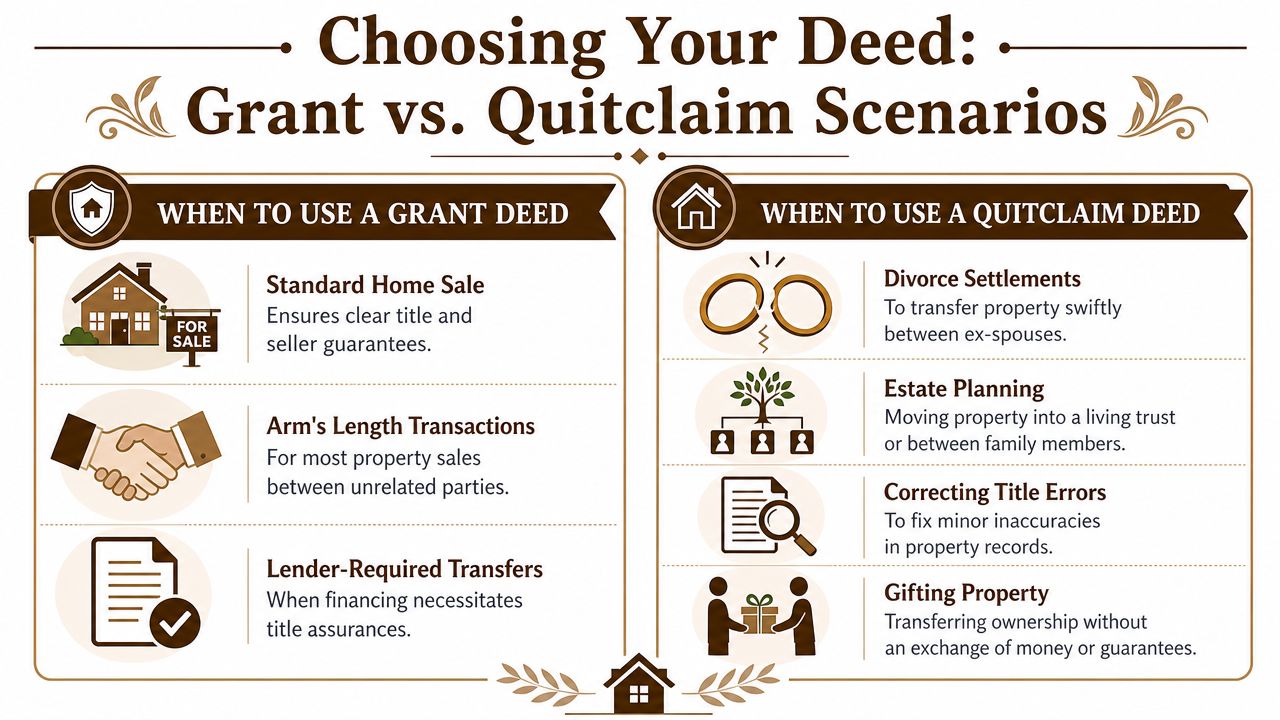
Use a grant deed in any transfer where money, financing, estate planning consequences, or future resale value are on the line. This includes the standard California home sale, but it also covers many family transactions where the parties are treating the property as a real asset, not an informal favor.
A grant deed is usually the right choice in situations like these:
- Standard home sale: The buyer is paying real money and should receive a deed that carries legal assurances.
- Transfer involving a lender or title company: Third parties want a clean record and a deed form that fits ordinary underwriting expectations.
- Buyout between co-owners: If one owner is paying the other for their share, document the transfer with the stronger deed.
- Family transfer that may affect inheritance later: If children, stepchildren, or a later probate proceeding may examine the chain of title, create a record that makes sense on its face.
- Any transfer where resale is likely: Today's shortcut can become tomorrow's escrow delay.
My view is simple. If the person receiving title would be angry to learn later that the signer made no title promises at all, use a grant deed.
When a quitclaim deed may fit
A quitclaim deed has a narrower job. It works best when the goal is to release a possible interest, not to reassure the recipient about the quality of title.
That can make sense in a few California situations:
- Divorce or separation: One spouse signs off any claim to the property as part of a broader settlement.
- Clearing up an old claim: A former partner, heir, or family member gives up any possible interest showing in the record.
- Adding or removing a spouse from title in a low-risk setting: This can work, but only after confirming what interest is being transferred and whether lender consent is needed.
- Correcting a title issue within a family: Sometimes the deed is being used to clean up the record, not to make warranties.
Even in these settings, families make a costly mistake when they treat a quitclaim deed as harmless. It can solve a narrow ownership problem, but it can also create a bigger one if nobody checks liens, vesting, prior deeds, tax consequences, and trust or probate implications first.
A quitclaim deed is not the bargain option. It is the higher-risk option.
The signing and recording rules families forget
The paperwork has to be done correctly or the deed can fail at the recorder's office or create confusion later. In California, deeds are generally expected to be signed, notarized, and recorded in the county where the property sits. Families also often need a preliminary change of ownership report with the recording package.
These details sound administrative. They are financial.
A rejected or badly prepared deed can delay a refinance, complicate a sale, or leave heirs fighting over whether ownership changed. In the worst cases, the family spends far more fixing the record than it would have cost to prepare the transfer properly at the start.
If you are choosing between these deeds because quitclaim feels faster, stop there. Speed is a poor reason to accept title risk. For California families, especially those thinking about probate avoidance, intergenerational transfers, or a future sale, the better question is whether the deed will still make sense years from now when a buyer, lender, title officer, or probate judge reads it.
Major Risks and How to Protect Your Title
The biggest deed mistakes don't explode on the day of signing. They surface later, when someone tries to sell, refinance, borrow against the property, settle an estate, or explain title to heirs who weren't around when the transfer happened.
What a clouded title looks like in practice
A clouded title means something in the record creates doubt about ownership or the condition of title. It may be an inconsistent deed history, a transfer that conveyed less than the family assumed, an unresolved claim by another person, or a recorded document that doesn't match the actual ownership story.
When that happens, practical consequences follow fast:
- Sales get delayed: Buyers don't want uncertainty.
- Refinancing gets harder: Lenders want clarity before they lend.
- Estate administration becomes more difficult: Heirs may spend months sorting out what should have been handled years earlier.
- Litigation becomes possible: A quiet title action may be required to ask a court to determine ownership.
Quiet title litigation is exactly the kind of problem families should work to avoid. It consumes time, legal fees, and advantage. It also creates emotional strain when the dispute is among relatives.
Protection steps worth taking before you sign
The best protection is boring. That's good. Real estate problems are usually prevented by careful front-end work.
Consider these habits essential:
- Review the chain of title: Don't assume the current owner's understanding matches the recorded history.
- Match the deed to the transaction: Sales usually call for a grant deed. Limited family or divorce transfers may call for a quitclaim, but only with eyes open.
- Use proper execution and recording: An unrecorded or improperly handled deed can create future confusion.
- Think ahead to probate and resale: Ask how this transfer will look to heirs, title officers, and buyers years from now.
- Don't confuse convenience with safety: The shortest form is not always the safest form.
The cost of prevention is usually modest. The cost of fixing title after a dispute starts is not.
Title insurance also matters in many transactions because it serves as a backstop against certain title defects. In ordinary sales, the use of a grant deed fits that framework much better than a quitclaim deed. If a transfer is being done outside the normal sale process, families should understand what protection they are and are not getting.
If the transfer involves probate planning, blended families, inherited property, or any uncertainty about prior ownership, attorney review is not a luxury. It's part of protecting the asset.
Making the Right Choice for Your California Property
For most California families, the rule is straightforward. If the property transfer is a sale, or if real money and serious reliance are involved, use a grant deed unless a lawyer gives you a very specific reason to do otherwise.
A quitclaim deed has a place, but it's a narrow one. It can make sense in a divorce-related transfer, a family adjustment to title, or another limited non-sale setting where everyone understands that no title warranties are being given. Even then, the family should look carefully at the title history before signing anything.
That's the core of the grant deed vs quit claim decision. The central concern isn't which form is shorter. The key aspect is who bears the risk if title turns out to be flawed. In California, that choice can shape later probate issues, trust administration, refinancing options, and whether a future sale moves smoothly or collapses into a dispute.
Orange County and Los Angeles real estate is too valuable to transfer casually. A deed is not just a form. It's a risk allocation document with long-term consequences for your family and your property rights.
If you're considering a transfer, slow down long enough to choose the deed that matches the transaction. A few careful decisions now can prevent years of avoidable legal trouble later.
If you need guidance on a California property transfer, probate-related title issue, or a potential quiet title problem, schedule a free consultation with Tanner Law. You'll get direct, practical advice focused on protecting your ownership rights before a simple deed choice turns into an expensive dispute.