What Is a Contingent Beneficiary? a California Guide
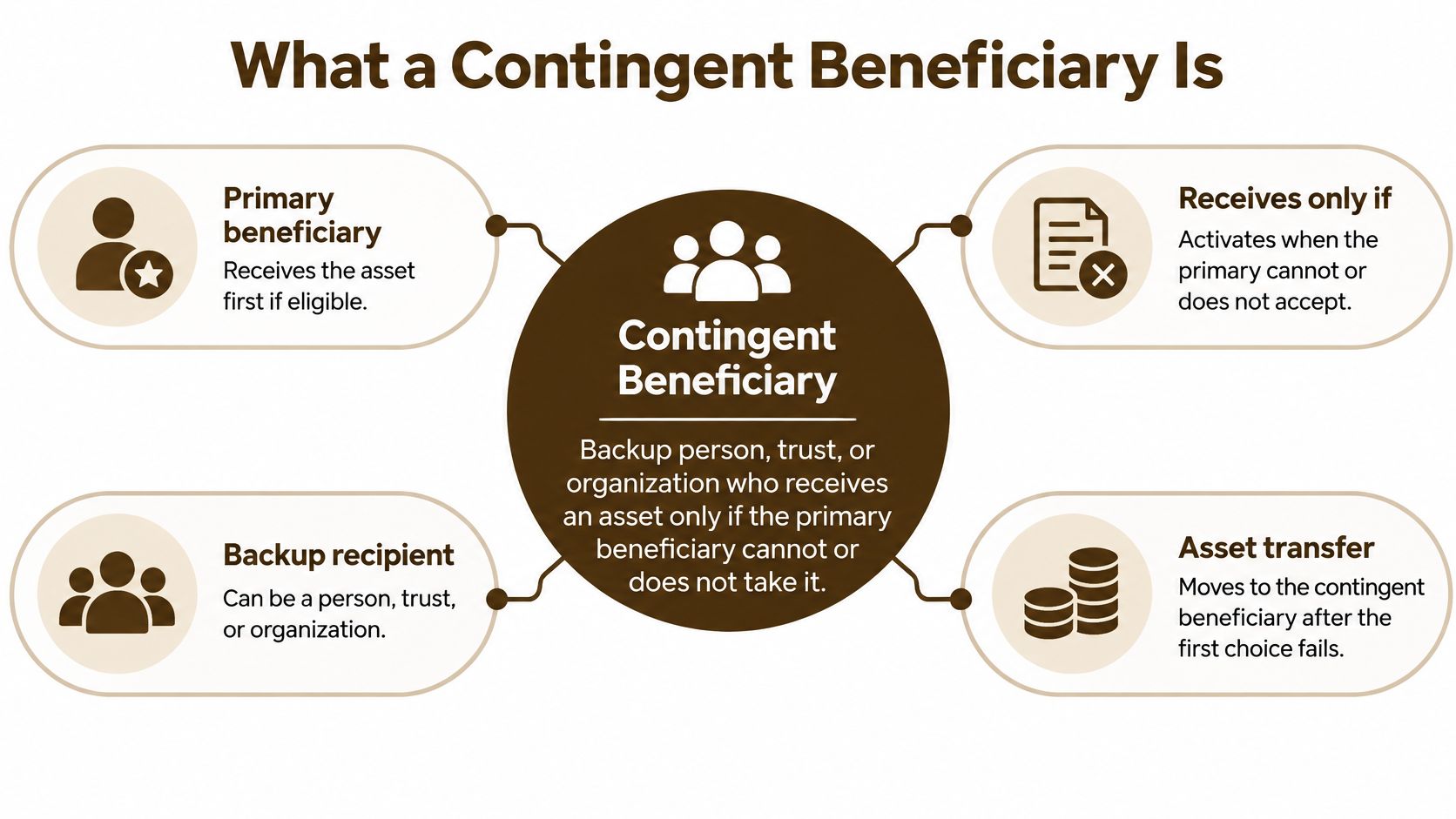
A contingent beneficiary is the backup person, trust, or organization who receives an asset only if the primary beneficiary cannot or does not take it. That backup waits in line. The first choice still takes the asset if that person is alive, eligible, and willing.
If your will already names your child, why would the bank still pay your estate? Many families in Orange County and Los Angeles treat the will as the only instruction that matters. For life insurance, retirement accounts, and many brokerage or bank accounts, the contract on file with the company moves the asset. A will that names the same person does not replace that form. A properly completed form can control the transfer even when the will says something different. The backup works only when the form is written the way the institution requires and is accepted on its records.
California does not use one statewide beneficiary form. The push toward clearer rules for succession and survival is visible in the original Uniform Probate Code, whose final version was promulgated in 1969 as a joint project described in the Uniform Probate Code history. Probate law remains state-specific. Your policy, account agreement, and California statutes still have to be read together.
Table of Contents
- What a Contingent Beneficiary Is
- Primary and Contingent Beneficiaries Side by Side
- How Payouts Move Down the Beneficiary Line
- Probate and Survivorship Risks Without a Backup
- California Rules for Transfer-on-Death Deeds and Accounts
- How to Name, Update and Revoke a Contingent Beneficiary
- Common Mistakes That Defeat a Backup Designation
- Schedule a Free Consultation to Review Your Designations
What a Contingent Beneficiary Is
Picture the line of succession for a presidency. The vice president does not share the office while the president is serving. The vice president steps in only when the president cannot serve. A contingent beneficiary works the same way on an account, a policy, or a plan. The primary beneficiary is first. The backup is second.
Under IRS retirement beneficiary guidance, a contingent beneficiary is a person, trust, or organization designated to receive an asset only if the primary beneficiary cannot or does not receive it. The usual reasons are that the primary beneficiary dies first, disclaims the inheritance (a formal refusal, not a casual decision to ignore the check), or is otherwise disqualified under the governing instrument. The designation operates through the account or plan's own procedures. A will that names the same person does not, by itself, make that person a designated beneficiary for federal retirement-distribution purposes.
The backup is second in line and waits for a condition. Until that condition is met, the backup holds a potential interest, not a present right to the money.
Say you name your spouse as primary and an adult child as contingent. The child generally becomes entitled under the plan's terms only when the spouse's primary entitlement fails. If you leave the backup line blank, the account may be payable to your estate or under the plan's default order. That path can mean probate (a court process), creditor claims, delay, and a less favorable payout schedule.
What you can check today
Pull the beneficiary form on file with your bank, insurer, brokerage, or retirement plan administrator. Confirm three things.
- Names and tiers: Primary and contingent recipients are identified, not described as "my heirs" or "as stated in my will."
- Shares: Each tier states percentage shares.
- Freshness: You have reviewed the form after marriage, divorce, a birth, a death, or a major change to a trust or estate plan.
Primary and Contingent Beneficiaries Side by Side
Use this comparison when you read the form in front of you.
| Feature | Primary beneficiary | Contingent beneficiary |
|---|---|---|
| Position on the form | Named first | Named second, after the primary tier |
| When the asset is paid | At the account owner's death | Only when no eligible primary beneficiary can or will take |
| Typical trigger | Alive and eligible at the owner's death | Primary predeceased, disclaimed, or is legally disqualified |
| Who can be named | Person, trust, or charity | Person, trust, or charity |
| Share setting | Percentages in the primary tier should total 100 percent | Percentages in the contingent tier should total 100 percent |
| Result if form is silent | Asset may pass to the estate or under the plan's default rules | Asset may pass to the estate or under the plan's default rules |
| Effect on a surviving primary | Receives the asset and blocks the backup | Receives nothing while a primary remains eligible |
A backup generally receives nothing while any eligible primary beneficiary remains alive and willing to take. One surviving primary is enough to keep the second tier off the check.
A simple two-tier example
Name your spouse as the only primary beneficiary and your adult child as the contingent beneficiary. The child is paid only if the spouse dies first, disclaims, or is legally disqualified. If your spouse survives you and accepts the asset, the child takes nothing from that account.
Percentages should add up to 100 percent within each tier. Two contingent children at 50 percent each is clear. Two children at 50 percent and 40 percent is not, because 10 percent has no owner. A missing backup can send the asset to the estate, which can trigger probate in California. That chain is the risk families underestimate.
How Payouts Move Down the Beneficiary Line

Say a California homeowner holds a $400,000 brokerage account. The form names the spouse as the only primary beneficiary. It names two adult children as contingent beneficiaries at 50 percent each. The label "contingent" is not what decides the result. The exact designation wording does.
Walk the same account through three outcomes.
- The spouse survives and accepts. The spouse receives the full $400,000. Both children receive nothing from this account, even though they are named.
- The spouse dies first. No eligible primary remains. The children split the account equally, $200,000 each, if both survive and the form gives them equal contingent shares.
- The spouse survives but signs a valid disclaimer. The spouse's refusal is formal, so the children take as contingent beneficiaries. An informal decision not to deposit the check is not the same thing.
Fidelity's explanation of contingent beneficiaries makes the point families miss. A contingent beneficiary is not automatically entitled merely because one primary beneficiary dies. The usual trigger is that all primary beneficiaries are unavailable, have predeceased the owner, or validly disclaim. If one primary beneficiary remains eligible, the contingent beneficiary generally receives nothing.
Co-primary is a different design
Naming the spouse and both children as co-primary beneficiaries can produce a different result from naming the spouse first and the children as backups. If one co-primary child dies, that share may pass to the surviving primary beneficiaries or to that child's descendants. The form and the governing document choose which path applies. A valid disclaimer can also change who receives the asset and whether tax or probate consequences follow. That distinction matters in blended households, with estranged relatives, and when a charity is on the form. A small wording choice can redirect a large retirement or insurance benefit.
Ask the plan administrator these questions, and write down the answers next to the form.
- Death of a primary: Who takes if one primary dies and another primary is still alive?
- Descendants: Do a deceased beneficiary's children substitute, or does the share stay with the surviving named people?
- Per stirpes: Does the form allow a per stirpes or similar descendants option, and is that box checked?
Probate and Survivorship Risks Without a Backup
A common assumption is that the will always controls. For many financial contracts, it does not.
Probate is the court-supervised process for paying debts and distributing property that is still in the deceased person's name. It is not a tax. It is a court file. When no valid backup exists and the primary beneficiary cannot take, the account may default to the estate or to the plan's own hierarchy. From there the chain is predictable. The asset may need probate administration. Creditors may have a clearer path to it. Payment waits on court steps. Distribution treatment can be less favorable than a direct payment to a named person.
A California statute that surprises will-drafters
California Probate Code section 6321 lets an insurance policy, annuity, endowment contract, or other plan designate a trustee named in the policyholder's will, or later named by that will, as a primary or contingent beneficiary, payee, or owner. The designation must follow the contract or plan's procedures. If the contract does not specify a procedure, the insurer, trustee, custodian, or plan administrator must approve the method. The designation may be made before or after the will is signed, and it does not have to satisfy the formal signing requirements for a will.
That is why a completed beneficiary form can control the asset even when the will contains different instructions. California residents have to coordinate the form with the estate plan. Updating only the will leaves the old form in charge.
Survivorship in plain words
A beneficiary generally must outlive the owner to take. If the named person dies first, that person's interest fails. A backup covers that gap, but only if the form names the backup and the institution has accepted it. For families in Orange County and Los Angeles, an outdated form that still names a former spouse or a relative who has died can send money to the wrong person or into the estate. Check the form after marriage, divorce, a birth, an adoption, or a death.
A finished will and an old beneficiary form are not one plan. They are two instructions, and the form often wins for that asset.
California Rules for Transfer-on-Death Deeds and Accounts
Which California rule applies depends on the asset and the document that names its recipient. A transfer-on-death deed, a brokerage registration, a trust, and a retirement plan do not all handle backup beneficiaries the same way. Use this table to identify the governing rule, then check the document or institution's requirements.
| Instrument | Contingent beneficiary rule | California code |
|---|---|---|
| Revocable transfer-on-death deed | Beneficiary must survive the owner. A failed share generally passes to the remaining beneficiaries in equal shares, subject to the statute's stated exceptions. | Probate Code 5652 |
| Transfer-on-death securities | Registration terms may name primary and contingent beneficiaries; LDPS may substitute a deceased beneficiary's descendants. | Probate Code 5510 |
| Insurance, annuity, or plan | Designation must follow the contract or plan procedure; a trustee may be named as primary or contingent. | Probate Code 6321 |
| Trust interest | A future interest may depend on a specified condition, such as surviving the owner. | Probate Code 24 |
| Retirement account | The plan's own designation method controls who is named as a backup; a will alone may not control. | Plan terms and federal IRS rules |
A house and a brokerage account
A revocable transfer-on-death deed lets a California homeowner name who receives the property at death without a probate transfer of that parcel, provided the deed is valid. Under Probate Code section 5652, a beneficiary's interest depends on surviving the transferor. If the beneficiary dies first, that interest lapses. When several beneficiaries are named, they generally take as tenants in common, meaning each owns a separate share rather than having a joint right of survivorship. A share that lapses or fails generally passes to the remaining beneficiaries in equal shares, subject to the statute's stated exceptions. As a result, surviving beneficiaries may receive more than the will would have directed.
A brokerage account follows a different set of instructions. Under Probate Code section 5510, the registration terms may address primary and contingent beneficiaries, proof of death, fractional shares, and substitution of a deceased beneficiary's descendants. The statute recognizes LDPS, short for “lineal descendants per stirpes.” Under that arrangement, descendants who survive the owner may take the place of a beneficiary who did not survive. They share according to the inheritance law governing descendants of a person who dies intestate, meaning without a will, at the owner's death. This differs from dividing the failed share only among the surviving named beneficiaries. Check whether the brokerage or bank accepts LDPS before relying on it.
Trust interests and retirement accounts
A trust can give someone a present or future interest, and that interest may be vested or contingent. California Probate Code section 24 recognizes these types of interests. If a future interest depends on surviving the owner, it remains contingent until that condition is met. Read the trust's terms to determine who receives the property and when. A backup designation on another asset does not automatically change the trust's instructions.
Retirement accounts follow plan terms and federal rules rather than California's transfer-on-death statutes. The IRS regulations on designated beneficiaries define a designated beneficiary as an individual entitled to benefits after the participant's death or another specified event. The plan's designation method determines who qualifies, and it may identify a class, such as the participant's children, if the class can be objectively determined. Someone who inherits under a will does not automatically become a designated beneficiary.
If the sole listed beneficiary dies first and no designated beneficiary remains, the account can pass to the estate. Distributions may then follow a shorter framework, with tax payable by recipients. Ask the plan administrator to confirm the backup designation and each named person's payout options. Naming a trust requires careful drafting so that the trust meets the retirement-account rules. A correctly completed designation filed through the plan's process can control the account even when a will says something different.
How to Name, Update and Revoke a Contingent Beneficiary
Work from the institution's form, not from memory of what the will says.
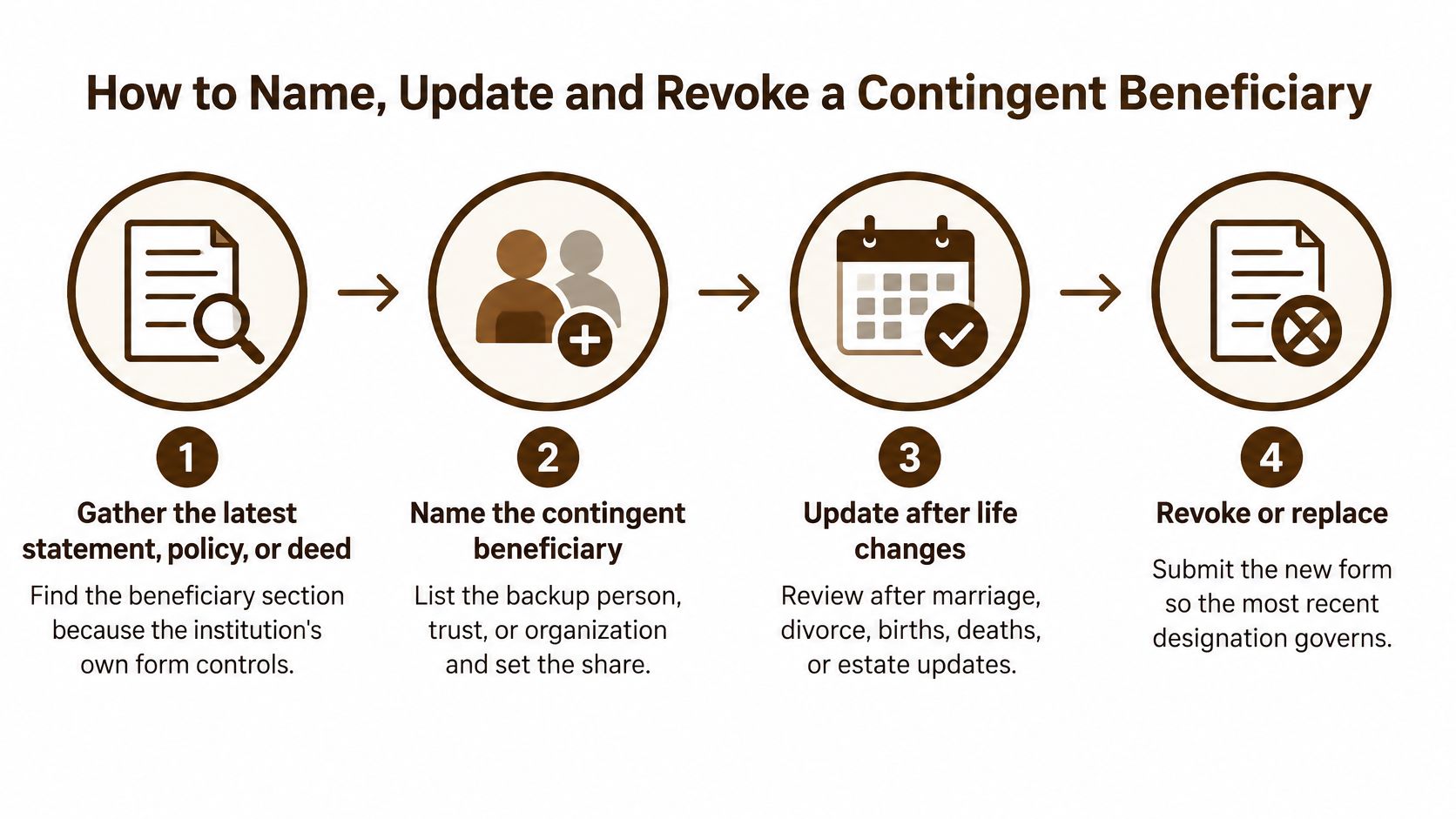
- Gather the latest statement, policy, or deed and find the beneficiary section. The institution's own form controls that asset. A letter to your lawyer does not update the insurer's records.
- Name primary and contingent beneficiaries with full legal names, relationship, and date of birth. Matching names reduce payout delays when a claims examiner has to tell two people with similar names apart.
- Set percentages within each tier that total 100 percent. An unambiguous split keeps the custodian from guessing, and from freezing the account while relatives argue.
- Decide whether descendants should substitute, and use the institution's per stirpes or LDPS option. Vague phrases do not create that substitution. The box or code on the form does.
- Skip "as stated in my will," and submit the form to the custodian. The plan has to be able to identify the recipient from its own procedures.
- Request written confirmation that the form is on file. A form that was mailed but never accepted may not take effect. Keep the confirmation with your estate papers.
- Revoke or replace by submitting a new form. The most recent valid form generally controls. Crossing out a name on an old copy in your desk drawer does not.
- Review after marriage, divorce, births, deaths, or a trust change. Life events make a correct form wrong without anyone at the bank noticing.
A transfer-on-death deed has one extra step. It must be recorded with the county recorder before the owner dies or it will not do its job. Recording after death is too late.
Practical rule: If you cannot get a current beneficiary printout from the institution, treat the designation as unfinished.
Common Mistakes That Defeat a Backup Designation
These errors sit outside the filing steps, and each one can undo a careful estate plan.
- Naming a minor directly: The institution may be unable to pay a child outright, so a court-supervised guardianship or a custodian under California's transfer-to-minors arrangement may be required unless a trust is already in place.
- Naming no backup at all: The primary beneficiary's death can send the asset through probate instead of to the person you would have chosen.
- Leaving a former spouse on the form after divorce: California rules that cut off some transfers to a former spouse do not reliably reach retirement plans governed by federal law, and insurers follow their own forms, so you have to change the form itself.
- Naming a trust that the retirement plan will not treat as you expect: The account can be paid on a timetable you did not want, or to the estate, if the trust fails the plan's rules.
- Assuming a workplace plan matches your personal IRA or brokerage form: Each institution keeps its own records, and a change at one does not update the others.
Request a current copy from each institution and compare it with the estate plan. The mismatch is usually on the form, not in the will.
Schedule a Free Consultation to Review Your Designations
List every account, policy, deed, and retirement plan that names beneficiaries, then set each form next to the will and any trust. A short review can catch a missing backup, a name that is stale after a divorce or a death, and a conflict between the will and the form. That conflict matters because a properly completed form can control the asset even when the will says something different.
Tanner Law serves families in Orange County and Los Angeles on probate, estate planning, and real estate matters, and initial consultations are free. Bring your current beneficiary forms, any deed, and your will. You can reach the firm through tannerlaw.org and schedule a free consultation today.
Tanner Law helps California families align wills, trusts, deeds, and beneficiary forms so a backup designation works when it is needed. If you are sorting out probate, estate planning, or real estate questions in Orange County or Los Angeles, bring your current forms to a free consultation. Visit Tanner Law to schedule that conversation.