Property Line Dispute Attorney: Costs and When to Hire
Your neighbor's new fence sits four feet inside the line you've mowed for nineteen years, and his contractor swears the stakes were exactly where they should be. Or your mother's house in Santa Ana is in escrow, the buyer's title company has flagged a strip of side yard, the closing date is three weeks out, and two beneficiaries want the file closed.
Both are boundary problems. Only one of them needs a property line dispute attorney this month.
What separates the two isn't how angry anyone is. It's whether a deadline, a transaction or a claim of ownership has entered the picture, because those three things turn an argument into a case with dates attached. What follows is the sequence of steps in a California boundary matter, what each one costs, and the statutes that decide who wins when the talking stops.
Table of Contents
- Signs a Property Line Dispute Needs an Attorney
- What an Attorney Does at Each Stage, With Typical Costs
- How an Attorney Investigates the Boundary Step by Step
- California Time Limits and Adverse Possession Rules
- Remedies Compared From Negotiation to Quiet Title
- Questions to Ask and Your Next Steps
Signs a Property Line Dispute Needs an Attorney
A disagreement over a hedge is a conversation. A boundary dispute has a record, a deadline or a claim of ownership attached, and that's the point where waiting starts to cost real money. Sort your situation into one bucket or the other before you spend anything.
Here's how the situations that reach Orange County and Los Angeles County courts most often break down.
| Situation | Attorney needed now? | Why it matters |
|---|---|---|
| Fence moved a few feet with no written record | Not yet; survey and a calm letter come first | Many cases settle early |
| Survey shows a structure or fence on your land | Yes, soon | Evidence and time limits start to matter |
| Neighbor claims your land through long use | Yes | Adverse possession has strict California rules |
| Boundary blocks a sale, refinance or trust transfer | Yes | A clouded title often needs a court judgment |
| Co-owners cannot agree on use or division | Yes | Partition is a court process |
| Property is part of an estate or trust | Yes, with estate counsel | Beneficiaries and deadlines are involved |
| Line is unclear on a county map only | No; get a licensed survey first | Assessor and GIS maps are not boundary surveys |
Two rows deserve more than a table line.
A survey showing a structure on your land is urgent, not because the law is complicated but because evidence decays. Posts rot, gravel gets repaved, and the neighbor who ran an irrigation line three summers ago may not remember the route. Photographs taken now, with a tape measure in frame and a date stamp, will outperform anybody's recollection in two years.
A county assessor map or the GIS layer on your phone is not a boundary survey. Those maps exist to locate property for tax assessment, and their lines can sit several feet from the ground truth (McKissock's guide to metes and bounds mistakes). Legal boundary records live with the county recorder, and a licensed surveyor is the professional who reconciles deeds and monuments with what was built. A fence is evidence of where somebody believed the line was. It is not proof of where the line legally sits.
Rule of thumb: call counsel once a claim, a deadline or a transaction is in play. Until then, keep records and stay civil.
That record-keeping instruction isn't busywork. When a file does go to litigation, the lawyer may work through historic deeds, tax records, surveys, fence placement, maintenance practices, old communications between neighbors, and whether prior owners recognized a particular line (Center for Rural Affairs analysis of adverse possession). Every one of those items is easier to assemble while it's still in a shoebox than after a deposition notice arrives.
What an Attorney Does at Each Stage, With Typical Costs
Boundary work runs up a ladder, and you should know which rung you are on before you climb. A competent property line dispute attorney prices the next step rather than the whole war, because in many files the later steps never happen. A common sequence moves from cheap certainty to expensive certainty: records first, then a survey, then a letter, then settlement tools, and only then a courtroom.
One firm mentioned in this article, Tanner Law, offers a free initial consultation. Treat that as that firm's policy rather than the market rate for every first meeting.
| Stage | What the attorney does | Typical cost | Typical timeline |
|---|---|---|---|
| Consultation and records review | Reviews deed, prior surveys, photos and tax records | Tanner Law offers a free initial consultation | 1-2 weeks |
| Boundary survey by licensed surveyor | Locates the line and flags discrepancies | Often $1,500 to $5,000 for a typical residential lot | 2-6 weeks |
| Demand letter and negotiation | States your position and proposes a line or fix | Often a few hours of attorney time, typically low thousands | 2-8 weeks |
| Mediation | Neutral helps reach a written settlement | Typically a few thousand dollars, often split between the parties | 1-3 months |
| Boundary or lot-line agreement | Records the agreed line or easement | Low to mid thousands, including recording | 1-2 months |
| Quiet title or partition lawsuit | Court decides ownership or divides the property | Often $25,000 to $75,000 or more through trial | 12-24 months or longer |
Use those figures as planning ranges for an ordinary residential parcel, not as quotes. A five-acre lot with two easements and a barn costs more to survey than a 6,000 square foot tract lot. A file that closes in six weeks also spends less attorney time than one that reaches a case management conference.
How the fees actually work
Most of this work bills hourly against a retainer, with the rate and scope written into the engagement letter. Hourly is the default because the workload depends on the neighbor and on how quickly county records come back, neither of which you control. Contingency arrangements do exist in real property litigation. If one is offered, insist on a written agreement stating the percentage, who advances costs, and what happens on an early settlement. Read that document before you sign it.
One narrow place where boundary costs get shared is a partition case. California allows reasonable expenses, including attorney's fees necessarily incurred to prosecute or defend proceedings to protect, confirm or perfect title, set boundaries or make a survey, to be treated as costs incurred for the common benefit, with interest at the legal rate from the time of the expenditure (California Code of Civil Procedure section 874.020). When a survey benefits every co-owner, part of that invoice follows the property rather than landing on one owner alone.
What pushes the number up
- Parcel size and survey difficulty. Acreage, brush, terrain and missing monuments all add field hours, and field hours bill by the hour.
- The number of parties. One neighbor is negotiable. Three neighbors, a deceased owner's heirs and an unrecorded lease create a different budget entirely.
- Whether the neighbor engages. A reply in two weeks opens a settlement window. Silence usually means service of process, which resets the meter.
- Court scheduling. Orange County and Los Angeles County Superior Courts both carry crowded civil calendars, and a continuance you did not request can cost months.
The economics argue for front-loading proof. A survey and a well-drafted letter cost a fraction of a quiet title trial and can produce the same practical result: a line both households can live with, written down and recorded. I recommend paying for litigation when title itself is contested, a limitation period is running, or a lender or buyer's title insurer will not move without a judgment in hand.
How an Attorney Investigates the Boundary Step by Step
A boundary investigation is a sequence, not a single act, and the order matters because each step tells you whether the next one is worth paying for. Skip to the survey before anyone has read the deeds and you'll pay a surveyor to answer the wrong question.
The routine below runs from paper to ground and back to paper.

- Assemble the paper. The vesting deed, the title report and every recorded map for both parcels. Deeds describe and maps locate. When they disagree, you want to know that before you talk to the neighbor, not after.
- Pull the history. Prior surveys, subdivision maps and any record of survey on file with the county surveyor. Earlier surveys show what previous owners believed, and a court will weigh that belief.
- Freeze the scene. Dated photographs, fence permits, contractor invoices, old aerial images, texts and emails. Once a fence comes out or a pad gets repoured, the physical evidence is gone and the case becomes a memory contest.
- Commission the comparison. A licensed surveyor retraces the record boundary and compares it with the line on the ground, flagging monuments, deed calls, adjoining descriptions, and the size and location of each discrepancy. That deliverable is what the rest of the case rests on.
- Verify the license and the filing. California treats locating, reestablishing and retracing a property line as regulated land surveying, and where a field survey reveals material physical evidence or a material discrepancy from a recorded map, the surveyor or civil engineer generally must file a record of survey with the county surveyor within 90 days of setting monuments or completing the fieldwork, whichever comes first (California Business and Professions Code surveying provisions). Confirm the license and the filing before relying on that line in a settlement, a partition or a deed correction.
- Name the theory. Senior rights, adverse possession, boundary by acquiescence (where both owners treated a line as the boundary for years), or an agreed boundary. The same fence can support more than one theory, and the theory decides which evidence you need.
- Choose the remedy the evidence supports. Negotiation, a recorded lot-line agreement, quiet title, or partition. Picking a remedy before the evidence is in is how owners end up paying twice for the same strip of dirt.
A survey is an expert opinion, not a ruling, and the American Bar Association's chapter on boundary evidence treats fences, walls and landscaping as evidence that may reveal a mismatch between the record line and the occupied one. That's why the report has to identify monuments, deed calls, adjoining descriptions, and the extent and location of every discrepancy. In court, the surveyor's method gets tested as closely as the final line, so a report that buries its assumptions is a liability rather than an asset.
California Time Limits and Adverse Possession Rules
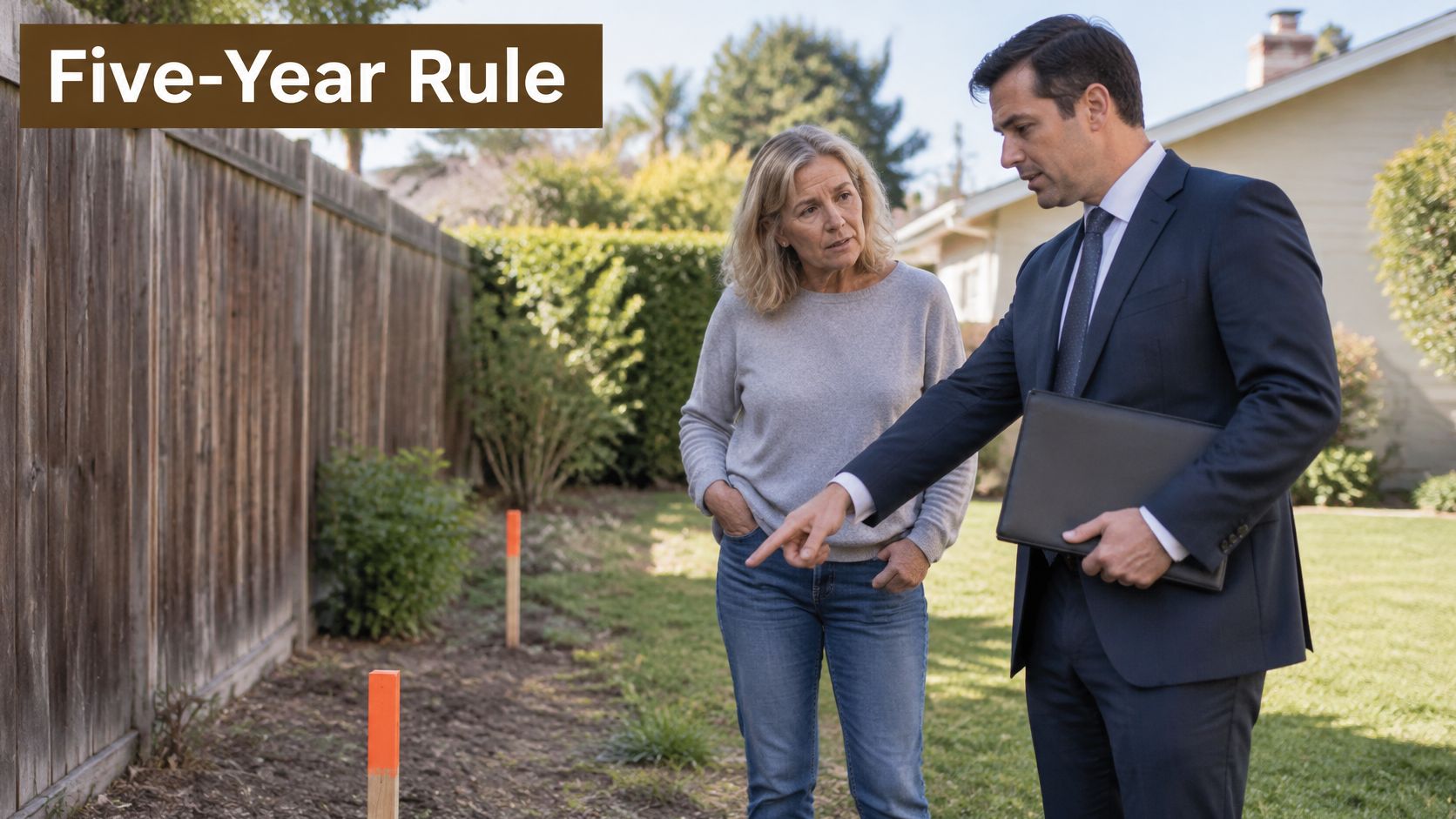
The belief that long use automatically creates ownership is the most expensive misunderstanding in boundary law. California requires proof of specific facts over a specific period, and the neighbor making the claim carries that burden.
What a neighbor has to prove
California Code of Civil Procedure section 325 sets the requirements: continuous occupation and a claim to the land for five years, protection by a substantial enclosure or usual cultivation or improvement, and timely payment of all state, county or municipal taxes assessed against the property during that five-year window. The tax payments must be documented, and missing payment records are a common reason these claims fail, because neighbors rarely pay each other's property taxes.
Permission defeats the claim. If the record owner let the neighbor use the strip, the possession is not hostile, and a short written permission, a text thread or a witness who remembers the conversation can be the entire defense.
| Element | What California requires | Evidence to gather |
|---|---|---|
| Length of possession | Continuous occupation and claim for five years | Dated photos, fence permits, landscaping receipts |
| Enclosure or improvement | Substantial enclosure, or usual cultivation or improvement | Fence history, aerial images, contractor invoices |
| Property taxes | Timely payment of all assessed taxes during the five years | Tax bills and payment records covering the full five-year period |
| Permission | Use with the owner's permission normally does not count | Written permission, texts, emails |
| Lawsuit to recover land | Generally needs possession within five years before filing | Installation dates and prior occupation records |
The five-year count runs in both directions. A fence that went in recently leaves the record owner free to demand removal, negotiate the line or sue. A fence that has stood longer than the statutory period may already support a limitation defense, and a neighbor who also paid the taxes on the strip may have an adverse possession claim. Either way, the installation date is the first document an attorney will ask for.
The five-year clock that also runs against you
The same period governs ordinary suits to recover possession. Under California Code of Civil Procedure provisions on recovery of real property, an action generally cannot be maintained unless the plaintiff, or a predecessor or grantor, was seized or possessed of the property within five years before filing. The statute presumes that a person holding legal title was possessed of the property, and that someone else's occupation happened under that title unless it was adverse for five years.
Read plainly, the installation date of a fence, wall or landscaping bed can decide the outcome. Records showing when a structure went in help establish or defeat a limitation defense, and the absence of records does the same work for the other side.
That timing decides what kind of help the dispute needs. A recent encroachment can often be answered with a survey and a demand letter. An old one near or past the five-year mark calls for counsel, because the deadline defense is already in play and a careless admission can concede it. For owners in Orange County and Los Angeles County, the practical instruction is dull and decisive: preserve documents, and don't alter disputed improvements or make admissions about where the line is until you've had advice.
Remedies Compared From Negotiation to Quiet Title
The same fence dispute can end several different ways, and the facts decide which doors are open. A neighbor who answers his phone is a negotiation. A neighbor who files a claim of right is a title case. Two siblings who inherited a duplex and can't agree on anything are a partition.
| Remedy | What it resolves | Best when | Main limit |
|---|---|---|---|
| Licensed boundary survey | Shows where the line is on the ground | Records conflict or are unclear | A survey alone does not bind the neighbor |
| Demand letter and negotiation | Stops the encroachment or sets terms | Neighbor is willing to talk | Nothing binds until agreed in writing |
| Mediation | Structured settlement with a neutral third party | Both sides want to avoid court | Must be drafted to change title or boundary |
| Boundary or lot-line agreement | Records the agreed line | Owners agree on where it sits | Needs careful drafting and recording |
| Quiet title action | Court judgment on competing ownership claims | Deeds or claims conflict | Longer and more costly than talks |
| Partition action | Divides or sells co-owned property | Co-owners are deadlocked | Court can order a sale |
| Trespass or ejectment claim | Removes an encroachment and may award damages | Encroachment is clear | Strict deadlines apply |
Three terms in plain words
Quiet title is a court judgment that settles who owns what when deeds, legal descriptions, easements or claimed boundaries conflict. California keeps quiet title proceedings in Code of Civil Procedure sections 760.010 through 765.060, separate from partition actions governed by sections 872.010 through 874.323, and the judgment can clear the cloud on title that stalls a sale, a refinance, an estate administration or a transfer into a trust (California Code of Civil Procedure quiet title and partition provisions).
Partition is the court process for dividing or selling property that co-owners can't agree about. Where the land supports a physical split the court can order one, and where it doesn't the court can order a sale and divide the proceeds. That is why co-owner deadlocks and boundary questions inside an estate so often travel together.
Ejectment is a lawsuit to remove someone occupying land without right. It's a blunt instrument. It gets an encroachment off your property, and it also ends any hope of a neighborly arrangement with someone you'll still see at the mailbox.
The order matters as much as the menu. Most files should work down the table from the top: a survey so both sides argue about the same line, a letter so the encroachment goes on record, a recorded agreement so the result survives a sale. Quiet title, partition and ejectment are what you file when talking has failed or a deadline forces the issue, and they cost more in time and fees than everything above them.
There's a financial reason to take the strip seriously even when the square footage looks trivial. Boundary uncertainty is expensive wherever it lands: it complicates a sale, a refinance, a development plan, an insurance placement, and the division of an estate among beneficiaries who were already tense. Buyers and title companies treat an unresolved line as a defect in the title, and the discount they demand usually exceeds what the dirt is worth.
A handshake does not move a property line. Any settlement that changes ownership, creates an easement or confirms a boundary must be written, signed, and recorded, usually with a legal description prepared from the survey.
A lot-line agreement drafted on a napkin and filed in a kitchen drawer is worth nothing to a buyer's title company ten years later. Record it with the county recorder, and give a copy to your title insurer.
Questions to Ask and Your Next Steps
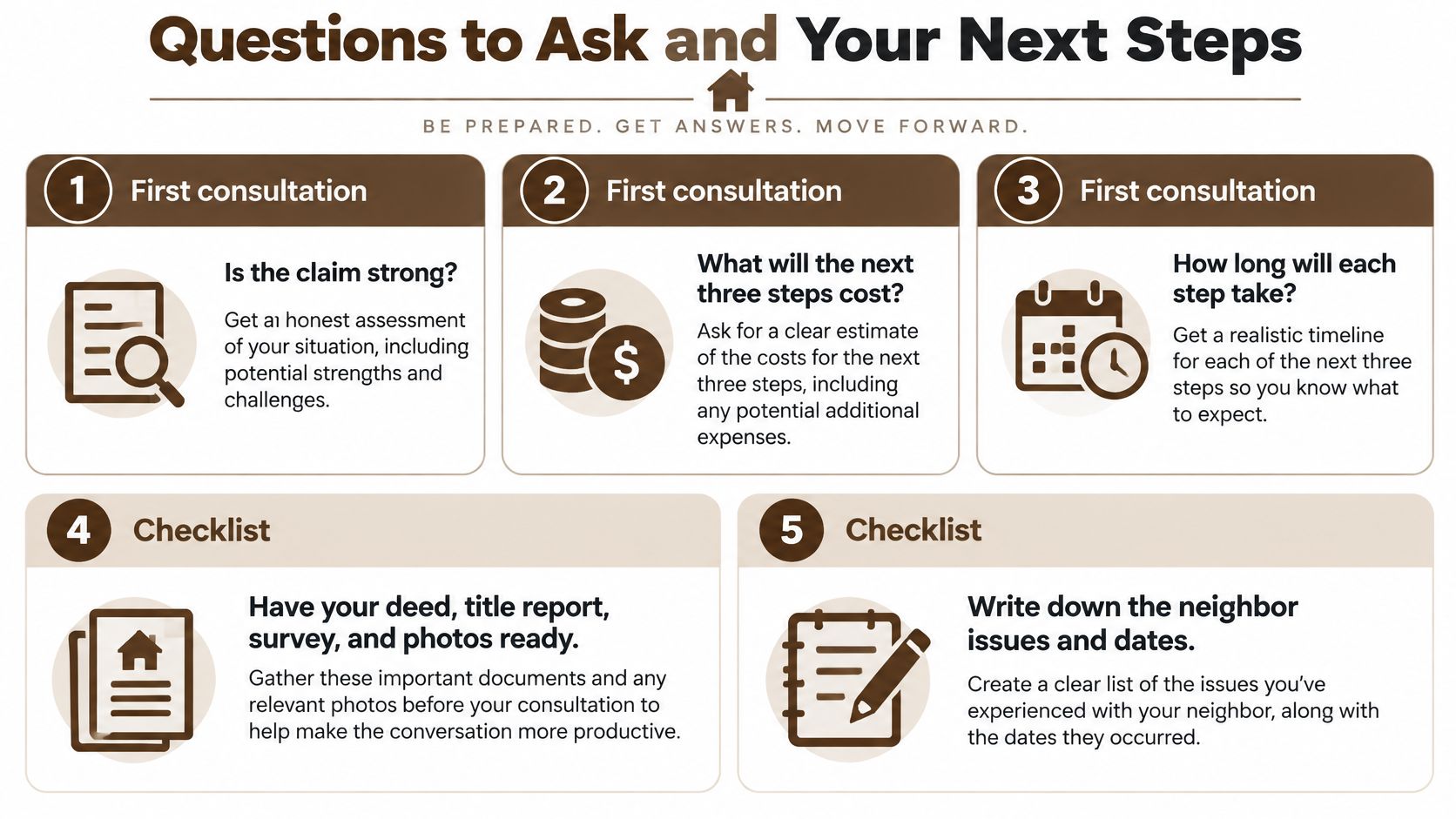
A useful consultation turns a boundary problem into a sequence: what can be handled with a survey and a letter, what needs counsel drafting the pressure, and what belongs in court before a deadline hardens. Leave with three answers: how strong the claim looks, what the next stage costs, and what date or document could change the outcome. If the meeting produces doctrine but no threshold for action, ask for the threshold again.
The questions worth asking
- Have you handled quiet title, partition or boundary matters in Orange County or Los Angeles County courts? Local procedure, local judges and local recording practice all matter, and a lawyer who has never filed a quiet title case will learn on your dime.
- Is this a survey-and-letter problem yet, or already an attorney problem? The answer should name the evidence that would move it from one stage to the next.
- Will you order the survey, and who pays for it? Many owners pay the surveyor directly while the attorney sets the scope, which keeps the markup off the bill and keeps the exhibit useful if the dispute grows.
- What is your fee structure, and will you put it in writing? Ask for the hourly rate, retainer amount, what happens when the retainer runs low, and whether costs are advanced or billed as incurred.
- Which stages are realistic here, and where would you stop to avoid litigation? A clear stopping point is a sign of judgment, not weakness.
- How do you handle mediation and recorded agreements? Ask who drafts the settlement, whether a survey exhibit is attached, and who makes sure the right parties sign.
- Which deadlines apply to my facts? The five-year rules cut both ways, and the answer should tie to your installation dates, tax payments and your neighbor's conduct.
- Who else needs to be told? A lender, title insurer, trustee, co-owner or beneficiary may have a stake, and an unnoticed party can undo a settlement later.
Documents to bring
- The vesting deed and any title report or policy you received when you bought or inherited.
- Prior surveys, plats and subdivision maps, including anything the seller left in a drawer.
- Dated photographs of the fence, wall, driveway or landscaping, plus older images from your phone's camera roll.
- Tax bills and payment records for the disputed area, and every text, email or letter exchanged with the neighbor.
Three things to do this week
- Collect the deed and every recorded map for your parcel and, if you can get them, the neighbor's. The recorder's office can help you pull them.
- Photograph and date the disputed feature from several angles, with a tape measure visible and a fixed reference point in frame. Do it before anything moves.
- Write down what the neighbor said and when, in plain sentences and without adjectives. A factual timeline is useful; a rant is not.
Before you sign anything: don't pull the fence, don't build over the line, don't sign the neighbor's proposed agreement, and don't admit where the boundary sits. Each of those becomes evidence, and some of them become permanent.
Tanner Law is the Orange County practice of William T. Tanner, an attorney and licensed real estate broker serving clients since 1994, with a practice that includes quiet title actions, partition suits and real estate contract disputes. The office is at 1913 E. 17th Street, Suite 212, Santa Ana, CA 92705, and free initial consultations are available by phone or email. Bring the deed, any surveys, the dated photographs and your timeline; that packet lets the first meeting sort evidence from noise and set the next stage, whether that is a scoped survey, a demand letter, mediation or a filing.