Tenant with Co Tenants: Rights in California
Your roommate has packed up, returned a key, and announced that their rent payments are over. Or an older parent has died, and relatives are arguing about who can stay in the shared apartment. Before anyone changes a lock or divides a deposit, the first question is the same: what did each person sign?
For families in Orange County and Los Angeles, the word co-tenant can describe very different relationships. Sharing a residential lease isn't the same as owning a home together, and California law treats rental obligations, ownership rights, and probate authority separately.
Table of Contents
- Why a Shared Lease Can Cost More Than Your Share
- Who Counts as a Co Tenant on the Lease
- What Joint and Several Liability Means for Rent
- How a Move Out or Missed Share Plays Out
- Eviction Repairs and Deposits Under California Law
- When Illness Death or Inheritance Enters the Rental
- Choose Mediation Small Claims or a Consultation
Why a Shared Lease Can Cost More Than Your Share
Three adults sign one Orange County apartment lease. Their private arrangement divides the $3,000 monthly rent into three $1,000 shares. Each expects to pay only that amount, but the landlord's agreement may make every signer responsible for the full rent.
The national figures show why housing costs matter to renters: the Census Bureau reported 42.5 million U.S. renter households in 2023, including more than 21 million that spent over 30% of their income on housing costs. That was 49.7% of renter households for which rent burden was calculated.
The Private Split Isn't the Whole Agreement
A tenant with co-tenants is generally someone named as a tenant on the same residential lease as other tenants. Keeping belongings in a spare room, receiving mail, or having a key does not, by itself, make someone a lease co-tenant.
The private payment arrangement works like a household budget: it records what the occupants intend to contribute. The landlord's lease is the contract that sets out who owes rent to the landlord and what each signer agreed to do. A roommate's promise to pay $1,000 may help resolve a dispute among roommates, but it does not necessarily cap what the landlord can demand from a signer.
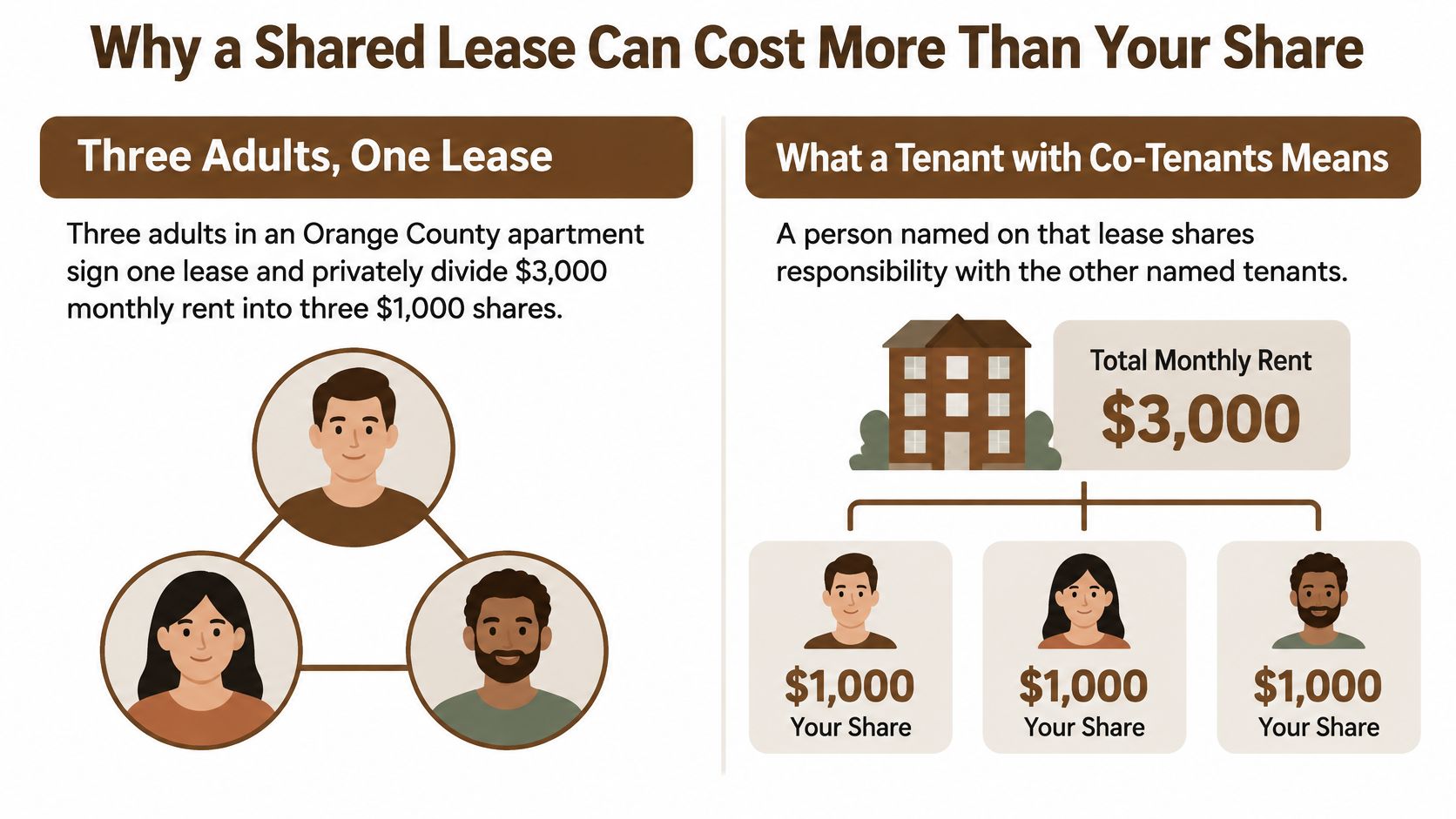
A Missed Share Can Threaten the Household
If one roommate stops paying, the other occupants may face a rent shortfall even while they argue about reimbursement. The household's planned $1,000 shares add up to the rent only when everyone pays.
That can turn a personal disagreement into a housing problem. A family considering who may stay in a shared apartment after a roommate leaves or dies should first distinguish lease obligations from ownership and inheritance questions.
Start with status: Identify the signed agreement before deciding who owes money, who may remain, or how someone can leave.
Who Counts as a Co Tenant on the Lease
California shared-housing statuses compared
| Status | On the landlord's lease | Who can be asked for full rent | How removal usually works | How the person leaves |
|---|---|---|---|---|
| Named co-tenant | Yes | Any signer, if the lease is joint and several | Landlord unlawful detainer against the tenants, subject to required procedure | Written release, amendment, accepted replacement, or lawful termination |
| Informal roommate or occupant | No | The signers, not the occupant, unless a separate landlord agreement exists | Landlord may treat occupancy as unauthorized; a roommate generally can't use the landlord's eviction rights | Move out; no release from an unsigned lease is needed, but a separate occupancy agreement may require notice |
| Subtenant | Usually only a sublease with a tenant | The master tenant still owes the landlord | Consent, the sublease, and local rules determine the lawful notice and court process | Sublease termination or end of the master tenancy, subject to applicable protections |
| Guest | No | No new rent obligor; the signers remain liable | A genuine temporary guest isn't a tenant; an overstay can become an occupancy dispute | Leave; avoid creating an unintended rental arrangement through rent payments |
| Approved assignee or replacement | Yes, after written landlord acceptance | The new signer for the remaining term, and old signers unless released | Court process applicable to the tenancy | Treated as a tenant from the effective acceptance date |
Read the Documents, Not the Household Labels
Start with the signed lease, addenda, and the landlord's written approvals. Compare the names on those documents with the people living in the home. A family's description of someone as a roommate, helper, or temporary visitor isn't conclusive.
A named co-tenant ordinarily contracts directly with the landlord. An informal occupant may instead have an agreement only with another resident. That distinction affects whom the landlord can pursue and who has authority to enforce an occupancy agreement.
A subtenant rents from a tenant, often called the master tenant. For example, an adult child who rents a bedroom from their parent may be a subtenant rather than a co-tenant. The parent ordinarily remains responsible under the landlord's agreement.
Guests and Replacements Need Closer Attention
A temporary visitor can become a disputed occupant when they establish a home there, contribute rent, or move in furniture. Don't assume that calling someone a guest resolves their rights. Equally, don't assume that accepting money automatically makes them a named party to the landlord's lease.
For a replacement, obtain written landlord acceptance and identify whether the outgoing signer is expressly released. Adding a new resident and releasing an old signer are separate decisions.
Shared housing extends beyond college households. SpareRoom reported that 54% of surveyed U.S. roommates in August 2025 spent at least 40% of take-home pay on rent, according to its roommate survey announcement.
A roommate agreement can allocate rent, utilities, deposits, notice, and damage among occupants. It generally can't amend the landlord's lease without the landlord's written consent. Circle the row that matches your documents before assessing liability.
What Joint and Several Liability Means for Rent
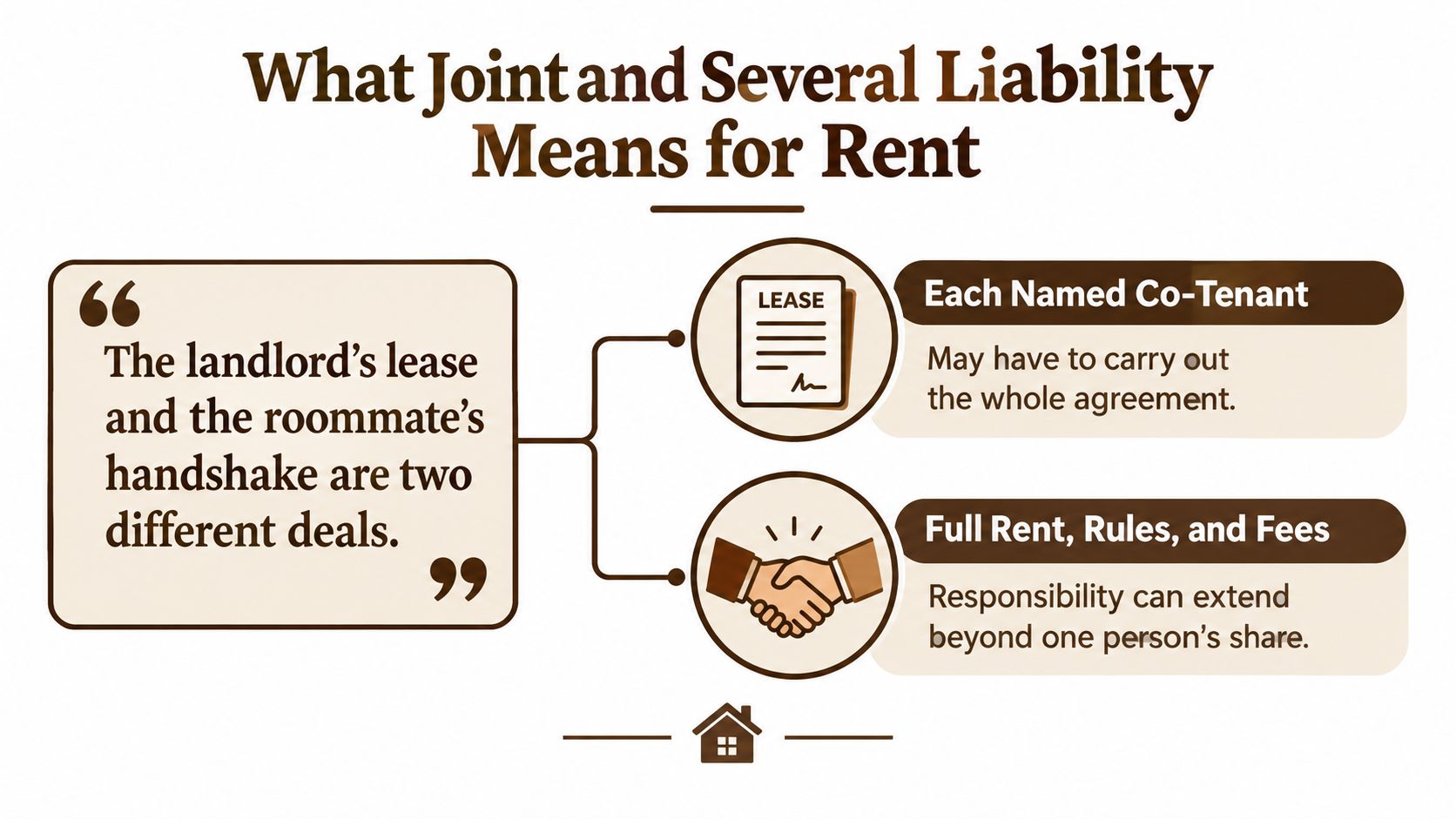
The landlord's lease and the roommate's handshake are two different deals.
Joint and several liability means the landlord may be able to require an individual signer to perform the entire rental agreement, not merely pay that person's private share. Cornell's Legal Information Institute explains that co-tenants are responsible for ensuring the landlord receives total rent and for addressing damage attributable to another co-tenant.
Under California law, the actual lease language and applicable rules determine the claim. If the household in the opening example falls behind, the landlord may pursue a signer for the unpaid balance, while that signer separately seeks contribution, meaning reimbursement of the other roommates' agreed shares.
The diagram separates responsibility under the lease from the occupants' internal arrangement.
Read the Clauses That Allocate Risk
Check whether all adult tenants signed and whether the lease expressly imposes joint and several liability. Then read the rent due date, late-fee provision, utilities, guest restrictions, subletting, assignment, early termination, and security-deposit terms.
Don't assume every printed fee is enforceable because it appears in the lease. Likewise, a landlord's practice of accepting separate payments doesn't necessarily divide the underlying obligation into separate leases.
A roommate who breaks a door creates another potential surprise. Even if everyone knows who caused the damage, the landlord's contractual claim may extend to other signers. Their reimbursement dispute with the person responsible remains a separate matter.
Put the Internal Agreement in Writing
Use a roommate agreement that addresses these practical points:
- Shares and due dates: Identify each person's obligation and when payment must arrive.
- Proof of payment: Require receipts or confirmation of electronic transfers.
- Utilities and damage: Explain how bills are divided and how responsibility for damage is documented.
- Replacement procedure: State how residents propose, screen, and obtain approval for a replacement.
- Early departure: Set out notice, unpaid contributions, and any agreed reimbursement obligations.
Keep rent receipts, bank-transfer records, move-in photographs, inspection notes, and written notices in a shared folder with backup copies. Label payments by rental period rather than relying on a vague transfer description.
For an additional explanation of shared-tenancy issues, the following video provides another learning format.
These records help separate money owed to the landlord from money owed between occupants. The checklist itself doesn't release a signer; an agreed release should be documented with the landlord in writing.
How a Move Out or Missed Share Plays Out
A Departing Signer's Written Exit Plan
A job change, separation, or caregiving emergency may explain why someone must leave. It doesn't, by itself, establish when contractual liability ends.
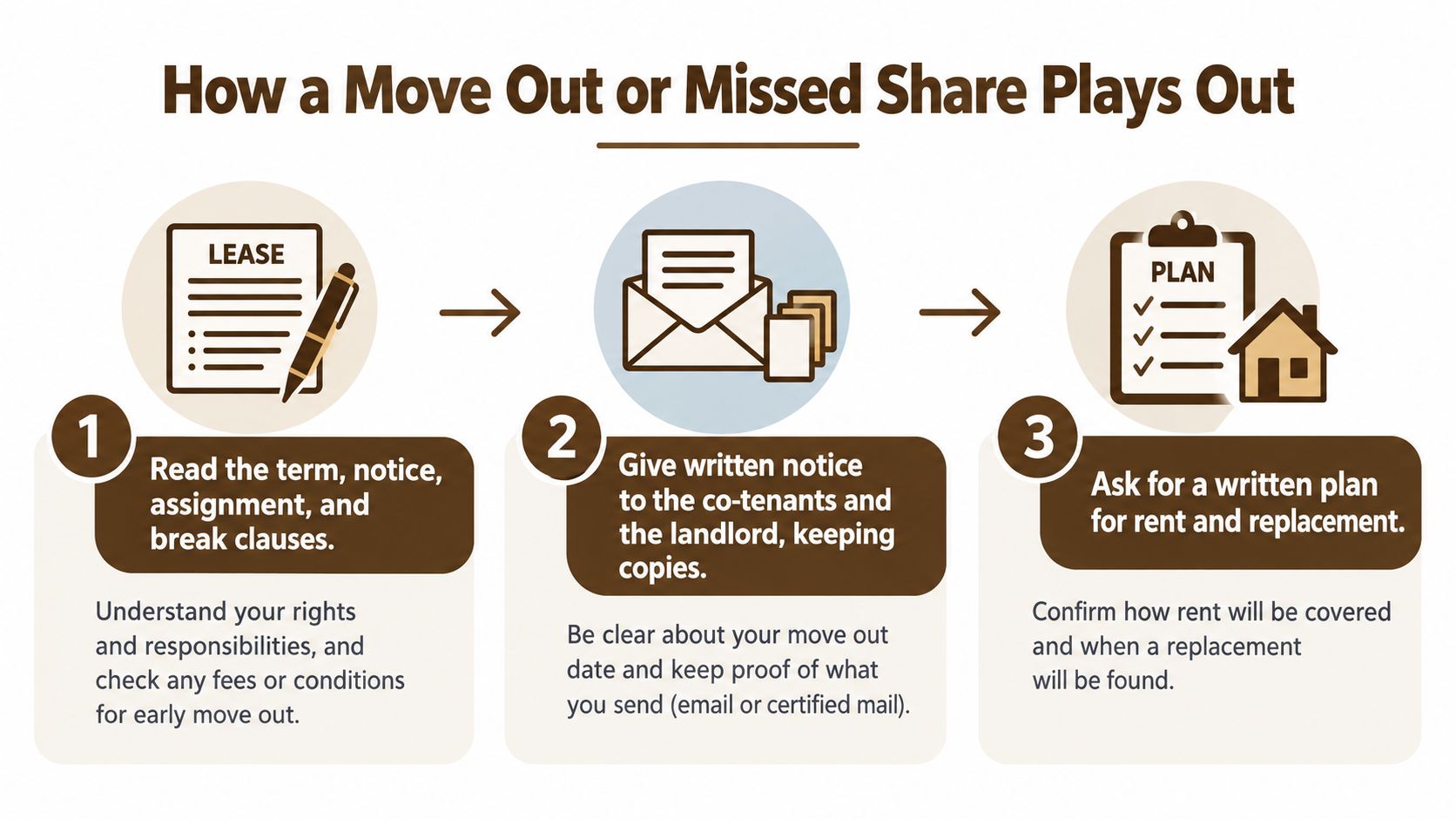
- Read the exit provisions. Review the lease term, notice requirements, assignment restrictions, and any early-termination clause.
- Give written notice. Communicate with both the landlord and co-tenants, and retain delivery records.
- Request a documented solution. Ask for a release, signed amendment, approved replacement, or agreed termination.
- Track continuing obligations. Keep paying amounts legally owed and preserve every payment record while the exit is being resolved.
- Settle the internal balance. Record rent contributions, utility charges, and any deposit adjustment with receipts rather than undocumented cash.
Returning keys alone doesn't release a signer. A written exit agreement should identify its effective date, any remaining balance, the deposit arrangement, and whether the departing tenant remains liable for earlier damage or unpaid rent.
This illustration summarizes the first practical actions to take before departure.
When a Roommate Stays but Stops Paying
The remaining signers need a parallel plan:
- Confirm the shortfall. Compare the landlord's ledger with bank records and the roommate agreement.
- Protect the tenancy where possible. If financially possible, address unpaid rent before further fees or an eviction case arise, without giving up reimbursement rights.
- Demand contribution in writing. Identify the unpaid rental periods, payments you covered, and the requested resolution.
- Propose a realistic agreement. Consider a payment schedule or approved departure, with signed terms rather than another verbal promise.
A California landlord generally need not accept whatever substitute the roommates select, although the lease and applicable law may restrict a refusal. An unauthorized sublet can itself breach the agreement.
A month-to-month tenancy and a fixed term ending in 2026 require different exit analysis. That year is a hypothetical contract end date: notice rules, renewal language, and California law must be checked before anyone moves. Proper legal termination can matter even without a negotiated release.
Avoid self-help: Moving out, blocking a bedroom, or changing locks doesn't cancel another adult's occupancy rights or erase the landlord's claim.
Before escalating the dispute, gather the signed lease, payment ledger, messages, photographs, and notices. Those documents establish what happened more reliably than competing recollections.
Eviction Repairs and Deposits Under California Law
Eviction Is a Possession Case
A landlord uses unlawful detainer, California's court procedure for recovering possession, rather than ordering residents out. A case may name multiple tenants on the lease, so one roommate's breach can expose others to litigation.
For example, a roommate's unauthorized occupant may lead the landlord to pursue a lease violation affecting the household. The other tenants shouldn't assume the dispute concerns only the person who invited the occupant.
An ordinary co-tenant generally can't act as the landlord and evict another named co-tenant. A master tenant's rights against an actual subtenant require separate analysis. Los Angeles and other local jurisdictions may add notice, just-cause, or other protections, making the property's location important.
Repairs Require a Different Record
A habitability problem concerns whether the landlord is providing a legally livable home. A roommate dispute about a broken chair is not the same kind of claim.
If water enters through the ceiling, notify the landlord in writing, describe the affected rooms, attach photographs, and preserve responses and access arrangements. Document when the condition started and whether it affects safe use of the home.
- Landlord repair issue: Keep maintenance requests, photographs, inspection information, and communications about access.
- Roommate damage issue: Preserve evidence of who caused the problem and any agreement about reimbursement.
Don't withhold rent or undertake repairs and deduct the cost without checking current California requirements. A legitimate repair concern doesn't automatically excuse every payment decision.
The Deposit Belongs to the Tenancy's Accounting
California's security-deposit rules include a statewide cap, exceptions, and itemized accounting deadlines. Those requirements govern the landlord's handling of the deposit; roommates then need to resolve their respective interests in the refund or deductions.
For a hypothetical example, assume the apartment has a $2,400 deposit. A roommate damages a door, and the landlord makes a lawful, documented deduction. The other signers may seek reimbursement from the person responsible rather than assume the landlord must absorb the loss or return each person's original contribution separately.
Keep the move-in condition record, move-out photographs, deduction statement, and repair documentation together. Distinguish ordinary wear from claimed damage, and don't treat a roommate's estimate as proof of the landlord's lawful deduction.
Eviction, habitability, and deposit accounting are landlord-related issues. A claim that another roommate owes you money is a different dispute with a different remedy.
When Illness Death or Inheritance Enters the Rental
An older parent and an adult child share a Los Angeles rental. A caregiver stays overnight to help. If the parent dies or moves into assisted living, the family may disagree about who can remain in the home and who is still responsible for rent. The first step is to separate the rental agreement from estate and property-ownership questions.

Separate Housing, Probate, and Ownership
Housing is about who has a right to occupy the rental under the lease and any applicable succession protections. A caregiver's help, even if regular, doesn't by itself make that person a tenant. Check the lease and any written landlord approval before treating a household member as a signer.
Probate is the administration of a deceased person's estate. A personal representative manages estate matters, but that role doesn't automatically give them authority to remove a surviving co-tenant or move into the rental. The security deposit may involve both the estate and the landlord, so relatives shouldn't assume they can divide it among themselves.
Ownership concerns who holds title to real property. California court probate guidance explains that property held in joint tenancy generally passes to the surviving joint owner outside the will. A will leaving a home to children may therefore not transfer that home if it was held in joint tenancy.
| Question | Document or rule to check | What it addresses |
|---|---|---|
| Who may live in the rental? | Lease, authorized occupants, and applicable succession protections | Occupancy rights |
| Who handles the deceased person's estate? | Estate documents and probate process | Estate administration |
| Who owns a home? | Recorded deed and title arrangement | Property ownership |
A relative's inheritance claim doesn't automatically create a right to occupy a rental. And when a co-tenant dies or moves to assisted living, the remaining lease signer's rent obligation doesn't automatically disappear.
Apply the Title Test Before Choosing a Remedy
A joint tenancy is an ownership arrangement, not a type of rental lease. Under California Civil Code section 683, a transfer generally must expressly declare a joint tenancy to create one, and joint tenants hold equal interests. Calling renters “co-tenants” doesn't create joint ownership.
Tenancy in common is another form of co-ownership. Check the recorded deed rather than relying on family terms, a will, or shared expenses to establish who owns the property.
Code of Civil Procedure section 874.311 addresses partition of qualifying real property held in tenancy in common, including a possible buyout after the property's value is determined. Partition concerns ownership disputes. It doesn't let one roommate remove another lease signer or end a residential lease.
If lease and title questions overlap, get legal advice before changing locks or inviting another relative to move in. Bring the lease, deed, estate documents, and deposit records so the advice can address whether the dispute concerns occupancy, the estate, ownership, or more than one of these.
Choose Mediation Small Claims or a Consultation
Where a California co-tenant dispute can go
| Path | Use it when | What it can produce | What it does not do |
|---|---|---|---|
| Written landlord amendment | You need a release, new signer, or changed term | A changed lease if the landlord signs | It doesn't happen merely through informal approval |
| Mediation or signed settlement | Roommates can negotiate money or a move-out | A private agreement that is binding if signed and otherwise enforceable | It doesn't remove a tenant by force |
| Small claims | A signer owes a documented share within the individual limit | A money judgment if you prove the claim | It doesn't award possession of the unit |
| Landlord unlawful detainer | The landlord seeks possession under California procedure | A court possession order if the landlord prevails | A roommate can't use it as a substitute landlord |
| Consultation with counsel | Lease, deposit, death, or title issues overlap | A strategy before notices or filings | It isn't a do-it-yourself form |
Match the Remedy to the Result You Need
If your goal is an approved replacement or release, start with a written landlord request. If the disagreement concerns timing or unpaid contributions, voluntary mediation can help the occupants negotiate a signed settlement. Participation alone doesn't make proposed terms binding.
For a documented reimbursement claim, California's individual small-claims limit is currently $12,500 for a natural person. Confirm the current limit and eligibility before filing. A money judgment doesn't remove an occupant, and collecting it may require additional work.
When possession is the issue, don't substitute a lock change for the proper legal process. When a death, deposit, or ownership claim complicates the tenancy, obtain advice before sending notices that may affect other residents.
Tanner Law is the Santa Ana practice of William T. Tanner, an attorney and licensed real estate broker serving clients since 1994, and offers assistance with overlapping real estate, probate, and civil disputes. The office is at 1913 E. 17th Street, Suite 212, Santa Ana, CA 92705; a free initial consultation can be arranged by phone or email.
California law and the written lease control. This article can't replace advice based on your documents and the property's local rules.
For help separating shared-lease obligations from probate or property ownership rights, visit Tanner Law to schedule a free consultation. Families and residents in Orange County and Los Angeles can discuss their lease, payment records, and estate or title documents before choosing a move-out agreement, money claim, or court proceeding.