How an Orange County CA Estate Planning Attorney Helps
Orange County had 211,608 owner households headed by people age 65 or older in 2024, and 53.1% of those homeowners had no mortgage, according to the California inherited-home report using Census-related data. For these families, estate planning isn't just about signing documents. It's about making sure the home's legal ownership matches what the family expects to happen after death.
Table of Contents
- What an Orange County Estate Planning Attorney Does
- When to Call an Estate Planning Attorney
- Which California Process Fits Your Family
- How a Trust Avoids Probate Only if Funded
- When the Deed and the Plan Conflict
- Taxes and Trustee Duties After Death
- How to Choose an Orange County Attorney
- Schedule a Free Consultation in Santa Ana
What an Orange County Estate Planning Attorney Does
An Orange County, CA estate planning attorney helps a family decide who receives property after death, who manages money and medical decisions during incapacity, and which California process transfers a home. The work includes wills, revocable living trusts, financial powers of attorney, advance health care directives, beneficiary forms, probate administration, and litigation when someone challenges a plan.
Say a married couple wants their children to inherit their home. The attorney must review more than their wishes: the deed, each spouse's ownership rights, account beneficiaries, and who could act if either spouse became unable to make decisions.
The U.S. Census Bureau counted 3,186,989 Orange County residents in 2020 and estimates that 18.5% of county residents are age 65 or older. Planning serves a broad population of homeowners and families, not just wealthy households.
The core services connect property, decision-making, and documents.

Start with the family and the title
California community-property law, high home values, and co-owners or blended families make coordination important. A will states inheritance instructions; a trust provides a structure for managing assets; financial and medical documents appoint lifetime decision-makers; beneficiary forms direct particular accounts.
Bring existing versions to the first meeting, even if they seem outdated. The hiring checklist and California transfer-path table below help turn those documents into practical questions.
When to Call an Estate Planning Attorney
Call before changing ownership, not just after someone dies. Adding a person to a deed can affect control, inheritance, taxes, and exposure to that person's creditors.
Use these triggers to decide whether a consultation should come before your next transaction or family decision:
- Buying or retitling a home. Get advice before adding a child, spouse, or other co-owner to the deed.
- Marriage or remarriage. Stepchildren and a surviving spouse's California community-property rights may require different planning than a simple gift in a will.
- Creating a trust. Ask who will handle the property transfer and confirm completion.
- Age, illness, or declining capacity. Financial and health-care appointments should be signed while the person can understand and authorize them.
- A parent's death. A house or rental still in the parent's name needs a transfer-path review.
- Disagreement among owners. Conflicts over occupancy, expenses, or selling often require property-law analysis.
- A court notice or demand letter. Preserve the envelope and attachments, and get advice promptly.
- A high-value or business-owning estate. Valuation, succession, and federal filing questions deserve coordinated legal and tax review.
Use intake to identify the immediate decision
Most families need only an initial attorney conversation before identifying their next step, though resolving the matter may require substantial work. A short intake can distinguish document planning from administration or a developing lawsuit.
Timing matters: Waiting until a response deadline approaches usually leaves less room to investigate ownership, negotiate, or correct paperwork.
Which California Process Fits Your Family
California transfer paths and current limits
The personal-property limits below come from the California Courts simplified-transfer guide, which identifies caps of $166,250, $184,500, and $208,850 for the respective death-date periods and a separate $750,000 limit for certain qualifying real-property petitions.
| Situation | California path | Value limit | Court role |
|---|---|---|---|
| Personal property, death before April 1, 2022 | Small-estate affidavit, Probate Code 13100 | $166,250 | No full probate if eligible |
| Personal property, April 1, 2022 to March 31, 2025 | Small-estate affidavit | $184,500 | No full probate if eligible |
| Personal property, death on or after April 1, 2025 | Small-estate affidavit | $208,850 | No full probate if eligible |
| Qualifying real property | Simplified petition | $750,000 | Limited court petition |
| Will only, or assets above the caps | Full probate when required | No small-estate cap | Court supervises title transfer |
| Assets deeded into a revocable trust | Trust administration | No probate cap | Usually no probate case |
| Account or policy with a beneficiary | Contract transfer | The named asset only | Outside the will |
| Joint title or a deed that conflicts with the plan | Title or probate dispute | No single monetary eligibility cap | May need probate, trust, or a property case |
Match the asset and the date of death
Start with what the deceased person owned, how they owned it, and when they died. Don't select a procedure merely because the family considers the estate small.
California Probate Code sections 13100 and 13101 govern the personal-property affidavit procedure. This is commonly relevant to qualifying accounts or other personal property, not a blanket authorization to transfer a house. Eligibility also involves statutory conditions beyond the amount shown in the table.
For example, a family collecting an individually owned bank account must determine which assets count toward the applicable estate-value limit. Looking only at the account balance can produce the wrong answer if the deceased person owned other countable assets.
The property petition is a separate route. Its availability requires checking the property category, applicable death-date rules, valuation requirements, and other conditions. Don't assume every California parcel under the displayed cap qualifies.
A will doesn't select every transfer path
A will gives instructions for property governed by the estate and nominates an executor, the person proposed to manage it. In California, a will doesn't itself avoid probate. When full probate is required, the court appoints a representative, oversees administration, and authorizes distribution.
A revocable trust uses a different administration structure for property properly placed in it. Accounts with effective beneficiary designations may pass under the account agreement instead, while some forms of joint ownership include survivorship rights under the deed.
That distinction explains why a will leaving everything equally to the children may not control a particular account or home. The attorney must read the ownership and transfer documents, not just the will's distribution paragraph.
Choose the procedure for the asset actually owned at death, not the procedure the family hoped would apply.
If a home exceeds the applicable simplified limit and no nonprobate transfer applies, full probate may be necessary. If someone disputes ownership, a separate property claim or a contested probate proceeding may also be needed. Another template won't resolve that disagreement.
Before filing, obtain the recorded deed, account ownership records, and beneficiary confirmations. Those records help determine whether the family needs estate administration, trust administration, a simplified transfer, or litigation.
How a Trust Avoids Probate Only if Funded
Think of the trust document as an instruction manual and the recorded deed as the key that puts an Orange County house inside the trust. Signing the manual doesn't change the property's ownership.
California Courts explains that assets placed in a trust can pass after death without a probate proceeding. Under California practice, a revocable living trust generally avoids probate for assets transferred into it during the owner's lifetime.
The relationship between the document and the deed is straightforward.

Complete the transfer work
- Sign the trust and backup will. The trust identifies the trustee who manages its assets and the beneficiaries who receive them. A pour-over will directs eligible assets left outside the trust toward the trust after death.
- Prepare and record the property deed. The deed should identify the appropriate trustee and trust accurately. Review the legal description, existing ownership, lender issues, and potential property-tax consequences before recording.
- Coordinate financial accounts and beneficiary forms. Bank and brokerage accounts may need ownership changes. Retirement accounts require separate beneficiary analysis; don't retitle them into the trust as though they were ordinary checking accounts.
- Keep a funding inventory. Record what was transferred, what remains outside, and why. Retain recorded deeds and institution confirmations with the plan.
“Vesting” means the way ownership is legally held and described. A funding review checks that wording against the trust rather than assuming a property address on an attachment proves the transfer was completed.
Understand what the backup documents can't do
Consider a hypothetical Santa Ana residence left in a parent's individual name. The parent signed a carefully drafted trust, but nobody completed the deed. After death, the family may still need probate or a corrective court procedure to establish the proper transfer.
A pour-over will is a safety net for forgotten assets, not a replacement for lifetime funding. It doesn't guarantee that the family can skip court.
A financial power of attorney serves another purpose: it authorizes an agent to handle specified financial matters during life. That authority ends at death. An advance health care directive addresses medical decisions and related wishes, not ownership of the home; limited instructions concerning remains or post-death matters may still be relevant.
Funding check: Pull the current recorded deed and compare the vested owner with the trust's intended ownership before assuming the house will avoid probate.
Also review title after refinancing, a sale, or a replacement purchase. A completed estate plan needs maintenance when the assets or ownership arrangements change.
When the Deed and the Plan Conflict
A deed can outweigh a family's expectations when its ownership terms conflict with an estate plan. A new trust may not resolve a disputed title, meaning an unresolved claim or defect in ownership, or establish that an informal promise was enforceable. Reviewing the deed and estate documents together helps identify what is in dispute.
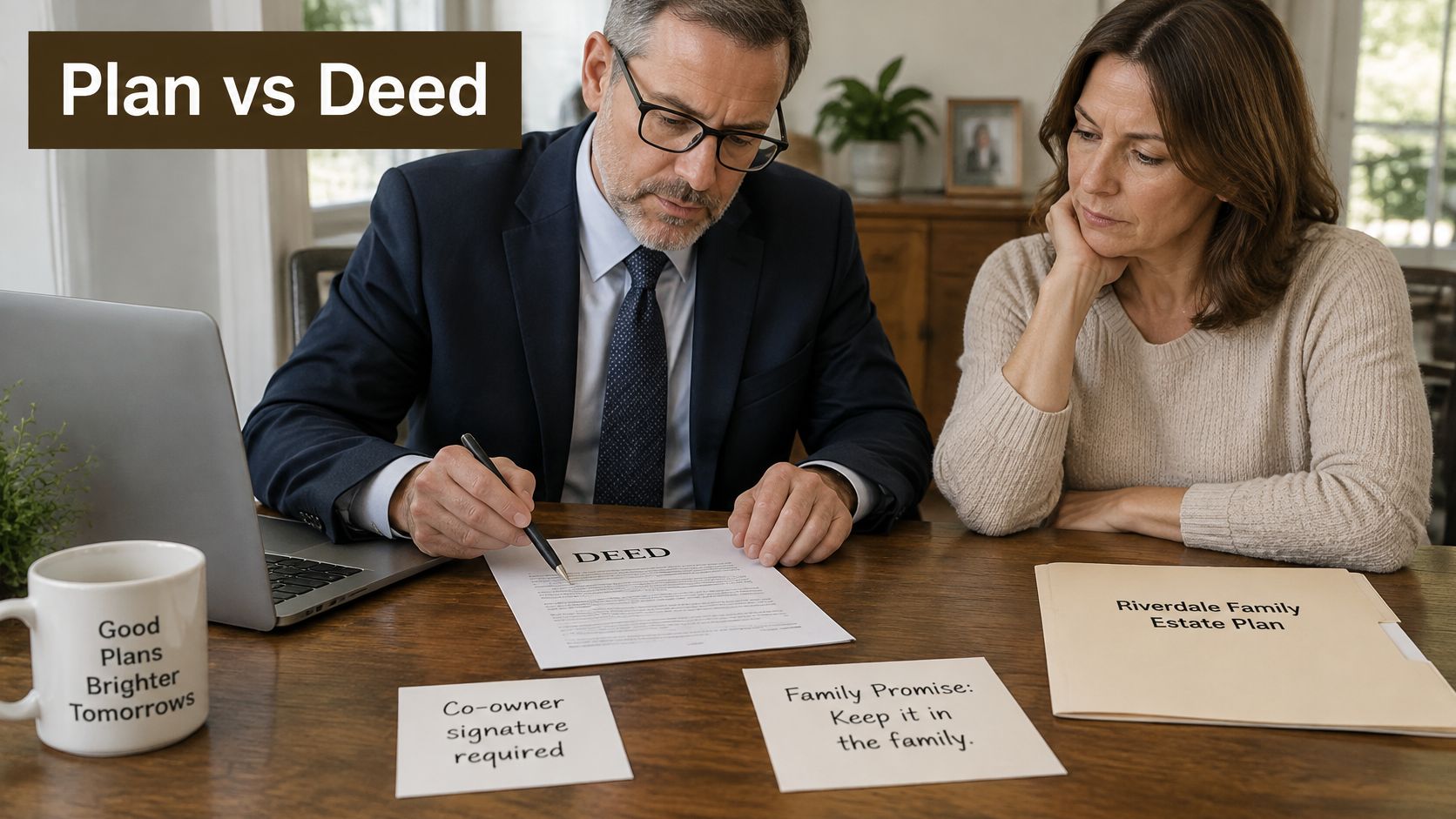
Hypothetical conflicts that need different claims
- A joint-tenancy claim. A parent signs a trust, but the grant deed still names the parent and an adult child as joint tenants. The child claims the property passed to them through survivorship. Counsel must examine whether the deed was valid and whether later transactions changed ownership before assessing that claim.
- A blended-family conflict. A will leaves the home to children from a first marriage, while the surviving spouse asserts community-property and homestead protections. The will can distribute only the deceased spouse's interest, not property that spouse did not own.
- An inherited rental disagreement. Siblings inherit a property as co-owners without a written agreement. One wants to sell, while the other refuses. The dispute may call for partition, a process for dividing co-owned property or arranging a sale when legally appropriate, rather than a challenge to the inheritance documents.
The Orange County Superior Court probate materials describe the local court setting. Probate matters range from administering estates to resolving questions about wills, trusts, and ownership. Estate administration involving real property can take time, especially when title or family claims are contested, so identifying the actual conflict helps clarify which court process may fit.
Which California forum fits the dispute
California Superior Court handles these proceedings, but probate and civil departments address different kinds of claims. “Standing” means having the legal right to bring a particular claim. Being related to the property owner does not, by itself, establish that right.
| Dispute | California forum | Who can bring it | Evidence to keep |
|---|---|---|---|
| Estate must move title from the decedent | Probate court | Heir, beneficiary, executor, or creditor with the required interest | Will, death certificate, deed, asset list |
| Dispute over a trust document or trustee's act | Trust litigation | Beneficiary, heir, or trustee with standing for the requested relief | Trust instrument, amendments, trustee records |
| Recorded owner unclear or title clouded | Quiet title action | Claimant to an interest in the property | Chain of deeds, recorded documents, tax records |
| Co-owners cannot agree to sell or divide | Partition action | Co-owner | Deed, payment records, any co-owner agreement |
| Alleged promise to transfer property | Contract claim | Person claiming an enforceable promise | Texts, emails, written agreements, witnesses |
A quiet title action asks a court to determine the parties' ownership interests. A partition action addresses how co-owned property should be divided or sold. A promise to transfer property raises a different question: whether the evidence supports an enforceable agreement. The deed, the inheritance documents, and the conduct of the people involved can point toward different claims, so the ownership issue should be examined alongside the estate plan.
Keep deeds, mortgage and tax payment records, texts, emails, and family agreements. Preserve original files and full conversations, not only selected screenshots, before anyone records another deed.
Taxes and Trustee Duties After Death
Avoiding probate doesn't mean avoiding tax filings. California has no state estate or inheritance tax, but federal estate-tax rules and separate trust income-tax rules can still apply.
The IRS estate-and-gift-tax update states that the 2026 basic exclusion is $15,000,000, compared with a 2025 filing threshold of $13,990,000. A federal estate-tax return can be required when the gross estate, adjusted taxable gifts, and other specified amounts exceed the applicable threshold, even if deductions eliminate the eventual tax.
For lifetime gifts, the IRS gift-tax guidance provides a 2026 annual exclusion of $19,000 per recipient per donor, or generally up to $38,000 per recipient when spouses combine exclusions, subject to gift-splitting and reporting rules.
Federal and trust tax figures after death
| Rule | Figure | What it decides |
|---|---|---|
| Federal basic exclusion for 2026 | $15,000,000 | Whether cumulative taxable lifetime and death transfers can trigger federal estate tax |
| 2025 filing threshold | $13,990,000 | The federal filing analysis for that year of death |
| Annual gift exclusion for 2026 | $19,000 per recipient per donor | Qualifying gifts that generally don't use the lifetime exclusion |
| Two spouses, one recipient in 2026 | Up to $38,000 | Combined annual exclusions, subject to applicable reporting rules |
| California estate tax | None | No state estate tax; federal rules still apply |
| Form 541 trust income | Above $10,000 gross or $100 net | A fiduciary income return, not an estate-tax return |
The California Franchise Tax Board identifies potential Form 541 filing obligations involving California-source income, distributions to California residents, or applicable income thresholds, generally gross income above $10,000 or net income above $100.
Separate transfer taxes from income taxes
A family estate centered on a home may have no federal estate tax due, yet a trust holding a rental can receive taxable income. Interest, gains, and distributions also require review. Real-estate gifts and gifts in trust may need valuation and specialized reporting even when no immediate gift tax is payable.
California Probate Code sections 16000 through 16632 provide the trustee-administration framework, including duties concerning loyalty, accounting, and compliance with the trust terms. A trustee manages property for others and shouldn't treat trust funds as personal money.
Before making distributions:
- Inventory assets and income. Include rent, interest, sales, and expenses.
- Obtain an EIN when appropriate. Confirm the trust's taxpayer-identification requirements.
- Determine the proper tax year. Coordinate with the tax preparer rather than selecting dates casually.
- Preserve beneficiary allocations. Keep records showing income, principal, expenses, and distributions.
Executors and trustees should not interpret the absence of a probate case as proof that no tax return is due.
How to Choose an Orange County Attorney
Choose counsel who can explain what happens to the house, not just what documents you'll sign. An estate plan involving disputed ownership may require probate knowledge and real-estate litigation experience.
Questions to ask before hiring
- California practice and deed review. Does the lawyer handle probate and trust law and read recorded ownership documents? Can the lawyer identify when quiet title, partition, or a contract claim needs separate attention?
- Court experience. Ask about appearances in Orange County, Los Angeles, Riverside, and San Bernardino, as relevant to the property and proceeding.
- Direct attorney access. Who reviews the facts, prepares the work, and answers substantive questions?
- Written fee scope. Is the fee flat or hourly, and what does it exclude? Ask specifically about deed preparation, recording, beneficiary coordination, and contested proceedings.
A low document-preparation fee isn't a bargain if nobody completes the property work. Request a clear description of both the deliverables and the client's responsibilities.
Ask who confirms completion, not just who prepares the paperwork.
Tanner Law is one option when inheritance questions overlap with property disputes. William T. Tanner has practiced since 1994, is an attorney and licensed real estate broker, teaches property law, and handles probate, quiet title, partition, and real-estate contract disputes from the Santa Ana office.
Apply the same checklist when comparing other Orange County or Los Angeles counsel. The firm isn't the only option; the appropriate fit depends on the work your family needs.
Schedule a Free Consultation in Santa Ana
A deed, a family promise, and a will or trust can point in different directions. A free initial consultation can help you identify whether the issue concerns probate, trust administration, or property rights. Contact Tanner Law by phone or email to arrange a consultation at its Santa Ana office, 1913 E. 17th Street, Suite 212, Santa Ana, CA 92705.
You do not need to identify the legal problem before calling. Bring the records that show who owns the property and what the family intended:
- Current deeds. Include the latest recorded deed for each property.
- Estate documents. Gather the will, trust, amendments, and any related court papers.
- Beneficiary records. Bring available statements or confirmations for accounts, insurance policies, and retirement plans.
- People and claims. List everyone on title and anyone who may object to a transfer.
Get a recommendation before filing
The attorney can review the relevant California law and assess whether a small-estate procedure, trust administration, probate, or a property case fits the facts. Explain any pending sale, threatened transfer, court notice, or disagreement about possession at the outset, since each may affect the next step.
This review can help homeowners, heirs, landlords, and co-owners in Orange County and Los Angeles identify a cost-conscious way to proceed. Contact Tanner Law by phone or email to schedule the free initial consultation before a deadline or a newly recorded deed makes a dispute harder to resolve.