Statute of Limitations Real Estate: CA Law & Deadlines 2026
A homeowner in Orange County can think everything is stable until a letter, a title report, or a probate file reveals a problem that should've been caught years earlier. That's when the real question hits, not just who owns the property, but whether there's still time to act before California law shuts the door. In real estate disputes, a missed deadline can turn a strong claim into a useless one.
That risk shows up in families handling inherited homes, disputed transfers, trustee sales, broker disputes, and contract fights across Orange County and Los Angeles. California law doesn't use one single deadline for every property problem. The clock depends on the type of claim and, just as important, the event that started the clock.
Table of Contents
- Introduction to California Real Estate Deadlines
- Understanding Statute of Limitations in Real Estate
- Statute of Limitations Real Estate Deadlines for Common Claims
- Calculating Real Estate Deadline Start Dates
- Tolling and Discovery Rules in California Real Estate
- Orange County Case Examples of Deadline Issues
- Practical Steps to Protect or Defend Real Estate Claims
- Conclusion and Next Steps
Introduction to California Real Estate Deadlines
A family in Irvine may inherit a house, pull a title report, and discover a recorded problem that nobody mentioned during probate. The natural reaction is to focus on the ownership dispute itself. The more urgent issue is whether the filing window is already closing.
In California real estate cases, deadlines are not just administrative details. They decide whether a court can even hear the claim. A quiet title action, a contract case, or a fraud claim may all arise from the same property transaction, yet each can move on a different clock.
That's why the phrase statute of limitations real estate matters so much for homeowners, heirs, buyers, sellers, and brokers. The deadline usually isn't tied to the house alone. It's tied to what happened, when it happened, and when the injured person knew, or reasonably should have known, enough to act.
For families in Orange County and Los Angeles, this often comes up during probate, trust administration, and inherited property transfers. A deed issue can overlap with disclosure problems, broker conduct, or contract disputes. If the wrong deadline is tracked, the case can lose value before it even begins.
Understanding Statute of Limitations in Real Estate
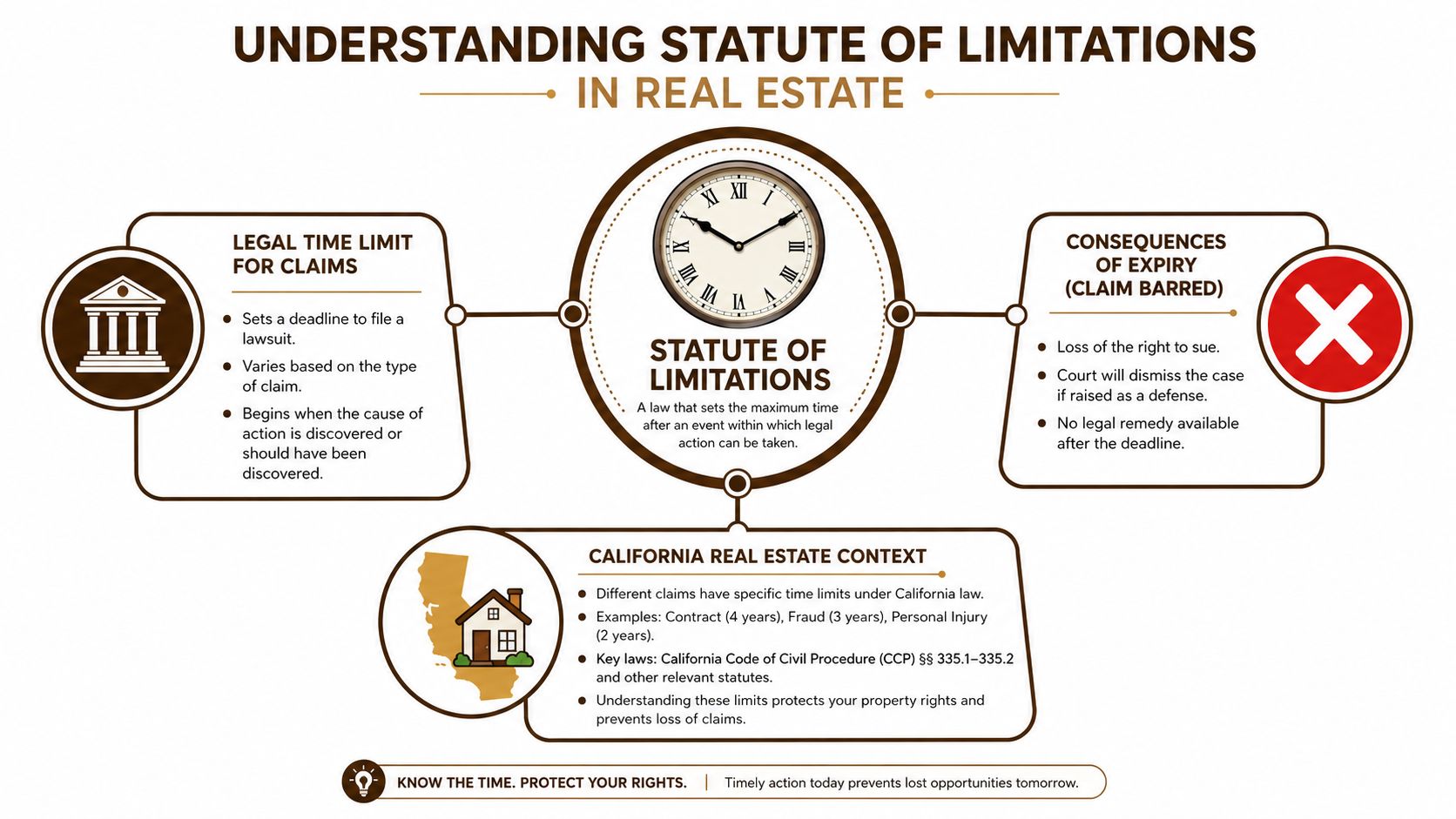
A statute of limitations is a legal time limit for filing suit. It operates like a clock that starts ticking when the law says a claim has matured enough to be brought in court. Once the clock runs out, the claim is usually barred even if the facts feel unfair.
Why the type of claim matters more than the property
A common mistake is asking for one universal answer to a real estate deadline question. California does not work that way. The legal deadline usually depends on the type of claim, not just the property itself, and that's why written-contract claims, fraud claims, and broker-duty claims can have different filing windows, even when they come from the same transaction California claim-type distinctions and trigger-event analysis.
Practical rule: The first question is not “What property is involved?” It's “What legal wrong happened?”
This distinction matters in estate and title disputes because one set of facts can create several claims at once. For example, a family may challenge a deed, allege nondisclosure, and argue breach of a written agreement. If each claim has a different start date, the filing strategy has to account for all of them.
Accrual, trigger date, and tolling in plain English
Lawyers use the word accrual to describe when a claim legally starts. The trigger date is the event that starts the clock, such as a breach, discovery of fraud, possession, or recordation. Tolling means the clock pauses or is extended because the law recognizes a special reason the deadline shouldn't run normally.
A simple analogy helps. If a carton of milk has an expiration date, you do not wait until it smells bad to check the label. Real estate claims work the same way. If you wait too long to confirm the deadline, the right to file can spoil before you use it.
In California practice, the trigger date can be the hardest part of the analysis. Missing that detail is how people lose otherwise serious claims. That's why real estate deadline work starts with the event, not the emotion.
Statute of Limitations Real Estate Deadlines for Common Claims
The fastest way to make sense of statute of limitations real estate rules in California is to match each claim to its deadline and trigger event. The same transaction may support more than one cause of action, but each one can move on a different schedule. That is why pleadings matter so much.
In California, breach of contract claims in real estate disputes often turn on a 4-year period, fraud on a 3-year period, and certain claims against a broker on a 2-year period. The broker deadline can run from the date of possession, recordation, or occupancy, whichever happens first California real-estate limitations by claim type.
Quick comparison of the main California deadlines
| Cause of Action in California | Limitations Period | Typical Trigger Event |
|---|---|---|
| Breach of written real estate contract | 4 years | Date of breach |
| Oral real estate agreement | 2 years | Date of breach |
| Fraud in a real estate transaction | 3 years | Date of discovery |
| Certain broker-related actions | 2 years | Possession, recordation, or occupancy, whichever occurs first |
The self-help court guidance in California also notes that many claims begin when the problem was discovered or reasonably should have been discovered California court guidance on when claims start. That matters in real estate because defects and misrepresentations often stay hidden for a while.
Why the pleading choice can change the result
Two people can describe the same property dispute and still get different deadlines. One may frame the facts as a contract case. Another may frame them as fraud. A third may focus on broker conduct. Each framing can change the filing window.
That's why a title dispute in probate can't be approached casually. If the ownership problem is rooted in a concealed transfer, the fraud deadline may be the central issue. If the dispute is about a signed agreement to convey property, the contract deadline may control instead.
Key point: The deadline follows the claim, not the emotion behind the claim.
Families often lose time because they spend months trying to prove the full story before checking the clock. The safer approach is to identify every possible claim early, then measure each one separately. In California, that step can determine whether the case moves forward at all.
Calculating Real Estate Deadline Start Dates
Knowing the length of the deadline is only half the job. You also need the right start date. In real estate disputes, that's where people get tripped up, because the trigger can be the breach itself, the discovery of the problem, or another legal event tied to the transaction.
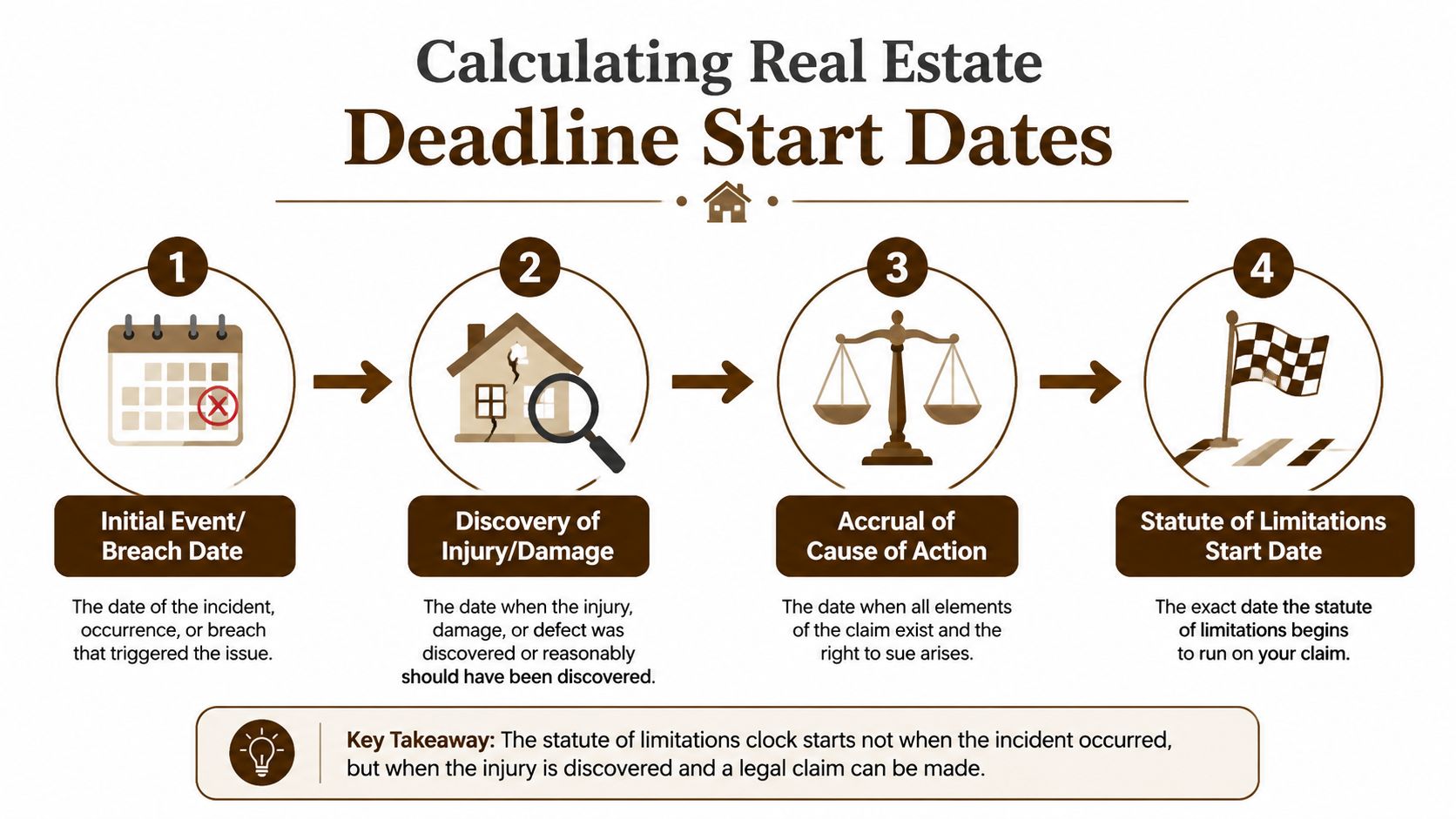
The California court guidance says the clock starts when the problem was discovered or reasonably should have been discovered for many claims California court guidance on discovery-based timing. That is especially important when a defect, concealed transfer, or misstatement wasn't obvious at closing.
How to track the start date step by step
Start with the legal event, not the calendar year you remember most clearly. For a written real estate contract, the breach date usually matters most. For fraud, the discovery date matters. For certain broker claims, possession, recordation, or occupancy can matter California real-estate limitations by claim type.
A written contract example is straightforward. If a real estate contract is breached on one date, the 4-year clock begins from that breach California written and oral contract time limits. An oral real estate agreement is shorter, with a 2-year limit.
The harder example is fraud. California treats fraud differently because the period begins when the fraud is discovered, not necessarily when the deal closed California fraud discovery rule. That rule protects buyers who learn later that information was hidden or misstated.
If the wrongful act was hidden, the calendar you trust may be the wrong calendar.
A simple homeowner example
Consider a family that learns in probate that a property transfer happened years earlier. If the transfer was concealed, the key question is not just when the deed was signed. The question is when the family first had enough information to reasonably investigate. That's where discovery and accrual become critical.
For practical purposes, a careful deadline review should ask four questions.
- What happened first? Identify the breach, transfer, or misrepresentation.
- When did the injured person learn about it? This is vital for fraud and concealed defect claims.
- What does the claim sound like in court? Contract, fraud, or broker misconduct may each have a different clock.
- Was the problem reasonably discoverable earlier? That issue can move the start date.
The biggest mistake is assuming all deadlines start on the sale date. In California real estate cases, that's often false.
Tolling and Discovery Rules in California Real Estate
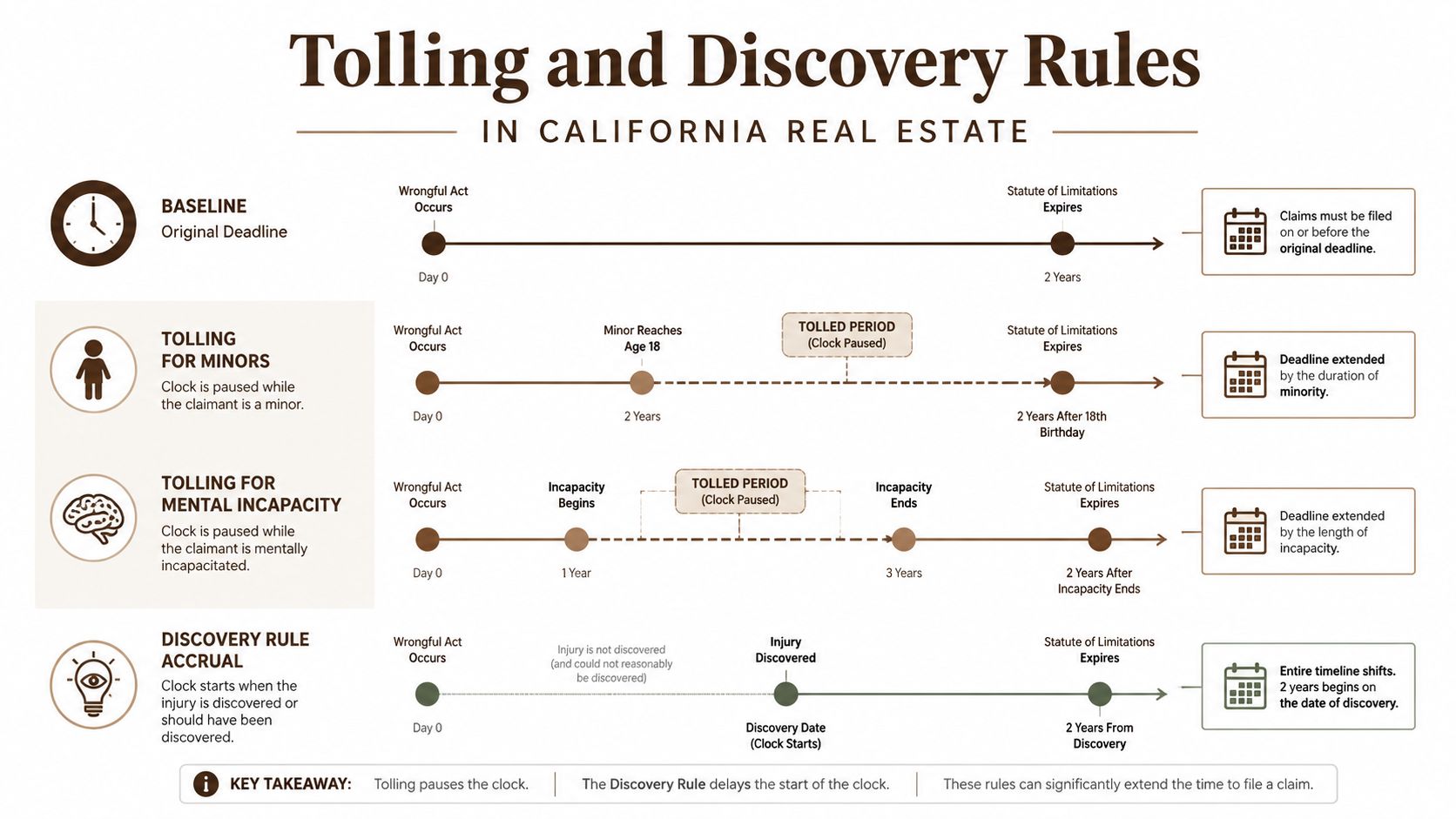
California does not always let the clock run in a straight line. Sometimes the law pauses it. Sometimes the clock starts later because the injury was hidden. In a property case, those differences can decide whether a claim survives.
Tolling means the clock can pause
Tolling is a legal pause. When tolling applies, the deadline may stop running for a period of time and then resume later. That matters when a person cannot reasonably act, or when the law recognizes a special circumstance that delays suit.
In fraud cases, the more important concept is often the discovery rule. California's discovery-based approach means the deadline can begin when the fraud is discovered, not when the transaction occurred California fraud discovery rule. That protects people from being forced to sue before they know they were misled.
Why hidden problems change the analysis
Real estate problems are often invisible at first. A title issue may surface only after a probate review. A misrepresentation may not make sense until repair documents, escrow records, or family records are reviewed together. In those situations, California law can recognize delayed accrual when the injured party could not reasonably have known earlier California fraud discovery rule.
Document the first reliable date of discovery. That date can matter as much as the deed date itself.
The court guidance also says the clock can start when the problem was reasonably should have been discovered, not just when someone says they first noticed it California court guidance on discovery-based timing. That means a person can't always wait for perfect proof before the deadline begins.
What families should watch for
In probate and estate disputes, the facts often overlap. Ownership questions, disclosure issues, and contract issues can all appear together. That overlap makes it easy to misread the deadline, especially when one family member learns about a transfer long after it happened.
The safe habit is to keep a written record of when you first saw the deed, first reviewed the probate file, first received the title report, or first learned of the alleged misstatement. That record helps a lawyer test whether the deadline started earlier or later. It also helps when the other side argues the claim was stale long before anyone knew the facts.
Orange County Case Examples of Deadline Issues
A real title dispute can look strong on the merits and still fail on timing. In Orange County, that is often what surprises families most. They assume the strength of the ownership claim will matter more than the filing date, but California courts care about both.
In one quiet title dispute, the homeowner learned that the action was filed just after the four-year contract window had closed. The underlying dispute was serious, but the court never reached the merits because the claim was time-barred. The lesson was simple. The wrong calendar date can defeat the right argument.
A second dispute involved a recorded-property issue that was tied to timing confusion. The owner focused on occupancy and missed the significance of the recordation date. That mistake mattered because certain California broker-related deadlines can run from possession, recordation, or occupancy, whichever occurs first California real-estate limitations by claim type.
What these disputes teach families in OC and LA
These examples show how easy it is to focus on the facts people talk about and miss the legal event that starts the clock. A family may keep discussing who lived in the house, who paid taxes, or who had the keys. The court may care more about when a document was recorded or when a breach occurred.
For families handling inherited property, that can be especially painful. Probate files often contain overlapping dates, and one missed deadline can affect ownership, sale proceeds, or the ability to clear title. That's why title disputes in Orange County and Los Angeles should be reviewed with the dates mapped out, not just the story retold.
A case can look strong and still be late. California deadline law does not forgive guessing.
If a matter may involve both probate and real estate issues, the safest move is to compare the deed history, estate file, escrow records, and any written agreement together. That lets counsel identify the likely trigger event before a filing window closes.
Practical Steps to Protect or Defend Real Estate Claims
When a property problem surfaces, speed matters, but organized proof matters too. The best cases are not just filed quickly. They're filed with the right dates, the right documents, and the right legal theory.
A homeowner or heir trying to preserve a claim should start with a title search and a document review. Pull the deed history, escrow papers, trust or probate records, and any written communications that show when the issue first became visible. If the claim may involve fraud or concealment, write down the first date of discovery and what caused the discovery.
For defense work, the checklist is different. Counsel should verify the trigger date, test whether the plaintiff could have discovered the issue earlier, and see whether the claim was filed after the applicable period. In California, that often means matching the cause of action to the correct deadline before the case gets framed incorrectly.
A practical filing and defense checklist
- Confirm the claim type early: Decide whether the dispute sounds in contract, fraud, broker misconduct, or another real property claim.
- Pin down the trigger event: Use the breach date, discovery date, possession date, or recordation date that fits the claim.
- Save the proof of discovery: Keep emails, title reports, probate notices, and notes showing when the problem first came to light.
- Watch overlapping deadlines: One transaction can create more than one clock.
- Act before the window closes: Filing late can end the case before the merits are heard.
If you want a local lawyer to review the timeline, Tanner Law handles property disputes, quiet title issues, partition matters, and related probate problems in Southern California. A timely review can help sort out which date controls and whether any defense to a stale claim applies.
Conclusion and Next Steps
California's real estate deadlines are unforgiving because they turn on the claim, the trigger event, and sometimes the date of discovery. A deed problem, fraud issue, or contract dispute can all carry different clocks, even when they arise from the same family conflict or property transfer. That's why careful date tracking is just as important as the underlying facts.
For families in Orange County and Los Angeles, the practical takeaway is straightforward. Don't assume the deadline starts when the sale closed. Don't assume a title problem is still timely just because it was discovered late. And don't wait to get legal help when ownership, probate, and disclosure issues overlap.
A prompt review can preserve options that disappear if the clock runs out. California law protects diligence, not delay.
A CTA for Tanner Law. Schedule a free consultation today so our team can review your dates, identify the correct California deadline, and help protect your property rights before time runs out.