Judgment Enforcement Attorney: Orange County, CA
You won your case. The judge signed the judgment. You assumed payment would follow.
Then nothing happened.
For many Orange County families, landlords, trustees, heirs, and small property owners, that's the most frustrating part of civil litigation. A court order says money is owed, but collecting it is a separate process under California law. If the debtor ignores the judgment, changes accounts, moves property, or hides income, the paper judgment doesn't enforce itself.
That's where a Judgment Enforcement Attorney becomes valuable. This work sits in the gap between winning in court and recovering money. It often matters in disputes tied to probate distributions, real estate obligations, family loans, contractor matters, and business conflicts. If you're in Orange County or Los Angeles, speed, documentation, and the right enforcement tool can make the difference between recovery and a judgment that expires unused.
Table of Contents
- Why You Need a Judgment Enforcement Attorney
- Understanding Judgment Enforcement Attorney Role
- Key Legal Tools for Enforcing Money Judgments
- Typical Timelines and Cost Breakdown
- Client Preparation Checklist for Enforcement
- Real Tanner Law Success Stories
- Frequently Asked Questions
- Next Steps and Free Consultation
Why You Need a Judgment Enforcement Attorney
A common California scenario looks like this. A family in Orange County lends money to a relative, or a property owner wins a money judgment after a contractor dispute. The creditor has a signed judgment for $10,000, but the debtor stops answering calls, closes one bank account, and keeps working as if nothing happened.
At that point, many people realize something important. A judgment is proof of the debt. It is not automatic collection.
California's post-judgment system gives creditors legal tools, but those tools have rules, filing steps, timing issues, and enforcement limits. A missed form, a delayed writ, or poor asset information can slow everything down. That's why a focused attorney often matters more after judgment than many people expect.
In a major Southern California judicial market, over 50% of civil judgments remain unpaid despite enforceable court orders, according to reporting on Los Angeles County judgment collection. That doesn't mean collection is hopeless. It means collection is technical.
Practical rule: Winning the lawsuit answers who owes money. Enforcing the judgment answers where the money is and how California law allows you to reach it.
A judgment enforcement attorney helps with that second question. The attorney's job is to locate assets, choose the right collection device, prepare the court paperwork, and act before the debtor has more time to transfer or conceal property.
For Orange County readers, this is especially relevant in cases involving inherited property disputes, unpaid settlement obligations, landlord matters, and real estate-related claims. When the underlying dispute is emotional or financially draining, people often wait too long. That delay can make collection much harder.
Understanding Judgment Enforcement Attorney Role
A judgment enforcement attorney focuses on the collection phase after the court enters judgment. The job is practical and procedural. Figure out what the debtor owns, determine which assets California law allows a creditor to reach, and set the process in motion correctly.
For many Orange County clients, this role becomes clearer with a simple example. A landlord wins a money judgment against a former tenant, or a business owner wins a settlement-related judgment against a partner. The court order confirms the debt, but it does not reveal where the bank accounts are, whether the debtor changed jobs, or whether real property in Irvine, Anaheim, or Newport Beach is already encumbered. Enforcement counsel handles those next questions.
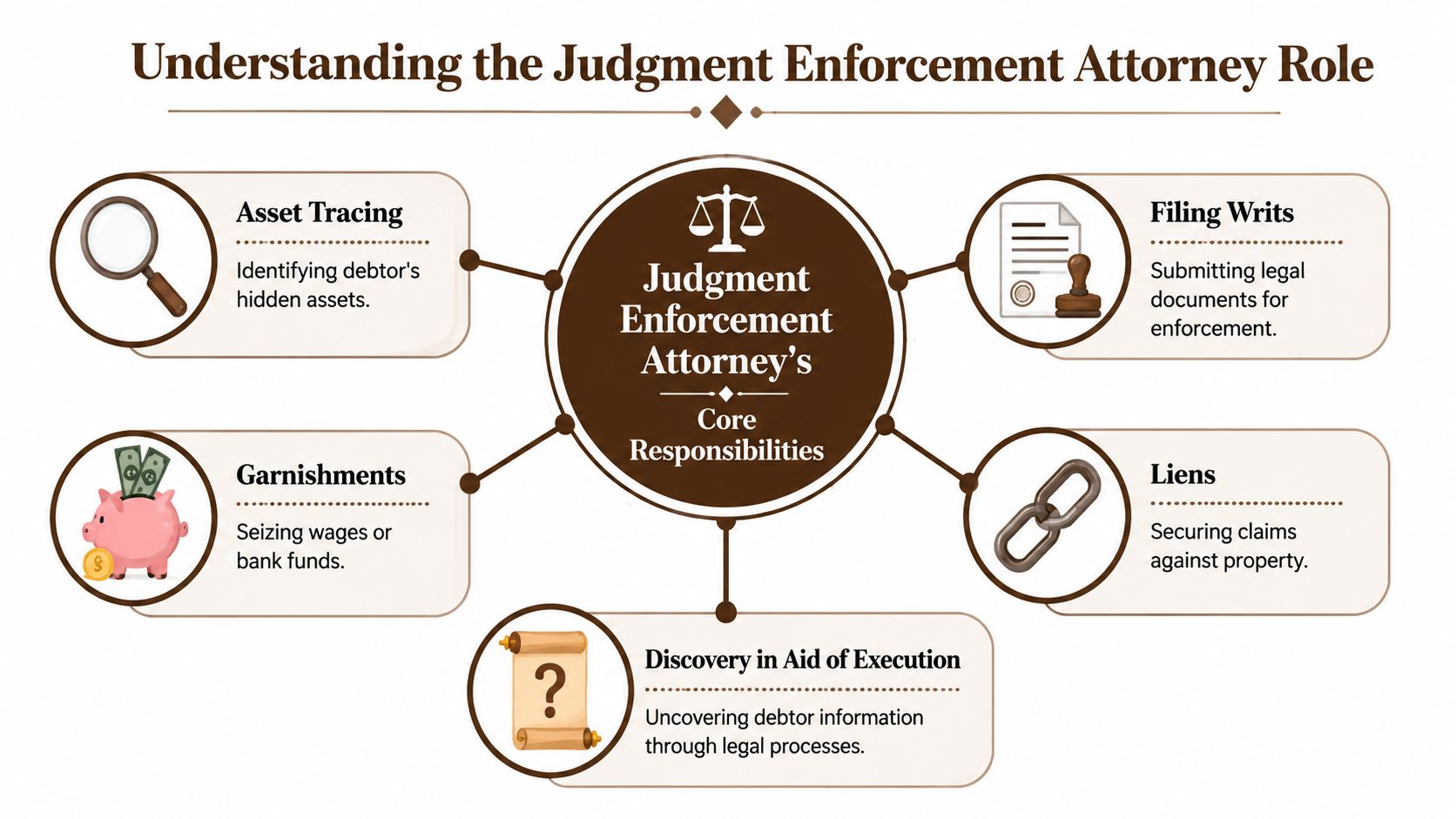
The five jobs that matter most
This attorney usually fills several roles at once: investigator, strategist, and procedural specialist.
- Asset tracing focuses on locating wages, bank accounts, business interests, vehicles, real estate, and money owed to the debtor by others.
- Filing writs means securing the court authority needed before a levying officer can act.
- Garnishments and levies aim at earnings or funds after a reliable source is identified.
- Liens attach the judgment to certain property interests, which can matter greatly in Orange County real estate cases where a future sale or refinance may create pressure to resolve the debt.
- Discovery in aid of execution uses formal legal procedures to require the debtor or third parties to provide financial information.
Those tasks sound straightforward on paper. The difficulty usually lies in timing, county-specific filing steps, service requirements, exemption issues, and choosing the right order of operations.
Why specialization matters
An attorney who handles enforcement regularly approaches the case like a mechanic diagnosing a specific engine problem instead of just listening for noise. The questions are narrower and more useful. Is the debtor a wage earner, a small business owner, or both? Is title held personally, jointly, or through an LLC? Is the Orange County property a residence, an investment, or part of a probate-related dispute? Does it make sense to record a lien first, pursue debtor examination procedures, or prepare a bank levy package?
California procedure leaves little room for guesswork. Deadlines continue to matter after judgment. So do court forms, county recording practices, sheriff instructions, and the debtor's possible exemption claims. In Orange County matters, small clerical errors can create expensive delay, especially when the creditor is trying to reach rent streams, escrow proceeds, or business receivables.
A strong enforcement plan usually begins with information gathering so the creditor can identify the right asset before attempting seizure.
What clients often misunderstand
Many judgment creditors expect a court clerk, sheriff, or collection company to do the whole job. In practice, each participant has a limited role. The court processes filings. The sheriff or levying officer carries out authorized instructions. A collection agency may help in some cases, but it may not be the right fit where the judgment involves California property records, entity ownership, or disputed asset locations.
Clients also underestimate the preparation work. A lawyer often needs old addresses, business names, copies of checks, wire details, prior contracts, property information, and any clue that shows where money flows. A missing detail can matter. The correct bank branch, employer name, or parcel information may be the difference between an effective levy and a wasted filing fee.
That is why the attorney's role is less about abstract legal theory and more about building a workable collection map, step by step, under California rules.
Key Legal Tools for Enforcing Money Judgments
Winning a judgment is like getting a map with several routes marked on it. The map helps only if you choose the road that reaches the debtor's money or property.
California offers several enforcement tools, but each tool is tied to a different kind of asset. In Orange County cases, that practical match matters a lot. A bank levy requires accurate bank information. A real property lien depends on proper recording. A charging order depends on how the business interest is legally structured.
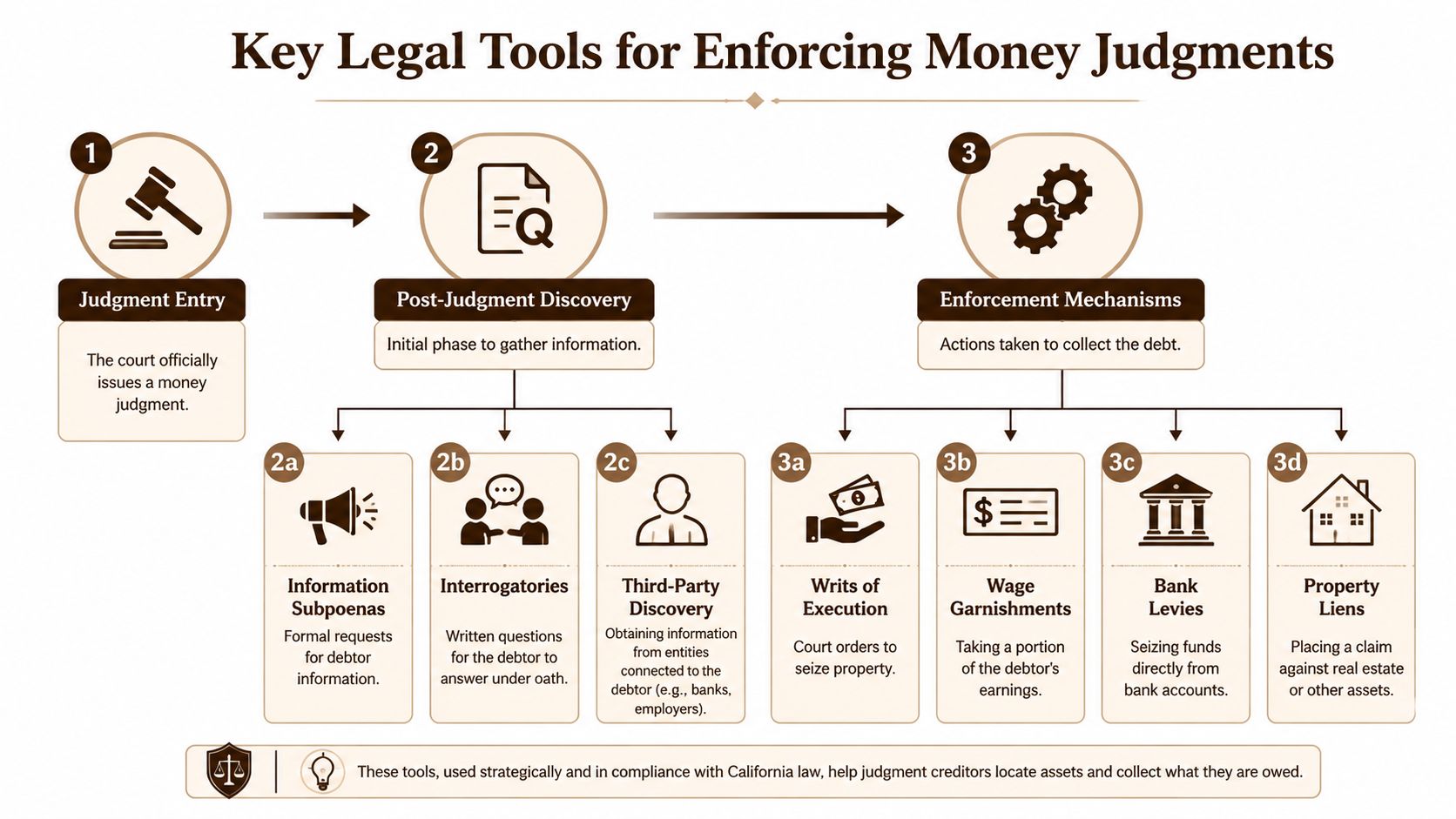
A useful way to organize the process is by sequence: locate the asset, choose the matching enforcement tool, then carry out the collection step under California procedure.
Post-judgment discovery
Post-judgment discovery is often the starting point because creditors usually need better information before spending money on levies, garnishments, or recorded liens. If the debtor has changed banks, moved income into a business, or shifted property into a different county, early discovery can keep the enforcement plan from heading in the wrong direction.
California practice may include written questions under oath, document demands, debtor examinations, and requests directed to third parties who hold useful records. The point is straightforward. Discovery gives the attorney a factual target for the next filing.
Key distinction: A writ is far more useful when the creditor already knows which account, employer, tenant, or property interest to pursue.
For Orange County creditors, this stage often uncovers details that general articles skip. Which bank branch has been used recently? Is the debtor collecting rent from a property in Newport Beach or Anaheim? Is income flowing through an LLC instead of a personal account? Answers like these can change the entire enforcement plan.
A short reference table helps:
| Tool | What it does | Why it matters |
|---|---|---|
| Information subpoena | Requests financial details | Helps locate accounts and assets |
| Interrogatories | Requires written answers under oath | Clarifies employment, income, and ownership |
| Third-party discovery | Seeks records from others tied to the debtor | Useful when the debtor's own disclosures appear incomplete |
The following video gives a practical overview of collection process concepts:
Writs of execution and levies
A writ of execution is the court's official authorization for an enforcement officer to act against a debtor's property. After the writ is issued, the next question is very specific: what asset is the levying officer being asked to reach?
If the creditor knows the debtor's bank account, a levy may freeze funds in that account. If the debtor owns nonexempt personal property, the writ can support action against that property as well. Precision matters here because enforcement instructions, identifying details, and county procedures have to line up.
That local detail matters in Orange County. Even a strong judgment can lose time over incomplete levy instructions, outdated addresses, or county-specific filing and service issues. Clients often focus on the legal right to collect. In practice, collection also depends on accurate paperwork and correct asset identification.
Wage garnishment
Wage garnishment can work well when the debtor has stable employment and no obvious bank balance large enough to satisfy the judgment quickly. Under California law, a judgment creditor may garnish up to 25% of the debtor's disposable earnings, subject to the statutory calculation described in the Sacramento County Public Law Library's enforcement guide.
This remedy usually works more like an installment stream than a one-time recovery. For that reason, attorneys often compare likely speed, employer stability, and exemption issues before recommending it. A debtor who changes jobs often may require more follow-up than a debtor with long-term employment at the same company.
Orange County cases sometimes raise another practical issue. Creditors may know where the debtor works informally, through business contacts or prior transactions, but still need legally usable employer details before garnishment can begin.
Liens on real property
A judgment lien places a recorded claim against real estate owned by the debtor. Payment may not arrive right away, but the lien can create pressure when the debtor wants to sell, refinance, or clear title.
That tool is especially relevant in Orange County, where real property values can make even a partial equity position worth tracking closely. Recording errors, name variations, and incorrect property identification can weaken the result, so the lien process has to be handled carefully under California recording rules.
In states such as New York and Florida, attorneys commonly use a recorded judgment lien certificate or transcript to establish priority against real property, and related guidance also notes that creditors often have a long statutory enforcement period but should move quickly against the most accessible assets, as described in this discussion of judgment liens and charging orders. For California readers, the practical lesson is similar. Real estate can become one of the most useful pressure points if the lien is recorded properly and monitored over time.
Charging orders for business interests
Business interests require a different approach because the debtor may own an LLC membership interest or partnership interest without personally owning the company's assets. In that situation, a charging order may direct distributions that would otherwise go to the debtor.
This issue comes up often in Orange County because many debtors hold value through closely held companies, family entities, and real estate ventures. A creditor may see a business with visible activity and assume its bank account can be levied immediately. The legal analysis is narrower than that. The enforcement remedy has to match the debtor's ownership rights.
That is why a judgment enforcement attorney spends time identifying the actual asset before filing the next paper. An LLC interest, rental stream, escrow payment, and personal bank account may all relate to the same debtor, but California law treats them differently.
Typical Timelines and Cost Breakdown
Most California creditors ask two questions first. How long will this take, and what will it cost?
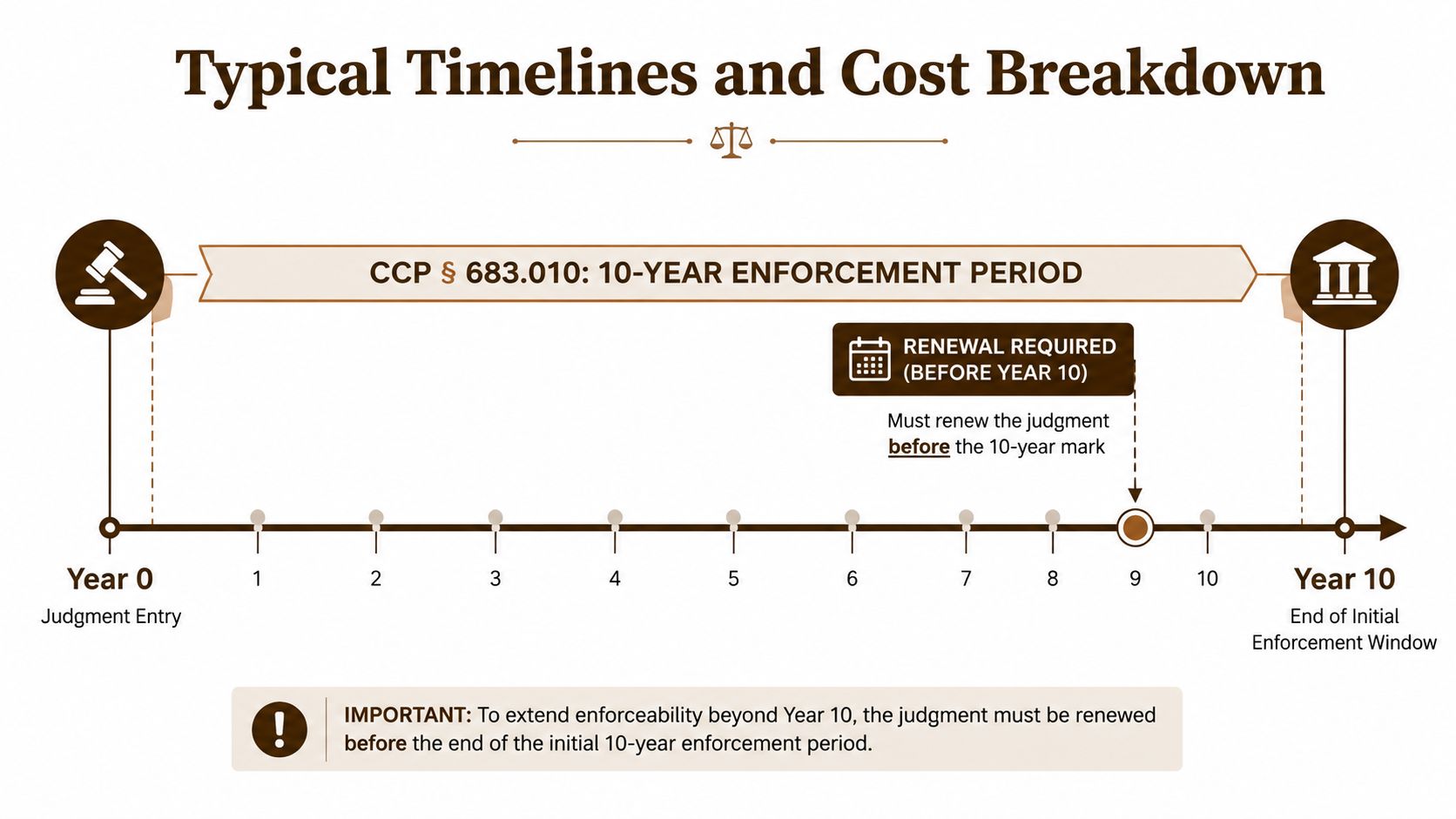
The first answer is that California law gives money judgments a 10-year enforcement period, and if the creditor doesn't renew in time, the judgment can become unenforceable, as reflected in California law materials addressing the 10-year enforcement window and renewal requirement. That's the outside legal window, not a recommended pace.
The timeline clients should watch
A practical timeline looks like this:
- Immediately after judgment. Gather debtor information, confirm addresses, and evaluate whether discovery should begin.
- Early enforcement phase. Identify the most reachable asset, such as wages, a bank account, or real estate.
- Active collection phase. File for the appropriate writs, levies, garnishments, or liens.
- Long-tail phase. Monitor payments, track property changes, and review whether renewal is needed before the original enforcement period expires.
Most delay problems happen at the front end. Clients assume they can always act later because the judgment exists for years. Legally, that may be true. Practically, assets move much faster than deadlines.
If a debtor is motivated to avoid payment, time usually helps the debtor more than the creditor.
The cost side of enforcement
For a collectible $10,000 judgment, the professional cost of enforcement typically ranges from $200 to $1,000, or about 2% to 10% of the judgment's face value, according to this discussion of judgment enforcement cost ranges.
That same source describes common components of that expense, including:
- Skip tracing fees in the $50 to $200 range
- Asset searches in the $100 to $500 range
- Court filing fees in the $25 to $150 range
- Levying officer charges in the $50 to $150 per action range
- Attorney fees that may range from $150 to $400 per hour
- Flat fees for some routine tasks, including $200 to $500 for a debtor examination and $300 to $800 for an assignment order motion
That doesn't mean every case will follow one pricing model. Some matters are document-heavy but straightforward. Others look simple until the debtor uses business entities, transfer tactics, or multiple counties.
A quick comparison helps:
| Cost issue | What it means for the client |
|---|---|
| Upfront search costs | Often necessary to avoid blind enforcement |
| Filing and levy charges | Procedural costs that attach to specific steps |
| Hourly legal work | Common when strategy and motion practice are needed |
| Flat-fee tasks | Helpful when the next move is clearly defined |
California also has an important fee rule. Under Code of Civil Procedure section 685.040, a judgment creditor may recover reasonable and necessary costs of enforcing a judgment, but post-judgment attorney's fees are recoverable only in limited circumstances tied to the underlying judgment's fee basis, as stated in California Code of Civil Procedure section 685.040. That's a detail clients often miss when budgeting.
Client Preparation Checklist for Enforcement
The fastest way to reduce delay is to give your attorney a clean file at the start. In Orange County enforcement work, missing records often cost more time than hard legal questions.
What to gather before the first meeting
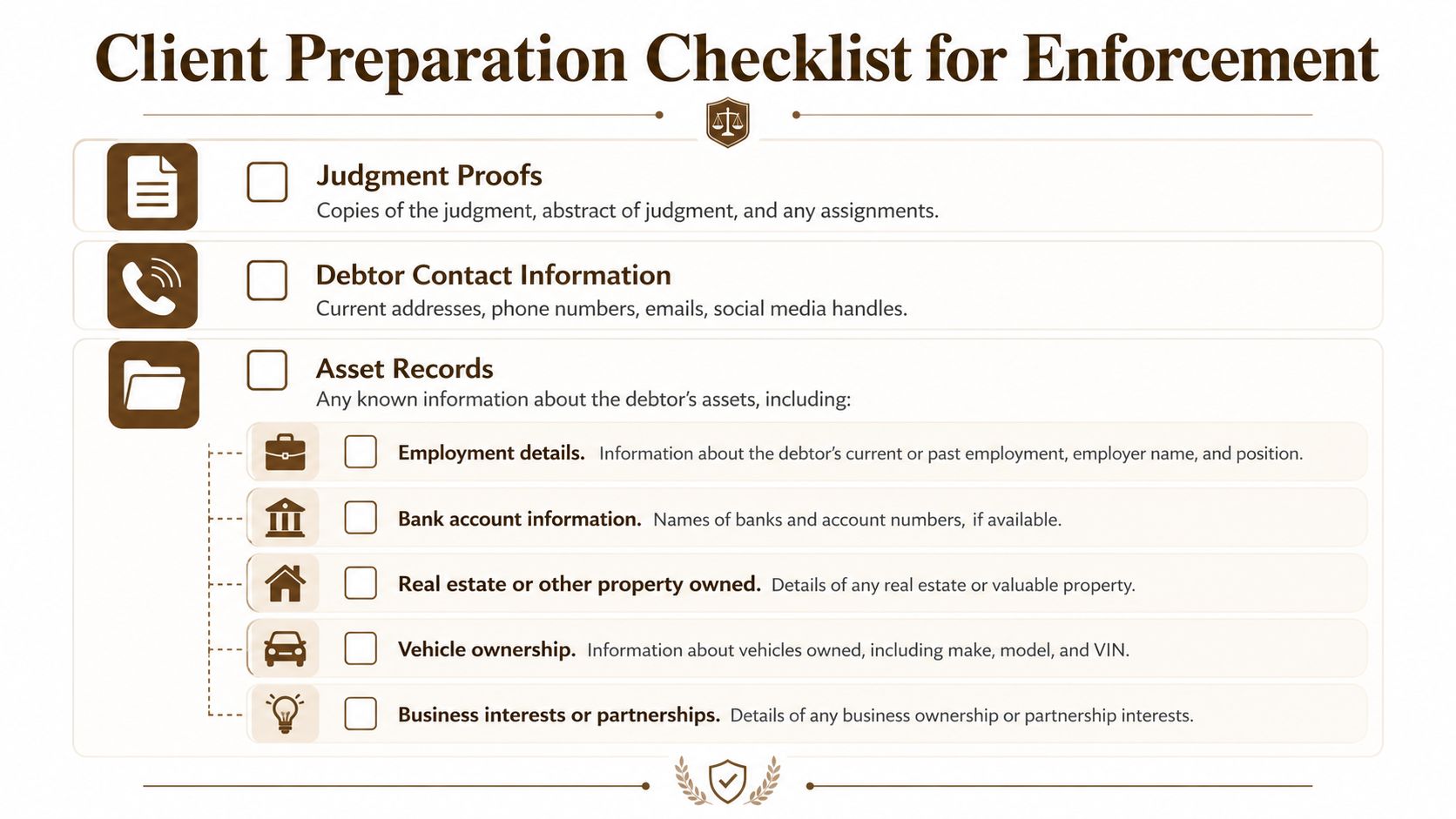
Bring the judgment itself, along with any related court papers that show who owes what and when the judgment was entered. If the claim changed hands or was assigned, bring the assignment records too.
Then focus on debtor information. Even imperfect information helps. An old address, an employer name, a vehicle plate, a real property address, or a business name can point the search in the right direction.
Use this checklist:
- Judgment papers. Bring copies of the judgment, abstracts, and any later orders related to enforcement.
- Debtor contact data. Collect current and former addresses, phone numbers, email addresses, and online profiles if you have them.
- Employment clues. Pay stubs, job titles, employer names, or workplace addresses can matter in wage enforcement.
- Banking details. Old checks, payment records, or transfer screenshots may help identify institutions.
- Property records. Deeds, listing history, tax bills, or escrow documents can reveal real estate interests.
- Vehicle and business information. Registration details, contractor license records, or entity records can open other enforcement avenues.
- Prior collection efforts. Save demand letters, settlement emails, payment promises, and records of partial payments.
What to track going forward
Create a simple timeline for yourself. Note the judgment date, any enforcement filings, any payment received, and any signs that the debtor is changing jobs or moving property.
Keep one master folder. The more your attorney has to reconstruct from scattered emails and text messages, the slower the first enforcement step becomes.
This matters in probate and family-related disputes because records are often split across siblings, trustees, property managers, and prior counsel. One organized client can save weeks of cleanup time.
Real Tanner Law Success Stories
Many people understand enforcement better through examples. Two Orange County matters show how post-judgment strategy can change the outcome.
In one case, a client obtained a $25,000 default judgment after a business-related dispute connected to property obligations. The debtor ignored demands and claimed there was no money to collect. Post-judgment investigation identified a bank account and Orange County real estate tied to the debtor. The enforcement strategy combined a bank collection step with a lien approach against the property. The matter resolved with $23,500 recovered within six months.
The lesson wasn't that one tool solved everything. It was that pressure worked from two directions. Liquid funds created urgency, and the property-based pressure reduced the debtor's ability to delay without consequences.
A second matter involved a debtor who appeared judgment-proof on paper. Direct personal assets were limited, but further investigation showed an interest in an LLC that made distributions. Instead of wasting time pursuing the wrong targets, the enforcement approach focused on the business interest. A charging-order strategy redirected the economic benefit flowing to the debtor and created a path toward payment.
What these stories show
- Hidden value isn't always hidden forever. It may sit in a bank account, in real estate equity, or in a business distribution stream.
- The right remedy depends on the asset. Real property, wages, and LLC interests each require different treatment.
- Delay favors the debtor. The faster counsel identifies the strategic point, the better the chance of meaningful recovery.
These examples also show why California judgment enforcement is not just form-filing. It is sequencing, investigation, and pressure applied lawfully.
Frequently Asked Questions
Does a partial payment stop enforcement fees
Not automatically. A debtor must fully satisfy the judgment by having payment received before a fee request, and mere tender without receipt doesn't cut off enforcement fee liability, according to this discussion of payment receipt and enforcement fee timing.
What if the 10-year deadline is close
That's urgent. California judgments have a renewal requirement before the original enforcement window expires. If you're nearing that point, get legal advice immediately because enforceability can be lost if renewal isn't handled in time.
Can I settle while a garnishment is active
Usually yes, but the paperwork has to match the agreement. A settlement during active enforcement should address payoff amount, timing, dismissal of enforcement steps, and proof of satisfaction. Don't assume the employer, levying officer, or court will stop activity based on informal promises alone.
Can attorney's fees for collection always be added
No. California law allows recovery of certain enforcement costs, but post-judgment attorney's fees aren't always recoverable. That issue often depends on the underlying contract, statute, or judgment language.
Next Steps and Free Consultation
If you hold an unpaid judgment in Orange County or Los Angeles, the most important step is usually the simplest one. Act while the information is still fresh.
A Judgment Enforcement Attorney works best when the file is organized, the debtor's trail is still warm, and the collection plan starts with the right asset. Under California law, that may involve discovery, levies, garnishments, liens, or business-interest remedies. The correct choice depends on what the debtor owns and how that ownership is structured.
Families dealing with probate disputes, inherited property issues, unpaid agreements, or real estate conflicts often need practical advice, not abstract legal theory. The goal is to convert a judgment into recovery with a strategy that fits the facts, the timeline, and the cost.
If you're holding an unpaid California judgment, don't let it sit in a drawer while assets move and deadlines approach. A focused review can identify the fastest realistic path forward and help you avoid wasted motions, missed renewal issues, and unnecessary expense.
If you need help enforcing a California judgment in Orange County or Los Angeles, schedule a free consultation with Tanner Law. William T. Tanner serves clients from Santa Ana with clear, cost-conscious guidance and direct attorney access.