Small Claims Court Security Deposit: California Guide
You opened the mailbox, found a terse move-out letter, and then saw the security deposit statement. Maybe the landlord kept part of it for “repairs” you never saw, maybe the amount makes no sense, or maybe the whole deposit disappeared after you already handed back the keys and cleaned the place. In California, that is exactly the kind of dispute that ends up in small claims court when the paper trail is thin and the landlord's explanation does not hold up.
The hard part is not knowing whether you're frustrated. The hard part is knowing whether you can collect. In Orange County and Los Angeles, the tenants who do best are usually the ones who treat a deposit dispute like a document case, not a venting exercise. They track the 21-day deadline, save the move-out photos, and file only after they know the numbers and the evidence line up under California Civil Code §1950.5.
Table of Contents
- When a Security Deposit Dispute Is Worth Pursuing
- California Law That Drives Your Small Claims Case
- Building Your Evidence Package Before You File
- Filing the Claim Step by Step in California Small Claims
- What Actually Happens at the Hearing
- Common Landlord Defenses and How to Beat Them
- After the Judgment Collecting What You Won
When a Security Deposit Dispute Is Worth Pursuing
A tenant moves out of a condo in Irvine after giving proper notice, leaves the unit broom-clean, and then gets a statement that claims carpet damage, paint touch-up, and extra cleaning. The landlord keeps most of the deposit, but the receipts are vague, the timeline is sloppy, and no one ever sent a solid itemization. That is the kind of case that can justify small claims court security deposit litigation in California, but only if the tenant can prove more than annoyance.
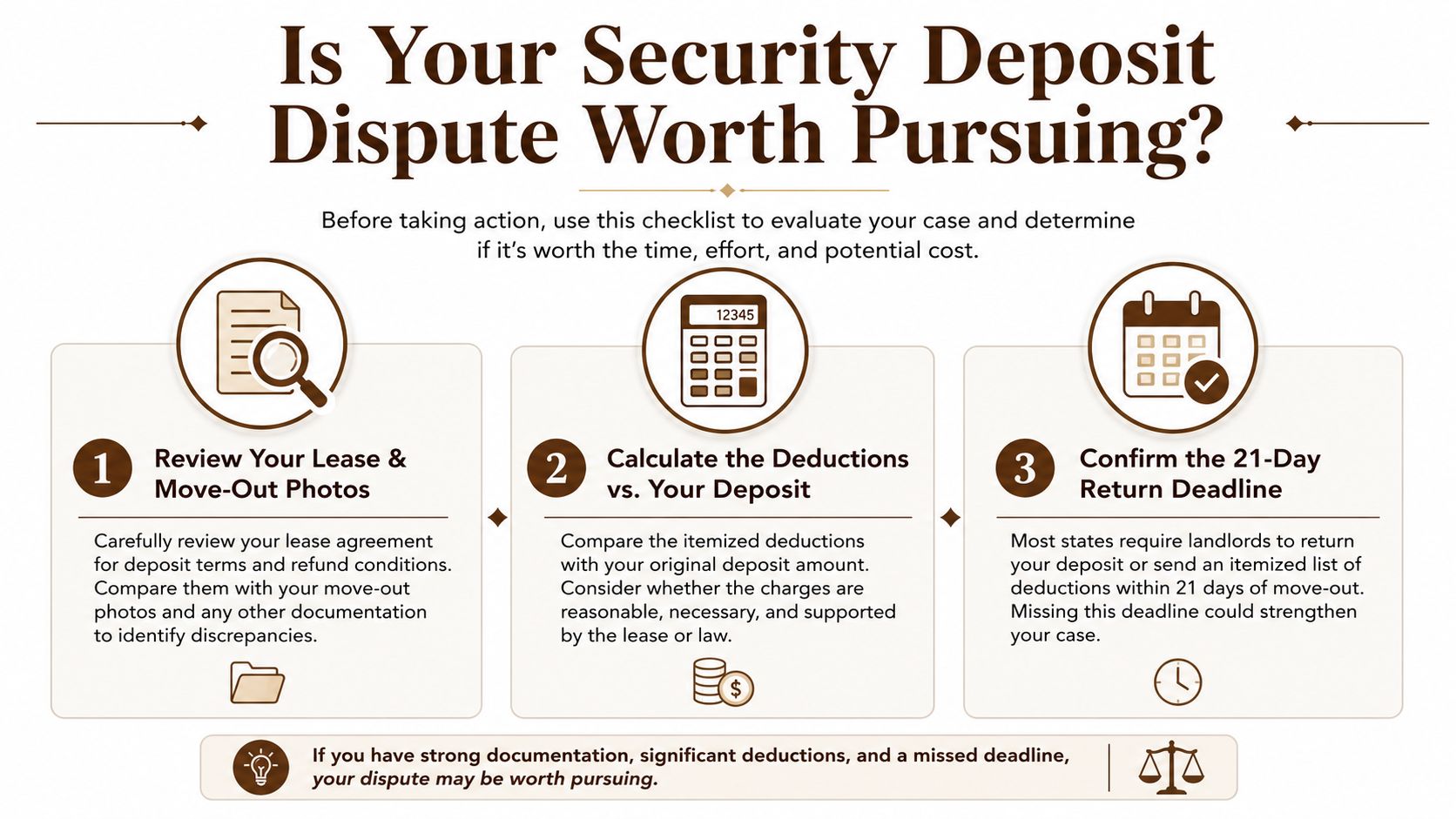
Three questions to answer before you file
First, ask whether the deposit was wrongfully withheld. If the landlord has no photos, no itemized statement, or no believable explanation for the deduction, the tenant often has the stronger story. California law puts the burden on the landlord to justify deductions by showing the unit's condition and explaining why the money was kept, which is why move-in and move-out documentation matters so much Nolo's discussion of California small claims deposit proof.
Second, ask whether the amount is worth the effort. Small claims is designed for disputes where the dollar amount is modest but the legal recourse matters. California tenants can sue for the deposit plus two times the security deposit in damages, and the recovery cap in small claims is $12,500, so the filing can be worthwhile even when the original deposit was not huge California courts security deposit guide.
Third, ask whether the timing is right. If the landlord's 21-day deadline has just passed, your claim is fresher and the documents are easier to line up. If weeks have gone by, witness memory fades, forwarding-address proof gets harder to reconstruct, and you lose some negotiating power even if the law is still on your side.
Practical rule: if you can't explain the deduction in one sentence and back it up with a photo or receipt, don't assume the landlord can.
A demand letter sometimes gets the job done without a hearing. When the landlord responds quickly and fixes the amount, that can save time, filing fees, and stress. When the response is vague or defensive, filing is often the better move.
California Law That Drives Your Small Claims Case
A deposit dispute in California turns on Civil Code §1950.5, not on how irritated the landlord is about the tenancy. For most tenancies entered into on or after July 1, 2024, the deposit is capped at one month's rent, the landlord must return it within 21 calendar days, and bad-faith withholding can trigger a penalty of up to twice the deposit. That statutory structure is why these disputes show up so often in small claims court California security deposit statistics and legal framework.
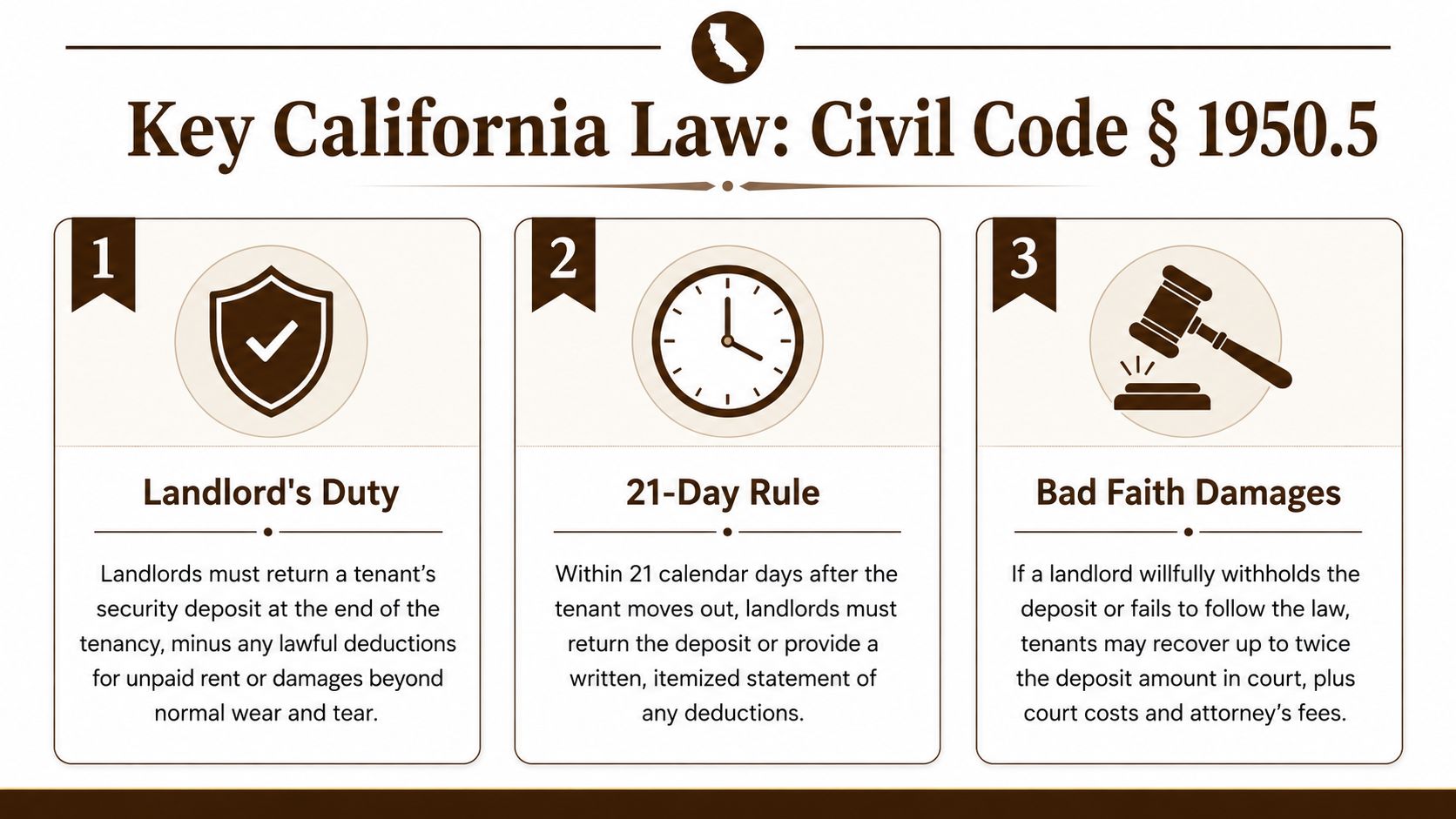
The decision tree California tenants should use
Start with the deadline. If the landlord missed the 21-day return window, the landlord has already created a problem. If deductions exceed $125, California tenant self-help materials say the landlord must attach receipts, which gives the tenant a concrete way to challenge unsupported charges California small claims and security deposit materials.
Then compare the claim to the small claims ceiling. California self-help courts say a tenant can sue for the deposit amount plus two times the security deposit in damages, but the tenant's recovery in small claims is capped at $12,500 California security deposit guide. Many ordinary deposit disputes still fit comfortably within one case, even after the statutory penalty is added.
Bad faith is a separate fight. California court-records analysis cited in later legal commentary found that tenants won more than 70% of security-deposit cases that reached judgment, but the bad-faith penalty was assessed in only 3.5% of tenant-filed cases. That difference matters in court. Proving the deposit was withheld is one thing. Proving the landlord acted in bad faith is harder, and judges usually want clean documents before they will go there.
California is also stricter than some other states. New York tenant guidance uses a 14-day return rule after move-out and forwarding address notice New York tenant guidance. California gives tenants more time, but the practical lesson is the same. The people who collect are the ones who document first and argue second.
The statute gives you an advantage, but the hearing still rewards clean facts over angry speeches.
Building Your Evidence Package Before You File
The best deposit case usually looks boring on paper. That is good. Judges trust neat, dated records more than emotional descriptions of a dirty wall or a disputed carpet stain. If you want a real shot in small claims court security deposit litigation, assemble the file before you file the claim.
What belongs in the packet
Start with the lease, every addendum, and any written move-in checklist. Add the move-in photos, the move-out photos, and any video that shows the condition of the unit on both dates. Include the forwarding-address notice, because California's timing rules only help you if you can prove the landlord knew where to send the money.
Then collect every text message and email exchange with the landlord or property manager. Save repair receipts if you paid for anything yourself, especially if the landlord later blames damage on you that never happened. If the landlord's deductions exceed $125, the statutory receipt issue becomes a useful pressure point, because unsupported line items often fall apart in front of a judge California small claims and security deposit materials.
Demand letter template
Demand for return of security deposit under California Civil Code §1950.5
Dear [Landlord Name],
I moved out of [address] on [date]. I am requesting the return of my security deposit because the deductions appear unsupported and/or were not timely provided under California law. Please send the full deposit balance, together with any itemized explanation and supporting receipts required by law, to [forwarding address] within 10 days of this letter. If this matter is not resolved, I will file a claim in California small claims court.Sincerely,
[Tenant Name]
That letter works because it does three things. It shows you asked first, it identifies the legal basis, and it creates a clean paper trail for the judge if the landlord ignores you.
| Document or Item | Why It Matters | Best Source |
|---|---|---|
| Lease and addenda | Shows deposit terms and rental obligations | Your signed rental packet |
| Move-in photos | Helps prove preexisting condition | Your phone, cloud backup, dated files |
| Move-out photos and video | Shows final condition when you left | Your phone, dated video, emailed copies |
| Forwarding-address notice | Proves where the refund should have gone | Your email, text, or written notice |
| Landlord's itemized statement | Tests whether deductions are specific and timely | The landlord's letter or email |
| Receipts for repairs or cleaning | Counters unsupported charges | Your own records, vendors, card statements |
Filing the Claim Step by Step in California Small Claims
Once the demand goes nowhere, file the case with the same discipline you used to gather the evidence. In California, the filing starts with Plaintiff's Claim and Order to Go to Small Claims Court, Form SC-100. The court wants the defendant identified correctly, the amount demanded stated clearly, and the reason the money is owed explained in plain terms. The cleaner the form, the easier it is for the judge to follow the dispute later.
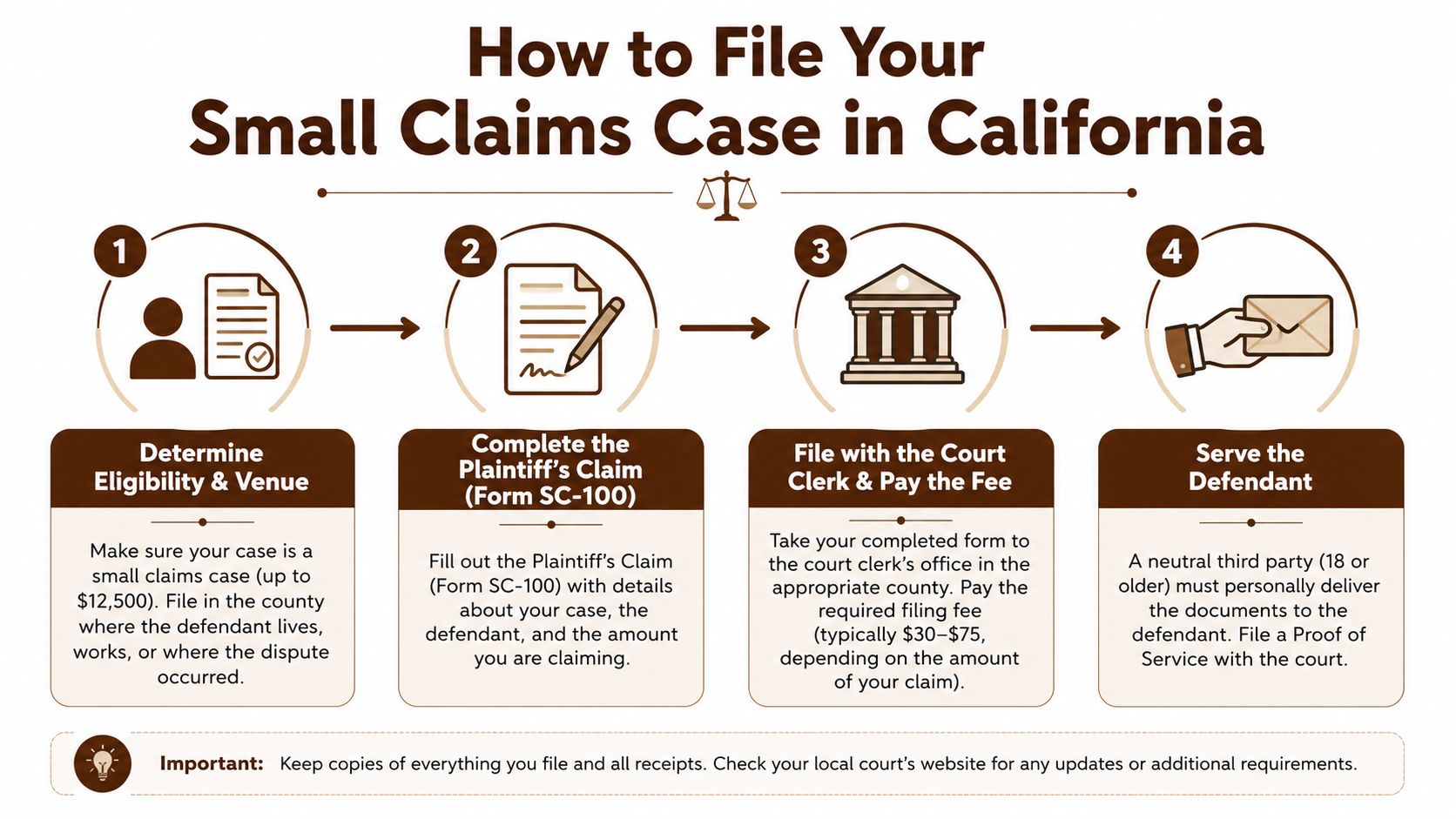
The filing sequence that works
File in the proper courthouse, usually where the defendant lives or where the rental property is located. Security-deposit cases follow California's ordinary small-claims filing rules, so the same basic filing and service steps apply after SC-100 is completed.
At the clerk's window, bring the completed form, your filing fee, and enough copies for service. California small-claims guides say the filing fee changes with the claim amount, and hearing dates are commonly set within a short window after filing. That is why waiting too long after the landlord's deadline can hurt you. The proof gets stale fast, and the landlord's records only get harder to challenge as time passes.
After filing, serve the defendant correctly. If service is defective, the case gets delayed or kicked. In a deposit dispute, that delay can matter because the landlord's receipts, photos, and memory are usually the first things to weaken.
Two filing mistakes that waste time
- Asking for the wrong amount: If your math is sloppy, the judge notices. Build the demand from the deposit plus the statutory damages you can support, then stay within the $12,500 ceiling.
- Waiting to serve: A filed case that is not properly served is just paperwork in a folder. The hearing will not fix that problem.
The case also has to be filed in the right place. If you choose the wrong courthouse, you create an avoidable fight before the judge ever reaches the merits. I have seen deposit cases lose momentum because the tenant filed in the courthouse that felt convenient instead of the one tied to the defendant or the rental property. Choose the venue that matches the rules, then move the paper through the system without gaps.
What Actually Happens at the Hearing
The courtroom is less formal than superior court, but it still rewards preparation. A judge in a deposit case wants to see the lease, the photos, the itemized statement, and a simple timeline. The tenant who walks in with a binder and a clear opening usually looks more credible than the landlord who arrives with a stack of unexplained papers.
The opening statement that lands well
Keep it short. “Your Honor, I moved out on [date], I gave my forwarding address, the landlord kept my deposit, and the deductions were not supported by the photos, receipts, or the required itemization.” Then stop. The judge knows what issue is in front of the court.
When you introduce exhibits, hand them up in order. Lease first, then move-in photos, then move-out photos, then the landlord's statement, then your demand letter. If the landlord appears, ask direct questions about the deductions, especially the basis for each line item and whether the landlord has receipts or inspection notes.
Do not argue every annoyance. Judges care about the deposit, the deadline, and the proof. They do not reward a tenant who turns the hearing into a rant about every maintenance issue from the whole tenancy.
What not to do in the room
Do not read your notes word for word. That usually makes the presentation feel scripted, not persuasive. Do not badger the landlord or talk over the judge. And do not skip the bad-faith argument if the facts support it. California law allows a penalty of up to twice the deposit for bad-faith withholding, so if the landlord ignored the deadline or invented deductions, that issue belongs in your presentation California security deposit statistics.
A fair hearing often ends with a practical settlement discussion. If the landlord suddenly offers a payment plan or a partial refund, compare that offer to the strength of your proof. A real offer can be better than waiting for a judgment you still have to collect.
Common Landlord Defenses and How to Beat Them
Landlords usually do not say, “I kept the money because I felt like it.” They say the tenant caused damage, left the place dirty, failed to give notice, or never proved the forwarding address. Those defenses can be real, but they are also often overstated.
How to test the most common excuses
Ordinary wear and tear. Normal aging is not the same as tenant damage. If the landlord is trying to charge for faded paint, worn carpet traffic, or minor scuffs, that often sounds more like routine use than a deductible loss. The judge will look for photos, not adjectives.
Damage beyond the deposit. If the landlord says the damage cost more than the deposit, ask for receipts, contractor invoices, and photos tied to the claimed repair. Unsupported numbers usually weaken the defense instead of helping it.
Late forwarding address. This argument matters only if the landlord can show the tenant never provided a forwarding address. If you have an email, text, or written notice, that defense gets much weaker.
The landlord's itemized statement. A paper list is not proof by itself. It needs to match the condition of the unit and the supporting records. When the statement is vague or generic, the judge often sees it as a stall rather than a real accounting.
| Landlord defense | Tenant response |
|---|---|
| Ordinary wear and tear | Show move-in and move-out photos, plus the lease condition at entry |
| Damage exceeded deposit | Demand receipts, dates, and repair evidence tied to the specific charge |
| No forwarding address | Produce the written notice, email, or text showing delivery |
| Itemized statement was provided | Attack the quality of the explanation, not just the existence of the letter |
Sometimes the landlord's settlement offer during the hearing is the better deal. If the offer is close to the provable amount and arrives before you have to spend more time enforcing a judgment, take it seriously. A clean, paid settlement beats a paper win that never turns into cash.
After the Judgment Collecting What You Won
A judgment is not the same thing as money in hand. In deposit cases, collection is where many tenants lose momentum. Once the judge signs the order, the next step is to wait through the post-judgment period, then use the enforcement tools California gives judgment creditors.
The tools that move a landlord to pay
Start with the Judgment Debtor's Statement of Assets, Form EJ-165. That form helps you identify wages, bank accounts, or other collectible assets. If the landlord does not volunteer payment, the form tells you whether wage garnishment, a bank levy, or property lien pressure makes sense.
An Earnings Withholding Order can reach wages when the landlord is employed by someone else. A bank levy can reach funds in an account if you know where the account is held. Recording an abstract of judgment can create a lien on real property the landlord owns, which matters in Southern California where many owners hold real estate rather than liquid cash.
Collection rule: the stronger your asset information, the cheaper and faster enforcement becomes.
The right method depends on the facts. If the landlord is an individual with steady wages, wage enforcement may be efficient. If the landlord owns a rental property but has no obvious paycheck, the abstract of judgment can create pressure. If you do not know where the money is, settlement pressure often starts with the post-judgment asset request.
California's small-claims housing docket is not a giant part of the overall court system, but it is recurring and real. The Connecticut court materials summarized landlord-tenant housing issues as only 0.08% to 2.4% of filings across the years reviewed, which is a reminder that these disputes may be a small slice of the docket, yet they still matter to the people living with them Connecticut court materials. The same practical truth applies here. A judgment only helps if you can collect it.
For a quick decision framework, check the deadline, calculate the amount, send the demand, file SC-100 if the landlord ignores you, and prepare the evidence before the hearing. If you are dealing with a California deposit dispute in Orange County or Los Angeles and you want a lawyer to review the papers, explain the venue, and help you decide whether to negotiate or litigate, schedule a free consultation with Tanner Law.