Breach of Lease Contract: A California Guide
A tenant stops paying rent, a homeowner finds an unauthorized pet in the unit, or a landlord in Santa Ana gets a complaint about repeated rule violations. At that point, emotions usually show up before the paperwork does. In California, a breach of lease contract is rarely just a private argument, because the notice, cure, and remedy steps can shape whether the dispute ends without further issue or turns into a lawsuit.
Orange County and Los Angeles families run into these problems in both residential and commercial settings. The legal answer depends on the lease language, the type of violation, and whether California notice rules were followed. A calm, document-based approach usually protects everyone better than threats or assumptions.
Table of Contents
- Why Lease Breaches Matter in California
- Defining Breach of Lease Contract Clearly
- California Remedies and Notice Procedures
- Common Breach Examples and Lease Data
- Practical Strategies for Landlords and Tenants
- Defenses and Misconceptions About Breach
- When to Consult an Attorney and Next Steps
Why Lease Breaches Matter in California
A Santa Ana landlord opens the door to a unit expecting a routine inspection and finds an unauthorized pet, extra occupants, and unpaid rent notices stacked on the counter. A tenant in Los Angeles may have the opposite experience, where the landlord ignores a repair issue and then suddenly threatens termination after a disagreement about payment. Either way, the problem is not just frustration, it is a lease breach with real legal consequences under California law.
The first reason these disputes matter is simple. A lease is the rulebook for who may do what, when, and under what conditions. When one side breaks the agreement, the question becomes whether the violation is serious enough to justify termination, or whether the law points to a narrower remedy like damages or a chance to cure. That distinction matters because the same facts can lead to very different outcomes depending on how the lease is written and how California treats the default.
Another reason is timing. In California, many residential disputes move through written notice before anyone talks about court. That means a landlord who skips the proper notice may weaken the case, while a tenant who ignores the notice may lose the best chance to fix the problem early. In practice, the legal timeline often matters as much as the underlying conduct.
Practical rule: The fastest path to a bad result is treating a lease problem like a personal argument instead of a document problem.
The stakes are even higher for families and investors who hold property for probate, inheritance, or long-term planning. A lease dispute can affect cash flow, move-out timing, repairs, and the ability to sell or transfer property cleanly. The good news is that California gives a structured framework for handling these disputes, and once you understand that framework, the issue becomes much less mysterious.
Defining Breach of Lease Contract Clearly
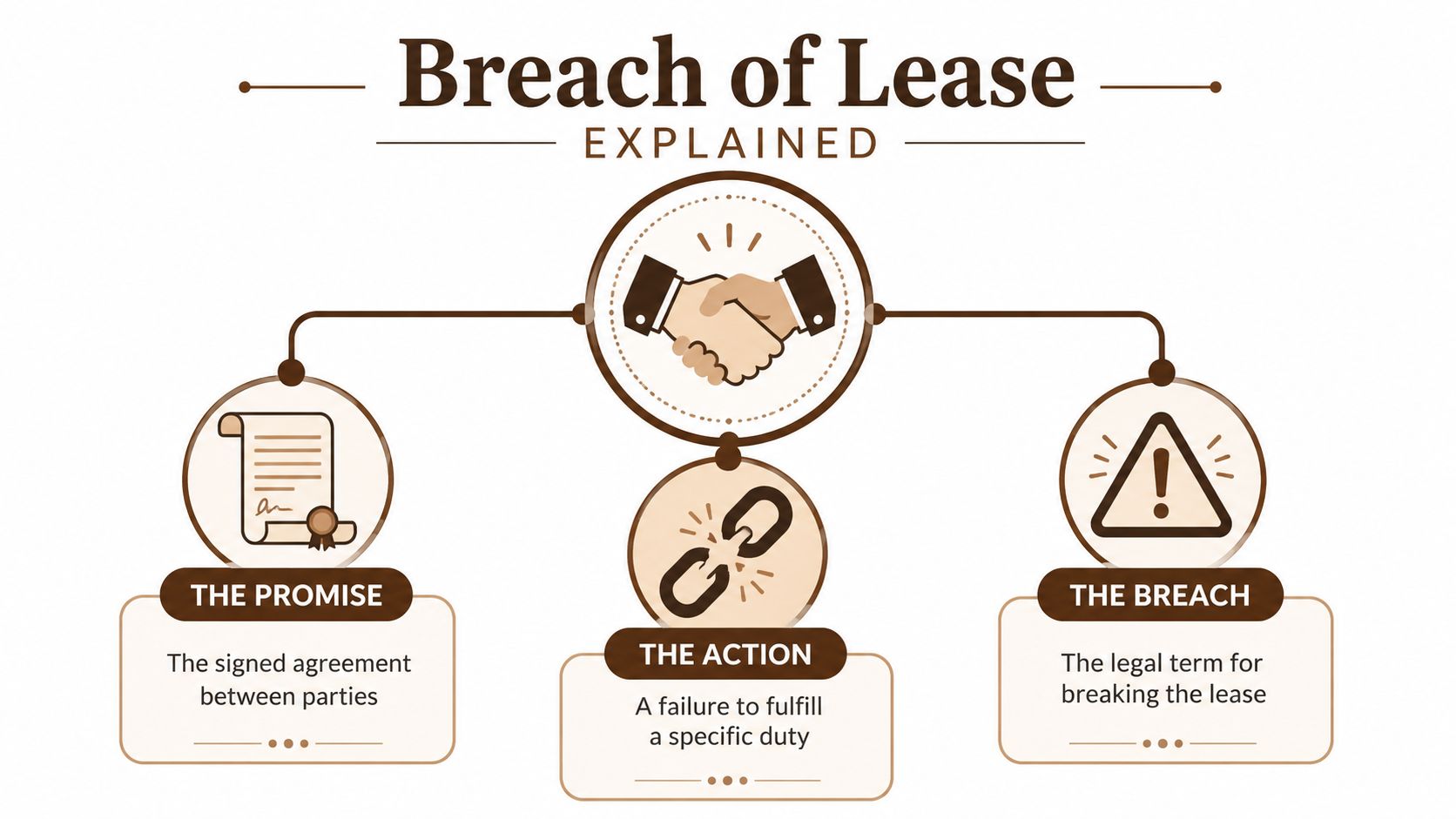
California law separates a lease problem into different kinds of failures, and that distinction matters before anyone talks about remedies. A missed promise can be a breach of lease contract, but the legal effect depends on whether the failure is serious enough to change the bargain or limited enough to be repaired without ending the lease.
Not every violation is equal
California lease disputes often turn on whether the problem is material or immaterial. That is the legal way of asking whether the violation goes to the heart of the deal or just creates a smaller problem. In commercial leasing, courts often look at factors tied to Restatement (Second) of Contracts § 241, including the loss of the expected benefit, whether money can fix the harm, the risk of forfeiture to the party in default, the likelihood of cure, and whether the conduct shows good faith or fair dealing (Provident Lawyers on material breach in a commercial real estate lease).
Those factors matter because a judge does not treat a minor technical slip the same way as a serious refusal to perform. If the harm can be corrected with money or a short cure period, the remedy is often narrower. If the breach strikes at the core promise of the lease, termination becomes more realistic. That is why a late payment, a noise complaint, or a small repair issue does not automatically end the tenancy.
A Los Angeles or Orange County dispute often turns on that same common-sense point. If the lease is like a detailed instruction manual for shared use of a property, the court still has to decide whether the broken instruction is one that changes the whole arrangement or one that can be fixed without tearing up the contract.
Condition and covenant are not the same thing
A second distinction matters just as much, the difference between a condition and a covenant. According to the California Department of Real Estate, failure of a condition can excuse further performance and support termination, while breach of a covenant generally points to damages or injunctive relief (California Department of Real Estate guidance).
That sounds technical, but the practical meaning is plain. If the clause is a condition, the other side may be allowed to stop performing. If it is a covenant, the dispute may call for compensation or a court order instead of immediate termination. The classification controls the remedy, so the same real-world event can lead to very different legal paths.
A lease clause is not just words on paper. It is a map for what happens after a mistake, a delay, or a refusal to comply. In practice, that map helps landlords decide what notice to give and helps tenants decide whether a problem can be cured before it turns into a bigger case.
A lease clause is not just words on paper. It is a map for what happens after a mistake, a delay, or a refusal to comply.
California Remedies and Notice Procedures
A lease breach in California often starts with a notice, not a lawsuit. That notice is the landlord's formal warning shot, the paper trail that says what went wrong, what must be fixed, and what happens if it is not fixed. In residential cases, the notice often gives a short window to pay rent, correct the problem, or move out, depending on the type of violation. A California legal resource describes a 3-day notice to pay or quit for nonpayment and a 3-day notice to perform covenants or quit for other lease violations, which means the tenant must cure the problem or vacate (Stone Sallus Law on tenant lease breach notice).
For landlords in Orange County and Los Angeles, the practical question is not just whether a breach happened. It is whether the notice matches the problem closely enough to hold up later. A rent default, an unauthorized occupant, or a rule violation may call for different language, and the wrong form can delay an otherwise valid case. For tenants, the notice should be read like a repair order with a deadline, because the words on the page control whether there is time to fix the issue or whether the next step is move-out.
Why the notice has to fit the breach
California notice practice works best when the landlord names the exact conduct and ties it to the lease duty that was broken. A notice for unpaid rent should say that rent is owed and identify the amount due. A notice for another lease violation should describe the conduct with enough detail that the tenant understands what must stop or be corrected. If the notice is vague, the other side may later argue that it never received a fair chance to comply.
For tenants, that means the first response should be practical, not emotional. Read the notice line by line, compare it to the lease, and ask whether the problem can be cured within the stated time. A tenant who fixes a curable issue quickly may avoid a larger dispute. A tenant who ignores the notice risks turning a small breach into a court case.
The usual sequence in plain English
A California lease dispute often moves through a short series of steps.
- The breach happens. Rent goes unpaid, a lease rule is broken, or a required duty is ignored.
- Written notice is served. The notice identifies the problem and gives the recipient the chance to cure it when the law or lease requires that chance.
- The recipient responds. The problem is fixed, payment is made, the conduct stops, or the tenant leaves. If none of that happens, the landlord may move to the next legal step.
Practical rule: The notice should describe the breach in ordinary language, state what cure is available, and give the other side a fair chance to act before the matter turns into a filing.
A simple sample approach helps. A landlord might write, “You are in breach of the lease because rent for the current period has not been paid. You must pay the full amount due within the notice period or vacate the property.” For a nonpayment issue, that kind of direct wording is easier to defend than a paragraph full of vague accusations. For tenants, the lesson is equally simple, if the notice does not say what to fix, what amount to pay, or by when to act, the document may be open to challenge later.
The timing matters because notice is the bridge between a disagreement and an eviction attempt or damage claim. Once the notice is served, the clock starts. That clock is what often decides whether the dispute stays fixable or becomes a court problem. For landlords and tenants working through a lease breach in California, the notice stage is where many Orange County and Los Angeles disputes are won or lost.
Common Breach Examples and Lease Data
A breach usually shows up in one of a few familiar ways. A tenant misses rent. Someone brings in an unauthorized occupant or pet. A unit suffers damage beyond normal wear. Or a tenant uses the property for something the lease forbids, like an unapproved business or other illegal activity. Those are the kinds of facts that send landlords looking for the written agreement first and the emotions second.
The timing of the dispute often depends on the lease term. A 2022 U.S. Bureau of Labor Statistics housing survey found that 59.6% of rental leases were for 12 months, 31.8% were month-to-month, and 8.6% were some other length, including 29.9% for 24 months, 14.8% for 13 months, and 12.4% for 6 months (BLS housing leases in the U.S. rental market). Those numbers matter because lease timing changes how disputes develop.
| U.S. Rental Lease Term Distribution (2022) | Percentage |
|---|---|
| 12 months | 59.6% |
| Month-to-month | 31.8% |
| Other lengths | 8.6% |
| 24 months among nonstandard leases | 29.9% |
| 13 months among nonstandard leases | 14.8% |
| 6 months among nonstandard leases | 12.4% |
A one-year lease often means the fight clusters around renewal, rent changes, and move-out obligations. A month-to-month arrangement can make the dispute feel faster and less predictable. In a practical Orange County scenario, that difference can decide whether a landlord is dealing with a short-term default or a broader performance issue.
The same timing logic helps explain why some breaches turn into renewal disputes rather than day-to-day arguments. A landlord who notices late payments near the end of a term may care as much about the next lease cycle as the current one. A tenant who is trying to stay in the property may care just as much about whether the problem is fixable before the term rolls over.
Practical Strategies for Landlords and Tenants
The best California notices are short, direct, and accurate. A landlord should identify the exact lease duty, the specific violation, and the deadline to cure if the law or lease allows one. A tenant should respond in writing, keep proof of payment or repair, and avoid guessing about what the notice means.

Sample language that stays practical
For a 3-day notice to pay or quit, the wording should stay plain.
“You have not paid rent due under the lease. Pay the full amount due within the notice period or vacate the property.”
For a 3-day notice to perform covenants or quit, the notice should identify the rule or duty.
“You have violated the lease by [describe the violation]. Cure the violation within the notice period or vacate the property.”
Those are not magic words, but they show the level of clarity California disputes demand. The notice should tell the other side what happened, what needs to change, and what happens if nothing changes. A vague notice creates confusion, and confusion gives the other side room to argue later.
What each side should document
- Landlords: Keep dated photos, rent ledgers, emails, and copies of every notice.
- Tenants: Keep proof of payments, repair requests, text messages, and any response to the notice.
- Both sides: Put important agreements in writing, especially if the original problem gets fixed or modified.
The goal is not to win a shouting match. It is to build a record that matches California procedure. If the paperwork is clean, the dispute often becomes much easier to resolve, or at least much easier to explain to a judge if it gets that far.
Defenses and Misconceptions About Breach
Many people assume a breach is always the tenant's fault. That is not how California disputes work in real life. A landlord can fail to repair, delay performance, or otherwise contribute to the conflict, and the legal outcome may shift because of that shared conduct.
Important point: A lease dispute is often about who did what first, who kept performing, and who took reasonable steps after the problem started.
Another common mistake is assuming that accepting money after notice always wipes out the breach. Independent landlord-tenant materials note that accepted payments after notice may not waive the breach unless the parties agree in writing, and they also point out that both landlords and tenants may have a duty to mitigate damages (People's Law on breach of lease). In plain English, taking money does not always erase the underlying problem, and stopping to look at the facts is safer than assuming the issue is gone.
Partial fault matters too. A tenant may be late with rent, but a landlord may also have ignored a repair issue. A landlord may complain about a violation, but the landlord may have accepted conduct for months without objection. Those details can change how a court sees the case and whether the remedy is termination, damages, or something narrower.
The biggest misconception is thinking every violation automatically ends the tenancy. California law is more careful than that. The facts, the lease language, the notice, and the parties' conduct all matter. That is why a calm review of the documents usually beats a rushed decision.
When to Consult an Attorney and Next Steps
Some lease disputes are straightforward. Many are not. If a termination is contested, an eviction filing is already underway, the lease is commercial, or the cure period has passed without a clear resolution, California counsel can help you avoid a mistake that is hard to undo.
Families dealing with inherited property, probate-related rentals, or co-owned real estate face extra pressure because a lease problem can affect the value and timing of a larger transaction. In those situations, the question is rarely just “Was there a breach?” It is also “What remedy protects the property, the timeline, and the people involved?” A California attorney can help sort that out before the dispute gets more expensive.
Tanner Law has served Orange County clients since 1994, with direct attorney access and practical guidance on real estate disputes. If you need help with a breach of lease contract in Los Angeles or Orange County, schedule a free consultation so you can get a clear read on your notice, your options, and your next step.
Tanner Law helps landlords, tenants, and property owners handle California lease disputes with clear advice and focused representation. If you're dealing with a breach of lease contract, a defective notice, or a termination dispute, visit Tanner Law to schedule your free consultation and get practical guidance before the situation escalates.