Real Estate Lawyer California: Your Complete Guide
You may be dealing with a family home that passed to several siblings, a title report that uncovered an old claim, or a buyer who won't perform under a signed agreement. Each problem concerns real estate, but each calls for a different legal response. The practical question isn't whether to hire a lawyer. It's which California remedy fits the dispute, what evidence supports it, and whether acting now can preserve options that may otherwise narrow.
For families and owners in Orange County, Los Angeles, Riverside, and San Bernardino, the right strategy may involve clearing title, resolving probate authority, arranging a co-owner buyout, or pursuing contract claims. A California real estate lawyer should help identify the actual problem before recommending a lawsuit. Filing the wrong kind of case can leave ownership, money, or possession unresolved.
Table of Contents
- Why You Need a California Real Estate Lawyer
- What a Real Estate Lawyer Actually Does in California
- Common Real Estate Matters Handled by California Attorneys
- How California Real Estate Lawyers Charge for Their Work
- When Hiring a Real Estate Lawyer Actually Pays Off
- Local Practice Across Orange County, Los Angeles, Riverside, and San Bernardino
- How to Evaluate and Choose the Right California Real Estate Counsel
- Take the Next Step Toward Resolving Your Property Matter
Why You Need a California Real Estate Lawyer
A parent dies, leaving a home to three adult children. One sibling lives there and pays expenses; another wants to sell; the third believes the deed never properly transferred the property out of a trust. The family may call this a disagreement over the house, but it can involve probate, title, contributions, and the legal right to sell. Treating it as a simple sale negotiation may miss the issue that controls the outcome.
California law matters because the remedy depends on how ownership is held and what each person is claiming. A general-practice attorney may be capable of handling some parts of a dispute, but property cases often require close attention to recorded deeds, liens, notices, probate documents, and the specific relief a court can grant. Out-of-state counsel may not know California's statutory procedures or local filing practices.
Three kinds of real estate work
Transactional work helps prevent disputes or document an agreed deal. It can include reviewing a purchase agreement, negotiating a lease, preparing a deed, or addressing title concerns before escrow closes.
Title-clearing work addresses uncertainty about ownership or competing claims. A quiet-title case, for example, asks a court to determine the parties' interests in a property. It doesn't automatically resolve every related claim for money or possession.
Litigation addresses disputes that the parties can't resolve through negotiation. A partition case may be appropriate when co-owners can't agree whether to keep or sell property. A contract case may be needed when a buyer, seller, lender, or other party allegedly failed to perform a promise.
The best route may combine more than one kind of work. A dispute over a parent's home might require authority to transfer property to be clarified first, followed by a negotiated buyout or a court-supervised partition. If one party also alleges fraud or breach of an agreement, that claim may need its own legal analysis.
Local familiarity matters, too. An attorney handling matters in Orange County, Los Angeles, Riverside, and San Bernardino should understand how to prepare the record, comply with the court's procedures, and account for each county's practical differences. That experience can help avoid procedural missteps, but it doesn't guarantee a particular result.
What a Real Estate Lawyer Actually Does in California
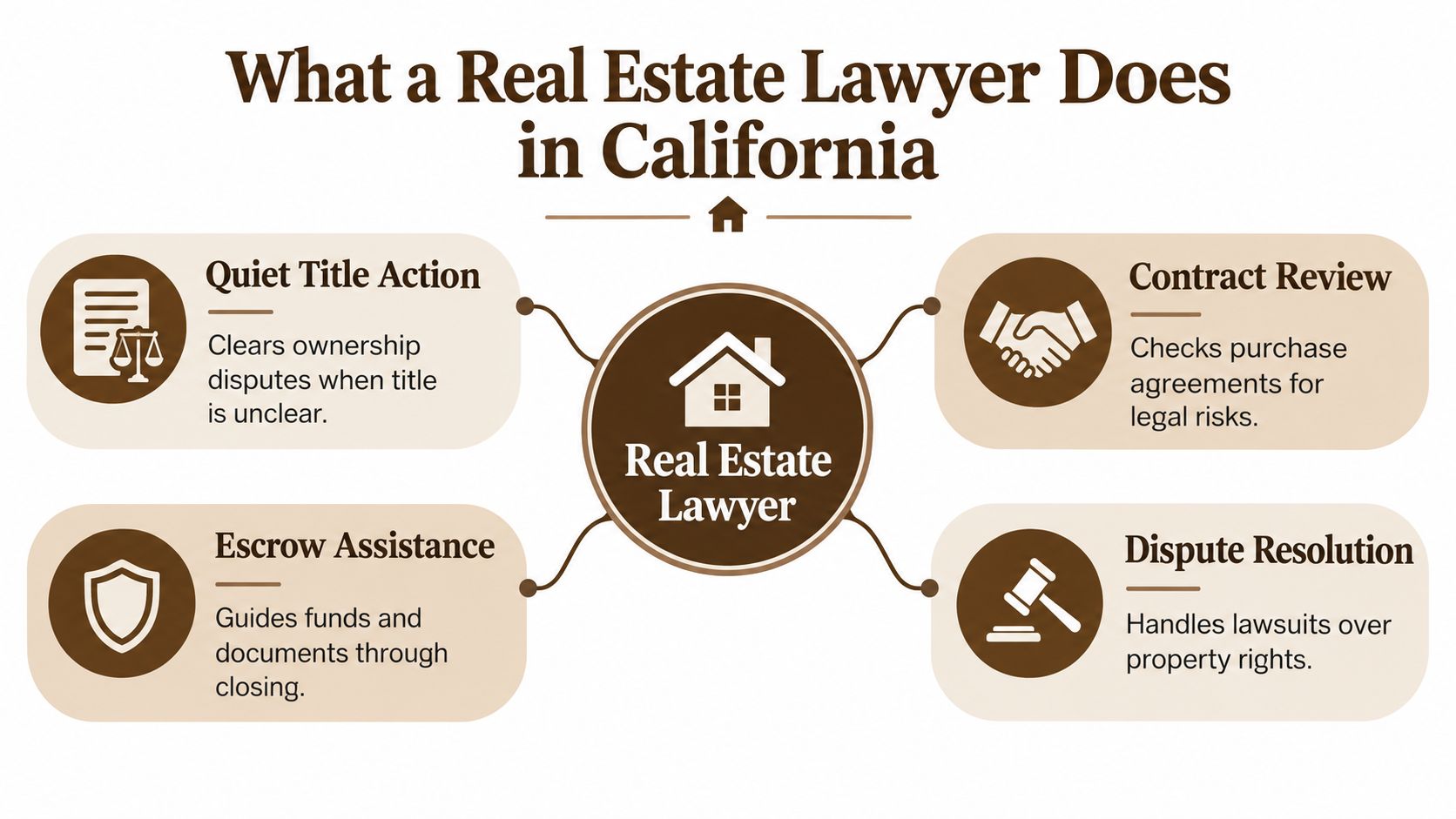
A California real estate lawyer starts by finding out what the dispute is about. That means reviewing the deed and other recorded documents, reading the relevant contract or trust papers, identifying the people who may claim an interest, and clarifying what the client wants the court or other party to do. A lawsuit drafted before that review can leave an important claimant out or request relief that doesn't solve the underlying problem.
Three common legal tools
A quiet-title action asks the court to determine competing claims to ownership or another interest in real property. California's procedure is governed by Code of Civil Procedure sections 760.010 through 765.060. The remedy is cumulative, not exclusive, so a claimant may pursue quiet title alongside legally available claims such as fraud, breach, rescission, or contract remedies. The California quiet-title statutes provide the statutory framework.
A partition action addresses the problem of co-owners who can't agree what should happen to jointly owned property. Depending on the circumstances, a court may order a sale or an in-kind division. For qualifying tenancy-in-common property, California's Partition of Real Property Act also creates a court-supervised buyout opportunity after a co-owner requests partition by sale. Whether that option is available depends on the ownership and the documents governing it.
A contract dispute concerns an alleged failure to honor a real estate agreement. The remedy may depend on the contract's terms, the conduct of the parties, and whether the client seeks performance, damages, or another legally available form of relief.
Why the title review comes first
Consider a Santa Ana homeowner who finds an old recorded notice tied to a dispute that appears to have ended years ago. Before filing, counsel needs to determine what the notice claims, whether it still affects the property, and who may have an interest connected to it. The title record might include deeds, deeds of trust, liens, easements, probate transfers, or recorded notices. Each can affect who should be named and what a judgment can resolve.
A useful analogy is straightforward: quiet title asks who holds which property interest; partition answers what to do when co-owners can't agree; contract litigation enforces or defends promises made in an agreement. The claims can overlap, but they aren't interchangeable.
Common Real Estate Matters Handled by California Attorneys
California real estate work spans transactions, property records, landlord-tenant problems, and inherited assets. One matter can touch several areas at once. A sale held up by an unclear deed, for example, may require title analysis and probate advice before the parties can negotiate a workable closing.
Transactions, leases, and title problems
Before buying or selling property, a lawyer can review the purchase agreement, identify obligations and contingencies, and help address disputed terms. For landlords and tenants, counsel may review lease provisions, advise on termination disputes, or handle an unlawful-detainer case, the court process commonly used to resolve possession disputes. The issue may not be limited to whether rent was paid. The lease language, notices, and parties' conduct can all matter.
Title defects can surface during a sale or refinance. An old lien, a deed with an error, or a transfer that wasn't recorded as expected may make a transaction difficult to complete. A title company can identify recorded issues and explain its underwriting requirements, but disputed ownership may require legal work to determine who has rights and what steps can clear the record.
Probate, inherited property, and tax consequences
An inherited home can raise questions about whether the property passed through a will, a trust, a survivorship deed, or another legal route. California's changing small-estate rules make it especially important to identify what kind of property is involved and which procedure applies. For qualifying primary-residence real property, the state's temporary procedure permits transfer outside ordinary probate for property valued up to $750,000 from April 1, 2025, through March 31, 2028; qualifying personal-property small-estate affidavits apply when the value is $184,500 or less. These rules and thresholds are described in the California small-estate procedure overview.
The personal-property affidavit isn't a universal shortcut for transferring a house. Families should first determine whether the asset is real or personal property, how title is held, and whether a trust or designated beneficiary controls the transfer. Depending on the answer, the next step could be a probate petition, title action, negotiated agreement, or another proceeding.
How California Real Estate Lawyers Charge for Their Work
Legal fees depend on the work, the dispute, and how clearly the parties define its scope. Litigation and title disputes often require ongoing analysis, filings, and court appearances, so hourly billing may be appropriate. A defined task, such as reviewing an agreement or preparing a specific document, may be better suited to a flat fee. Limited-scope or hybrid arrangements can cover a defined part of a larger dispute while leaving other work to the client.
| Fee Model | Typical Use Case in Real Estate Work | Main Client Risk |
|---|---|---|
| Hourly | Litigation, title disputes, negotiation that may expand | Total cost can grow if scope or case complexity changes |
| Flat fee | Defined document review, deed preparation, or other limited work | Work outside the agreed scope may cost extra |
| Limited-scope or hybrid | A demand letter, mediation preparation, or selected litigation tasks | Gaps can arise if the client and lawyer don't clearly divide responsibilities |
| Contingency | Some claims involving recovery of money | Fees depend on the written agreement and the claim's outcome |
Ask what the fee covers, what triggers additional charges, who will perform the work, and how the firm handles costs such as filing expenses. A lower hourly rate doesn't necessarily mean a lower total bill if the lawyer hasn't defined the work or communicated when the strategy changes.
Foreclosure-related questions deserve particular care. California's 2026 changes prohibit solicitation for foreclosure-sale surplus funds during the first 90 days after a trustee's deed is recorded and impose a 67% fair-market-value floor for certain residential trustee sales. Those provisions are described in the Central District of California's fiscal year 2025 annual report. Because the rules concern different issues, don't assume a surplus-fund offer, a challenge to a sale, and a possession dispute require the same lawyer or fee arrangement.
When Hiring a Real Estate Lawyer Actually Pays Off
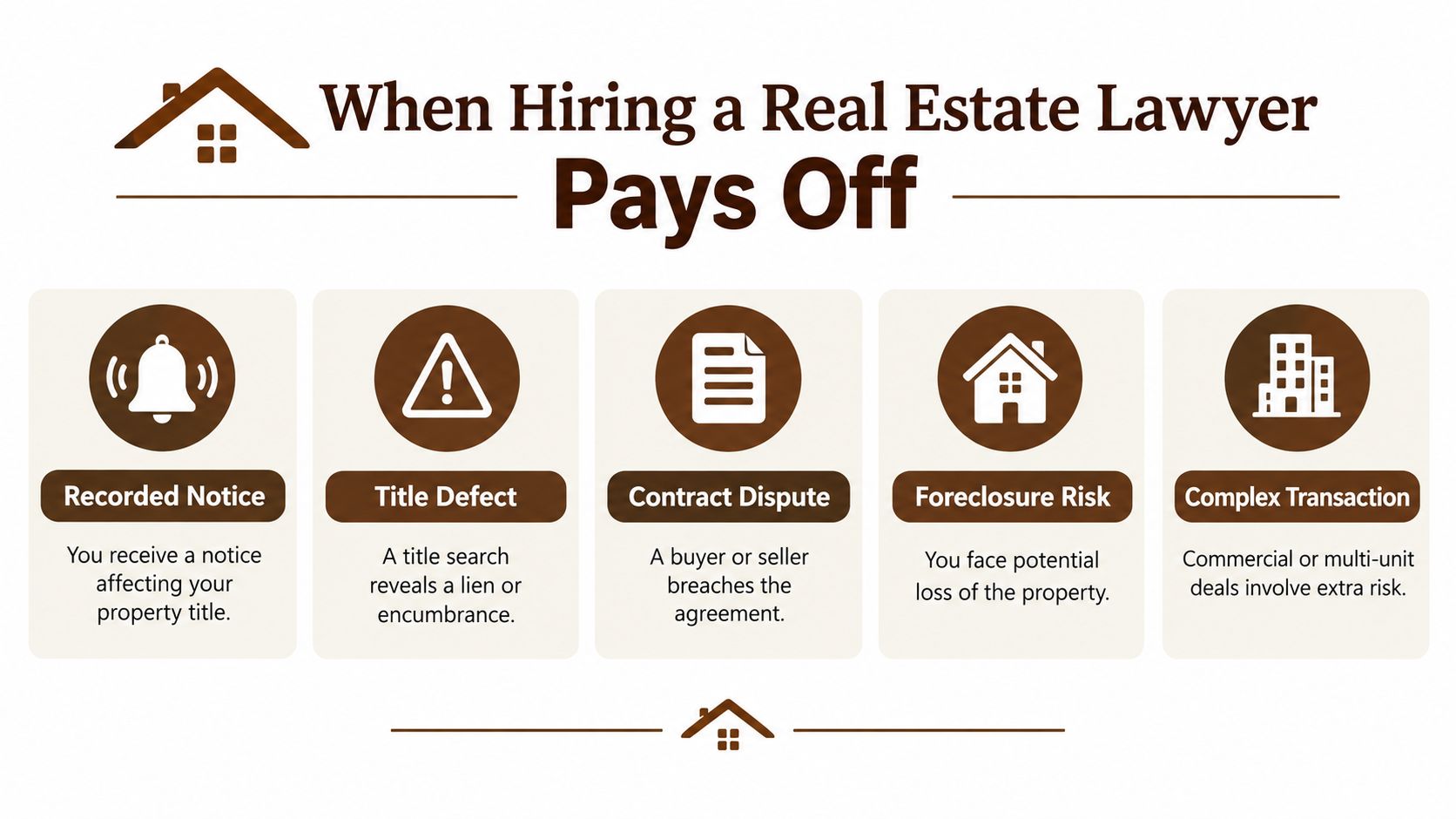
A lawyer is most useful when the consequences of getting the issue wrong are substantial, the facts or documents are disputed, or a legal deadline affects available options. That doesn't mean every disagreement requires a lawsuit. It does mean that an informal conversation should not substitute for legal advice when someone's ownership, equity, or right to remain in a property is at risk.
Practical reasons to act
- A notice affects title or possession. A recorded notice, notice of default, or trustee's deed can change the urgency and the available responses. Have counsel review the document and the underlying record rather than relying on a verbal summary.
- A title search reveals an unresolved claim. An old lien, unrecorded interest, or disputed inheritance can affect a sale or refinance. A title company may explain what it needs to insure a transaction, but it doesn't decide a contested ownership issue.
- A co-owner wants a sale and you want to keep the property. Determine the vesting, ownership shares, agreements, valuation, and ability to finance a buyout before assuming that sale is inevitable.
- A party alleges breach of contract. Save the agreement and related communications, and ask counsel to assess the claim and any response requirements.
- Probate documents and the deed don't match. Don't assume a will, trust, or family understanding automatically establishes current record title.
For qualifying tenancy-in-common property, a co-owner responding to a partition-by-sale request may have a statutory buyout opportunity. Under California Code of Civil Procedure section 874.317, after the court determines value under section 874.316, it must notify the parties that an eligible cotenant may buy the interests of the cotenants who requested sale. The election period is 45 days after notice under the statutory procedure. The opportunity doesn't guarantee that a buyout is affordable or that every form of co-ownership qualifies.
If the issue is a routine title-company request or an agreed document change, a title officer, escrow officer, or mediator may be enough. When people dispute ownership, demand a sale, or threaten litigation, have an attorney compare the likely exposure with the cost of getting advice before choosing a path.
Local Practice Across Orange County, Los Angeles, Riverside, and San Bernardino
California statutes apply statewide, but local court procedures and case flow can affect how lawyers prepare and manage a matter. Orange County, Los Angeles, Riverside, and San Bernardino have different court systems, filing practices, and caseloads. A lawyer should confirm the rules and procedures that apply to the specific courthouse and case rather than rely on assumptions based on another county.
What local familiarity can change
In Orange County, a property dispute may involve a home in Santa Ana or another city, with related probate or title issues that need to be coordinated. In Los Angeles, a property case may be part of a broader dispute involving contracts, possession, or family succession. Riverside and San Bernardino cases can involve properties and ownership arrangements that differ considerably across communities. These are practical distinctions, not promises about how quickly a court will act or how it will rule.
County practice can also matter before filing. Counsel should check recording requirements, confirm the appropriate court and case type, review relevant probate procedures, and make sure the parties with potential interests are identified. A filing that overlooks an heir, trustee, lienholder, or other claimant may complicate the case regardless of which county hears it.
Property-tax consequences also apply across county lines. Under Proposition 19, a parent-to-child transfer of a family home may avoid reassessment only if it was the parent's principal residence and becomes the child's principal residence. The child must occupy the home and file a homeowners' or disabled-veterans' exemption within one year, using form BOE-19-P. The California State Board of Equalization's Proposition 19 guidance explains these requirements. Families should review them before a deed transfer or estate distribution, rather than assuming an inheritance preserves the prior tax treatment.
A lawyer familiar with the relevant county should be able to explain which court handles the dispute, what local procedures need attention, and how probate, title, and tax questions interact. That preparation reduces avoidable surprises, though it can't eliminate delay or guarantee a result.
How to Evaluate and Choose the Right California Real Estate Counsel
A useful consultation should produce more than a general assurance that the lawyer handles real estate. You should leave with a clearer understanding of the dispute, the documents that matter, the likely legal routes, and what further information could change the analysis. Be wary of anyone who guarantees an outcome before reviewing the facts.

Questions to ask before you hire
Ask how much experience the attorney has with the kind of matter you're facing, whether that means quiet title, partition, probate-related property claims, or contract litigation. Ask who will handle the case day to day and how the lawyer will keep you informed. A lawyer's California real estate broker license can be relevant to transactional knowledge, but it doesn't replace legal skill or experience with the specific dispute.
You should also ask for a written fee agreement that describes the work, billing method, and what falls outside the scope. Discuss the likely range of outcomes and what facts could change the assessment. No responsible lawyer can promise a court's decision, but counsel should be able to explain the strengths, weaknesses, and unresolved questions in plain English.
Look for warning signs: pressure to sign immediately, a vague description of services, no written engagement terms, or an unwillingness to discuss risks. Check that the lawyer is authorized to practice in California, then confirm that their approach fits your goals. A lawyer who handles courtroom disputes and understands transactions may recognize practical settlement options that a litigation-only analysis could miss.
For a closer look at how to prepare for a conversation about a property dispute, you can watch this overview before speaking with counsel.
Tanner Law is one option for California owners and families seeking help with quiet title, partition, or real estate contract disputes. The firm's practice combines property litigation with transactional insight, and it serves clients in Orange County, Los Angeles, Riverside, and San Bernardino. When comparing attorneys, focus on whether the lawyer understands your actual ownership records, explains the available routes, and provides direct, clear communication.
Take the Next Step Toward Resolving Your Property Matter
Start by identifying the problem: a transaction, unclear title, co-owner dispute, probate issue, or broken contract. Then gather the deed, relevant agreements, probate or trust documents, and any recorded notices so counsel can assess the facts. The right remedy depends on those records and your practical goal, whether that's keeping the home, completing a sale, confirming ownership, or recovering money.
Tanner Law offers a free initial consultation by phone or email. The office is at 1913 E. 17th Street, Suite 212, Santa Ana, CA 92705. A candid conversation can help you understand whether the matter calls for a negotiated solution, a court filing, or a closer review before you act.
Schedule a free consultation with Tanner Law to discuss a California property dispute, inherited home, title problem, partition, or real estate contract. The firm offers practical guidance for matters in Orange County, Los Angeles, Riverside, and San Bernardino, by phone or email.