Real Estate Contract for Deed in California Explained
You've lived in the house for two years. You've paid every month, fixed the plumbing, and paid the property taxes, yet the deed still isn't in your name. If you're buying from a relative, a family friend, or a private seller in Orange County or Los Angeles, that's not unusual with this kind of deal. It's also where the risk starts.
Table of Contents
- What a Real Estate Contract for Deed Actually Is
- How a Contract for Deed Works Step by Step
- Buyer and Seller Rights and Obligations
- Title, Recording, and Default Risk in California
- How Federal Lending Law Now Reaches These Deals
- Safer Alternatives Worth Comparing First
- Practical Checklist Before You Sign in California
What a Real Estate Contract for Deed Actually Is
A Los Angeles family offers a familiar example. A parent owns a small house, an adult child can't qualify for a bank loan, and they agree the child will move in and pay monthly until the price is paid off. It feels like buying. Under California law, the paperwork tells a different story until the very end.
A real estate contract for deed, also called a land contract or land-installment contract, is a form of seller financing. The buyer takes possession and makes installment payments directly to the seller, while the seller keeps legal title until the buyer completes the purchase obligations. That split is the whole point, and it's the source of most disputes.
You can live like an owner, pay like an owner, and still not hold legal title. Economic ownership and record ownership are split until payoff.
The basic parts are simple. There's usually a modest down payment to start. Then come monthly installments that combine principal and interest, much like a mortgage payment. Some agreements add a large balloon payment near the end, meaning the remaining balance comes due all at once instead of spreading out evenly.
The concept map below shows how the buyer, seller, and agreement fit together.

How This Differs From a Normal Purchase
In a conventional California purchase, escrow closes, the deed is recorded in the buyer's name, and the bank holds a lien as security. The buyer owns the home on day one, subject to that lien. With a contract for deed, the seller stays on title and the buyer holds a contract right to receive the deed later.
That difference changes everything when something goes wrong. Default, insurance, taxes, repairs, and forfeiture, which means losing your interest under the contract, don't work the same way they do with a bank mortgage. The contract language and California law control more than most buyers expect.
These agreements aren't new. They became established in American practice in the 1800s for buyers who couldn't pay the full price upfront, a history traced in academic research on nineteenth century land contract practice. They later re-emerged after the 2008 housing crisis for households shut out of institutional credit. That history matters because the same access problem still drives families toward private deals today, often without the safeguards a lender, escrow company, and title insurer normally provide.
How a Contract for Deed Works Step by Step
Think of it as renting to own, but with a key twist. Your payments aren't rent. They're installments toward the purchase price, and you're usually expected to act like the owner from the start. You're building toward ownership without yet holding the deed.
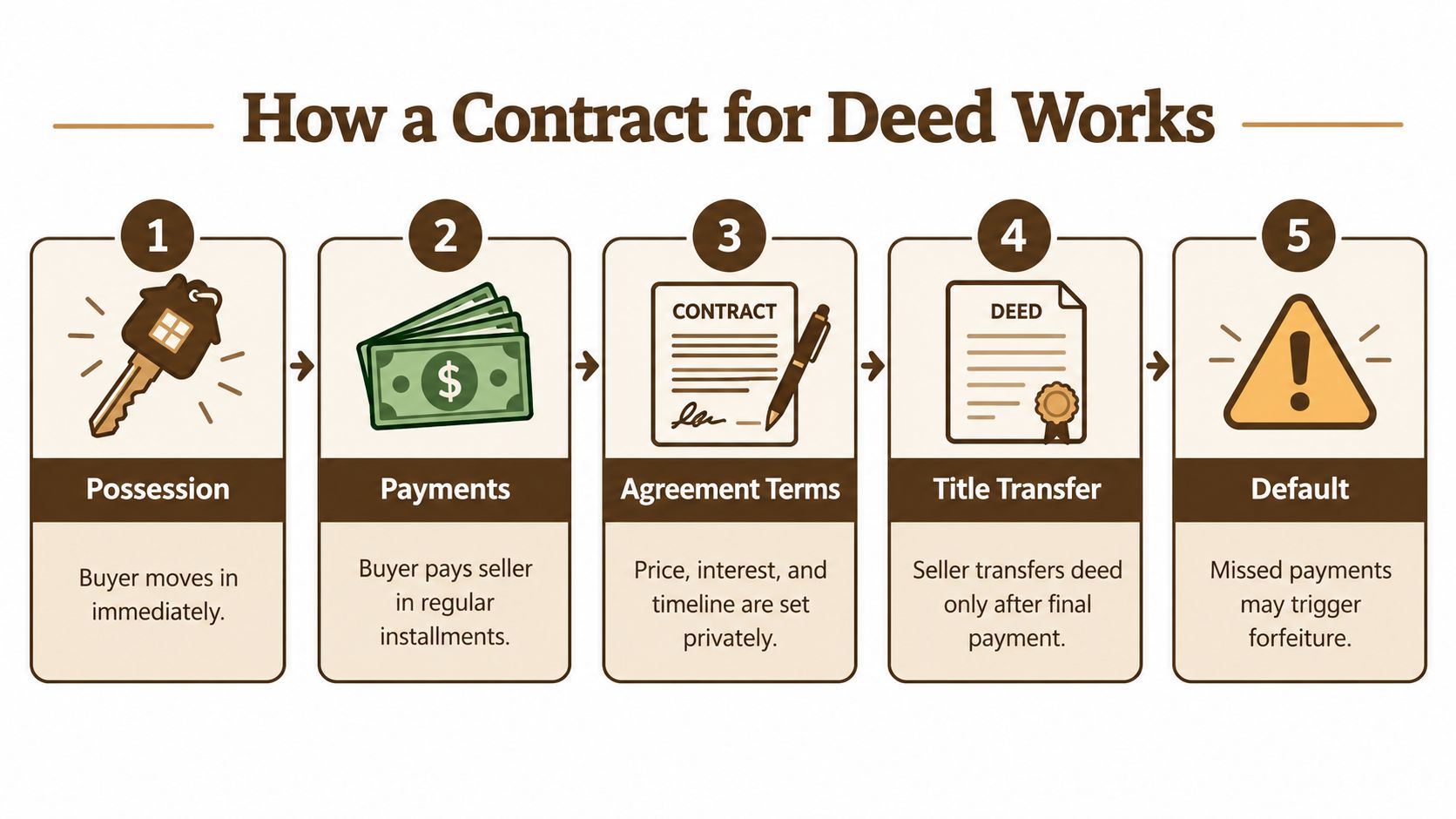
The flow below traces the typical path from move-in to title transfer, and to default.
The Three Milestones to Track
Down payment and possession come first. You sign the contract, pay the initial amount, and move in. In a well handled California deal, a title search happens before this point and the contract, or a memorandum of it, is recorded promptly so third parties can see your interest.
The installment period is the long middle. You pay the seller monthly, usually covering principal and interest under a written amortization schedule. That schedule shows how much of each payment reduces the balance. Without one, you can't verify what you still owe, and payoff disputes become guesswork years later.
Completion or balloon payment ends the contract. Some buyers make the final regular payment. Others face a balloon, a large lump sum that often requires refinancing into a conventional loan or paying cash. If that refinance isn't available when the balloon hits, a buyer who never missed a monthly payment can still default.
Where the Deed Finally Moves
The seller should deliver the deed through escrow when you satisfy the obligation. Escrow is a neutral holder that follows written instructions, collects the final funds, and records the deed. Strong contracts place a signed deed or clear escrow instructions in place early, so the transfer doesn't depend on finding a cooperative seller years later.
During the installment period, you typically handle the daily costs of ownership. That includes repairs, maintenance, property taxes, and homeowner's insurance, even though the seller's name remains on title. Read those clauses closely. A contract that makes you pay taxes and insurance directly should also say how proof of payment is shared, what happens after a casualty loss, and who receives insurance proceeds.
If you can sketch the timeline, down payment, installments, then payoff and deed, you understand the structure. The harder question is who bears which risk during that long middle period.
Buyer and Seller Rights and Obligations
Most arguments don't start over the price. They start over a roof leak, a missed tax bill, or an insurance lapse, with each side insisting the other was responsible. California courts look first to what the contract says, so vague promises between family members create expensive problems.
The buyer gets possession, meaning the right to live in and use the home during the contract. In exchange, the buyer usually assumes the burdens that normally follow ownership. The seller keeps legal title as security for payment, but that doesn't give the seller a free hand to sell or borrow against the property in ways that defeat the buyer's interest.
| Duty | Buyer | Seller |
|---|---|---|
| Possession and Use | Lives in and maintains the home | Stays off the property except as contract allows |
| Payments | Pays installments, plus any balloon | Applies payments as the schedule requires |
| Taxes and Insurance | Usually pays or reimburses both | Provides bills and records, keeps coverage clear |
| Repairs | Handles routine and often major repairs | Discloses known defects before signing |
| Title | Receives deed after full payoff | Keeps title clear and delivers deed through escrow |
| Default Risk | Risks forfeiture or other remedies | Must follow contract and California procedure |
What Buyers Commonly Underestimate
Buyers often focus on the monthly payment and miss the total carrying cost. Property taxes, insurance premiums, repairs, and improvements come out of your pocket while the deed sits in someone else's name. Money spent on a new roof or a kitchen remodel increases the value of property you don't yet legally own.
- Taxes paid directly: Keep receipts from the county treasurer, not just copies of checks to the seller.
- Insurance in the right names: The policy should protect both the seller as title holder and you as the occupant with an equitable interest.
- Repairs in writing: Decide in advance who fixes major systems, not after the water heater fails.
- Payment proof: Pay by traceable means and demand an updated balance statement regularly.
What Sellers Still Owe
Sellers carry obligations too. You must disclose existing mortgages and liens, maintain clear title subject only to what the contract permits, and avoid encumbering the property in ways that block the eventual deed transfer. If there's an underlying loan, the contract should say who pays it and how the buyer can verify those payments.
Practical rule: If the seller can't produce a title report, tax records, and lien information at the start, the buyer shouldn't fund the deal and hope it sorts out later.
Sellers also face exposure when the buyer stops paying. You may hold title, but repossessing a home in California isn't as simple as changing the locks. The remedy depends on the contract structure, how much the buyer has paid, and which legal process applies. That enforcement question deserves its own careful look.
Title, Recording, and Default Risk in California
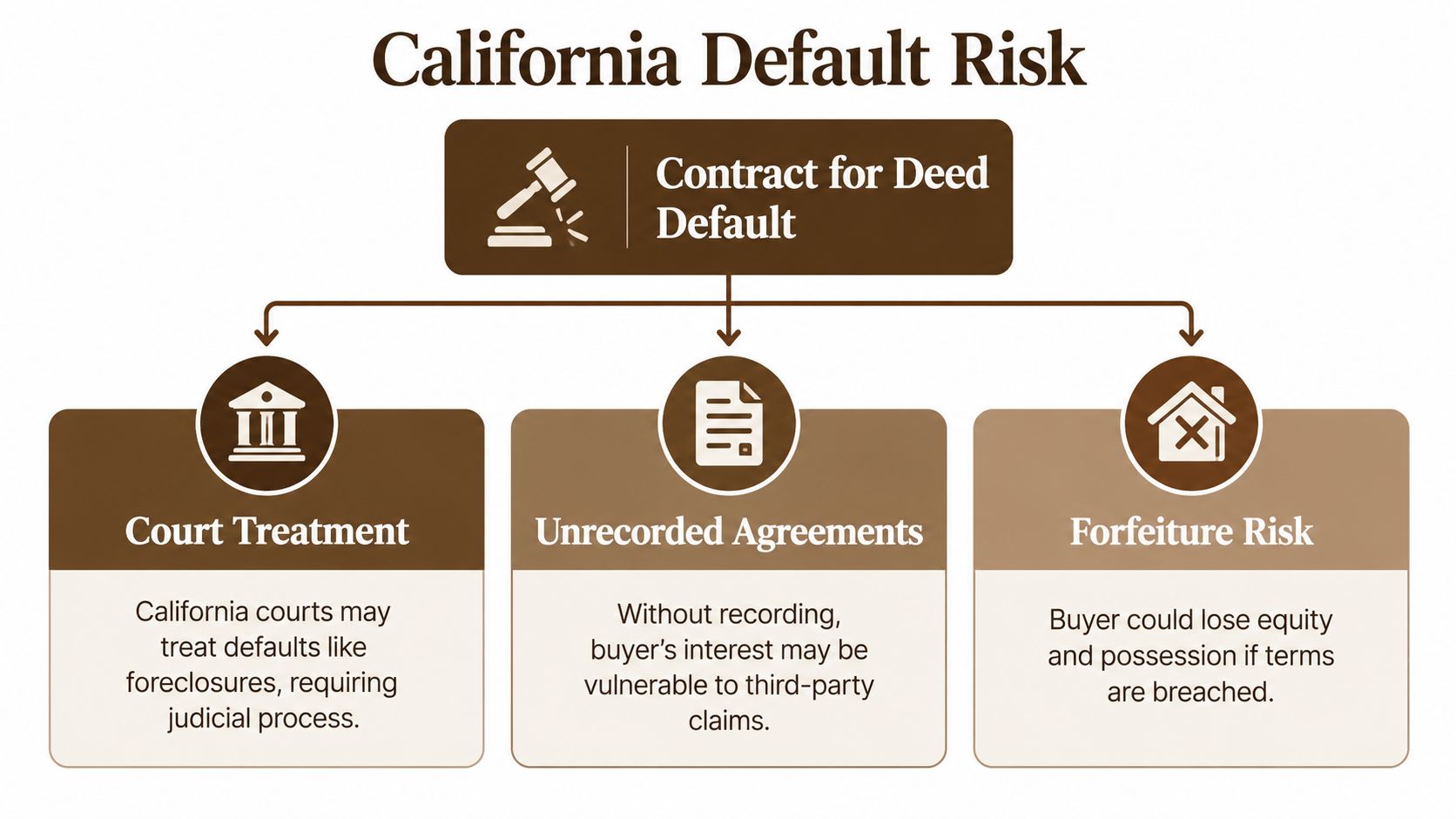
The question clients ask after a missed payment is direct. Do I lose the home through eviction, or through foreclosure, and what can I do right now? The answer determines whether you get notice, a chance to cure, which means catching up on what's owed, redemption rights, or a much faster loss of possession.
The diagram below outlines how California default risk breaks down.
Why Recording Protects the Buyer
If the contract isn't recorded, your interest may be difficult to enforce against later purchasers, mortgagees, or lienholders who claim they didn't know about you. Recording in the county where the property sits puts the world on notice. It can also help you receive notice of later transfers or liens affecting the home.
An unrecorded deal creates a second problem in probate. If the seller dies while holding title, the house may be pulled into the seller's estate, and heirs may dispute what the deceased promised. Families in Orange County and Los Angeles then face a quiet title action, a lawsuit asking a court to declare who owns the property, just to finish a purchase they believed was settled. Co-heirs can also push a partition suit to force a sale of co-owned property, further clouding the buyer's position.
Eviction, Forfeiture, and Foreclosure Are Not Interchangeable
Sellers sometimes try to treat a defaulting buyer like a tenant and pursue a quick eviction after a missed payment, a missed balloon, or a tax or maintenance default. State laws differ substantially, and some require foreclosure-like procedures before repossession, as the Consumer Financial Protection Bureau guidance on contract for deed remedies explains. Default doesn't automatically mean the seller can take the property immediately.
Use this decision path when trouble starts.
- Review the contract: Find the default, notice, and cure language exactly as written.
- Check recording status: Confirm whether the contract or a memorandum appears in county records.
- Search title: Look for mortgages, tax liens, and judgment liens recorded after you signed.
- Identify the remedy: Determine whether the seller is pursuing eviction, forfeiture, or a foreclosure-style process, and whether California law permits that route.
Scale helps explain why this recurs. The Federal Reserve Bank of Minneapolis reported that 5.0% of all owner-occupied households used a contract for deed in 2005, rising to 9.5% among Hispanic and 7.1% among Black owner-occupied households, according to the Federal Reserve Bank of Minneapolis figures cited in the CFPB contract for deed report. Earlier figures in that same data showed 8.3% of Hispanic and 7.7% of Black owner-occupied households in 2001, compared with 5.7% overall, and about 3.5 million households, or 4.6%, in 2009. Buyers outside conventional credit channels carry this title risk most often.
How Federal Lending Law Now Reaches These Deals
Many families assume a private installment sale sits outside consumer lending law. It's just an agreement between two people, so bank rules shouldn't apply. That assumption is now wrong in many cases, and relying on it can leave both sides exposed.
The signing moment below looks informal in many private deals, but federal law may already treat it as a loan closing.

The Consumer Financial Protection Bureau's August 2024 advisory opinion explains that a contract for deed is generally consumer credit under the Truth in Lending Act and, when secured by a dwelling, a residential mortgage loan subject to disclosure and other federal requirements, as set out in the CFPB August 2024 advisory opinion on Truth in Lending Act coverage. In plain English, calling a loan a land contract doesn't make it something else.
What Coverage Can Mean in Practice
Covered sellers may need to assess the buyer's ability to repay, provide disclosures including the annual percentage rate and payment schedule, and comply with restrictions affecting high-cost loans and many balloon payments. The APR matters because a low monthly payment can hide expensive credit once fees and the balloon are counted.
Whether coverage attaches depends on the facts. Who is the seller, is the property a dwelling, does the seller regularly extend credit, and does the deal include a balloon? A one time family sale and a business that repeatedly sells homes on installment contracts don't present the same federal questions.
The short video below walks through how these transactions are structured and where buyers get tripped up.
Federal coverage isn't a universal cure. It doesn't record your contract, clear a defective title, or keep the property out of a seller's probate estate. Not every existing contract complies with the law or contains the protections of a traditional mortgage, and a violation doesn't automatically cancel the deal or hand you the deed.
Federal rights and California title rights solve different problems. You may need both analyses, especially when an estate, trust, or family dispute is also in play.
Treat the 2024 clarification as a reason to review the paperwork, not as a promise that a bad deal protects itself.
Safer Alternatives Worth Comparing First
A contract for deed often wins because it looks simple. No bank, no lengthy underwriting, just signatures and monthly checks. Simpler at signing frequently means harder at payoff, default, or death of a party, which is why California practitioners routinely compare other structures first.
Recorded Seller Financing With a Deed of Trust
The closest safer alternative flips the title sequence. The buyer receives the deed at closing, and the seller records a deed of trust, California's usual mortgage-like security instrument, to secure the unpaid balance. The buyer is the record owner from the start, the seller has a lien that can be foreclosed if payments stop, and escrow plus title insurance handle the closing.
This structure costs more upfront. It also answers the questions that plague land contracts. Title is searchable, the lien priority is recorded, payoff leads to a reconveyance that clears the lien, and the seller's later death doesn't leave the home sitting in the seller's probate estate.
Lease-Option Agreements
A lease-option keeps the parties in a landlord and tenant relationship until the tenant exercises an option to buy at an agreed price. That can suit a buyer who needs time to repair credit, provided the option money, rent credits, exercise deadline, and maintenance duties are spelled out clearly.
The trade-off is stark. Until you exercise the option, you're a tenant, and missed rent can lead to eviction and loss of the option. You're not building the same equitable interest an installment buyer may claim. A lease-option works when both sides accept that no sale has happened yet.
Wraparound Financing and Conventional Loans
A wraparound deal leaves the seller's existing loan in place while the buyer pays the seller, who then pays the underlying lender. It can bridge a rate or qualification gap, but it layers risk. The underlying loan may contain a due-on-sale clause, and the buyer depends on the seller forwarding payments faithfully.
A conventional purchase-money loan remains the cleanest route when you can qualify, even with a co-signer, a gift of equity from family, or a smaller property. You get recorded title, regulated disclosures, and a servicer that must account for your balance. For many families, helping a buyer qualify for that loan, rather than replacing the bank entirely, produces the durable result everyone wanted.
Ask one structural question about each alternative. Who holds title on day one, what gets recorded, and what process follows a default? The answers explain why each option exists.
Practical Checklist Before You Sign in California
Good intentions don't record documents. Before money changes hands in California, run through this checklist with the actual paperwork in front of you, not from memory of a kitchen table conversation.
- Confirm the seller owns what they're selling: Order a title search and title commitment, then verify taxes, mortgages, and liens directly with public offices.
- Check the price independently: Compare the contract price with market data so an inflated price doesn't wipe out your equity from day one.
- Record the contract: Record the agreement or a memorandum of it promptly in the county recorder's office to protect against later buyers and lienholders.
- Demand an amortization schedule: Reconcile the down payment, interest, monthly installments, maintenance charges, insurance, and any balloon in one written schedule.
- Set escrow instructions now: Specify how the deed will be held and delivered at payoff, and what payoff proof the seller must provide.
- Screen the home's condition: Get inspections and required disclosures, since you'll likely pay for repairs the seller might otherwise handle.
- Review federal compliance: Ask whether ability-to-repay review, APR disclosures, and balloon restrictions apply to this seller and this dwelling.
- Plan for death and incapacity: Address what happens if either party dies during the term, especially when the property ties into an estate plan, trust, or expected inheritance.
When Review Matters Most
Manufactured homes deserve extra caution. A January 2025 Pew report noted that one in five manufactured-home borrowers uses risky contract financing, including contracts for deed, lease-purchase arrangements, or seller financing, a finding discussed in the CFPB research report on contract for deed lending. Title to the home and rights to the land beneath it can follow different rules, which compounds the recording problem.
If you're already in a contract, don't wait for the balloon or a family death to test it. Pull the recorded documents, reconcile your payment history against the schedule, and confirm the seller's underlying liens are current. Problems found early are usually fixable with an amendment, a refinance, or a corrected escrow. Problems found in probate or litigation cost far more.
California families use these contracts to help each other, and that goal is legitimate. Protect it with the same care a bank closing would receive.
If you're considering a real estate contract for deed in Orange County or Los Angeles, or you're already in one and worried about title, recording, default, or what happens in probate, Tanner Law in Santa Ana can review your contract and map out your options under California law with direct attorney access from the first call. Schedule your free consultation today through Tanner Law and get clear answers before you sign, pay a balloon, or risk losing the home you've been paying for.