California Partition Action Attorney: Resolve Disputes
You may be dealing with a house you inherited with siblings. Or a condo you bought with a former partner. Or an investment property where one owner wants to sell and the other refuses to sign anything. In Orange County and Los Angeles, these disputes usually start with frustration, then turn into stalemate, and then into real financial damage.
When co-owners can't agree, a partition action is the legal tool California law provides to break the deadlock. It can force a division of the property or, more often with homes, a court-supervised sale so each owner can receive their share and move on.
That doesn't mean filing suit is always the smartest first move. In many cases, the better question isn't just whether you can file. It's whether filing makes economic sense compared with a buyout, refinance, or negotiated exit. That decision is where a good partition action attorney adds real value.
Table of Contents
- When Co-Owners Disagree About Real Estate
- What Is a Partition Action Under California Law
- The California Partition Action Process Step by Step
- Understanding the Costs of a Partition Lawsuit
- Smart Alternatives to Forcing a Property Sale
- How a Partition Attorney Protects Your Interests
- Choosing the Right Attorney in Orange County
When Co-Owners Disagree About Real Estate
Most partition cases don't begin with a dramatic legal moment. They begin with ordinary silence. One owner stops returning calls. Another keeps living in the property without paying their share. A sibling wants to hold the family home forever, while another needs liquidity now. A former couple agrees they should separate, but they can't agree on price, timing, repairs, or who gets what.
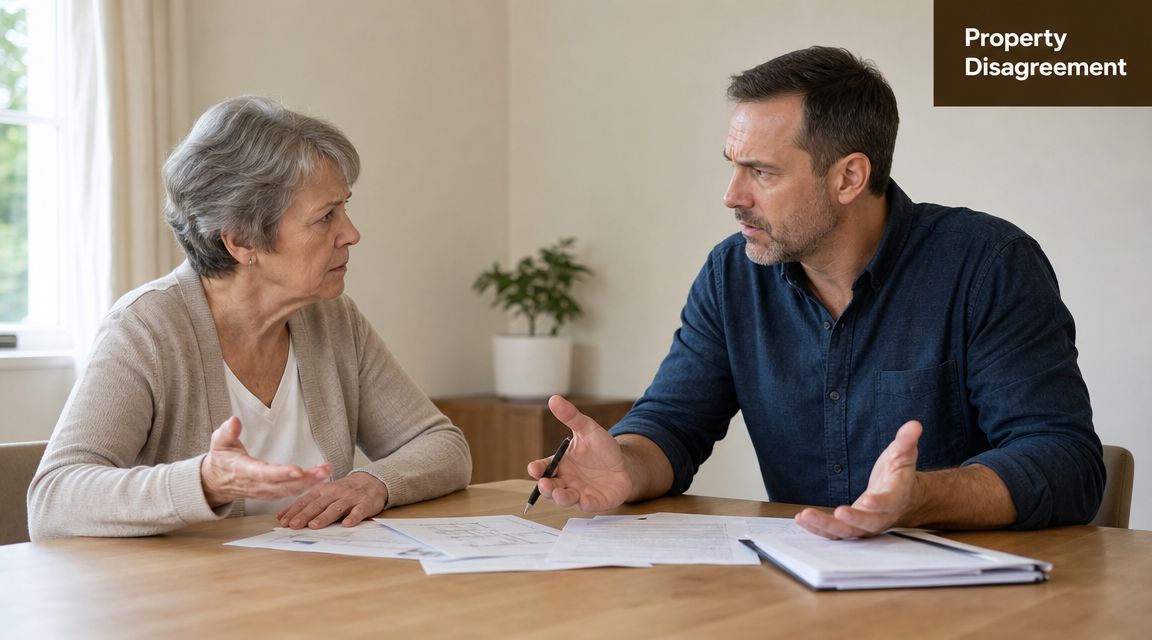
In California, co-ownership disputes over real estate often become more expensive the longer they sit. Mortgage payments continue. Property taxes continue. Insurance continues. So does resentment. By the time many owners speak to a lawyer, they aren't really asking for a legal definition. They're asking a practical question: How do I get out of this without losing more money than necessary?
That's where a partition action attorney comes in. The job isn't only to file papers. The job is to create a path forward when co-owners are stuck.
Common situations that lead to partition
- Inherited property: Brothers and sisters inherit a house but disagree about keeping it, renting it, or selling it.
- Unmarried co-owners: A breakup leaves both names on title, but only one person is living in the home.
- Investor disputes: Friends or business partners bought property together and now disagree about management or exit strategy.
- Unequal contributions: One owner paid the mortgage, taxes, or repairs for years and doesn't want a simple fifty-fifty split.
Practical rule: If ownership is shared and decision-making has broken down, delay usually helps no one.
A lot of people assume the dispute will eventually resolve itself. It usually doesn't. Someone has to take the first serious step, and in California that often means evaluating whether a negotiated buyout is possible or whether a partition lawsuit is the only realistic option.
If you're dealing with a co-owner dispute over California real estate and need a clear plan, schedule a free consultation with Tanner Law.
What Is a Partition Action Under California Law
A partition action is a lawsuit between co-owners of real property. Its purpose is simple. It asks the court to end shared ownership when the owners can't agree on what should happen to the property.
Why California treats partition seriously
California law treats partition as a strong ownership right. The broader legal framework in major markets is formalized, and practitioners in states such as New York describe partition as a matter of right for a co-owner with a present possessory interest, with courts commonly ordering either division or, more often for homes and investment property, sale and distribution of proceeds, as summarized in this discussion of New York partition law under RPAPL Article 9 and section 901. California operates under its own statutes and procedures, but the practical takeaway is familiar to co-owners here: a court won't force people to remain in a dysfunctional real estate partnership forever.

That matters because many clients come in believing they need the other owner's permission to move forward. They usually don't. If you legally co-own the property, the court can step in and untangle the ownership.
Partition in kind versus partition by sale
There are two basic outcomes.
| Type | What it means | When it tends to fit |
|---|---|---|
| Partition in kind | The property is physically divided into separate portions | Larger parcels of land where legal division is practical |
| Partition by sale | The property is sold and the proceeds are divided among the owners | Single-family homes, condos, and most residential income property |
Think of it this way. If two people own a vacant parcel large enough to split legally, the court may be able to divide it. If two people own one house on one lot in Orange County, physically cutting the house in half isn't realistic. In that situation, a sale is usually the workable result.
A partition case is often less about "who wins" and more about converting a frozen ownership conflict into a usable outcome.
For Southern California residential property, the central dispute usually isn't whether the case can proceed. It's how the value will be handled. Will one owner buy out the other? Will the court order a sale? Will credits be applied for mortgage payments, taxes, repairs, or occupancy? Those details often determine whether the result feels fair.
If you need help deciding whether California partition law applies to your property, schedule a free consultation with Tanner Law.
The California Partition Action Process Step by Step
Once owners reach impasse, the legal process becomes much easier to manage when you know the sequence. The names can sound intimidating, but the structure is more predictable than many people expect.
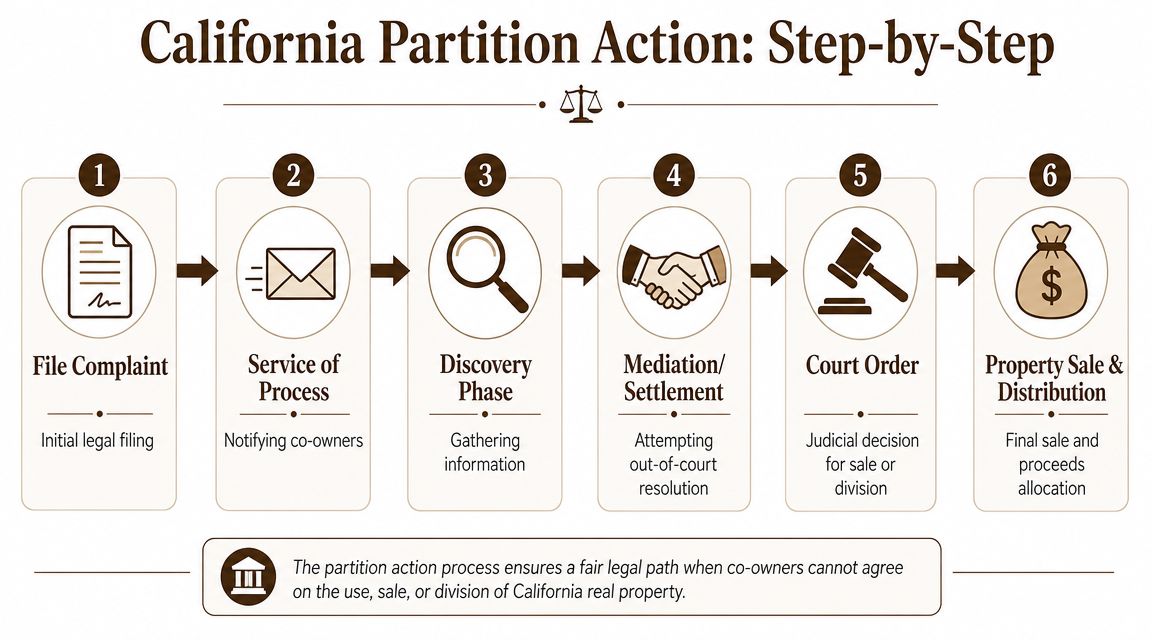
Near the beginning of the process, this visual helps show the overall path:
How a case usually begins
A partition action starts with a complaint filed in the California court that has authority over the dispute. The complaint identifies the property, the owners, and the relief being requested. In many cases, counsel also records a lis pendens, which acts like a public warning that the property is tied up in litigation. It doesn't transfer title, but it makes clear that anyone dealing with the property is taking notice of the lawsuit.
Then the other owners must be formally served. This step matters. A lot of co-owners avoid texts, calls, and email, but service of process creates an official legal starting point.
What happens after the court gets involved
After the case is underway, the court addresses whether partition should be ordered and what form it should take. In residential cases, the practical focus is often sale rather than physical division.
Typical stages include:
- Initial pleadings: The parties set out their positions about ownership, contributions, reimbursements, or defenses.
- Information gathering: Deeds, loan records, tax records, repair invoices, insurance statements, and communication history become important.
- Settlement efforts: Many cases become serious only after filing, because the lawsuit shifts the balance of power and forces deadlines.
- Interlocutory ruling: The court may issue an initial order directing partition and resolving threshold issues.
- Referee involvement: A neutral may be appointed to help manage the mechanics of sale or division.
- Sale and accounting: If the property is sold, the court supervises distribution after liens, costs, and approved adjustments are addressed.
A short video overview can also make the process feel more concrete before you make any decision about filing.
Where cases often turn
The legal filing gets attention, but the outcome often depends on the accounting. Historical partition practice shows that lawyers frequently build these cases around contribution evidence such as down payments, mortgage payments, taxes, utilities, and HOA dues, and one reported result described counsel obtaining more than a 50% ownership share for a client based on contribution records, as discussed in this analysis of partition action costs and contribution-based outcomes. That is why documents matter so much.
If you paid for the down payment, covered taxes, made major repairs, or carried the property while the other owner contributed little or nothing, don't assume the court will just split everything mechanically. The paper trail can change the financial result.
The strongest partition files usually aren't the loudest. They're the best documented.
Many California cases also resolve before a final trial because once the records are gathered and the likely economics become clearer, settlement starts to look more attractive. A good partition action attorney uses the process not just to litigate, but to pressure-test whether continued litigation still makes sense.
If you want a realistic view of how a California partition case would likely unfold in your situation, schedule a free consultation with Tanner Law.
Understanding the Costs of a Partition Lawsuit
Cost is usually the first question, and it should be. Owners often assume a partition suit is just one more real estate dispute. It isn't. It combines title issues, civil procedure, valuation questions, and sale logistics.
Where the money goes
For California owners, the most useful starting point is this: the California Lawyers Association notes that a relatively routine partition action commonly costs about $10,000 to $30,000, and costs can rise when there are title disputes, eviction issues, or a lawyer-referee conducts the sale, as explained in this California Lawyers Association discussion of partition action costs.
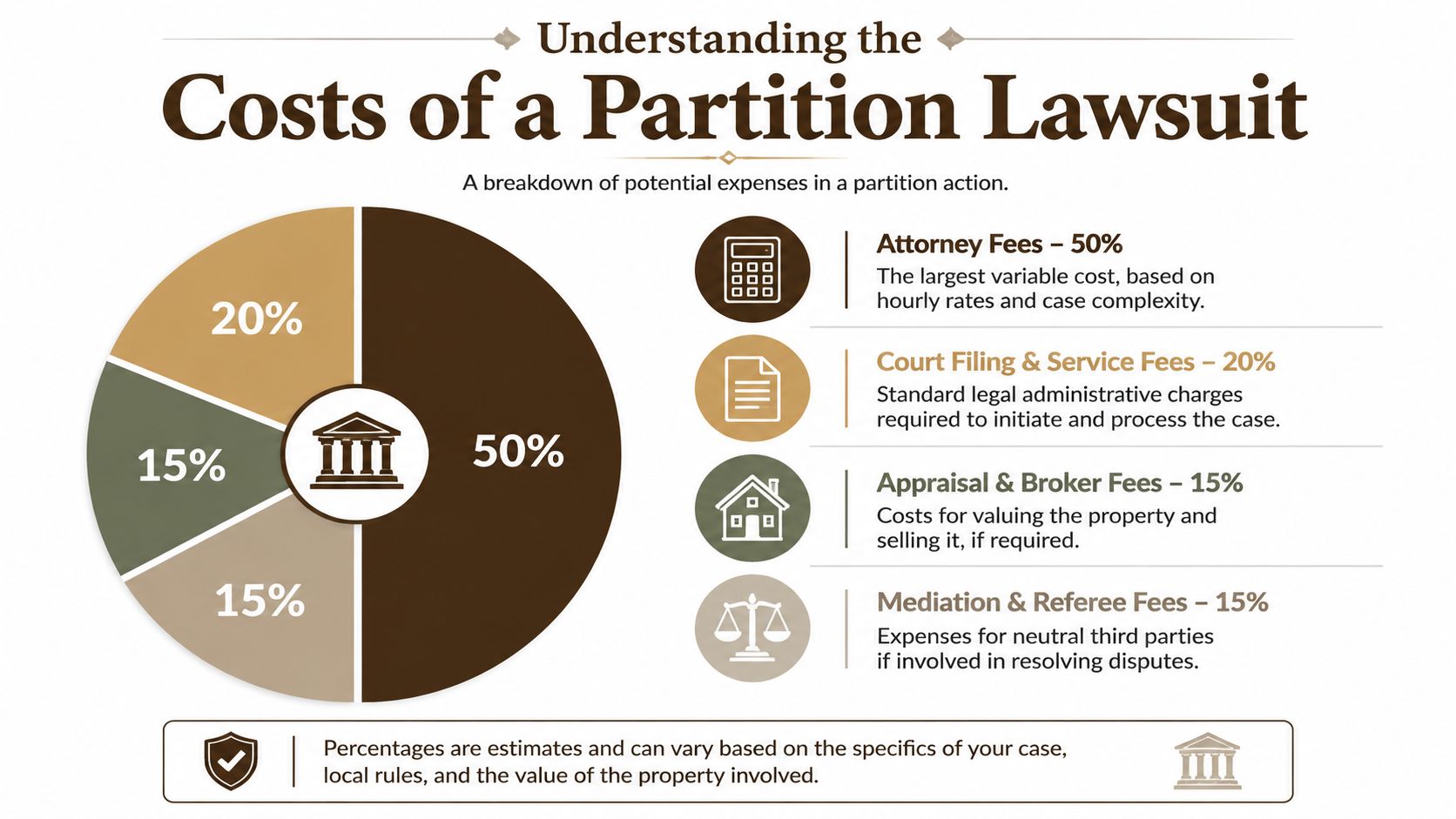
That figure is for a relatively routine case. It doesn't mean every case lands there, and it doesn't mean a difficult dispute will stay there. But it does tell owners something important. Partition litigation is a serious financial decision, not a symbolic threat.
The major expense categories usually include:
- Attorney work: Drafting pleadings, appearing in court, negotiating, handling discovery, and preparing accounting claims.
- Court costs: Filing fees and service-related expenses.
- Valuation and sale costs: Appraisal, broker involvement, and sale administration where needed.
- Neutral third parties: Mediation or referee fees if the court or the case requires them.
Why cost recovery matters
Some owners are cash-poor but equity-rich. They may own a significant share of a valuable California property and still feel unable to start the case. That's where fee allocation becomes important.
Courts may authorize attorney fee reimbursement from the sale proceeds, which can make professional representation more practical in the right case, and practitioner guidance in other jurisdictions also notes that reasonable fees and costs are sometimes reimbursed from proceeds or allocated by statute. The practical lesson isn't that fees disappear. It's that how the case is built affects what may be recoverable.
Bottom line: The cost question isn't only "What will this lawsuit cost?" It's "What will I likely recover after costs, delays, and sale expenses?"
That analysis is where many owners change course. Sometimes filing is necessary. Sometimes the projected net recovery makes a negotiated solution smarter.
If you're weighing the likely expense of a California partition case against the equity at stake, schedule a free consultation with Tanner Law.
Smart Alternatives to Forcing a Property Sale
A partition lawsuit is powerful, but it shouldn't be treated as the automatic first choice. In many California disputes, the best result is the one that preserves the most equity and ends the conflict fastest.
When a buyout makes more sense
The cleanest solution is often a buyout. One owner keeps the property and pays the other for their interest. That can happen with cash, refinancing, installment terms, or a structured agreement backed by title documents.
Owners need to think in net numbers, not emotion. Some California law firms warn that contingency fees can consume 30 to 40% of a client's equity, making negotiated settlement or buyout often financially superior to a forced sale once legal costs and referee fees are considered, as noted in this California discussion of whether owners can afford a partition action.
If your likely litigation path ends with a sale, then deductions, delay, and conflict all eat into the final distribution. A buyout may produce less headline value than an optimistic listing price, but still leave you with more actual money in hand.
Other off-ramps before litigation
Not every dispute is ready for court on day one. Practical alternatives include:
- Mediation: A neutral can help co-owners reach agreement on sale timing, listing terms, occupancy, repair credits, or buyout value.
- Refinancing: If one owner wants to keep the house, a refinance may provide the funds needed to remove the other owner.
- Agreed sale with rules in writing: Owners can select the broker, listing price strategy, repair budget, and timeline before conflict escalates.
- Temporary management agreement: In inherited-property disputes, families sometimes need a short-term plan for expenses and occupancy while deciding on a final exit.
A court case is often the means that makes settlement possible. But there is no prize for filing first if a businesslike solution would produce a better net result.
Before forcing a sale, compare two numbers side by side: what litigation might yield after expenses, and what a realistic buyout would put in your pocket.
The owners who do best usually stop asking, "Can I force this?" and start asking, "Which option protects the most equity and ends the dispute with the least damage?" That's the right frame for Orange County and Los Angeles property, where emotions run high and carrying costs don't wait.
If you want help comparing a buyout, refinance, settlement, and partition filing under California law, schedule a free consultation with Tanner Law.
How a Partition Attorney Protects Your Interests
People sometimes think a partition action attorney is there to push a case into court. In practice, the most valuable work often happens around the numbers, the records, and the pressure points that shape settlement.
The case isn't just about forcing a sale
A strong lawyer doesn't treat the dispute as a simple request to sell the property. The attorney builds the financial story behind the ownership.
That usually means gathering and organizing proof of:
- Purchase contributions: Who paid the down payment, closing costs, or later capital infusions.
- Carrying costs: Mortgage payments, property taxes, insurance, HOA dues, and utility payments.
- Repairs and improvements: Which work preserved value, and which expenses were merely personal preferences.
- Use and occupancy issues: Whether one owner had exclusive possession while the other did not.
Those details can influence reimbursements, offsets, and the final allocation of proceeds. Without a disciplined record, owners often leave money on the table because they can't prove what they contributed.
Counsel changes the economics
A partition attorney also protects you during the sale mechanics. If a referee is appointed, someone still needs to watch the process closely, question weak assumptions, and object when the proposed path needlessly reduces value. The same is true for appraisals, broker selection, repair disputes, and settlement drafting.
This is one reason partition work is highly technical. The attorney isn't just arguing legal doctrine. The attorney is protecting equity inside a process that can slowly erode it.
A good lawyer also knows when not to keep fighting. If an early settlement captures most of the value without months of additional fees, that's often the better result. Strategic restraint is part of the job.
A partition lawyer earns value by improving the outcome, not by increasing the temperature of the conflict.
For families handling inherited property, this matters even more. Probate issues, title questions, reimbursement claims, and sibling dynamics often overlap. The legal right to partition may be straightforward, but the fair unwinding of the ownership rarely is.
If you need a California partition action attorney who will focus on protecting your share and not just pushing paperwork, schedule a free consultation with Tanner Law.
Choosing the Right Attorney in Orange County
Partition cases sit at the intersection of litigation and real estate. That's why choosing counsel based only on general civil experience can be a mistake.
Look for three things.
First, choose a lawyer with actual partition and property dispute experience in Orange County and Los Angeles courts. Partition cases involve title, sale procedure, accounting, and negotiation. A lawyer who rarely handles real property disputes may miss the issues that change financial outcomes.
Second, look for real estate fluency, not just litigation skill. An attorney who also understands transactions, valuation pressure points, listing issues, and sale logistics can often spot solutions a pure litigator won't see. That perspective matters when the best result may be a buyout, stipulation, or structured sale instead of a drawn-out fight.
Third, choose someone who is cost-conscious from the beginning. The right attorney should be candid about whether the likely recovery justifies the expense. In some matters, filing quickly is the right move. In others, a well-positioned settlement demand backed by records is the smarter first step.
For Southern California property owners, legal strategy shouldn't be divorced from market reality. Orange County homes often carry too much equity, emotion, and risk to treat a partition like a routine lawsuit. You want counsel who can evaluate the case both as a courtroom matter and as a real estate asset that needs to be protected.
If you're weighing a partition action, a buyout, or another path for co-owned California property, schedule a free consultation with Tanner Law.
If you're dealing with a co-owner dispute over a home, inherited property, or investment real estate in Orange County or Los Angeles, Tanner Law can help you evaluate the practical options under California law. William T. Tanner has served clients since 1994 and brings both attorney advocacy and licensed real estate broker insight to complex property disputes. Schedule a free consultation to discuss your situation, the likely costs, and the best path toward resolution.