Forced Sale of Jointly Owned Property: CA Legal Guide 2026
When a jointly owned property turns into a stalemate, the legal issue rarely feels abstract. It usually starts with a house, a deed, and a disagreement that won't go away. Two siblings inherit a parent's home in Orange County. One wants to keep it for sentimental reasons. The other needs liquidity and can't keep paying taxes, insurance, or maintenance on a property they don't control. Or former partners own an investment property in Los Angeles and no longer agree on whether to sell, refinance, rent, or renovate.
At that point, many owners start searching for a way to force a sale of jointly owned property. In California, the legal tool is usually a partition action. That lawsuit gives a co-owner a path to break deadlock when informal talks have failed.
The important point is that California law does provide a remedy. But having the right to force a sale and choosing the smartest way to resolve the dispute are not always the same thing. In many cases, the best outcome comes from using the law strategically, not reflexively. A court-ordered sale can solve the impasse, but it can also reduce the money everyone takes home.

Table of Contents
- Introduction The Co-Owner Deadlock
- Understanding Your Right to Force a Sale in California
- The Forced Sale Process in Orange County Courts
- How Proceeds Are Divided After a Forced Sale
- Exploring Alternatives to a Court-Ordered Sale
- When You Must Hire a Real Estate Attorney
- Frequently Asked Questions About Partition Actions
Introduction The Co-Owner Deadlock
Deadlock over shared property usually builds slowly. At first, one owner asks for cooperation. Then the calls stop getting returned. Bills keep arriving. The person living in the house feels entitled to stay. The person paying from a distance feels trapped.
That tension is especially common in inherited property cases. A home passes to multiple heirs, but no one left a clear plan for who would live there, who would pay the carrying costs, or what happens if one heir wants out. The conflict becomes both emotional and financial. Family history gets tied to title rights, and practical decision-making often disappears.
A business dispute can look different on the surface but create the same legal problem. Co-investors may agree when the market is rising, then split sharply when one wants cash and the other wants to hold. If the property can't be managed by agreement, co-ownership starts working against everyone involved.
A partition case exists for one reason. Co-owners can't be required to remain stuck together indefinitely.
In California, that legal escape valve is the partition action. It's the formal court process used to divide jointly owned property or, more often with a single residence, order its sale and divide the proceeds. For many owners, the knowledge that this remedy exists changes the conversation. It replaces paralysis with negotiating power.
Still, people often focus only on whether they can force a sale. The better question is often whether they should file immediately, negotiate first, or structure a buyout that avoids unnecessary loss. That distinction matters in Orange County and Los Angeles, where even a straightforward property dispute can involve substantial equity, disputed reimbursements, and serious family strain.
Understanding Your Right to Force a Sale in California
California does not require co-owners to stay in permanent disagreement. The law recognizes that deadlock over real estate has to end somehow, and partition is the long-standing remedy used to end it.

What a partition action actually does
Under California law, a co-owner generally has the right to ask the court to divide or sell jointly owned real property. California Civil Code section 872.210 preserves that right, and courts have described it as broad and generally available to co-tenants, which is why partition remains a reliable tool for breaking ownership deadlock, as discussed in this overview of California partition rights under Civil Code section 872.210.
That rule matters because ownership share alone doesn't decide whether someone can bring the case. A minority co-owner can still seek partition. One owner cannot veto the process because they prefer to keep the property.
Here is the practical effect:
- If you co-own the property: you may have the ability to ask the court for partition.
- If the other owners refuse to sell: that refusal does not necessarily end the matter.
- If the court orders a sale: the property is sold under court supervision and the proceeds are later divided.
Practical rule: A co-owner usually can't force an off-the-books sale on their own, but they often can force the issue through a proper California partition case.
Why a house is usually sold instead of split
Partition can happen in two basic forms. One is partition in kind, which means physically dividing the property. The other is partition by sale, which means selling the property and distributing the net proceeds.
For vacant land or certain larger parcels, physical division may be possible. For a typical single-family home in Orange County, it usually isn't. A judge isn't going to split one kitchen, one roof, and one driveway into practical ownership shares.
A simple analogy helps. If two people co-own a pie, cutting it in half makes sense. If two people co-own one car, cutting it in half destroys the value. Most houses are much closer to the car example than the pie example.
That's why a forced sale of jointly owned property in California usually means a partition by sale, not a literal split of the structure.
The Forced Sale Process in Orange County Courts
Once negotiations fail, the issue moves from family argument or business dispute into formal litigation. The process is methodical, and knowing the sequence helps reduce some of the anxiety around it.

How the case starts
A partition lawsuit begins with a complaint filed in court. That pleading identifies the property, names the co-owners, and states each party's claimed ownership interest. In California practice, getting this first step right matters. If title issues are unclear, if an heir's interest is disputed, or if the deed history is messy, those problems can slow the case immediately.
After filing, the other owners must be formally served. Service is not just a courtesy notice. It is the legal step that brings the other parties into the case and gives the court authority to proceed as to them.
At that stage, a few things often happen at once:
- Positions harden: one side insists the property should be kept.
- Settlement talks restart: because the lawsuit now creates urgency.
- Documents begin to matter: deeds, title reports, tax records, mortgage statements, and expense histories move to the center of the dispute.
The court process is often easier to understand when you can see it visually:
What the court and referee do
If the case doesn't resolve early, the court decides whether partition should be granted and what form it should take. In a typical residential case, that means a sale. Courts commonly appoint a neutral referee or commissioner to help manage the sale mechanics, as described in this explanation of how a partition referee oversees sale logistics and accounting.
The referee's job is not to “take sides.” The referee usually helps implement the court's order by coordinating valuation, sale procedures, and reporting back to the court. Depending on the case, the property may be listed with a real estate broker and marketed in a way the court approves.
This part often surprises owners. They expect the case to end once the judge says the property will be sold. In reality, that order usually starts the operational phase of the case.
A typical flow looks like this:
- Court order entered: the judge authorizes partition, usually by sale for a house.
- Neutral appointed: a referee or similar officer handles the sales process.
- Property prepared: valuation, disclosures, occupancy issues, and listing details are addressed.
- Offer reviewed: the proposed deal may require court review before closing.
- Proceeds held for distribution: money is not handed out at close without accounting.
How long the process usually takes
Timing matters because delay can erode value. A partition-based forced sale in California typically takes 6 to 12 months, while contested matters can extend to 18 months or more, according to this discussion of California forced sale timelines and delay risks.
That timeline affects real people in practical ways. The owner living in the property may remain in limbo. The owner paying part of the expenses may keep advancing funds. And the market may not stand still while the case moves through court.
If the parties can agree on a buyout or voluntary sale early, they usually keep more control than they will under a court-managed timeline.
How Proceeds Are Divided After a Forced Sale
A forced sale often creates the next fight. One co-owner expects an equal split because title shows equal ownership. The other expects credit for years of mortgage payments, taxes, insurance, or repairs. In California partition cases, both issues matter.
The court usually starts with each owner's title interest, then adjusts from there. Sale proceeds are not divided directly at closing. The money is reduced by costs tied to the property and the sale, and the court can order credits or offsets between co-owners before anyone receives a final distribution. California's partition statute addresses the court's authority to account for these matters in the action, including liens and other charges affecting distribution, as reflected in the California partition statutes collected in the Code of Civil Procedure.
That is why a 50-50 ownership split on paper may end with a very different result in dollars.
What gets paid before the owners divide the remainder
The sale price is only the top-line number. The amount available for the owners is the net amount after deductions, which often include:
- Brokerage and closing costs
- Property taxes and other unpaid charges
- Mortgages, deeds of trust, and recorded liens
- Referee fees and court-approved costs
- Attorney's fees and costs if the court allocates them under the partition statutes
- Reimbursement claims between co-owners
In practice, families are often surprised by how much gets resolved in this accounting stage. A partition case involving inherited property can turn on years of uneven contributions, informal promises, and missing records.
Credits, offsets, and reimbursement claims
The hardest disputes usually involve contribution claims. If one co-owner carried the property for years, that owner may seek reimbursement for necessary expenses paid beyond their share. Common examples include mortgage principal and interest, property taxes, insurance, and necessary repairs.
Some claims are stronger than others. Necessary carrying costs are usually easier to prove than elective upgrades. A new roof is different from a kitchen remodel done without the other owner's agreement. Courts also look closely at whether an improvement increased value, not just whether money was spent.
A co-owner in sole possession may face the opposite argument. If that owner lived in the property and excluded the other owner from use, the court may consider whether an offset for occupancy or related benefits should be part of the final accounting, depending on the facts and the claims properly presented.
The documents that usually decide the issue
Judges do not sort this out based on family history alone. They look for records.
The most useful documents usually include bank statements, canceled checks, mortgage statements, tax bills, insurance records, contractor invoices, and a clear timeline showing who paid what and why. If the property was inherited, trust and probate records can matter too, especially when one sibling handled the house for years without formal accounting.
| Issue | How it can affect your share |
|---|---|
| Mortgage payments | May support reimbursement if one owner paid more than their share |
| Property taxes and insurance | Often treated as necessary carrying costs |
| Necessary repairs | Can support a credit if the expense preserved the property |
| Improvements | May be credited only to the extent they added value |
| Exclusive occupancy | May lead to an offset claim in some cases |
| Liens and sale costs | Reduce the net proceeds before distribution |
Here is the practical point. Owners who keep clean records usually have more settlement power before the accounting fight reaches a hearing.
That matters financially. In my experience, co-owners often spend so much energy arguing over principle that they ignore the math. If the dispute over credits will consume a large share of the remaining equity in attorney's fees, a negotiated allocation can leave both sides better off than pressing every claim to the end.
Exploring Alternatives to a Court-Ordered Sale
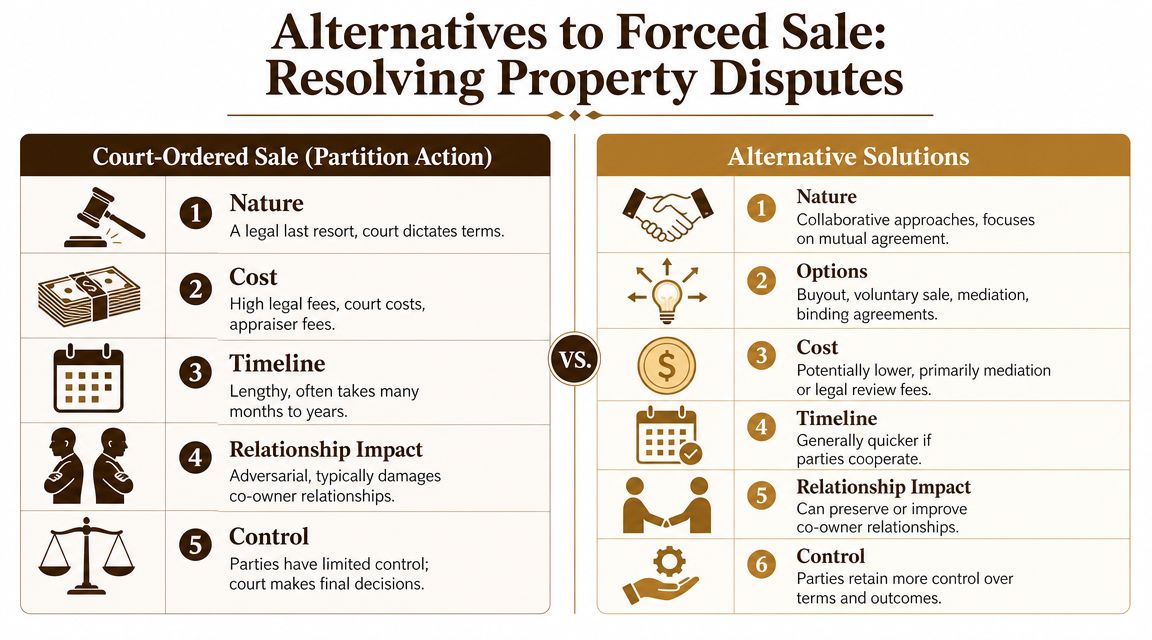
A partition action is powerful. It is also expensive, disruptive, and slow compared with a negotiated resolution. In many California disputes, the credible ability to file is most valuable when it pushes the parties toward a practical deal.
When a buyout works better
A co-owner can generally compel partition unless a valid waiver applies, but parties often attempt a buyout first because court-supervised sales add legal fees, appraisal costs, and delay that reduce the net proceeds available to everyone, as noted in this overview of buyouts versus partition litigation in jointly owned property disputes.
A buyout often works best when one owner wants to remain in the property and has the means to refinance or raise funds. That option can preserve occupancy, reduce hostility, and avoid a court-managed sale.
Other times, a voluntary listing on the open market makes more sense than a lawsuit. If all owners agree to sell, they can choose the broker, timing, pricing strategy, and repair decisions without waiting for court approval.
A practical comparison of your options
Not every case fits neatly into one solution. The right move depends on the property, the personalities involved, the documentation available, and whether anyone is capable of completing a buyout.
Here is the practical trade-off:
| Option | Main benefit | Main risk |
|---|---|---|
| Buyout | Preserves ownership for one side and avoids sale friction | Financing may fail or valuation may be disputed |
| Voluntary sale | More control over timing and marketing | Requires real cooperation |
| Deferred sale agreement | Gives parties time to plan occupancy or refinance | Conflict may simply be postponed |
| Partition lawsuit | Produces an enforceable outcome when no one agrees | Costs, delay, and relationship damage |
One finance issue gets overlooked in many disputes. A forced sale may also force someone to give up a favorable mortgage that cannot be replaced under current lending conditions. In California, that matters more than many owners realize, especially where one co-owner wants to keep the home and the existing loan is part of the property's practical value.
Some of the strongest settlements happen after everyone sees what litigation will actually cost them in time, control, and net recovery.
Good negotiation in these cases is not wishful thinking. It is structured bargaining power. Owners who document a fair buyout proposal, support it with a credible valuation, and show they are prepared to file if necessary often get farther than owners who rely only on threats.
When You Must Hire a Real Estate Attorney
Some co-ownership disputes are manageable with a focused negotiation. Others become legally dangerous quickly. When title, inheritance rights, occupancy, reimbursement claims, or hostile parties are involved, legal counsel is not optional if you want to protect the value of your interest.
Inherited property disputes need more than basic advice
Partition actions are increasingly common in family wealth transfers, especially when heirs disagree over whether to keep, rent, or sell inherited real estate, and those cases often involve complex accounting for taxes, repairs, and mortgage payments made by one heir, as discussed in this article on partition disputes involving inherited property and family transfers.
These disputes are rarely just “real estate cases.” They often overlap with probate administration, trust issues, occupancy rights, and family expectations that were never put in writing. If one heir has been living in the home, another has been paying expenses, and a third lives out of state and wants cash, the legal and emotional stakes rise fast.
The cases that become expensive fast
Certain warning signs usually mean you need experienced representation right away:
- One owner won't respond: delay often becomes a strategy, not an accident.
- Title is unclear: missing deeds, old transfers, or probate gaps can derail a partition claim.
- Contribution claims are substantial: reimbursement fights can change the final payout materially.
- The property is occupied by one side: move-out timing, access, repairs, and sale preparation become contested.
- A low-rate mortgage is part of the dispute: a forced sale may destroy financing value that should be considered in settlement talks.
An attorney in these cases does more than file papers. Counsel identifies the ownership issues early, frames the accounting claims properly, and pushes the matter toward the outcome that best preserves your financial position. In Orange County and Los Angeles, where the underlying equity can be significant, strategic mistakes are costly.
Frequently Asked Questions About Partition Actions
Can I stop a co-owner from forcing a sale
Sometimes, but not usually by simple refusal alone. If the other owner has a valid right to partition under California law, the court may still order a sale unless a valid waiver or other narrow defense applies. In practice, the more realistic path is often to negotiate a buyout or structured settlement.
What happens to the mortgage in a forced sale
The mortgage doesn't disappear because the ownership dispute is in court. It is typically addressed through the sale process and paid as part of the closing and distribution structure if it remains attached to the property. The exact treatment depends on title, payoff demands, and the court's accounting orders.
Is filing a partition case always the best move
No. Sometimes it is necessary. Sometimes it is a bargaining tool. A forced sale can solve deadlock, but it can also create avoidable loss if the parties could have completed a sensible buyout or voluntary sale.
Why does the current lending environment matter
A practical but often overlooked issue is financing. With mortgage rates in 2025 and 2026 remaining higher than pre-2022 norms, forcing a sale may also force a co-owner to surrender a low-rate loan that may not be replaceable, which can become a meaningful factor in settlement and buyout negotiations, as noted in this discussion of mortgage-rate realities and partition strategy in California.
What should I gather before speaking with an attorney
Start with the deed, any trust or probate documents, mortgage statements, tax records, insurance records, repair receipts, and a basic timeline of who paid what and who has been occupying the property. Clear records make strategy decisions much easier.
If you're dealing with a forced sale of jointly owned property in California, don't guess your way through a high-stakes dispute. Tanner Law helps Orange County and Los Angeles property owners evaluate partition actions, inheritance disputes, buyouts, title issues, and reimbursement claims with clear, practical guidance. Schedule a free consultation to discuss your situation and the best path forward.