Joint Tenants with Survivorship in California
A parent in Orange County adds an adult child to the deed, expecting the family home to pass smoothly when the parent dies. The surviving child later learns that the deed's vesting language, a recorded severance, a divorce, a creditor claim, or a disputed transfer may determine whether that plan works. In Los Angeles and throughout California, the difference between a successful survivorship transfer and a quiet title lawsuit often begins with words recorded years earlier.
Joint tenants with survivorship, more precisely joint tenancy with right of survivorship, can provide a direct transfer at the first owner's death. But it isn't a complete estate plan, and it isn't permanent protection against every later dispute. California law treats the form of ownership, the deed, the timing of recording, and the owners' family circumstances as separate issues that must be reviewed together.
Table of Contents
- Why California Families Choose Joint Tenancy
- How Joint Tenancy With Right of Survivorship Works
- Joint Tenancy Compared to Tenancy in Common and Community Property
- Creating a Valid Joint Tenancy in California
- Severing Joint Tenancy and the California Recording Trap
- Creditor Claims, Tax Effects, and Other Practical Risks
- Quiet Title and Partition Disputes Involving Joint Tenants
- Counseling Clients and Choosing the Right Title Form
Why California Families Choose Joint Tenancy
A family may choose joint tenancy because it appears simple. A parent and adult child own a home together, the parent dies, and the child becomes the sole owner without the deceased parent's interest passing through the parent's estate administration. Under the survivorship mechanism, the deceased owner's interest extinguishes and the surviving owner or owners take full title automatically, so the property typically bypasses probate for that first death. The California Law Revision Commission materials describe this outside-probate transfer in California.
That result can be attractive to a married couple, a parent concerned about delays, or a family trying to keep a residence available to the surviving household member. It can also seem reassuring in a second marriage, where each spouse wants the other to have immediate control of the home. The emotional appeal is clear. The family wants the survivor to have a place to live, access to the property, and fewer court-administered steps during an already difficult time.
The plan can be narrower than the family expects
The first death is the critical limitation. Joint tenancy's probate-avoidance effect ends at the last owner's death. If the surviving owner later dies while holding the property alone, the home may still enter probate unless another valid planning device applies, as explained by Nolo's discussion of joint tenancy and probate.
The arrangement can also produce an unintended inheritance result. A parent may think the child is merely helping with the property, while the deed gives the child survivorship rights. If the child survives the parent, the child may receive the property automatically, even if the parent's will names different beneficiaries.
Practical rule: A deed that avoids probate at the first death may still redirect the family's inheritance plan.
A recorded deed can also change the outcome. A joint tenant may sever the arrangement, and California's recording rules can decide whether that severance is effective. That's why a family reviewing an Orange County or Los Angeles property should examine the current deed, every later recorded instrument, and the intended beneficiaries before assuming survivorship will work as expected.
How Joint Tenancy With Right of Survivorship Works
Joint tenancy is a form of co-ownership in which the owners hold the property together under a survivorship arrangement. When one joint tenant dies, that owner's interest doesn't pass to the owner's heirs under a will. Instead, the interest extinguishes, and the surviving joint tenant or tenants take the property automatically. The Cornell Legal Information Institute's explanation of the right of survivorship identifies survivorship as a legal mechanism that can control what happens to an owner's interest at death.
The easiest analogy is a relay race. Each joint tenant runs with an interest in the same property. If one runner leaves the race, the baton continues with the surviving runner rather than going to the departing runner's family. The analogy breaks down if the ownership was never properly created or if a later act severed the joint tenancy.

The four unities
Traditional joint tenancy doctrine describes four required unities. They're useful as a practical checklist:
- Time: The owners acquire their interests at the same time or through the same transaction.
- Title: The owners receive their interests through the same instrument or source of title.
- Interest: The owners hold matching interests in the property.
- Possession: Each owner has the right to possess and use the whole property.
A deed that names two people but fails to create the necessary survivorship relationship may not accomplish what the family expects. A later inheritance also generally doesn't create joint tenancy merely because the heir and another person now appear connected to the same property. The ownership structure must be established through a legally effective title transaction.
Survivorship reaches only the joint tenants
The right belongs to the surviving joint tenant or tenants. It doesn't automatically extend to the deceased owner's children, siblings, or other heirs. That distinction matters when an adult child is added to a parent's deed, when spouses have children from earlier relationships, or when one owner expects a will to control the eventual disposition.
A will generally cannot redirect an interest that passes by survivorship. If the owner wants a share to remain available for children from a prior relationship, a tenancy in common, trust, or another structure may better match that goal. The correct choice depends on the deed, the family plan, and the owner's broader estate objectives.
Joint Tenancy Compared to Tenancy in Common and Community Property
Consider a California home owned by two people. The same address can produce different inheritance outcomes depending on the vesting language. The title form determines whether the first owner's interest disappears into the survivor's title, remains part of the deceased owner's estate, or passes to a surviving spouse under California's community-property framework.
| Ownership Form | What Happens at First Death | Probate Avoided at First Death | Can Co-Owner Will Their Share |
|---|---|---|---|
| Joint tenancy with right of survivorship | The deceased owner's interest extinguishes, and the surviving owner or owners take full title automatically | Typically, yes, for the first death | No, not if survivorship remains effective |
| Tenancy in common | The deceased owner's separate interest passes through the estate or another valid transfer plan | Typically, no, for that interest | Yes |
| California community property with right of survivorship | The surviving spouse receives the deceased spouse's interest under the survivorship form | Yes, for the covered transfer | No, while the survivorship form remains effective |
Joint tenancy
Joint tenancy favors the surviving co-owner. The arrangement can keep the property outside probate at the first death, but the deceased owner gives up the ability to direct that interest by will. It can work for spouses who want a straightforward transfer, but it may frustrate a parent who wants a share to reach a child from a prior relationship.
Tenancy in common
Tenancy in common preserves testamentary control. Each owner has a separate interest that can be transferred through a will or other estate plan. That flexibility can help siblings, unmarried co-owners, investors, or blended families, but the deceased owner's interest may require estate administration and may place heirs into a new co-ownership relationship with the survivor.
Community property with right of survivorship
California recognizes community property with right of survivorship as a separate title form for married couples. The California Law Revision Commission materials explain that property held this way can pass to the surviving spouse without probate, and the cited California materials state that this form applies to property deeded after July 1, 2001. See the California community property with right of survivorship materials.
That form isn't merely a sales phrase. It follows a statutory pathway with its own vesting language and should be evaluated alongside tax, estate, and marital objectives. Married couples shouldn't assume that joint tenancy and community property with right of survivorship produce identical consequences in every planning context.
Creating a Valid Joint Tenancy in California
The deed must do the legal work. In California, the owners and the vesting language should clearly establish joint tenancy with right of survivorship. A deed that lists two names without the intended form may create uncertainty, particularly if the instrument doesn't state that the grantees hold title as joint tenants.
A useful drafting review asks three questions:
- Who receives the interest? The deed should identify every intended co-owner accurately.
- How do they hold title? The instrument should state the intended ownership form, not leave the result to assumption.
- Does the language match the family's plan? A survivorship deed may conflict with a will, trust, marital agreement, or intended gift to other heirs.
Review the title record before relying on the deed
A preliminary title report can reveal how the property is currently vested and identify later deeds, liens, or other recorded instruments. Title companies review vesting language when evaluating title and issuing an owner's policy, but a title report isn't a substitute for legal advice about whether the vesting matches the family's objectives.
Transfers through inheritance deserve special attention. Receiving property from an estate doesn't automatically place the recipient into a joint tenancy with another person. The new instrument, the source of title, and the language used in the transfer must be examined.
A parent who adds an adult child should also consider whether the parent intends an immediate present ownership interest or only a transfer at death. Joint tenancy generally gives the child current rights as a co-owner, not merely a future expectancy. That can affect control, sale decisions, creditor exposure, family relationships, and later disputes.
Use the right California form
Married couples may want to compare joint tenancy with California community property with right of survivorship. The two forms should not be treated as interchangeable labels. A California attorney can review the proposed deed, the existing title report, the couple's estate plan, and the family's intended beneficiaries before recording a transfer that may be difficult to unwind.
Severing Joint Tenancy and the California Recording Trap
A joint tenant who signs a severance deed in Los Angeles may believe the survivorship feature ended that day. The family may discover after death that the deed remained unrecorded. In California, the recording record can decide whether the severance binds the other joint tenants. The First Tuesday analysis of severing survivorship vestings addresses why recording procedures matter in a later title dispute.
California Civil Code section 683.2 generally makes a deed or written instrument severing a joint tenancy effective against the other joint tenants when recorded before the severing tenant dies. California law provides a narrow alternative. The instrument must be signed before a notary no earlier than three days before death and recorded within seven days after death, as explained in California Civil Code section 683.2.
Why signing isn't always enough
A signed deed in a desk drawer may leave survivorship intact. If the instrument was not recorded during the owner's life and does not satisfy California's limited notary and post-death recording rules, the surviving owner can argue that the severance never became effective against them.
The practical dispute usually centers on the record, not the family's recollection. Counsel should examine the county recorder's index and recorded documents, along with delivery, notarization, the instrument's execution date, and the timing of death. An old deed found after death may show intent, yet still fail to change title.

California's divorce rule can produce a different result. Under Probate Code section 5601, a joint tenancy between a decedent and a former spouse, created before or during marriage, is severed as to the decedent's interest if the spouses are no longer married at death, subject to a narrow exception. A judgment of legal separation is not a dissolution for this purpose. The California Probate Code section 5601 materials describe that distinction.
Recording controls outcomes: Signing a severance instrument is only one part of the analysis. The decisive question is whether California law treated it as effective against the other joint tenants at the relevant time.
Creditor Claims, Tax Effects, and Other Practical Risks
Joint tenancy doesn't make an owner invisible to creditors. A creditor pursuing one co-owner may be able to reach that owner's interest, and a recorded judgment lien can create pressure for a sale or partition. The survivorship feature concerns what happens at death. It doesn't necessarily prevent creditors from asserting rights during the owner's lifetime.
A family also shouldn't assume that adding a child to a deed is a neutral administrative step. The child becomes a co-owner with legal rights and potential exposure to personal financial problems. A later bankruptcy, judgment, divorce, or disagreement about sale and occupancy can place the home in a very different situation from the one the parent originally imagined.
California property tax questions require separate review
California property tax consequences can involve change-of-ownership rules, reassessment exclusions, and documentation requirements. Families often ask about parent-child and spouse exclusions, but eligibility depends on the particular transfer, the property, the filing requirements, and the law in effect when the transfer occurs. The fact that a transfer uses joint tenancy doesn't answer those questions by itself.
Basis tracking creates another practical issue. When a parent adds a child, the family should preserve records showing acquisition cost, improvements, ownership history, and later transfers. If the property is eventually sold, those records may be important to the tax analysis. A probate attorney or real estate attorney may need to coordinate with a tax professional rather than treating title advice as a complete tax opinion.
Separate title advice from tax advice
The deed answers who owns the property. It doesn't automatically answer whether the transfer produces the tax result the family wants. Before adding a child or changing vesting, the owners should ask how the transaction affects control, creditor exposure, future sale planning, property tax treatment, and the family's larger estate plan.
Quiet Title and Partition Disputes Involving Joint Tenants
A parent dies, one child claims survivorship, and another points to a later deed or agreement. The dispute may turn on whether the joint tenancy was severed, whether a conveyance was effective, or whether simultaneous deaths changed the result. California analysis requires the court to examine the governing instrument and applicable statutes rather than rely on a general survivorship summary.
Under California Civil Code section 683.2, a written instrument, agreement, or other permitted act may sever a joint tenancy, but the details matter. The court may review the original deed, later conveyances, delivery, recording history, death records, marital status, and the parties' competing claims. A purported severance can fail if it did not satisfy California's requirements, while an informal family understanding may carry little weight against the recorded title.
Quiet title actions test the record
A quiet title action asks the court to determine ownership and the validity or effect of a recorded instrument. In a survivorship dispute, the pleadings and evidence should identify the specific document that allegedly created, changed, or severed the joint tenancy. The parties may also need to address whether a transfer was completed during life and whether Probate Code section 5601 affects a former spouse's rights after dissolution or annulment.
The strongest position usually rests on documents, not recollections. A child may remember a parent promising the house as an inheritance, yet the deed may grant a surviving joint tenant immediate ownership. Conversely, a surviving tenant may face a valid severance that was completed before death. A title report, certified deeds, death certificates, and the full chain of recorded instruments should be reviewed before filing.
Partition creates an exit mechanism
A partition action addresses a different conflict. One co-owner wants to sell or divide the property, while another refuses. A court may order partition by sale or, where legally and practically appropriate, division in kind. The remedy can change the economic result of survivorship because the property is being divided or sold during the owners' lives rather than passing automatically at death.
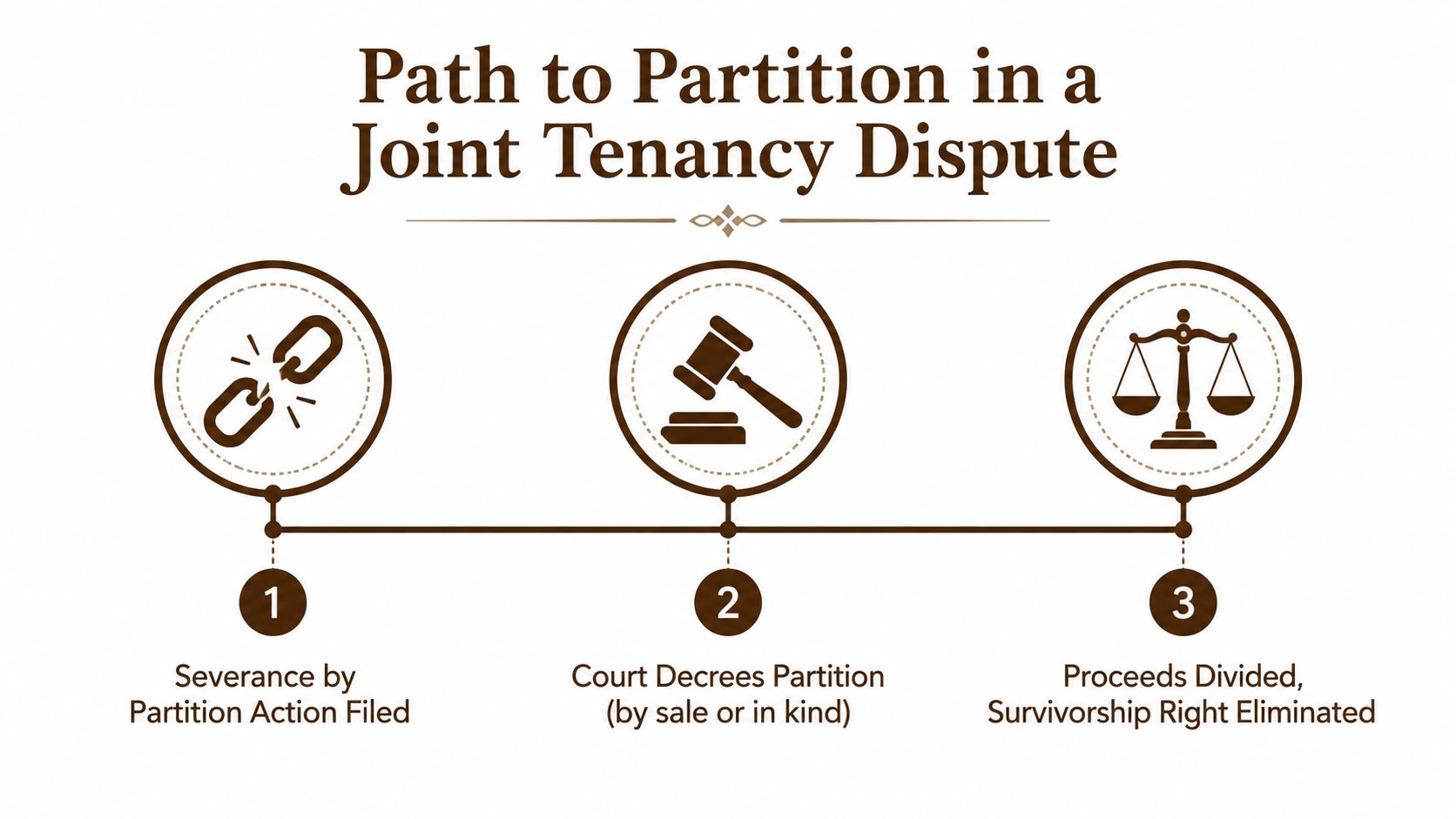
A partition case may include accounting for mortgage payments, taxes, repairs, improvements, rental value, possession, sale expenses, and proceeds. The court determines each party's legal interest and allowable credits. A family member's greater need or contribution may matter only through recognized claims and evidence, not as a substitute for the title documents.
The following video provides additional visual context for the partition process:
Counseling Clients and Choosing the Right Title Form
Joint tenancy is often appropriate when the owners want the survivor to receive the property automatically and understand that the survivor's title may later become part of the survivor's own estate. It can suit married couples seeking simplicity and families focused on avoiding probate at the first death. It's less suitable when the owners want each person to control who ultimately receives that person's interest.
A practical consultation should address the relationship first, then the property:
- Marital relationship: Married couples should compare joint tenancy with California community property with right of survivorship, especially where the couple's estate and tax objectives require a specific statutory form.
- Blended family: A parent with children from a prior marriage should be cautious about giving a new spouse or adult child survivorship control without reviewing the entire estate plan.
- Creditor and divorce exposure: Owners who want to shield the property from a co-owner's future creditors or divorce-related claims shouldn't assume joint tenancy provides that protection.
- Control during life: Adding a child creates present co-ownership, not merely a future inheritance promise.
- Exit strategy: Co-owners should discuss what happens if one wants to sell, move, refinance, or stop contributing to expenses.
When another structure may fit better
A tenancy in common can preserve the ability to leave a separate interest to selected heirs. A revocable trust may provide broader control over management and distribution, although the trust must be properly created and funded. A transfer-on-death deed may be worth evaluating where California law and the property's circumstances permit it. Community property with right of survivorship may be a better comparison for married couples who want survivorship while using a different California title form.
The cheapest deed can become the most expensive document in the file if it creates a quiet title dispute, a partition action, or an inheritance result the family never intended. Reviewing vesting before a purchase or transfer is usually more efficient than asking a court to reconstruct the parties' intentions after death.
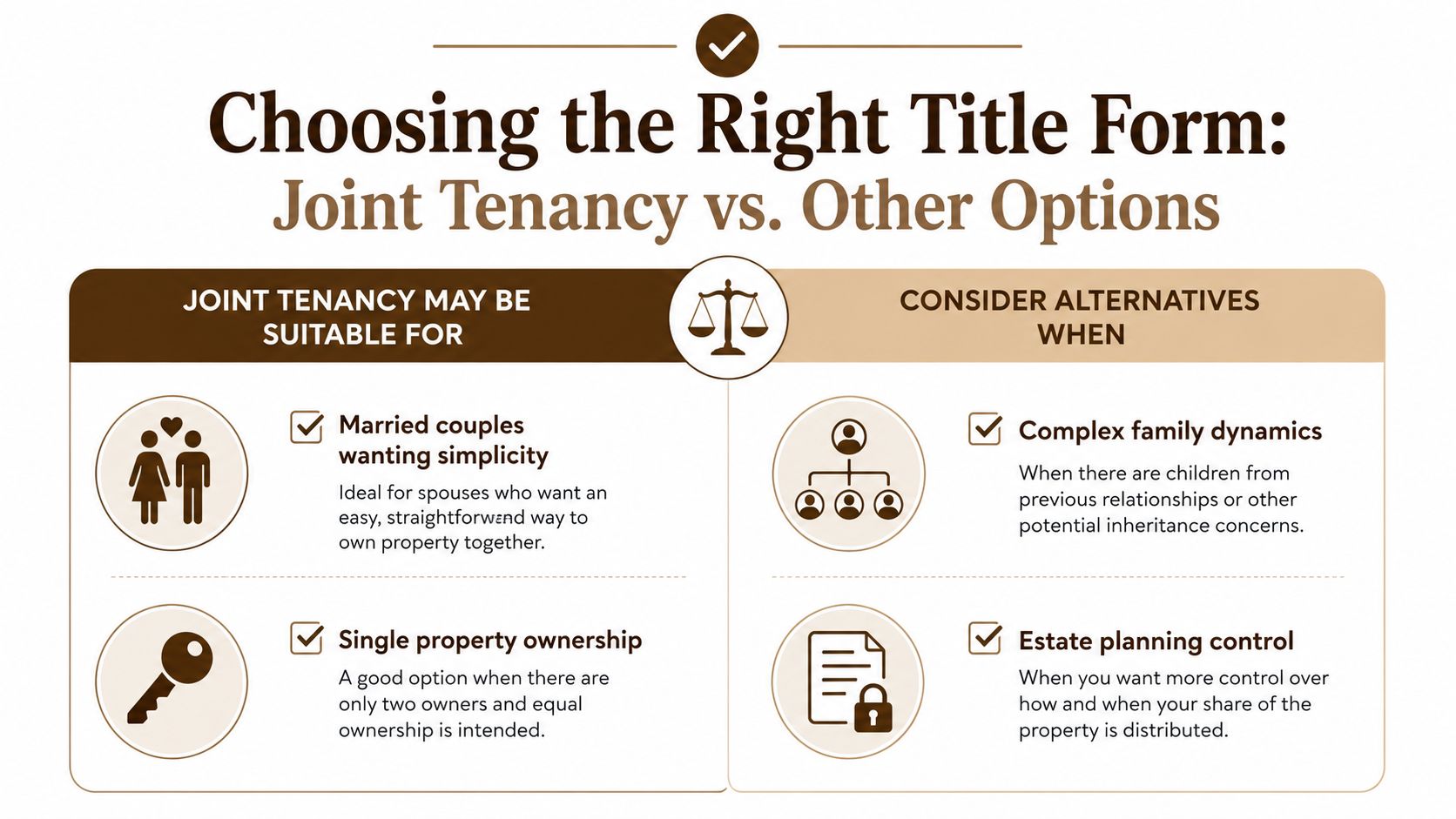
Decision point: Choose survivorship because it matches the family's intended outcome, not simply because the deed appears easier to prepare.
If you own property in Orange County, Los Angeles, Riverside, or San Bernardino, review the vesting deed and the probate plan before recording a new transfer. The right advice depends on the title history, family relationships, creditor concerns, and the intended result after the first and last owner dies.
Tanner Law offers practical California counsel on joint tenancy, quiet title claims, partition disputes, probate issues, and real estate ownership planning. Schedule a free consultation by visiting Tanner Law so your deed and survivorship plan can be reviewed before a title dispute becomes a lawsuit.