
Conservatorship Attorney Guide for California Families
Your parent's bills are late, bank accounts are difficult to access, and siblings disagree about what should happen next. One relative says a power of attorney already solves the problem. Another says the family must immediately file for conservatorship. Meanwhile, the person at the center of the dispute may be unable to explain what they want or protect their own finances.
A California conservatorship attorney helps separate the emergency from the legal answer. The right lawyer evaluates whether court involvement is necessary, identifies the type of authority at issue, prepares the evidence and filings, represents the family at the hearing, and plans for the ongoing reporting duties that begin after appointment. Conservatorship isn't a one-time form submission. It's a court-supervised relationship that can require continuing attention for years.
Table of Contents
- What a Conservatorship Attorney Does for Your Family
- Conservatorship of the Person Versus the Estate
- The California Conservatorship Filing Process
- Understanding Conservatorship Costs and Timelines
- Exploring Alternatives Before Filing for Conservatorship
- How to Choose the Right Conservatorship Attorney
- Post-Appointment Duties and Ongoing Court Oversight
- Take the Next Step with a Free Consultation
What a Conservatorship Attorney Does for Your Family
Consider a common situation. An aging parent still owns a home, receives income, and has regular bills, but dementia has made it unsafe for that parent to manage bank accounts. One child wants to file immediately. Another believes the parent can still sign a power of attorney. A third worries that a court proceeding will permanently remove the parent's independence.
A conservatorship attorney starts by sorting through those competing concerns. The lawyer asks what decisions the parent can still make, whether valid planning documents exist, what assets require protection, and whether a narrower solution would address the immediate risk. That evaluation matters because California courts expect families to consider less restrictive alternatives before requesting broad authority.
The lawyer's work before the hearing
If a court proceeding is appropriate, counsel prepares the petition, capacity evidence, notices, supporting declarations, and proposed orders. California probate conservatorship is document-intensive. The attorney must also anticipate questions from the court investigator, address objections from relatives, and explain the proposed conservatee's rights in understandable language.
The lawyer's role isn't limited to advocating for the person who wants to serve as conservator. The proposed conservatee has legal interests that must be protected. In Washington, for example, statutory counsel must make reasonable efforts to determine the respondent's wishes and advocate those wishes when reasonably ascertainable, or seek the least restrictive outcome consistent with the person's interests. That preference-sensitive model illustrates why conservatorship representation involves more than moving paperwork through a clerk's office. Washington's conservatorship counsel statute provides a useful comparison for understanding the advocacy standard.
Practical rule: A lawyer who only discusses getting appointed, but never explains what happens afterward, isn't giving the family the full picture.
Why a specialist becomes essential
A general estate planning lawyer may prepare wills, trusts, and powers of attorney without regularly litigating court-supervised incapacity proceedings. A conservatorship attorney works inside the probate process, where a judge controls the appointment and major decisions.
That distinction becomes especially important when family members disagree, the proposed conservatee objects, real property must be managed, or the estate requires formal accounting. National court data materials estimate that about 1.3 million adult guardianship and conservatorship cases are active or awaiting hearing or review in the United States, with courts overseeing roughly $50 billion in assets under those cases. Justice in Aging's guardianship data materials also explain that many states don't reliably separate guardianship from conservatorship in their reporting, so the recorded workload may understate the actual volume.
For an Orange County or Los Angeles family, counsel is essential when no one can safely act under existing documents, when authority over property is disputed, or when the court must approve decisions affecting a vulnerable adult's rights and assets.
Conservatorship of the Person Versus the Estate
California treats authority over personal decisions and authority over finances as distinct concerns. Families sometimes ask for “a conservatorship” without identifying which powers are needed. That can lead to an overbroad petition, unnecessary conflict, or confusion about what the proposed conservator may legally do.
A conservatorship of the person concerns personal care and living arrangements. Depending on the order, it may involve decisions about medical care, residence, food, clothing, and daily needs. A conservatorship of the estate concerns money and property, including collecting income, managing accounts, paying expenses, and protecting real estate.
A parent might be unable to recognize unsafe medical conditions but still understand bank statements and manage a checking account. In that situation, a family may need to examine personal authority without assuming that financial control is necessary. Another parent may live safely with a caregiver but be unable to pay property taxes, manage investments, or protect a rental property. That situation raises a different question.
Side-by-side comparison
| Feature | Conservatorship of the Person | Conservatorship of the Estate |
|---|---|---|
| Primary scope | Medical care, residence, and personal needs | Finances, property, income, and expenses |
| Typical concern | Unsafe living conditions or inability to make personal-care decisions | Unpaid bills, financial exploitation, property management, or inaccessible accounts |
| Evidence considered | Functional limitations, care needs, and ability to make personal decisions | Financial capacity, assets, income, debts, and management needs |
| Court oversight | Reports and reviews concerning personal welfare and authority granted | Accountings, asset management, transactions, and financial reporting |
| Possible result | Authority over selected personal decisions | Authority over selected financial decisions |
| Family fit | A parent who needs help with medical or living decisions | A parent who needs help managing money or property |
The authority must match the problem
The court order controls the conservator's powers. A person appointed over the estate doesn't automatically gain authority to make every medical or residential decision. Likewise, personal authority doesn't automatically permit control of bank accounts or real property.
The National Center for State Courts distinguishes financial conservatorship from guardianship and emphasizes that courts must monitor these matters as separate areas of protection. The NCSC's 2025 trends report also discusses separate reporting for guardianship and conservatorship proceedings.
A careful attorney will identify the least authority needed to protect the person. The answer may be one proceeding, both proceedings, or neither. A family shouldn't request every available power because the petition makes those powers available.
The California Conservatorship Filing Process
A California conservatorship petition begins with an assessment of the person's functional limitations, not merely a diagnosis. The court needs evidence showing why the requested authority is necessary and what decisions the proposed conservatee cannot safely manage. Medical evidence must connect the condition to the specific powers being requested.

Documents that make or break the petition
California probate courts commonly require a coordinated filing packet that may include:
- Petition: Identifies the proposed conservatee, petitioner, requested powers, and reasons for court intervention.
- Citation and notice of hearing: Tells the proposed conservatee and other legally interested people about the proceeding.
- Capacity declaration: Provides professional evidence concerning the person's limitations and the authority sought.
- Confidential disclosures: Supplies information the court needs without placing sensitive details in a public filing.
- Proposed order and letters: Gives the judge a framework for the decision and, if granted, documents the conservator's authority.
- Duties acknowledgment: Confirms that the proposed conservator understands the obligations attached to appointment.
California's official conservatorship handbook explains that an estate conservator must locate and control assets, collect income, create a budget, and pay bills. The California Courts handbook also reflects the broader reality that appointment paperwork connects directly to continuing financial responsibilities.
Notice, investigation, and hearing rights
The petitioner must serve the required people using legally compliant methods and within the applicable deadlines. Defective notice can force the court to continue the hearing, even when the family faces a genuine emergency. The court investigator may interview the proposed conservatee, relatives, caregivers, and professionals before making a report or recommendation.
The proposed conservatee has concrete due-process rights. California court materials identify the right to appear and oppose the petition, hire an attorney of choice, receive court-appointed counsel if unable to retain one, request a jury trial, and, in a limited conservatorship, object to some or all requested powers. California's GC-320 court form describes these hearing rights.
At the hearing, the judge may grant the petition, limit the requested powers, request additional evidence, or continue the matter. The process isn't a simple paperwork exercise. It's a formal proceeding that can affect a person's autonomy, property, and relationship with family members.
Understanding Conservatorship Costs and Timelines
Families often budget for filing the petition and the first hearing, then discover that court supervision continues after appointment. A responsible estimate separates initial costs, case-specific expenses, and recurring compliance work.
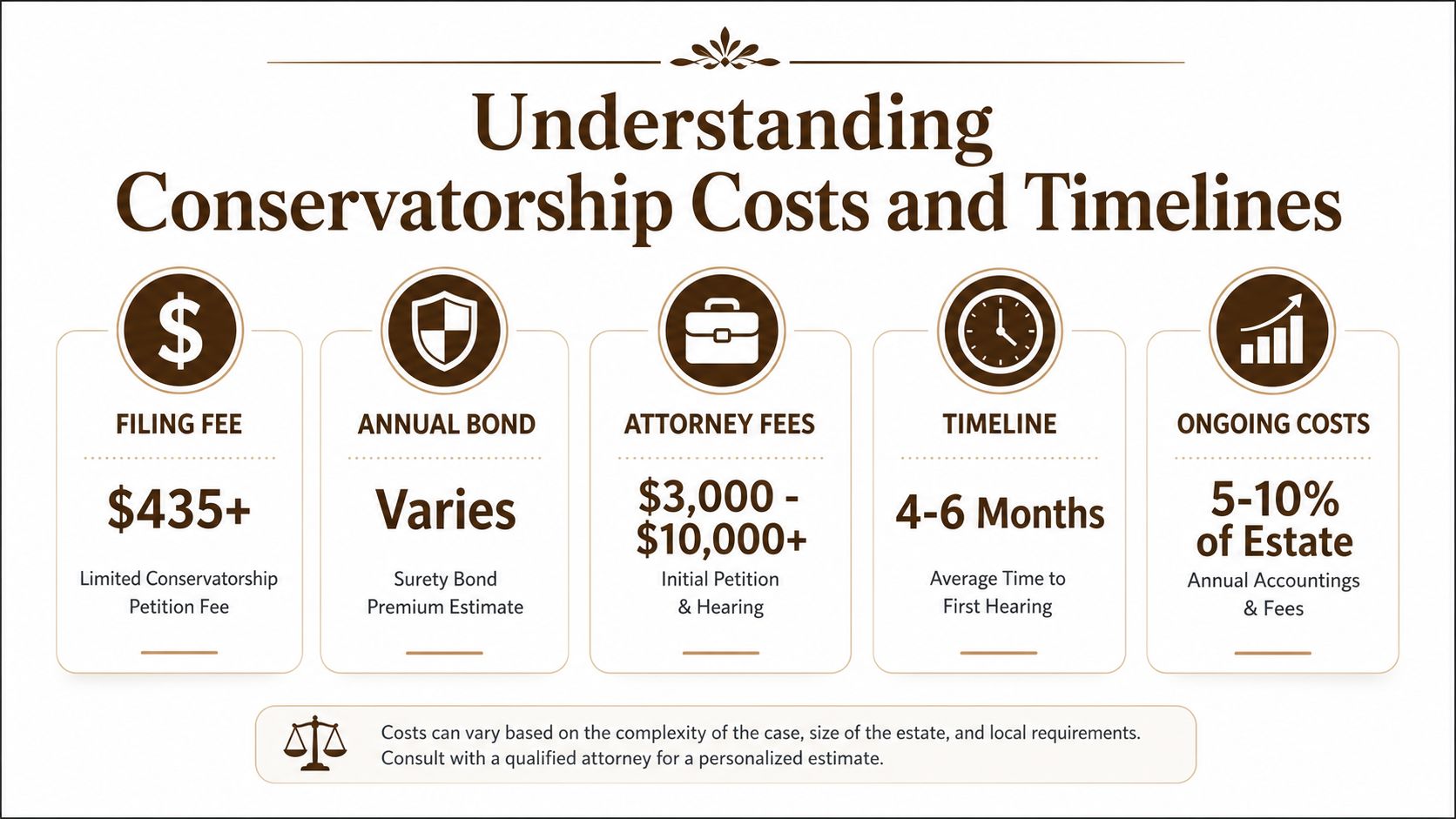
California's statewide civil fee schedule and court self-help materials state that a limited conservatorship petition begins with a filing fee of $435, while investigation costs are separate and set by the court. The California statewide civil fee schedule provides the filing-fee baseline.
What the family should put in the budget
The filing fee is only one line item. Families may also face court investigation charges, medical-record and capacity-evaluation expenses, service costs, bond-related expenses, and attorney fees. The amount depends on the county, the size and complexity of the estate, the level of disagreement, and the number of court appearances required.
Attorney billing may be hourly, flat-fee, or a combination. Ask exactly what the initial engagement covers. Some arrangements include preparation and the first hearing but exclude contested litigation, emergency applications, accountings, real-estate transactions, and later petitions.
Ongoing expenses deserve equal attention. Estate accountings require organized records, transaction support, and explanations that reconcile income, expenses, and remaining assets. Property sales or other major transactions may require advance court approval, separate legal work, and additional professional costs.
Why timing varies
The first hearing depends on court availability, investigation scheduling, proper service, complete filings, and whether someone objects. An uncontested matter with accurate documents may move more smoothly than a case involving disputed medical evidence, sibling conflict, or incomplete notice.
The family should plan for a continuing court relationship rather than a single event. Before signing an engagement agreement, ask the attorney to identify what happens if the hearing is continued, if the proposed conservatee requests a jury trial, or if the court requires amended paperwork.
The following video offers a general visual introduction to the subject, but it doesn't replace advice about a specific California case.
Exploring Alternatives Before Filing for Conservatorship
A conservatorship may be necessary, but it shouldn't be the automatic response to every family concern. California courts consider whether a less restrictive arrangement can protect the person while preserving as much decision-making ability as possible.
Common alternatives and their limits
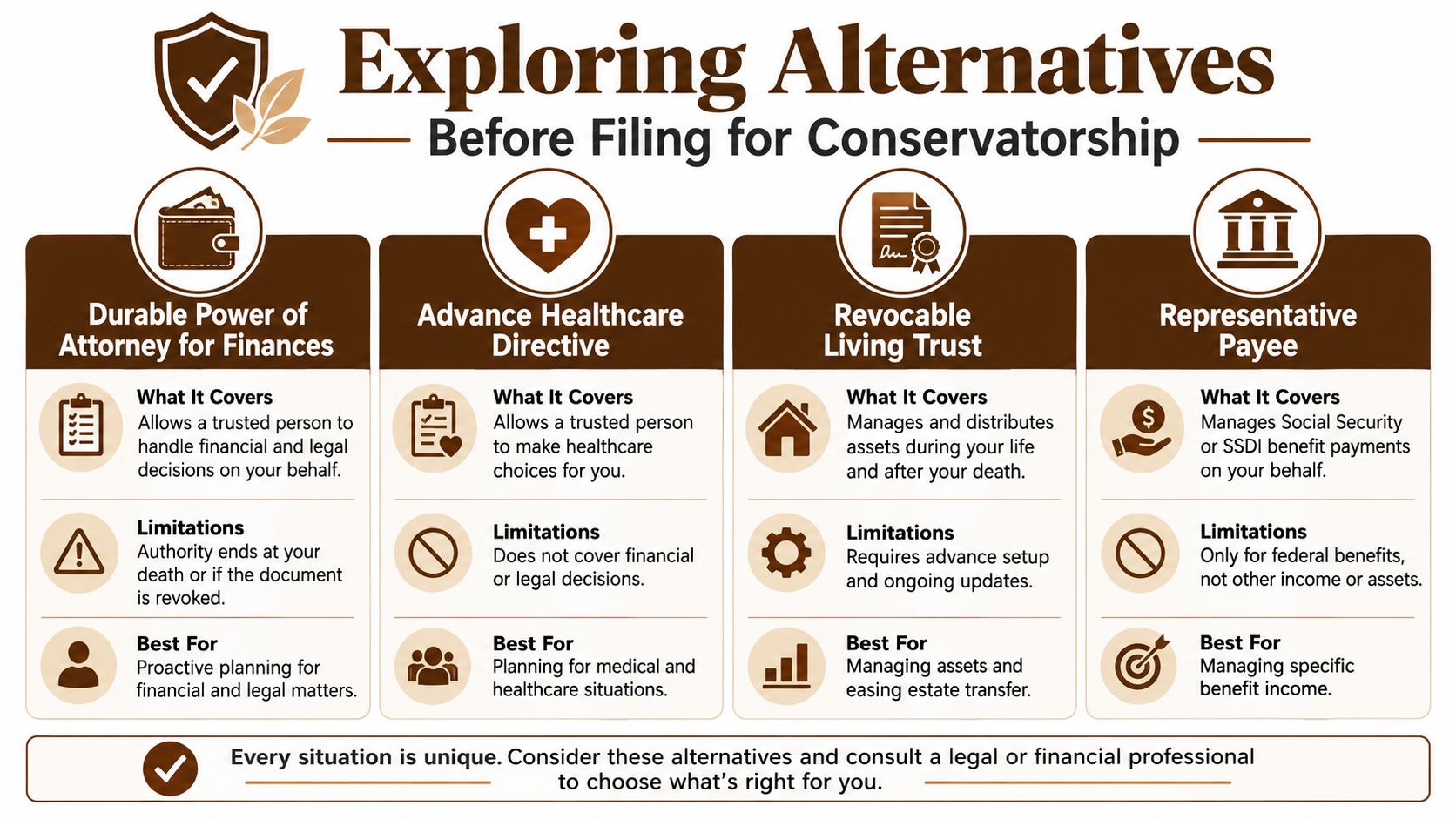
A durable power of attorney for finances can authorize someone to manage money and property. It works best when the person understands the document and signs it before capacity has materially declined. It won't solve the problem if the person can no longer understand the authority being granted, or if financial institutions challenge the document.
An advance healthcare directive addresses medical preferences and identifies a health-care decision-maker. It doesn't authorize financial management, property sales, or payment of household expenses.
A revocable living trust may allow a successor trustee to manage trust assets during incapacity and after death. It only controls assets properly transferred into the trust. A house, account, or investment left outside the trust may require another planning solution.
A representative payee can manage specified federal benefit income, such as Social Security or SSDI. That authority is limited to the benefits covered by the appointment and doesn't control other accounts, real estate, or personal decisions.
Limited authority can be the better answer
A limited conservatorship may fit an adult with developmental disabilities when the person can make some decisions but needs help with particular areas. The court can evaluate the requested powers rather than treating incapacity as an all-or-nothing condition.
A family should inventory existing documents, accounts, property, benefits, and immediate risks before filing. That review often reveals that a trust or valid power of attorney solves part of the problem, while a court proceeding is needed only for the gap. In other cases, the documents are invalid, incomplete, or too narrow, and the court becomes the only practical route.
The strongest petition is often the one that explains why narrower tools won't protect the person.
An attorney who files first and investigates later may create needless expense and conflict. A careful conservatorship attorney tests the alternatives, identifies their limits, and requests only the authority the facts support.
How to Choose the Right Conservatorship Attorney
Not every probate lawyer regularly handles California conservatorship proceedings. The work requires familiarity with capacity declarations, court investigators, service rules, local probate procedures, accountings, and the practical management of real property and financial records.
Start with county experience. Orange County and Los Angeles courts may apply different local procedures, calendars, forms, and filing expectations. An attorney who understands the assigned courthouse can often identify procedural problems before they cause a continuance.
Questions to ask during the consultation
- Relevant experience: How often do you handle conservatorship matters, rather than only trusts or uncontested probate?
- County familiarity: Which Orange County or Los Angeles probate court locations do you regularly appear in?
- Evidence strategy: What medical information and capacity declaration will the petition require?
- Family conflict: How would you respond if the proposed conservatee or a relative objects?
- Scope of representation: Does the engagement include only appointment, or also accountings, property transactions, and later reviews?
- Billing structure: Will the matter use a flat fee, hourly billing, a retainer, or different arrangements for different stages?
- Communication: Who will answer questions when a bank, court investigator, or family member needs information?
California qualification standards
California imposes experience and education requirements for certain court-appointed counsel representing a conservatee, proposed conservatee, or person alleged to lack legal capacity. After first becoming available for appointment, that attorney must complete at least three hours of approved continuing education each calendar year, including at least one hour on less restrictive alternatives to conservatorship. California's Rules of Court, Title 7 sets out those requirements.
That rule doesn't mean every privately retained attorney has the same appointment role. It does give families a useful benchmark for asking whether counsel stays current on capacity, alternatives, and conservatorship procedure.
Check the lawyer's standing through the State Bar of California, request a written fee agreement, and be cautious if the attorney promises a guaranteed result, dismisses the proposed conservatee's rights, or cannot explain post-appointment duties. Clear explanations are a qualification in practice. You should understand what the lawyer recommends and why.

Post-Appointment Duties and Ongoing Court Oversight
Appointment is the beginning of the conservator's operational responsibility, not the end of the case. For an estate conservator, California's handbook describes core tasks that include locating and controlling assets, collecting income, preparing a budget, and paying bills. Those tasks require records that can withstand review, not informal notes or memory.
The conservator must also keep personal and conservatorship funds separate, preserve supporting documents, monitor property, and follow the limits in the court order. A real-estate decision may require a separate request for court approval. The conservator shouldn't assume that appointment alone authorizes every major transaction.
Annual accounting is a legal responsibility
Annual accountings generally require a clear record of what came into the estate, what left it, why each expense was necessary, and what remains. Bank statements, receipts, leases, invoices, tax records, and investment statements help establish that the conservator acted properly.
Massachusetts created a dedicated oversight office through its 2025 standing order to track required annual reports and accounts. A 2026 public report estimated 6,535 active conservatorship cases and found that only about 6% of conservators were in compliance with annual accounting requirements. Massachusetts Standing Order 1-2025 shows why post-appointment compliance has become a central court-management concern, even though California has its own rules and procedures.
Missed deadlines create practical exposure
A late or incomplete accounting can lead to court notices, demands for correction, additional hearings, restrictions on authority, or other consequences determined by the court. The conservator may also face difficulty explaining transactions years later if records were never organized.
Court investigators and judges may review whether the arrangement remains necessary and whether the conservator is performing the assigned duties. Families should establish a calendar for reports, tax work, insurance, property maintenance, and court deadlines immediately after appointment.
Ongoing attorney guidance can prevent a manageable reporting issue from becoming a contested compliance dispute. The right lawyer helps the conservator understand what requires court approval, prepares accurate accountings, and keeps the family focused on the conservatee's welfare rather than informal sibling agreements.
Take the Next Step with a Free Consultation
Conservatorship decisions affect a person's autonomy, housing, medical care, property, and family relationships. Before filing in a California court, determine whether the concern involves the person, the estate, both, or neither. Then examine existing planning documents, consider less restrictive alternatives, prepare for the filing process, and budget for continuing court oversight.
The most important question isn't, “Can our family get appointed?” It's whether the proposed authority is necessary, properly limited, supported by evidence, and manageable after the hearing. A conservator must be ready to maintain records, meet reporting duties, and seek court approval when required.
William T. Tanner has served Orange County and Los Angeles families since 1994, combining courtroom advocacy with practical guidance. Tanner Law's office is located at 1913 E. 17th Street, Suite 212, Santa Ana, CA 92705. The initial consultation is free and confidential, and families can discuss their circumstances by phone or email before deciding how to proceed.
Tanner Law can help you evaluate whether a California conservatorship is necessary, identify less restrictive options, and prepare for both the initial proceeding and ongoing court compliance. Schedule your free, confidential consultation by visiting Tanner Law or contacting the office by phone or email.