How to Respond to a Debt Collection Lawsuit
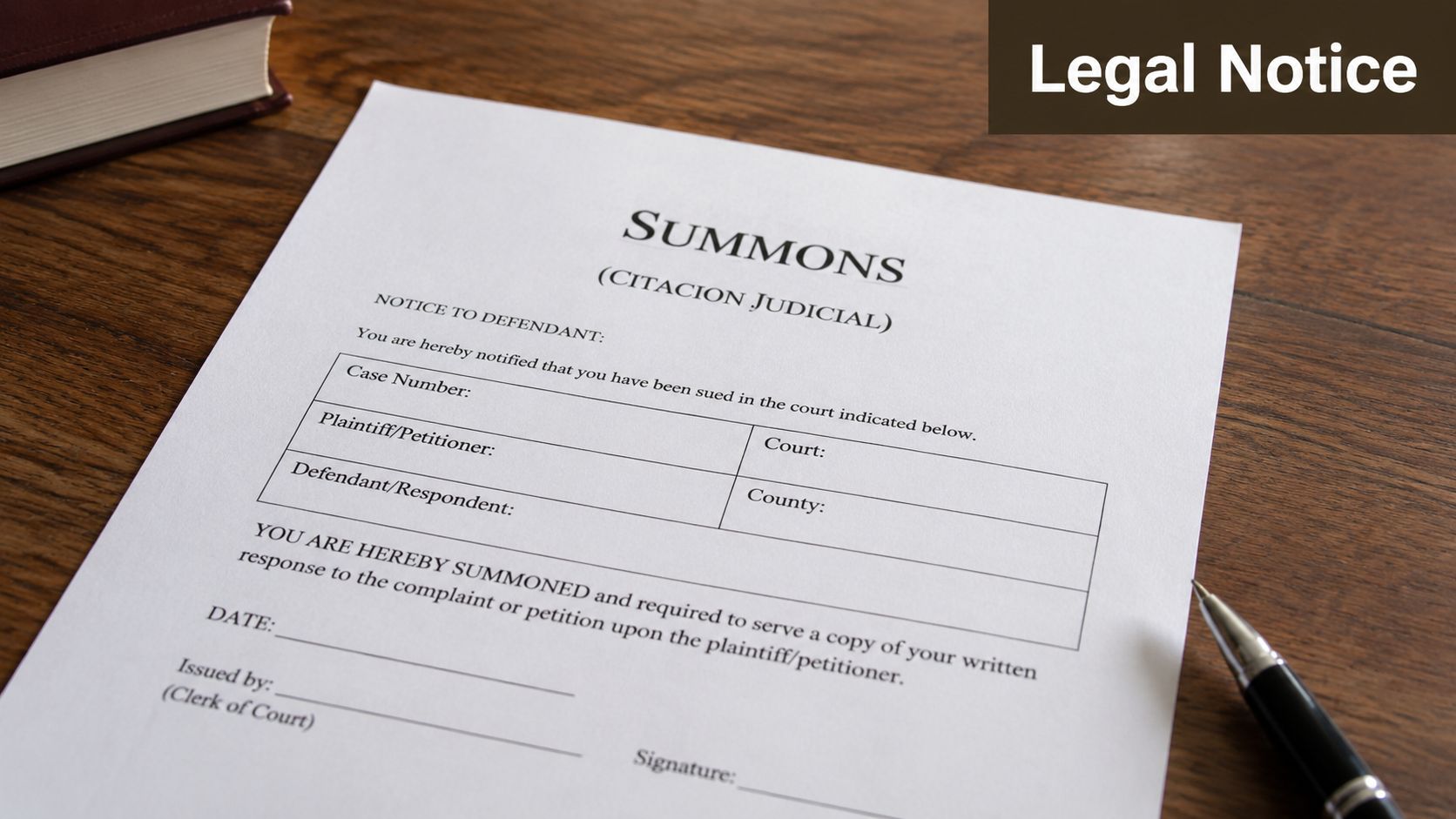
A process server comes to your door, or you open your mail and see papers from the Superior Court of California. The first reaction is usually the same. Panic, anger, embarrassment, or all three at once. It's common to be unprepared for how formal a debt collection lawsuit looks, and many assume there must already be a court date, a judgment, or some immediate seizure around the corner.
Usually, the papers are two core documents. A Summons tells you that you've been sued and that you must respond within the legal deadline. A Complaint lays out what the plaintiff claims you owe and why. In California, those papers matter most at the beginning, not because everything is already decided, but because your next step decides whether you get a voice in the case.
If you're trying to figure out how to respond to a debt collection lawsuit in California, especially in Orange County, start with one rule. Don't ignore it. You do not need to prove your whole case on day one. You do need to respond correctly and on time.
Table of Contents
- You Have Been Sued for Debt Now What
- Your Crucial First Steps After Being Served
- Drafting and Filing Your Answer in California Courts
- Asserting Powerful Affirmative Defenses
- Navigating the Lawsuit After Filing Your Answer
- Avoiding Default and Seeking Professional Legal Help
You Have Been Sued for Debt Now What
I often encounter individuals after service who have done the same thing. They flipped through the papers, looked for a hearing date, didn't find one, and then set the packet aside because they weren't sure what else to do. That instinct is understandable, but in California debt cases it creates the worst result.
Over the past decade, more than 70% of debt collection lawsuits have been resolved by default judgments in favor of the plaintiff, meaning many people never respond and lose automatically, which can lead to wage garnishment and bank account levies, according to Pew's report on debt collection and state courts.
A default judgment is not the court deciding the plaintiff proved everything after a full fight. It usually means no timely response was filed, so the court entered judgment without hearing your side. That distinction matters. A debt buyer may still have weak records, incorrect balances, or poor proof of ownership, but none of that helps if you never file an Answer.
What the papers usually mean
The Summons is your warning that the clock is running. In California civil cases, the deadline shown on the summons is critical.
The Complaint is the plaintiff's version of the story. It may come from the original creditor, but often it comes from a collection law firm or debt buyer. The complaint might attach account statements, a contract, or almost nothing at all.
Practical rule: Your first job isn't to argue by phone with the collector. Your first job is to stop an automatic loss by responding through the court.
What works and what doesn't
Some reactions help. Others don't.
| Response | Likely result |
|---|---|
| Reading the summons carefully | You understand the deadline and court listed |
| Reviewing the complaint line by line | You start spotting gaps and errors |
| Calling the plaintiff's lawyer without filing | Usually does not protect you from default |
| Waiting for a hearing notice before acting | Risky, because the case can move without your response |
A phone call, a promise to pay, or a complaint to customer service doesn't replace a filed court response. California procedure is formal. The court expects a written response. If you file one, the case becomes a lawsuit that has to be proved. If you don't, the plaintiff may never need to prove much at all.
Your Crucial First Steps After Being Served
The best immediate response is calm, organized, and boring. That is good news. You don't need a dramatic legal strategy in the first day or two. You need a checklist and a pen.

Debt collection cases have become routine in civil courts. They account for about one in four cases on civil court dockets nationwide, up from one in nine in 1993, as discussed in this SSRN paper on debt claims in state courts. That volume is one reason these cases often move in a standardized, paperwork-driven way. You should respond with the same level of organization.
Mark the deadline first
In California, the summons generally gives you 30 days to file a response after service. Count carefully from the date you were served, not from the date you finally opened the envelope or decided to deal with it.
If you're unsure about the service date, don't guess. Look at the proof of service paperwork if it was included, and compare that with what happened. If service was unusual, substituted, or confusing, get legal advice quickly.
Read the caption and court information
Before you read the allegations, look at the top of the complaint.
Check these items:
- Court name: Is it the Superior Court of California, County of Orange, or another county?
- Case number: You will need this for all filings.
- Case type: Many debt matters are filed as Limited Civil cases.
- Plaintiff name: Is it the original creditor, or a company you've never heard of?
- Plaintiff's attorney: This tells you who will receive your filed Answer.
For Orange County residents, a complaint filed in Orange County Superior Court should be handled as an Orange County court matter from the start. That affects filing method, local practice, and where documents are submitted.
Review the complaint like a recordkeeper, not like an outraged customer
People often focus on whether the debt feels unfair. That matters, but first look for what the complaint alleges.
Use a simple worksheet and note:
- Who is said to own the debt
- What type of account is involved
- Whether the amount claimed looks familiar
- Whether interest, fees, or attorney's fees are requested
- Whether the dates match your records
When a complaint is thin on details, that doesn't mean you automatically win. It means you should force the plaintiff to prove what it alleges.
Gather your own documents
Do not rely on memory. Debt cases often involve old accounts, charge-offs, sold accounts, and incomplete records. Pull together whatever you have before drafting anything.
Useful records may include:
- Account statements from the original creditor
- Payment confirmations or bank records
- Letters or emails from the creditor or collector
- Settlement agreements if you ever negotiated before
- Identity theft reports if the account isn't yours
- Bankruptcy paperwork if you believe the debt was discharged
Decide what kind of case this appears to be
Not every debt lawsuit is the same, even if the forms look similar.
Some involve a debt buyer with limited paperwork. Some involve an original creditor with better business records. Some cases involve a debt that may be old enough to raise limitations issues. Others center on the wrong balance, missing credits, or mistaken identity.
That early review changes the quality of your Answer. A rushed form filing is better than no filing, but a careful review gives you a stronger position from the start.
Drafting and Filing Your Answer in California Courts
California courts make this part more manageable than many people expect. In most contract-based debt cases, the standard form is PLD-C-010, Answer, Contract. That form allows you to deny allegations and assert defenses without writing a long essay.
California court guidance states that the most important technical step is filing a written Answer that addresses each numbered allegation by admitting, denying, or stating you lack sufficient information, because doing so forces the collector to prove its case with evidence, as explained in California Courts' debt lawsuit response guidance.
Read the Complaint Before You Fill Out Anything
Don't start checking boxes until you compare the complaint's numbered paragraphs to what you know.
Some complaints are detailed. Others are sparse. Either way, your job is to respond to allegations, not to tell your life story. The court wants a legal response. It does not want a narrative about every frustrating interaction you had with the creditor.
A practical approach is to mark each allegation with one of three categories:
| Complaint allegation | Common response |
|---|---|
| You know it is true | Admit |
| You know it is false | Deny |
| You cannot verify it from your own knowledge | Lack sufficient information |
How to Respond to Each Allegation
Be careful with admissions. If you admit too much, you may hand the plaintiff elements of its case.
For many self-represented defendants, the safest truthful response to key ownership and amount allegations is often that they lack sufficient information to admit or deny, especially where the plaintiff is a debt buyer and the records are incomplete.
Examples:
- Admit: "Defendant admits the allegations in paragraph 1 regarding Defendant's name and county of residence."
- Deny: "Defendant denies the allegations in paragraph 4."
- Lack sufficient information: "Defendant lacks sufficient information or belief to admit or deny the allegations in paragraph 6 and therefore denies them."
That last phrasing matters. It doesn't dodge the issue. It preserves your right to require proof.
A good Answer is disciplined. It doesn't try to win the whole case in one filing. It makes the plaintiff prove the case properly.
Sample Language for a California Answer
If you are using PLD-C-010, your wording should stay simple and direct. Here is sample language in the style commonly used:
General denial example
- "Defendant generally denies each and every allegation of the Complaint and further denies that Plaintiff has been damaged in any sum alleged."
Paragraph-specific examples
- "In response to paragraph 2, Defendant admits that Defendant resides in Orange County, California."
- "In response to paragraph 5, Defendant denies the allegation that Plaintiff is the lawful owner of the alleged account."
- "In response to paragraph 7, Defendant lacks sufficient information to admit or deny the amount alleged and therefore denies the same."
Reservation-style language for uncertainty
- "Defendant denies each allegation not expressly admitted."
That kind of language is usually better than argumentative statements like "Plaintiff is lying" or "This is a scam." Strong legal writing is controlled, not emotional.
Filing and Serving Your Answer
After the form is completed, the next issue is logistics. In California, filing means submitting the Answer to the court clerk, paying the filing fee unless you qualify for a fee waiver, and making sure the plaintiff's attorney is served with a copy.
For Orange County cases, pay close attention to current Orange County Superior Court filing procedures. Many civil filings are handled through electronic filing, though some litigants may qualify for different handling depending on case type and status. If you are self-represented, verify the current process before the deadline. Do that early, not on the last afternoon.
A solid filing routine looks like this:
- Prepare the signed Answer: Use the correct case caption and case number.
- Check fee issues early: If you need a fee waiver, prepare that paperwork at the same time.
- File before the deadline: Earlier is better than same-day scrambling.
- Serve the plaintiff's lawyer: Mail service is common, but follow the court rules carefully.
- Keep proof: Save conformed copies, submission receipts, and proof of service.
If you're filing in person, bring extra copies. If you're e-filing, save the confirmation immediately. Do not assume a draft upload equals a completed filing.
Asserting Powerful Affirmative Defenses
An Answer is not only about admissions and denials. It is also where you raise affirmative defenses, which are legal reasons the plaintiff should not recover, even if parts of the complaint are accepted as true.
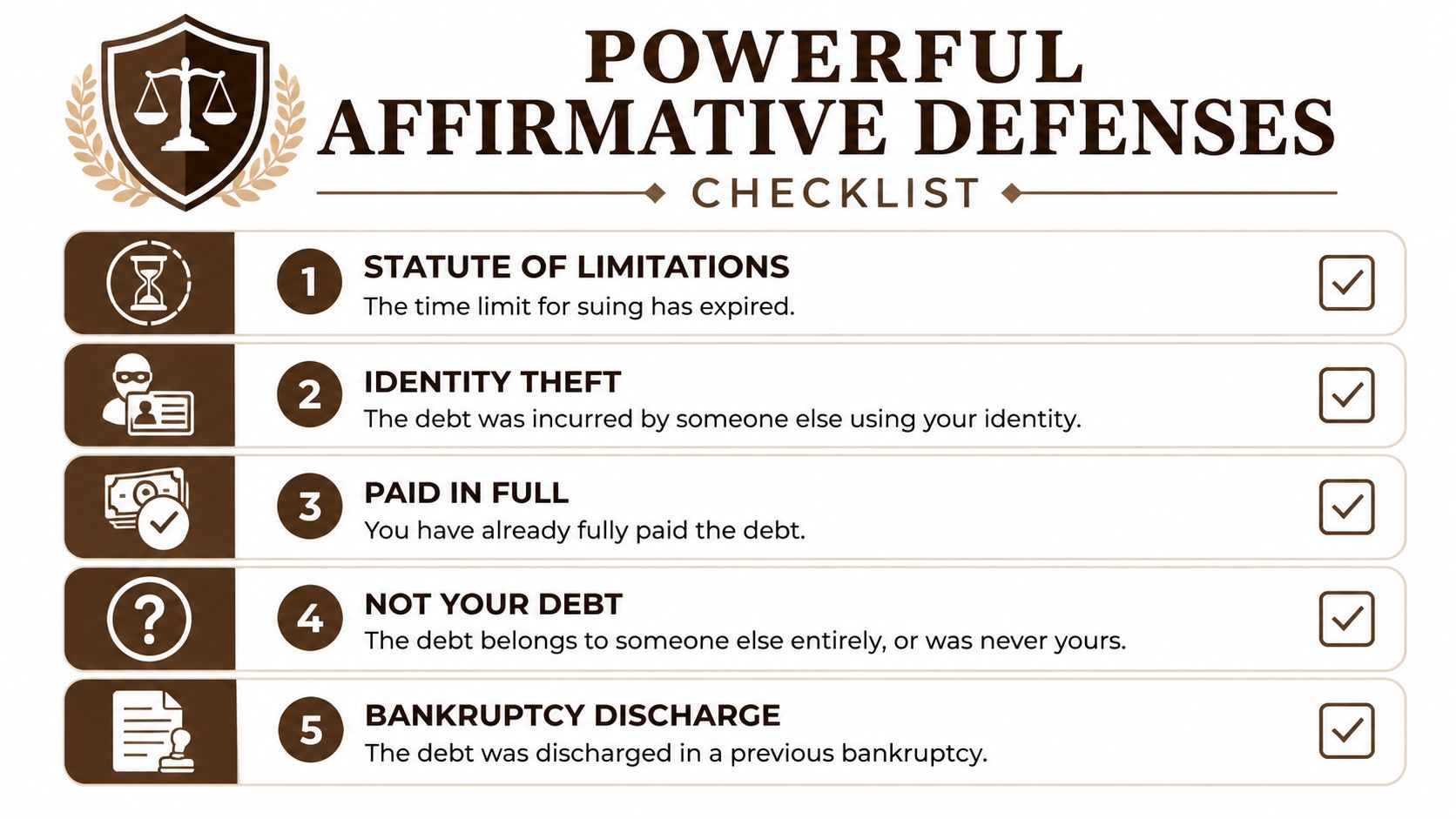
FTC guidance highlights checking whether the statute of limitations has expired, and it also points to reviewing account records to test chain of title, account accuracy, and fee calculations, as described in the FTC's guidance on what to do if a debt collector sues you.
What an Affirmative Defense Actually Does
A denial says, in effect, "Prove it."
An affirmative defense says, "Even if some of your allegations are assumed true, you still should not win for this legal reason."
That distinction is important in California debt litigation. If you omit a defense that applies, you may make your case harder later.
Common Defenses That Matter in Debt Cases
Not every defense applies in every case. The right ones depend on the account history and available records.
- Statute of limitations: If the debt is too old to sue on, that can be a complete defense. This requires careful date analysis under California law.
- Lack of standing: If the plaintiff is a debt buyer, it must show it owns the debt and has the right to sue.
- Incorrect amount: Fees, interest, credits, or payments may be wrong.
- Payment or settlement: If you already paid or settled the account, the claim may be barred or reduced.
- Identity theft or mistaken identity: If the account is not yours, say so clearly and support it with facts.
- Bankruptcy discharge: Some debts can no longer be collected through suit after discharge.
A short comparison helps:
| Defense | Why it matters |
|---|---|
| Statute of limitations | The lawsuit may be legally too late |
| Lack of standing | Plaintiff may not be able to prove ownership |
| Incorrect balance | The claimed amount may be overstated |
| Payment or accord | The account may already have been resolved |
| Identity defense | Plaintiff may be suing the wrong person |
The strongest affirmative defenses usually grow out of documents. Bank records, settlement emails, prior statements, and discharge papers do more work than outrage ever will.
A common mistake is listing every defense someone finds online whether it fits or not. Courts notice that. A better approach is to include defenses that have a factual basis, even if you still need discovery to develop them.
For example, if the complaint names a plaintiff you've never done business with, lack of standing may be a sensible defense because the plaintiff still must prove assignment and ownership. If the account amount seems inflated, incorrect amount may be appropriate. If the account has been dormant for years, statute of limitations deserves close attention.
Navigating the Lawsuit After Filing Your Answer
Filing the Answer is a turning point, not the finish line. Once you've responded, the case moves into ordinary civil litigation. That means there is now a structure to follow, deadlines to watch, and opportunities to pressure the plaintiff to produce real proof.
Many consumers feel relief after filing, then become anxious again when new paperwork arrives. That is normal. The key is to understand that post-Answer activity doesn't mean you're losing. It means the case is active.
What Discovery Usually Looks Like
After an Answer, each side may seek information from the other. In California, that can include written questions, requests for documents, and requests to admit specific facts.
In practical terms, discovery often focuses on basic proof issues:
- Who owns the debt now
- What records support the balance
- Whether there is a contract
- How interest or fees were calculated
- Whether payments were properly credited
If you receive discovery requests, do not ignore them. The same discipline that mattered at the summons stage matters here too. Read each request, calendar the response date, and answer carefully.
If the plaintiff cannot support the account with reliable records, discovery is where those weaknesses often become visible. That can improve your bargaining power for settlement or support later motion practice.
Settlement Can Happen at More Than One Stage
A filed Answer often changes the tone of the case. Before that, you are just another default risk. After that, you are a defendant who has appeared and may require the plaintiff to do real work.
That doesn't guarantee dismissal, but it often creates room for negotiation. Depending on the case, possible outcomes include:
- Settlement for a reduced amount
- Payment plan terms
- Voluntary dismissal
- Motion practice
- Trial
A realistic defendant keeps two ideas in mind at once. First, you preserve defenses and push for proof. Second, you evaluate settlement with clear eyes. Some cases should be fought aggressively. Others should be resolved on terms that protect your finances and avoid a judgment.
If you negotiate, do it carefully. Get terms in writing, confirm whether dismissal will be filed, and never assume a phone conversation changed the court case by itself.
Avoiding Default and Seeking Professional Legal Help
The path in these cases usually splits early.
One path is inaction. That path leads to default, and then the plaintiff can use the judgment collection tools the law allows. The other path begins with a timely Answer, careful document review, and a deliberate defense.

California law gives you the right to respond. Use it. If you're in Orange County, Los Angeles County, or nearby Southern California courts, local practice and filing details matter. Small procedural mistakes can create avoidable problems, especially when dealing with service, affirmative defenses, fee waivers, or e-filing requirements.
A practical lawyer's role in these cases isn't just to "go to court." It is to identify weak proof, preserve defenses, avoid unhelpful admissions, and decide when settlement makes sense and when it doesn't. That judgment is difficult to get from a form alone.
Some people can file a basic Answer on their own and buy themselves time. That can be the right first move. But if the amount claimed is large, the account history is messy, the plaintiff is a debt buyer, or you suspect identity theft, prior settlement, limitations issues, or bankruptcy effects, legal advice can change the outcome materially.
For a helpful overview of the stress and process many defendants face, this video may help put the situation in perspective.
You do not need to know everything today. You do need to act before the deadline runs out. If you're trying to decide how to respond to a debt collection lawsuit in California, the safest course is to treat the summons seriously, file an Answer correctly, and get guidance specific to your situation.
If you've been served with a debt collection lawsuit in Orange County, Los Angeles, or elsewhere in California, Tanner Law can help you evaluate your options and take the next step with confidence. Schedule a free consultation to discuss the summons, complaint, deadlines, and possible defenses in your case.