How to Prepare for Small Claims Court: An OC Guide
A contractor stopped answering after taking a deposit. A former tenant left damage that exceeds the security deposit. A family loan was never repaid, and the text messages now matter more than the promises that were made at the kitchen table. These are the kinds of disputes that push Orange County residents toward small claims court.
For many people, the amount at stake is too important to ignore but too limited to justify full civil litigation. California small claims court exists for exactly that space. It gives people a forum to resolve money disputes without the cost and complexity of a conventional lawsuit. That said, the court is still a court. Judges expect preparation, accuracy, and respect for procedure.
From a practitioner's perspective, the biggest difference between people who present strong small claims cases and those who struggle usually isn't passion. It's organization. In property and contract disputes especially, the party who can explain the timeline clearly, support each point with documents, and stay focused on the legal issue often has the advantage.
Table of Contents
- Introduction Navigating Your Path to Small Claims Court
- First Steps Is Small Claims Right for Your Case
- Building Your Case Organizing Evidence and Exhibits
- The Filing Process Navigating the Orange County Court System
- Preparing Witnesses and Your Courtroom Script
- On the Day of Your Hearing Etiquette and Presentation
- After the Judgment Collecting What You Are Owed
Introduction Navigating Your Path to Small Claims Court
If you're learning how to prepare for small claims court for the first time, the process can feel more intimidating than it needs to be. You likely aren't confused about the dispute itself. You know what happened. What you don't know is how to present it in a way the court can use.
That distinction matters in California. Small claims court is designed to move quickly. Judges usually hear a large number of cases in a limited window, so the parties who do best are the ones who arrive with a clean timeline, labeled documents, and a short explanation of what they want and why they're entitled to it.
In Orange County, that practical approach matters even more in disputes involving home repairs, deposits, unpaid invoices, damage to property, or failed agreements tied to real estate. These cases often look simple on the surface, but they can turn on one estimate, one email chain, or one witness who directly observed what happened.
Practical rule: Don't prepare for small claims court by writing a long story. Prepare by building a short, provable story.
First Steps Is Small Claims Right for Your Case
A homeowner in Orange County pays a contractor, the work stalls, and the text messages turn into excuses. The first question is not whether the contractor acted unfairly. The first question is whether small claims court can fix the problem you have.
That distinction saves time and money. Small claims works best when the dispute is about a specific dollar loss and the judge can decide it in a short hearing. It is often a good fit for unpaid invoices, security deposit disputes, property damage, failed repair work, and straightforward contract breaches. It is usually a poor fit if you need an order forcing someone to perform, a ruling on title or ownership, or a decision that depends on a long and technical factual record.
In California, and especially in Orange County property disputes, clients often focus on the bad conduct and overlook the remedy. Courts care about both. If your real objective is to clear title, stop interference with property, or interpret a complicated real estate agreement, filing in small claims can leave you with only part of the dispute addressed.
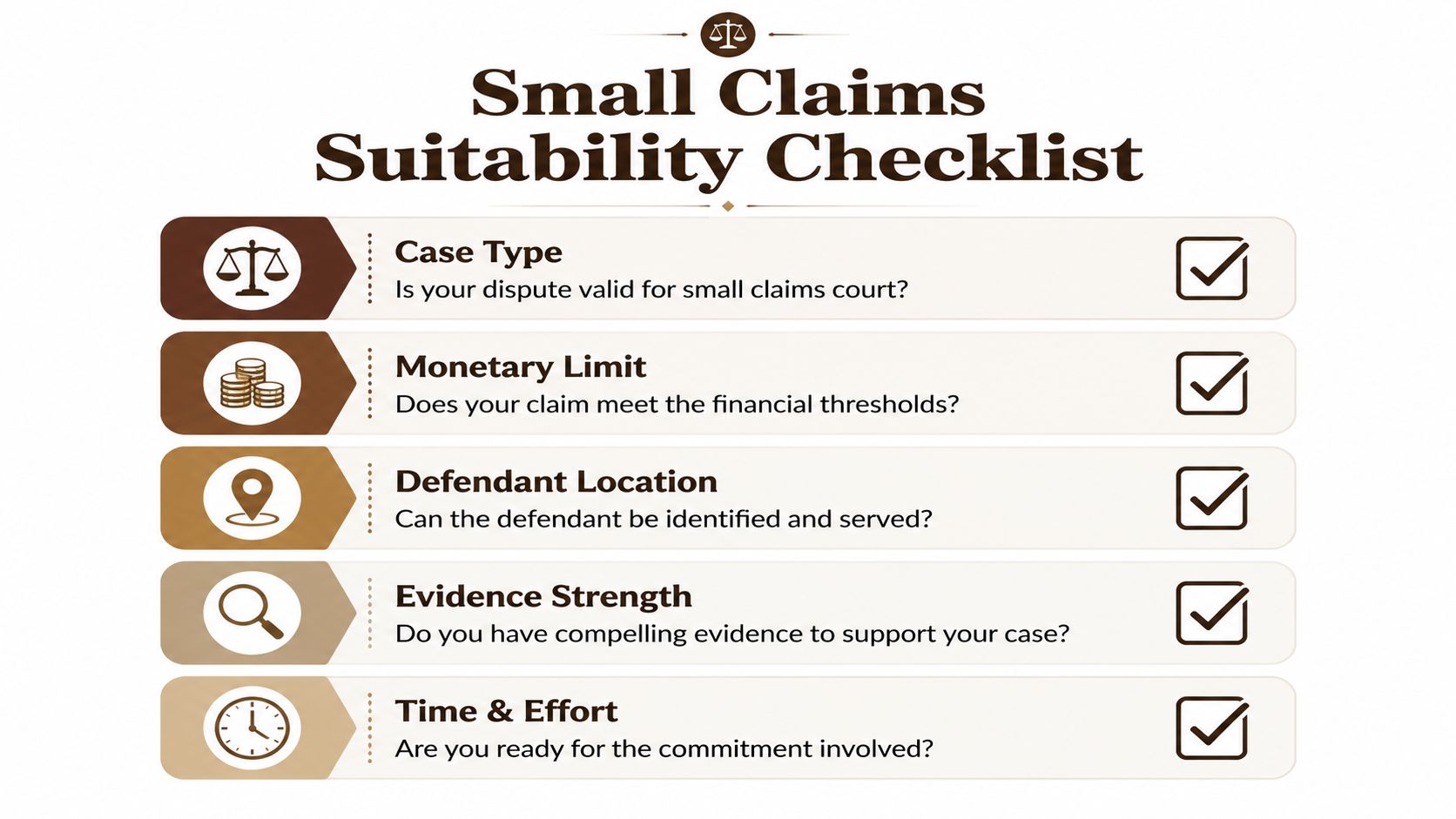
I tell clients to pressure-test the case with five practical questions:
- Type of relief: Are you seeking a money judgment, or do you really need the court to order someone to act or undo a transaction?
- Right defendant: Can you identify the proper legal party, whether that is an individual, sole proprietor, corporation, or LLC?
- Court procedures: Have you checked the Orange County filing forms, fee schedule, and hearing requirements early enough to avoid preventable mistakes?
- Service reality: Do you have a real address and a workable plan to get the defendant properly served?
- Proof: Can you show what happened with documents, photos, invoices, messages, or first-hand witnesses?
Cost matters too. Filing fees, service costs, time off work, and the effort required to prepare a clean presentation all count. For a modest claim, those costs may still make sense. For a dispute that really belongs in a different court, small claims can become a detour instead of a solution.
The strongest small claims cases are narrow. One agreement. One failed obligation. One clear measure of damages.
Cases become harder when they involve multiple oral changes, long business relationships, technical construction issues, or several people telling different versions of events. A judge in small claims may still rule for you, but the forum rewards simplicity and punishes clutter. That is not a moral judgment. It is a function of how quickly these calendars move.
A useful screening test looks like this:
| Dispute profile | Better fit for small claims | Harder fit for small claims |
|---|---|---|
| Agreement | One clear written agreement | Several changing oral terms |
| Timeline | Short and specific | Long and tangled |
| Evidence | Receipts, photos, texts, invoices | Gaps, assumptions, missing records |
| Witnesses | One or two direct witnesses | Many witnesses with partial knowledge |
| Remedy sought | Payment of money | Complex property or equitable relief |
Property cases in Orange County often sit on the line between simple and too complicated. A claim for a withheld deposit, unpaid repair bill, or damage to flooring may belong in small claims. A dispute over easement rights, ownership interests, or competing readings of a real estate contract usually does not. The right filing choice is the one that matches the problem the court has power to solve.
Building Your Case Organizing Evidence and Exhibits
Most small claims cases are won or lost before the hearing starts. Not because the judge has decided anything in advance, but because one party arrives with a usable file and the other arrives with a stack of loose papers and an emotional summary.
Build a dated timeline first
The most reliable way to prepare is to create a chronological story. Practitioner guidance repeatedly recommends writing down the dates, times, and sequence of events, then matching each point to supporting proof. One court-preparation guide says parties should present facts to the judge “quickly and in an organized manner” and another says to be “brief and stick to the facts,” as discussed in this small claims preparation guide from KTS Law.
That advice aligns with what works in California courtrooms. Judges need the sequence. They need to know what happened first, what happened next, and which document proves each step.
Start with a simple outline:
Date of agreement
What was promised, by whom, and for what amount?Performance or nonperformance
What did you do, and what did the other side fail to do?Notice and opportunity to fix
Did you demand payment, request repairs, or object in writing?Current loss
What are you asking the court to award, and how did you calculate it?

Turn the timeline into an exhibit file
Once the timeline exists, every document should earn its place. Don't bring papers just because they're related. Bring documents because they prove a point in your sequence.
Your file should usually include:
- Core agreement documents: Contracts, work orders, leases, estimates, invoices, or receipts.
- Payment proof: Cancelled checks, bank records, payment confirmations, or account statements tied to the dispute.
- Communications: Printed emails, text messages, and letters that show notice, promises, delays, or refusals.
- Condition evidence: Photographs or printed images showing damage, unfinished work, delivery condition, or repairs needed.
Bring a compact file, not a paper avalanche. Judges don't reward volume. They reward clarity.
A strong file is arranged in the exact order you plan to speak. If Exhibit 1 is the written agreement, Exhibit 2 may be the invoice, Exhibit 3 the payment proof, Exhibit 4 the demand email, and Exhibit 5 the repair photos. That way, when you make a point, the judge can verify it immediately.
Several court materials also recommend bringing multiple copies of key exhibits and arranging them in the order you'll use them. In practice, that means one set for you, one for the judge, and one for the other side. If your dispute involves texts or photos stored on a phone, print them in advance. Don't assume the courtroom is the place to scroll.
The Filing Process Navigating the Orange County Court System
A well-prepared file doesn't help if the case never gets properly onto the court's calendar. Filing is procedural, but it isn't merely clerical. In California, mistakes at this stage can delay the hearing, create service problems, or cause the defendant to argue they never received proper notice.
File carefully and file in the right place
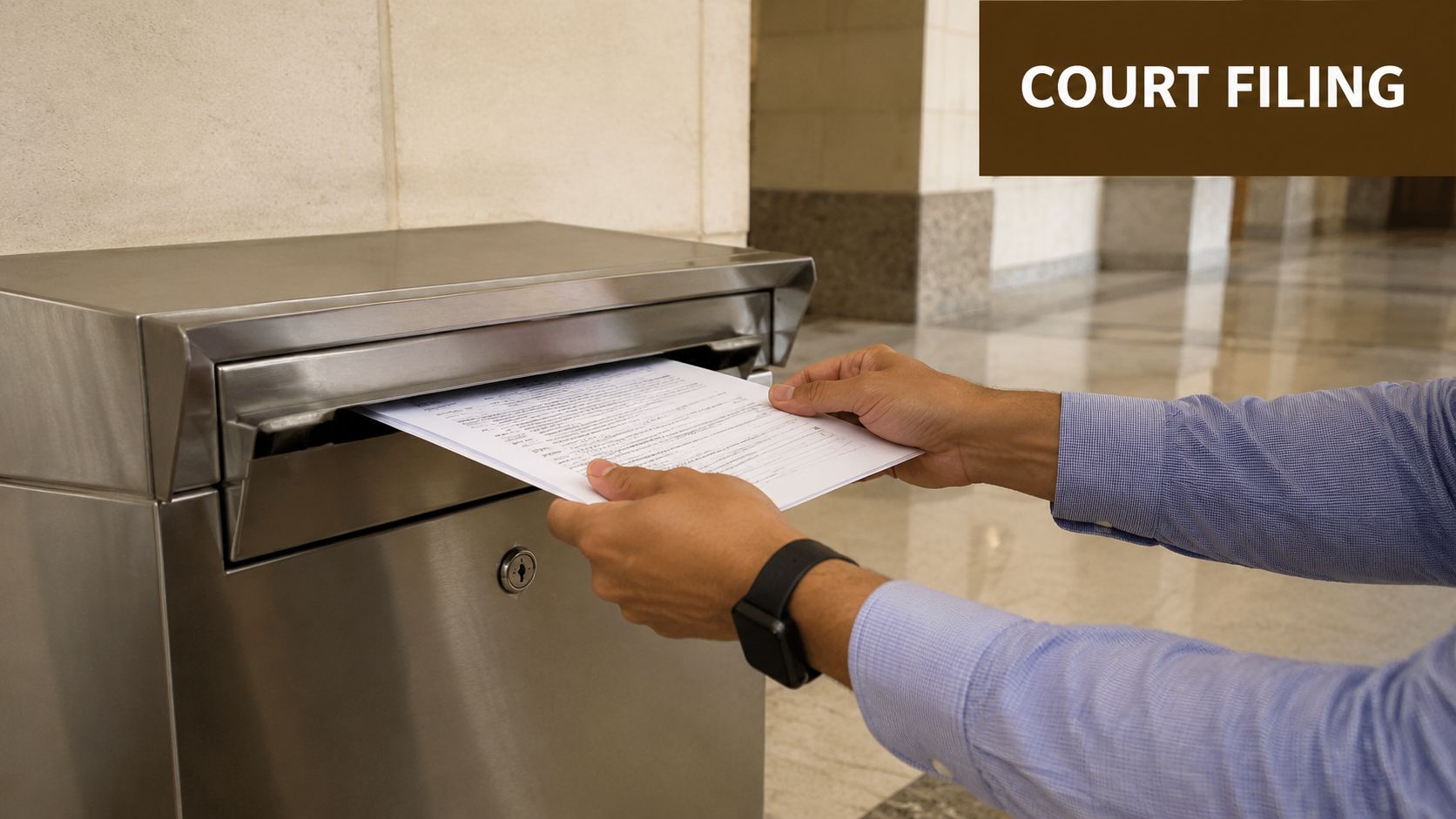
For most California small claims matters, the starting form is the Plaintiff's Claim and ORDER to Go to Small Claims Court, commonly known as Form SC-100. The form itself isn't difficult, but the details matter. The names must be accurate. The amount claimed must match your documents. The statement of claim must be brief but specific enough to identify the transaction or event.
Orange County filers should also confirm venue and courthouse procedures before submitting anything. Different court systems can have different local practices for filing, scheduling, and evidence handling, and some jurisdictions require parties to have evidentiary materials complete well in advance rather than waiting until hearing day, as reflected in Éducaloi's preparation guidance for small claims hearings.
That point matters even when California procedure differs on specifics. The broader lesson is the same. Don't treat filing day as the beginning of preparation. Treat it as the point where your paperwork should already be under control.
When you review your filing packet, check these issues:
- Correct legal names: Suing “Mike's Plumbing” may not be enough if the defendant is an individual, corporation, or LLC under a different legal name.
- Clear damages statement: Ask for a specific amount and know how you reached it.
- Court location: File where venue is proper under California rules, not just where it feels convenient.
- Attachments: If a short attachment helps clarify the claim, keep it clean and factual.
A short walkthrough can help if you haven't filed before:
Service is where many cases go sideways
After filing, the defendant must be served correctly. This is the formal delivery of the filed claim and hearing notice. If service is defective, the court may continue the hearing or refuse to proceed.
In practice, service errors usually come from one of three problems:
| Service problem | What it leads to |
|---|---|
| Wrong person served | The defendant argues they never received legal notice |
| Late service | The hearing may be delayed |
| Bad proof of service | The court may not accept that service was completed |
For Orange County litigants, service deserves the same level of attention as the claim itself. Tanner Law also maintains a service of process practice area because formal notice issues affect whether a case can move forward at all.
If you're representing yourself, read the court instructions carefully and don't improvise. Service feels mechanical until it derails a good case. Then it becomes the only issue anyone is talking about.
Preparing Witnesses and Your Courtroom Script
Documents rarely speak for themselves. Someone has to connect them to the actual events, and that's where many self-represented litigants struggle. They bring records, but they don't prepare the people who will explain those records.
Choose witnesses with firsthand knowledge
The best witness is not the most sympathetic person. It's the person who directly saw, heard, did, or received something that matters. In a contractor dispute, that might be the person who inspected incomplete work. In a loan dispute, it may be the person who attended the conversation where repayment terms were agreed on.
A common mistake is relying on written statements from people who won't appear. Some courts make clear that a written statement, even if sworn, cannot substitute for live testimony. That's why the gap between “evidence I have” and “evidence I can use” can determine the result, as discussed in New Jersey Courts' guidance on preparing for small claims trial.
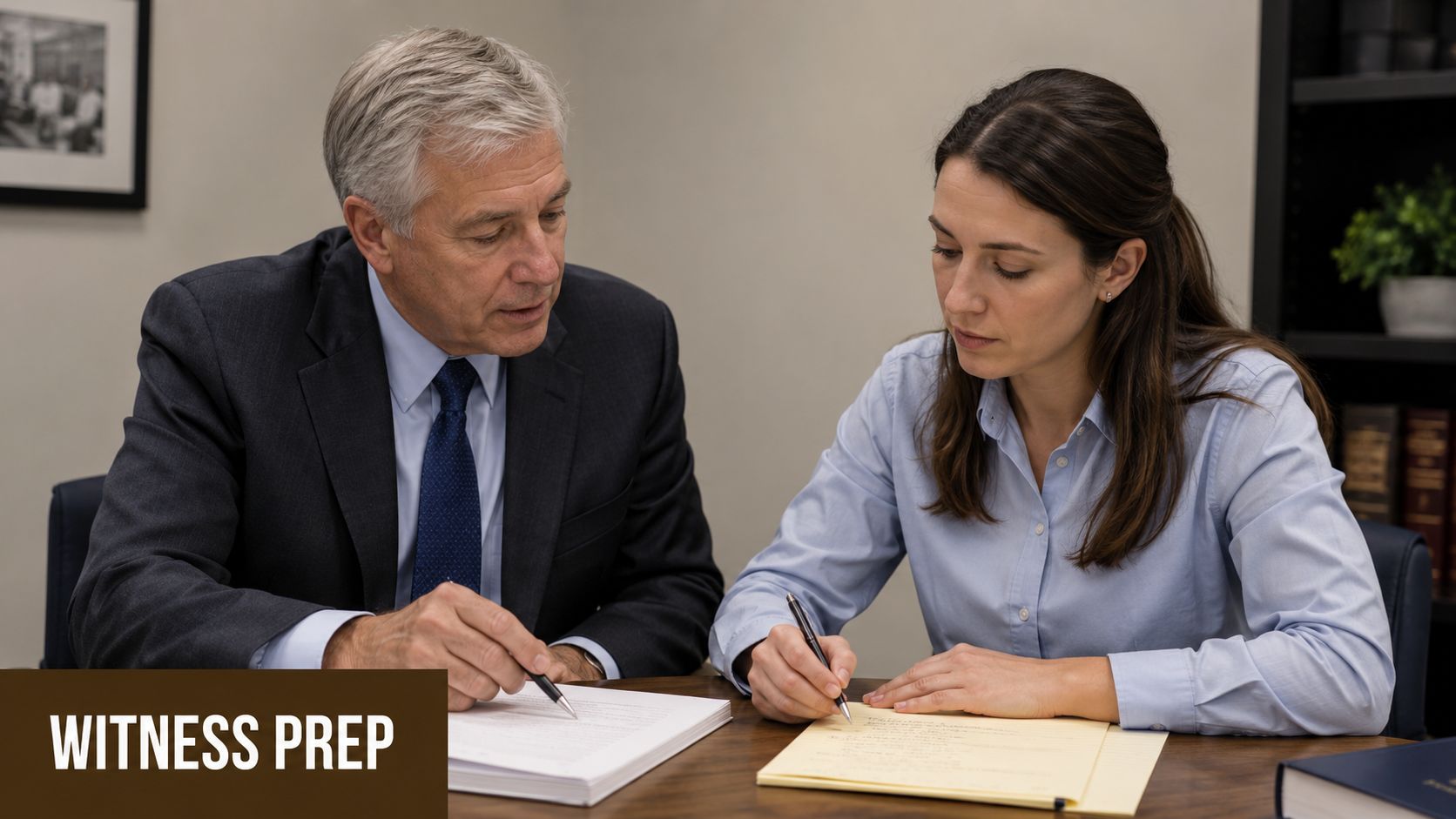
Good witness preparation is practical, not theatrical. Review the timeline with the witness. Confirm what they personally know. Make sure they understand they should answer only the question asked and avoid guessing.
A witness becomes stronger when their testimony is narrower, not broader.
Useful witness prep usually includes:
- Personal knowledge only: The witness should testify to what they directly observed, not what someone else told them.
- Document familiarity: If the witness is tied to a photo, invoice, or message, make sure they can identify it cleanly.
- Courtroom manner: Calm, direct answers carry more weight than speeches.
Write a short script and practice it out loud
You also need a script for yourself. Not a dramatic speech. A disciplined opening that tells the judge what happened, what proves it, and what you want awarded.
A good small claims opening usually does four things:
- States the relationship between the parties.
- Explains the agreement or event.
- Identifies the breach or loss.
- Ends with the amount requested and the exhibits that support it.
Here is the structure I recommend in California small claims matters:
- Opening sentence: “Your Honor, this case concerns an unpaid home repair deposit.”
- Core facts: “On this date, I hired the defendant. On this date, I paid. On this date, performance stopped.”
- Proof references: “The written estimate is Exhibit 1. Payment proof is Exhibit 2. My demand for refund is Exhibit 3.”
- Request: “I'm asking for judgment in the amount shown by these records.”
Practice that out loud until it sounds natural. Nervous people tend to overtalk, repeat themselves, and drift into side issues. A short script prevents that. It also signals to the judge that you respect the court's time and understand the issue you're asking the court to decide.
On the Day of Your Hearing Etiquette and Presentation
Court day usually starts with waiting. You'll arrive, pass through security, locate the courtroom, and sit with other people whose cases may have nothing to do with yours. Some are there for unpaid invoices. Some are there over vehicle damage. Some are there because a landlord, tenant, buyer, seller, or contractor dispute finally ran out of informal solutions.
What the morning usually looks like
The most prepared person in the room often looks the calmest because they aren't trying to reorganize their file in the hallway. They already know the order of exhibits. They know the name of the defendant. They know the amount they're requesting.
Dress neatly. Be early. Speak respectfully to clerks, bailiffs, and the judge. In California courtrooms, basic professionalism still matters. It won't replace proof, but it affects how easy it is for the judge to follow your presentation.
A last-minute settlement discussion may happen before the case is called. Sometimes that's smart. Sometimes it isn't. If the other side finally wants to talk, listen carefully, but don't agree to something unclear just because you feel pressure in the courthouse hallway.
How to present without rambling
When your case is called, move to the point. Identify yourself, identify the defendant, and deliver the short opening you practiced. Then walk through the exhibits in order.
A simple hearing sequence often looks like this:
| Stage | What you should do |
|---|---|
| Opening | Give the court your two- to three-minute summary |
| Evidence | Hand up documents in the order of your timeline |
| Witnesses | Ask short questions tied to firsthand knowledge |
| Response | Listen carefully when the other side speaks |
| Closing request | Restate the amount sought and the basis for it |
If the defendant says something inaccurate, don't interrupt unless the judge invites it. Take notes. When it's your turn, correct the point with a document or a precise statement. Judges notice who stays disciplined.
The strongest small claims presentation usually sounds plain. It doesn't sound like a closing argument from television. It sounds like someone who knows the facts and can prove them.
After the Judgment Collecting What You Are Owed
You win the hearing, walk out with a judgment, and expect a check to follow. In many Orange County cases, that is where the hard part starts.
A judgment is not the same as payment
Small claims court decides who owes money. It does not force payment the same day. If the defendant does not pay voluntarily, you have to enforce the judgment through California procedures.
That gap catches people off guard. They spend their time proving the debt, the damage, or the broken agreement, but give no thought to where collection will come from. As noted in Oregon Law Help's discussion of small claims procedure and collection realities, collection often requires a separate effort after judgment.
In California, enforcement may include identifying assets, obtaining a writ, levying a bank account, garnishing wages where permitted, or recording a lien against real property. Those are not abstract options. In property and contract disputes, they often determine whether the judgment has practical value.
I tell clients to treat collectability as part of the case, not as an afterthought.
Think about enforcement before the hearing
Before the hearing, ask a few blunt questions:
- Employment and bank information: Do you know where the defendant works or banks?
- Real property: Does the defendant own a house, condo, rental property, or other real estate?
- Correct defendant: Did you sue the right individual, business, or legal entity?
- Settlement value: Is a clear payment plan today worth more than a paper judgment you may spend months trying to enforce?
These questions matter in Orange County more than many first-time plaintiffs expect. A dispute over a contractor deposit, a failed home repair, a co-owner expense, or damage to rental property can start small and then turn into an enforcement problem tied to title, ownership records, business structure, or exempt income. At that point, the habits that matter in larger civil litigation start to matter here too. Accuracy in naming parties, identifying assets, and preserving records often decides whether collection is realistic.
California also has post-judgment procedures and appeal rules that can complicate the timeline. If the defendant is evasive, insolvent, or hard to find, the hearing may only establish liability. It may not put money in your hands.
If you need guidance on a California small claims matter, property dispute, or contract claim in Orange County or Los Angeles, schedule a free consultation with Tanner Law.