How to Protect Assets from Creditors: CA Legal Guide
If you own a home in Orange County, have a rental in Los Angeles County, or run a small business in California, you may already have the uneasy sense that one lawsuit could put years of work at risk. That concern is reasonable. Many homeowners and investors have solid income, equity, and savings, but very little real separation between what they own personally and what could be exposed to a creditor.
Asset protection is not about hiding property or gaming the system. It is the lawful process of arranging ownership, entities, insurance, and trusts so that future creditors have fewer paths to reach what you own. In California, that usually means combining built-in exemption laws with clean business structuring and, in the right cases, carefully drafted irrevocable trusts.
The most important point is timing. The strongest plans are set up before any claim is threatened. Once a dispute is on the horizon, many transfers can be challenged and undone. A practical plan is layered, documented, and boring in the best way. It works because it was put in place early and maintained properly.
Table of Contents
- Understanding Your Asset Protection Foundation
- Leveraging California's Built-In Legal Shields
- Using Business Entities to Wall Off Liability
- Advanced Protection With Irrevocable Trusts
- Avoiding Critical Mistakes and Fraudulent Transfers
- Building Your Plan and When to Call an Attorney
Understanding Your Asset Protection Foundation
A common California scenario looks like this. A couple in Orange County owns a primary residence, one spouse has a professional practice or consulting business, and together they also hold a rental property or brokerage account. On paper, they feel established. Legally, they may still be exposed if assets are titled casually, insurance is thin, or business activity sits in their personal names.
How to protect assets from creditors starts with a mindset shift. The question isn't, “How do I make everything untouchable?” The better question is, “Which assets are already protected, which are exposed, and how do I reduce preventable risk before anything happens?”

What asset protection really means
In practice, asset protection is lawful pre-planning. You arrange ownership and legal structures in advance so future claims face real barriers. That might mean keeping a rental property inside an LLC, relying on California exemptions where they apply, carrying meaningful liability coverage, and using an irrevocable trust only when the facts justify it.
Practical rule: Asset protection is strongest when it is proactive, ordinary, and well documented.
A useful framework appears in this California asset protection discussion. A technically sound workflow is to layer exemptions, entity segregation, and insurance before any creditor claim exists. First, separate business and personal assets through entities such as LLCs or corporations. Then use available legal exemptions. Finally, add liability and umbrella insurance as the outside buffer. That sequence matters because transfers made after a claim is foreseeable can be attacked as a fraudulent conveyance.
Why layering works better than any single tool
People often look for one magic document. There usually isn't one.
A stronger approach uses several tools that cover different risks:
- Statutory shields: California and federal law may already protect some categories of property.
- Entity separation: LLCs and corporations can contain risk inside a business or investment activity.
- Insurance: Insurance pays lawyers and claims. It often prevents a crisis from becoming a liquidation event.
- Trust planning: For larger estates or concentrated risk, irrevocable trust planning may provide another layer.
That structure is especially important in California because many clients hold a mix of real estate, retirement assets, and operating businesses. Each asset class has a different risk profile. A rental property creates premises liability risk. A professional practice may raise contract or malpractice concerns. A residence raises different exemption questions than a brokerage account.
The goal isn't secrecy. The goal is lawful separation, clean title, and fewer easy targets.
Leveraging California's Built-In Legal Shields
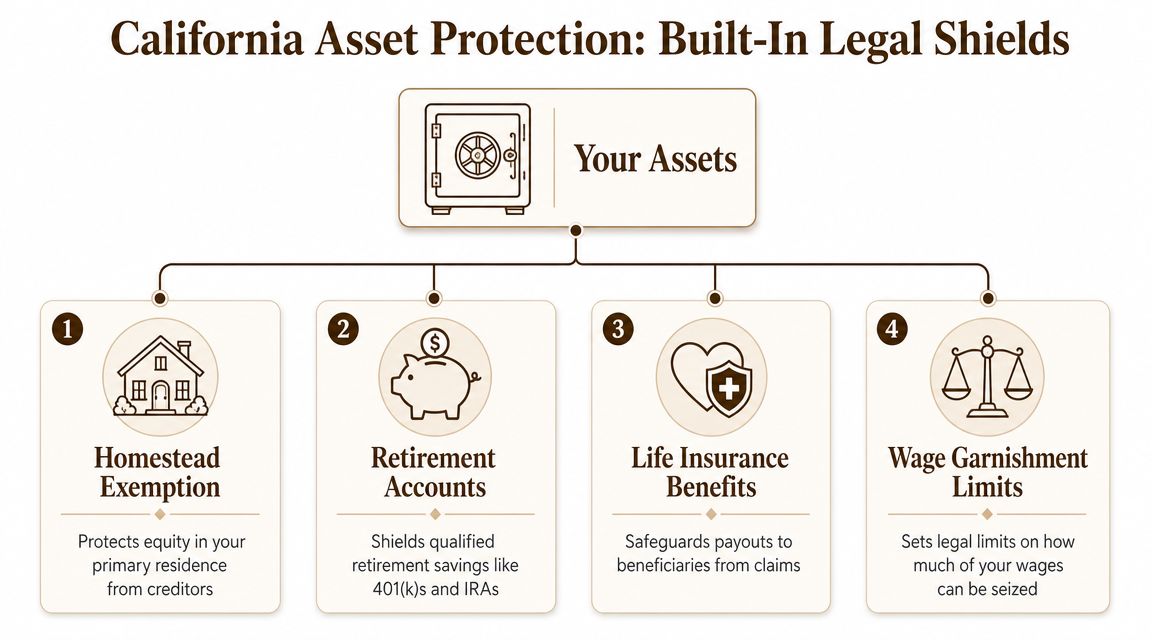
Before anyone forms a new entity or signs a trust, the first job is to identify what may already have legal protection. Many Californians are surprised to learn that some assets stand on stronger ground than ordinary cash or investment accounts held in their own names.
Start by identifying what may already be protected
For many households, the first inventory should include:
| Asset category | General protection theme | Why it matters |
|---|---|---|
| Primary residence | California exemption rules may protect part of home equity | Home equity is often a family's largest asset |
| Employer retirement plans | Federal law provides strong protection for many plans | These are often among the most defensible assets |
| IRAs and similar accounts | Protection depends on context and applicable law | Not all retirement assets are protected in the same way |
| Life insurance and beneficiary-designated assets | Protection can depend on structure and claim type | Labels alone don't decide the outcome |
California law is particularly relevant. A homeowner in Santa Ana, Irvine, Newport Beach, or Anaheim shouldn't assume that “my house is protected” tells the whole story. The actual answer depends on the kind of creditor, where the claim is being enforced, and how title is held.
Why retirement accounts matter so much
Retirement assets are one of the clearest examples of built-in legal shielding. According to Fidelity's overview of asset protection strategies, the Employee Retirement Income Security Act of 1974 created strong anti-alienation protections for many employer-sponsored retirement plans. The Bankruptcy Abuse Prevention and Consumer Protection Act of 2005 strengthened safeguards for many tax-qualified retirement funds in bankruptcy.
That doesn't mean every retirement account is identical. It means many Californians already have one category of assets that is often treated more favorably than nonqualified property held in a checking account or brokerage account.
A related point gets missed all the time. The same Fidelity discussion notes that revocable living trusts do not provide creditor protection. That's an important correction because many California families use revocable trusts for probate avoidance and incapacity planning, then assume they also solve creditor exposure. They don't.
If an asset stays under your effective personal control, a creditor may still have a path to it.
California homeowners should pay close attention to equity
For Orange County and Los Angeles homeowners, home equity is emotional and financial at the same time. It's where many families have built much of their net worth. California law can protect a primary residence through homestead rules, but the practical takeaway is narrower than many people think: protection depends on the facts, and excess equity may still become a planning issue.
That is why a homeowner should ask:
- How much of my net worth sits in home equity?
- Is this my primary residence or an investment property?
- Would a creditor be chasing the home itself, or trying to reach equity through another route?
- Do I have uninsured exposure through a business, rental, or personal guarantee?
A homeowner with modest exposure may need nothing more complicated than better insurance and careful titling review. A homeowner with significant equity, investment property, and a high-risk profession usually needs a more deliberate structure.
Using Business Entities to Wall Off Liability
If you own a rental property in Irvine, a family business in Orange, or a consulting company that signs contracts with vendors and clients, the legal issue is straightforward. If the activity sits in your personal name, the liability often sits there too.

How an LLC or corporation changes the risk map
An LLC or corporation creates a separate legal person. That separation can help keep a business debt or property-related claim from automatically becoming a claim against your house, personal savings, or other nonbusiness assets.
For many California investors, the logic is simple:
- You don't want a lawsuit tied to one rental property reaching unrelated assets.
- You don't want a business contract dispute to spill into your personal balance sheet.
- You don't want years of personal savings exposed because a business was run informally.
An entity is the legal wall. It isn't perfect, but it's far better than operating as a sole proprietor or holding every investment directly.
What causes the liability shield to fail
The most common problem isn't the LLC form itself. It's bad maintenance.
The same California guidance referenced earlier emphasizes that separate accounts and strict compliance are required to preserve liability shields. In real life, that means the owner has to behave as though the entity is separate, because it is.
Common breakdowns include:
- Commingling money: Paying personal expenses from the LLC account or depositing rent into a personal account.
- Poor records: No operating agreement, no written decisions, no organized books.
- Incomplete setup: Deeds, leases, contracts, or insurance still remain in the individual's name.
- Casual guarantees: Owners sign personal guarantees without understanding they may be stepping around the wall.
A business entity can contain liability only if the owner respects the boundaries every day.
A short overview may help if you're deciding whether entity separation fits your situation:
| Situation | Personal ownership | Ownership through an entity |
|---|---|---|
| Rental property dispute | Risk may connect more directly to personal assets | Claim is more likely to stay tied to the entity and its assets |
| Business contract issue | Owner is often front and center | Entity structure may reduce spillover risk |
| Bookkeeping mistakes | No separation to preserve | Sloppy records can weaken the shield |
A practical California investor example
Take a landlord who owns a rental home in Orange County. If title is held personally and a serious claim arises from that property, the creditor's lawyer will look broadly at the owner's balance sheet. If the same property is owned and operated through a properly maintained LLC, with separate banking, clean accounting, lease documents in the entity name, and matching insurance, the analysis changes.
That doesn't make the lawsuit disappear. It narrows the battlefield.
Later in the planning process, many owners also benefit from understanding how lawyers and courts look at real property disputes in California:
Advanced Protection With Irrevocable Trusts
For clients with substantial nonretirement assets, concentrated real estate equity, or a higher level of professional or business exposure, basic structuring may not be enough. Here, trust planning becomes more advanced, and California residents must understand a critical distinction.
Revocable trust versus irrevocable trust
A revocable living trust is excellent for probate avoidance, management during incapacity, and orderly estate planning. It is not an asset protection device for the person who created it and still controls it.
An irrevocable trust is different because the protection comes from separation. Assets moved into the trust are no longer held in the same way as property in your personal name. That is the trade-off. Stronger protection usually requires giving up some control.

A practical comparison looks like this:
| Trust type | Main strength | Main weakness |
|---|---|---|
| Revocable living trust | Flexibility and probate planning | No meaningful creditor protection for the settlor during life |
| Irrevocable trust | Potential creditor separation | Reduced control and greater complexity |
Where domestic asset protection trusts fit
For higher-end planning, some families consider domestic asset protection trusts, often called DAPTs. A major legal development in this area is that more than 20 U.S. states had enacted some form of DAPT statute by the early 2020s, as described in this discussion of trust-based creditor planning. Those statutes created a modern framework for shielding assets from future creditors while allowing the settlor to remain a discretionary beneficiary.
California is not generally known as a DAPT state, which is why California residents need careful legal analysis before assuming an out-of-state trust will perform as advertised. Still, the broader lesson is important. Modern asset protection has moved beyond simple titling tricks. Properly drafted irrevocable structures now play a mainstream role for professionals and business owners facing tort, malpractice, or contract exposure.
Funding matters more than the binder on the shelf
The trust document is only the beginning. This discussion of advanced wealth protection strategies makes a point that practitioners see often: if the trust is not funded, the protection is ineffective. The legal title to the asset has to be transferred correctly and completely.
That is where many self-help plans fail. The client signs the trust, but the deed never changes, the account is never retitled, or the membership interest in an LLC is never assigned.
Trust planning succeeds on paper only when title changes in the real world.
That same analysis also notes a practical benchmark. Home equity above the homestead cap is often the portion targeted for additional shielding. For Californians, that issue comes up often with appreciated real estate and long-held homes.
Avoiding Critical Mistakes and Fraudulent Transfers
Most bad asset protection planning starts in a panic. Someone gets a demand letter, hears about a threatened lawsuit, or worries that a creditor is closing in. Then they start moving money, changing title, or asking a relative to hold funds “temporarily.” That is usually where the legal trouble begins.
The fire-insurance problem
The easiest way to explain fraudulent transfer law is this: you can't buy fire insurance after the house is already burning and expect coverage for the fire that's underway. Asset protection works much the same way.
If a transfer is made after a claim is known, threatened, or reasonably foreseeable, a creditor may argue that the transfer was intended to hinder, delay, or defraud creditors. If a court agrees, the transfer can be unwound.
That is why timing isn't a technical footnote. It's the center of the analysis.
Mistakes people make when they panic
Some moves sound common, but they're weak or dangerous:
- Putting assets into a revocable trust for “protection”: That doesn't solve the creditor problem if the grantor still controls the assets.
- Transferring money to family members: Informal transfers create legal and factual problems, and they can be challenged.
- Adding someone to title without a plan: That can create tax, ownership, and litigation issues without creating real protection.
- Ignoring insurance gaps: A good umbrella policy is often less glamorous than a trust, but it may be the most immediate practical fix.
- Using an LLC as a prop: If there is no separate bank account, no records, and no real operations discipline, the paperwork won't carry the day.
Ask the right protection question
A useful legal question is not, “Is this asset protected?” The better question is the one framed in this asset protection discussion from a law office source: protected from which creditor, in which forum, and under what ownership structure?
That same source also makes an important point. Revocable trusts do not protect assets from the grantor's creditors during life because control remains with the grantor.
California families can lose time and money. They may have done responsible estate planning and still be exposed because estate planning and creditor planning are not the same thing.
A revocable living trust is often the right probate tool. It is not a substitute for asset protection.
Building Your Plan and When to Call an Attorney
A workable California asset protection plan usually starts with ordinary housekeeping, not exotic strategies. Identify what you own. Separate what creates liability from what you want to preserve. Check how each asset is titled. Review whether insurance matches the actual risk. Then decide whether your exposure justifies entity work, trust planning, or both.
A workable checklist for California families and investors
Use this as a practical self-audit:
- List the assets that matter most. Focus on your residence, rentals, business interests, retirement accounts, and liquid investments.
- Mark which assets create risk. Rental property, operating businesses, and personal guarantees deserve close attention.
- Review title and ownership. Many problems start because valuable property sits in the wrong name.
- Separate activities. Business income and personal spending should never run through the same account.
- Check insurance realistically. Liability and umbrella coverage should match your actual exposure, not your best-case assumptions.
- Review existing trust documents. If you have a revocable living trust, understand what it does and what it doesn't do.
- Get legal advice before moving assets. Once a claim is foreseeable, many options narrow.
This checklist usually reveals the weak points in asset protection from creditors in California. It also shows whether your problem is basic or advanced. Some clients need better structure and insurance. Others need deeper planning because they have substantial equity, multiple properties, or a profession with recurring liability exposure.
When legal advice becomes necessary
You should speak with an attorney promptly if any of these apply:
- You own real estate beyond your primary residence
- You operate through a sole proprietorship
- You have significant nonretirement savings in your personal name
- You have been threatened with a claim or lawsuit
- You assume your revocable trust already protects you
- You want to transfer property to a trust or family member now
California asset protection is highly fact-specific. The right answer depends on creditor type, ownership structure, timing, and the interaction between state and federal law. A plan that helps one Orange County family may be ineffective for another.
If you're a homeowner, investor, landlord, or business owner in Orange County or Los Angeles and you want clear guidance on protecting what you've built, schedule a free consultation with Tanner Law. The firm can help you evaluate your current exposure, review your ownership structure, and build a lawful, practical plan under California law.