How to Expunge a Record in California: A 2026 Guide
A past conviction often starts causing problems long after the case feels finished. You apply for an apartment in Orange County, update your resume, or start looking for a professional license, and the same old record keeps following you. For many people, that's the moment they start searching for how to expunge a record in California.
California law does offer meaningful relief, but the process is often misunderstood. What is commonly referred to as an expungement is usually a dismissal under Penal Code section 1203.4, not a complete erasure of the record. That distinction matters. So does filing the right paperwork, in the right court, with the right case information.
Table of Contents
- Starting Fresh with a Clean Record in California
- Determining Your Eligibility for Expungement
- The California Expungement Process Step by Step
- Navigating Common Obstacles and Complications
- What California Expungement Actually Means for Your Future
- Costs, Timelines, and When to Consult an Attorney
Starting Fresh with a Clean Record in California
A criminal record can block ordinary parts of life. Employers hesitate. Landlords pass. People who are otherwise qualified get screened out before anyone hears their side of the story. That's why record clearing matters so much in California.

California's system has changed substantially in recent years. Laws including AB 1076 and SB 731 expanded relief on a large scale, and 929,322 old conviction records were permanently expunged in 2024 alone, according to Californians for Safety and Justice. That shift matters because record relief is no longer limited to a small group of applicants who know how to work through a difficult petition process.
What people usually mean by expungement
In everyday conversation, people say they want an expungement because they want a fresh start. In California, that usually means asking the court for a dismissal under Penal Code 1203.4. It can be a powerful remedy for employment, housing, and peace of mind, even though it isn't a total wipeout of the case.
Orange County clients are often surprised by that. They come in expecting the record to disappear completely. What the law usually offers instead is a court order changing the status of the conviction and reducing its public impact.
The most useful first step is not filling out forms. It's identifying the correct kind of relief for your case.
Why this is worth pursuing
For many people, the practical goal isn't theoretical legal cleanup. It's getting through a background check, improving job prospects, and moving on without a decades-old mistake controlling current opportunities. California law now gives many people a realistic path to that outcome.
A petition-based dismissal still matters even with broader automatic relief. Some people aren't on the automatic timeline yet. Others have older or more complicated records that need active review. In those cases, careful filing makes the difference between a clean order and a rejected petition.
If you're trying to learn how to expunge a record in California, the right mindset is simple. Start with accuracy, not speed. A well-prepared filing usually works better than a rushed one.
Determining Your Eligibility for Expungement
Eligibility is where most good cases begin and most bad filings fall apart. Before you prepare forms or contact the court, you need to know whether your record fits a petition-based dismissal, an automatic sealing process, or some other form of relief under California law.

Know what relief you are actually seeking
California doesn't use one single record-clearing tool for every case. Some records may be addressed through dismissal. Others may qualify for automatic sealing under newer laws. That's one reason generic advice online can be misleading.
SB 731 expanded relief in a major way. When its automatic process took effect for many felony cases, it was estimated that around 225,000 Californians would immediately qualify, according to CalMatters' reporting on California criminal records relief. For people covered by automatic relief, that can remove the need to hire counsel, pay filing fees, or appear before a judge.
Basic screens before you file anything
If you're pursuing a petition-based dismissal, start with these practical questions:
- Have you finished probation or other criminal supervision for the conviction you want dismissed? California guidance generally requires that you are no longer on probation or under criminal supervision before filing.
- Do you have the exact case details needed for the petition? You'll usually need the case number, conviction date, code section, and county of conviction.
- Are you dealing with one case or several? California courts can require a separate petition for each eligible conviction, which changes the amount of work and the filing strategy.
- Was the sentence the kind of sentence that qualifies? In Orange County court guidance, dismissal is not available for convictions sentenced to state prison or under CDCR authority.
Practical rule: Don't assume that finishing your sentence automatically means you're ready to file. The sentence type and supervision status still need to be screened first.
Cases that need closer review
Some records look simple but aren't. Older files may have been purged. A person may have convictions from more than one county. One case may be eligible while another isn't. Those are the situations where people lose time by treating California expungement as a one-form process.
A quick comparison helps:
| Issue | Why it matters |
|---|---|
| Multiple convictions | Each eligible conviction may require its own petition |
| Different counties | You must usually file in the court that handled each case |
| Old records | Missing file details can stop the petition before it starts |
| State prison sentence history | This can be a threshold issue for dismissal eligibility |
People searching how to expunge a record in California often focus on the offense itself. In practice, the file history and sentencing history often matter just as much.
The California Expungement Process Step by Step
Once eligibility is confirmed, the work becomes procedural. At this stage, details matter. Courts want complete, accurate filings, and a surprising number of petitions get delayed for simple administrative reasons.

Step one gets overlooked most often
Start by gathering the exact identifying information for the case. For a standard dismissal workflow in California, that usually means confirming the case number, conviction date, code section, and county of conviction. If any of that is wrong or incomplete, the clerk may reject the filing or the petition may stall.
The standard forms commonly used are CR-180 and CR-181. California Courts describe the process as completing those dismissal forms, filing them in the original court, and serving the District Attorney through the workflow described in the California Courts clean-your-record guidance.
After you understand the sequence, this overview can help visualize the path from eligibility review to court order.
The filing process in practical terms
The usual petition flow looks like this:
Confirm eligibility first
Don't draft forms until you know the conviction qualifies and supervision is complete.Get the court information together
Pull the case identifiers from court records or your RAP sheet if needed.Prepare the dismissal forms
In many cases, that means CR-180 and CR-181.File in the original court
The petition goes to the court that handled the conviction, not the court closest to where you live now.Serve the District Attorney
This step matters. A petition that isn't properly served can be delayed or rejected.Attend a hearing if the court sets one
Some petitions are handled on the papers. Others require an appearance.
What works and what usually causes delays
The most common filing mistake is trying to package several convictions into one request. California courts can require a separate petition for each eligible conviction, and bulk filing is a frequent reason for delay.
Another recurring problem is filing too early. If probation or supervision isn't fully finished, the petition is often premature. In Orange County matters, I also pay close attention to sentence classification at the start, because if the conviction falls into a category that isn't eligible for dismissal, no amount of clean paperwork will fix that threshold issue.
Here's the practical difference between a strong filing and a weak one:
Strong filing
Accurate case identifiers, correct forms, proper court, service completed, and one petition per eligible conviction.Weak filing
Missing dates, wrong county, combined cases, or filing before supervision ends.
A dismissal petition is paperwork-driven, but it's not mechanical. The court still expects the record and the request to match.
If you want to know how to expunge a record in California without avoidable setbacks, focus less on form names and more on file accuracy. The forms are only part of the job.
Navigating Common Obstacles and Complications
A common call I get starts the same way. Someone has a job opportunity, a housing application, or a professional license issue, and then learns an old California case is still showing up. They assumed the matter was too old to fix, or simple enough to handle in one filing. Often, neither is true.
This part of the process tends to get messy when the record is old, spread across counties, or missing details the court needs to grant a Penal Code 1203.4 dismissal.
When the court file is old or incomplete
Older cases create a specific problem. The court may no longer have an easy-to-access file, or the available docket may be too thin to confirm the charge, disposition, or case number. That does not end the analysis, but it does change the work.
County guidance notes that purged files may require the person to obtain a DOJ criminal history record first, as described in the San Diego County public defender expungement FAQ. In practice, that report often gives enough detail to identify the case correctly and match it to the right courthouse.
Memory is rarely enough here. A rough recollection of the year, the city, or "it was probably a misdemeanor" can send a petition to the wrong court or attach the wrong case information. In Orange County and Los Angeles cases, I have seen old matters stall for that reason alone.
Multiple cases create real administrative problems
Multi-case records are where people get tripped up. One conviction in one county is usually manageable. Several matters across Orange County, Los Angeles County, and Riverside County require a more deliberate approach because each court wants its own paperwork, its own filing procedure, and the correct record for that case.
The practical job is part legal screening and part file control.
- Sort by county and courthouse so each petition goes to the correct court
- Separate clearly eligible cases from borderline ones instead of filing everything at once
- Confirm how probation, jail time, or other supervision ended because the answer affects eligibility
- Match each case number, charge, and disposition carefully so one clerical error does not slow down the rest
A law firm can be helpful with that organizational work. The value is often not a dramatic courtroom argument. It is identifying which cases qualify, preparing separate petitions, correcting record inconsistencies, and meeting local filing requirements that generic statewide guides tend to gloss over.
If the prosecutor objects
Some petitions draw no opposition. Others do. An objection from the District Attorney does not mean the request will fail, but it usually means the court wants a clearer explanation of the record, the sentence, or the applicant's compliance since conviction.
Once there is an objection, the quality of the file matters even more than the filing itself.
That is especially true with older cases, multiple convictions, or sentence histories that are harder to read from the docket alone. In those situations, the question is not whether California offers record relief in theory. The question is whether the court has a clean, accurate basis to dismiss this conviction under PC 1203.4. A careful filing answers that question before the hearing starts.
What California Expungement Actually Means for Your Future
People usually come to this process wanting one thing. They want the record gone. California law doesn't quite work that way, and understanding that upfront prevents disappointment later.
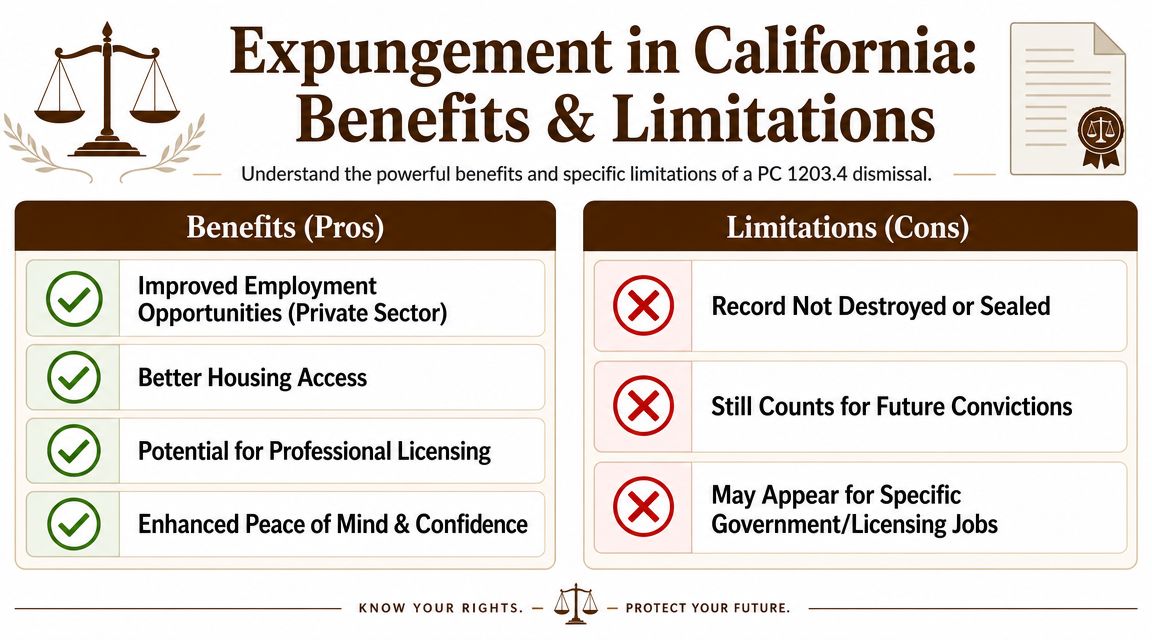
California Courts state that “true expungement does not exist” in the state, and a dismissal under Penal Code 1203.4 mainly limits public access and relieves many disclosure duties for private employment, as explained in the California Courts misdemeanor record-relief guidance. It does not erase the record for government agencies or restore all rights.
What you gain
For many clients, the value is still substantial. A dismissal can improve the way a record appears in background screening and can help with private-sector employment and housing decisions. It also gives people a court order that reflects that the case was dismissed, which matters in real life even when it isn't a complete erasure.
A simple way to think about it is this:
| Area | Practical effect |
|---|---|
| Private employment | Many disclosure duties are reduced |
| Housing | A dismissed case is often better than an unresolved conviction record |
| Professional progress | The dismissal can be part of a broader rehabilitation record |
What a dismissal does not do
A California dismissal has real limits. The record isn't destroyed. Government agencies may still access it. It can still matter in later legal contexts. It also does not automatically restore rights that people often assume come back with expungement.
You should never treat a dismissal as if the conviction never happened. It's better understood as a legal improvement in status, not total erasure.
That distinction matters when someone applies for a government job, a state-issued professional license, or faces another proceeding where the government can still see the underlying case.
Some of the worst mistakes happen after a successful dismissal, when a person answers a later disclosure question as if the case vanished entirely.
So if you're researching how to expunge a record in California, keep the expectation realistic. The process can be powerful, but it's strongest when used for what it does.
Costs, Timelines, and When to Consult an Attorney
The filing cost changed
California made this process more accessible by removing the filing cost for expungement petitions beginning in July 2023, according to Legal Services of Northern California's expungement guidance. Before that change, some counties charged fees such as $120 for each felony case and $60 for each misdemeanor case. The filing cost is no longer the barrier it used to be.
That doesn't mean every case is easy. You still need the right court, the correct case information, complete forms, and proper service.
When legal help is worth it
Some people can handle a straightforward single-case petition on their own. Others shouldn't. Legal help is worth serious consideration when any of these issues are present:
- Multiple convictions in one or more counties.
- Old or purged records that require reconstruction.
- Unclear eligibility because of sentence history or supervision issues.
- A likely objection from the prosecuting agency.
- Licensing or career concerns where a mistake on disclosure could create a new problem.
Timeline depends on the county, the court calendar, and whether the petition is clean or contested. A complete, well-organized filing usually moves better than a rushed one with missing information.
If you need help clearing a record under California law, Tanner Law can evaluate the conviction, determine whether dismissal or another form of relief fits your case, and help prepare the necessary filings. To discuss your options, schedule a free consultation with Tanner Law.