
Update Your Will: A Codocil to a Will Guide 2026
You signed your will when things were settled. Then life kept moving.
A named executor may have moved out of California. A beneficiary may have changed a last name. You may have sold the house or account that appears in the will. None of those changes feels big enough to justify rebuilding the whole document, but leaving the will untouched can create real problems for the people who will have to carry out your wishes in Orange County or Los Angeles.
That's where a codicil to a will comes in. A codicil is the legal tool people use when they need to make a focused change without discarding the rest of an existing will. Used correctly, it can be efficient. Used carelessly, it can create exactly the confusion you were trying to avoid.
California law matters here. Local probate courts won't treat a handwritten margin note, crossed-out paragraph, or family email as a reliable substitute for a properly executed amendment. If you want a change to hold up, the document has to be prepared and signed with care.
Table of Contents
- What Exactly Is a Codicil to a Will
- California's Strict Legal Requirements for a Valid Codicil
- Codicil vs New Will Which Is Right for You
- Common Codicil Mistakes and How to Avoid Them
- A Step-by-Step Guide to Drafting Your Codicil
What Exactly Is a Codicil to a Will
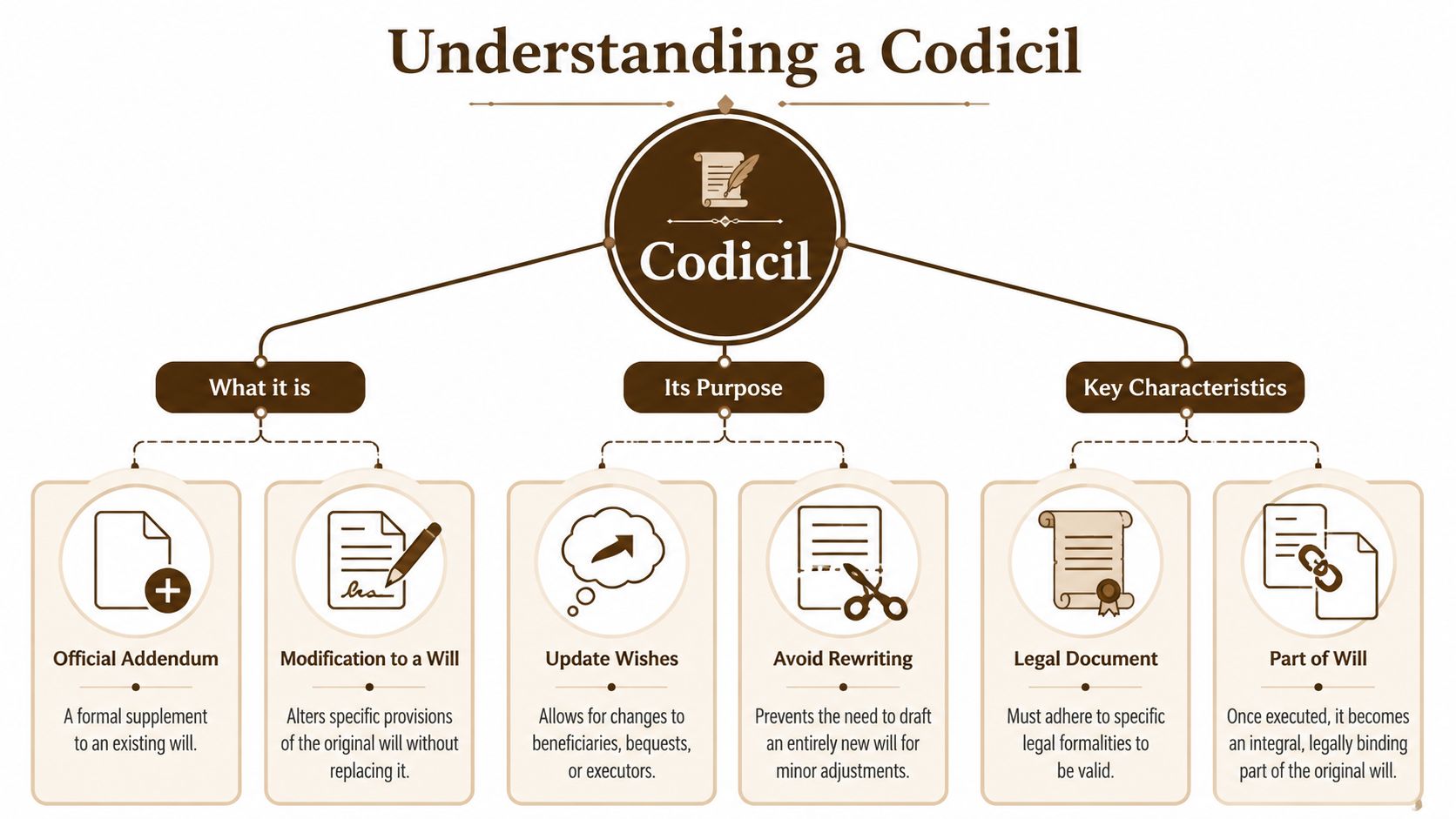
A codicil is a legally recognized amendment to an existing will. It changes part of the original document without replacing the whole thing. The term comes from the Latin codicillus, meaning a “small writing” or “little codex,” which fits its role as a short supplement rather than a brand-new will, as explained in this discussion of a codicil's legal meaning and history.
It functions as an addendum to a contract. The original contract still exists. The addendum doesn't erase it. Instead, it says, in effect, “keep everything else the same, except for this specific change.”
What a codicil can do
A codicil can handle a narrow update, such as:
- Changing an executor if the person you named can no longer serve
- Revising a gift to a beneficiary
- Clarifying language if a sentence in the will could be read more than one way
- Updating an asset description when the rest of the estate plan still works
That's why people often search for “codocil to a will” when they really mean a codicil to a will. They're usually looking for a practical way to make a small correction, not to restart the entire estate plan.
What a codicil is not
A codicil is not an informal note. It isn't a sticky note clipped to the will. It isn't a sentence crossed out in pen. It isn't a verbal instruction to your spouse or adult child.
A codicil becomes part of the will only when it's executed with the legal seriousness required for testamentary documents.
That point matters in California probate practice. Families often assume a simple written statement is enough if everyone “knows what Mom wanted.” Courts don't work that way. The question is whether the change was made in a legally valid form.
Why people use one
Individuals often opt for a codicil due to its efficiency. If the rest of the will still reflects their wishes, a narrow amendment may make sense. It can be a practical fix when the change is targeted and the original document remains sound.
But a codicil works best when it stays small. Once the changes start piling up, the document set can become harder to read, harder to interpret, and harder for a probate court to administer. That's the point where a fresh will often becomes the cleaner solution.
California's Strict Legal Requirements for a Valid Codicil
A common Orange County probate problem starts like this. A parent signs a one-page amendment at home, asks one neighbor to witness it, plans to get the second signature later, and puts the paper in a desk drawer next to the will. After death, the family brings both documents to court expecting the update to control. The court's first question is not whether the change was reasonable. It is whether the codicil was executed with the same legal formality California requires for a testamentary document.
That is the right starting point. A codicil may be short, but under California law it is still a will amendment, not a casual correction. As FreeWill explains in its guide to California codicils, the document generally must be signed with the required witness formalities, and using multiple codicils can create confusion if the papers do not fit together cleanly.
The rule that controls the analysis
Practical rule: If the will had to be formally executed, the codicil does too.
Clients are often surprised by that. They assume a small change should require a small process. California does not work that way. A codicil works like a patch applied to a legal document that only has force if the patch is installed correctly.
For that reason, treat the signing like an actual legal event. Set it up carefully. Use the final version. Gather the right witnesses. Sign in an organized way so nobody later argues that the amendment was incomplete, unsigned, or witnessed improperly.

What a valid California codicil usually needs
In practice, several points matter over and over in Los Angeles and Orange County probate matters:
- A written document. Oral instructions do not amend a will.
- Language identifying the document as a codicil. The paper should say what it is.
- A clear reference to the existing will. Identify the original will by date so there is no fight over which document is being amended.
- The testator's signature. The person making the change must sign the codicil.
- Proper witnessing. California generally requires two qualified witnesses for a formally executed codicil.
- Clear amendment language. State exactly what article, paragraph, or gift is being changed, revoked, or replaced.
- A date. Dating helps establish sequence if more than one estate planning document exists.
The point that causes the most confusion is simple. The amendment may be narrow, but the execution standard is not lighter.
A short video can help reinforce how formal execution works in practice.
Mistakes California courts see again and again
Execution mistakes are usually ordinary human mistakes. Someone asks an adult child to witness. One witness signs in another room. A second witness signs hours later. The codicil says “change my will” but never identifies which will. Someone believes a notary can substitute for witnesses.
Those errors can turn a well-meant update into a probate dispute.
Here is the safer approach. Use two disinterested witnesses. Have everyone present for the signing process. Make sure the codicil clearly states it is amending the will dated on a specific day, then identify the exact section being changed. Judges and court staff should be able to read the will and codicil together without guessing how they fit.
That matters in local practice. In Orange County and Los Angeles, probate courts are not trying to reconstruct unclear family conversations after a death. They are looking at documents, signatures, dates, and whether the statutory formalities were followed.
Is notarization required
Notarization may help prove authenticity later, but it does not replace the witness requirement for a formally executed California codicil. That distinction matters. Families often assume a stamp from a notary fixes any defect in signing. It does not.
The safest takeaway is practical. If you want the amendment to hold up, prepare the codicil as carefully as you would prepare the will itself. A small execution mistake can cause the court to ignore the very change you were trying to make.
Codicil vs New Will Which Is Right for You
This is usually the actual question. Not “What is a codicil?” but “Should I even use one?”
A codicil is a precision tool. A new will is a reset. If the estate plan still works and only one limited term needs revision, a codicil may fit. If the changes are broad, emotional, or structurally important, a new will is often safer.
When a codicil usually makes sense
A codicil is often appropriate when the change is narrow and easy to describe. Examples include replacing an executor, revising one beneficiary gift, or clarifying how one asset should pass while leaving the rest of the will intact.
In those situations, the amendment functions like a clean patch. It doesn't force you to rebuild language that still reflects your intent.
When a new will is usually better
The danger rises when the will starts to read like a stack of edits. Probate disputes often turn on internal inconsistency, and every added amendment increases the chance of ambiguity if old and new language conflict, as discussed in this analysis of codicils, ambiguity, and substantial changes.
That's why a new will is often the better choice after major family or distribution changes. It gives your loved ones one controlling document instead of a paper trail they have to reconcile under stress.
A practical comparison
| Situation | Best Tool | Reasoning |
|---|---|---|
| You want to change the executor only | Codicil | The change is targeted and doesn't disturb the rest of the plan |
| You want to revise one specific gift | Codicil | A narrow amendment may be enough if the original will is otherwise current |
| You sold an item named in the will and need a small update | Codicil | The revision can be precise and limited |
| You've had several life changes affecting multiple parts of the will | New will | A fresh document is easier to read and less likely to create conflicting instructions |
| You want to significantly change who inherits and in what shares | New will | The distribution plan is changing at the core level |
| You already have prior amendments | New will | Additional layers can increase ambiguity and make probate administration harder |
The hidden cost of “just one more amendment”
Here's where many families get stuck. They made one small amendment years ago. Then another. Then another after a move, a death, or a falling out within the family. None of the changes looked large in isolation.
Together, they become a puzzle.
A judge, executor, or beneficiary may have to read the original will and each later codicil side by side and decide how they fit together. If one clause says “my daughter shall receive,” and a later codicil partly changes that gift without fully replacing the earlier sentence, tension appears immediately.
If your family would need a meeting to explain how all the pieces fit together, that's often a sign a new will is the cleaner option.
For many Orange County and Los Angeles families, the practical question isn't whether a codicil is legally possible. It's whether using one will make administration easier or harder later. If the answer is “harder,” redrafting the will is usually the stronger move.
Common Codicil Mistakes and How to Avoid Them
Most codicil problems don't start with bad intentions. They start with shortcuts.
A parent wants to make a quick change. A child finds a form online. Everyone assumes the update is simple. Years later, the family ends up in probate trying to sort out whether the document changed anything.
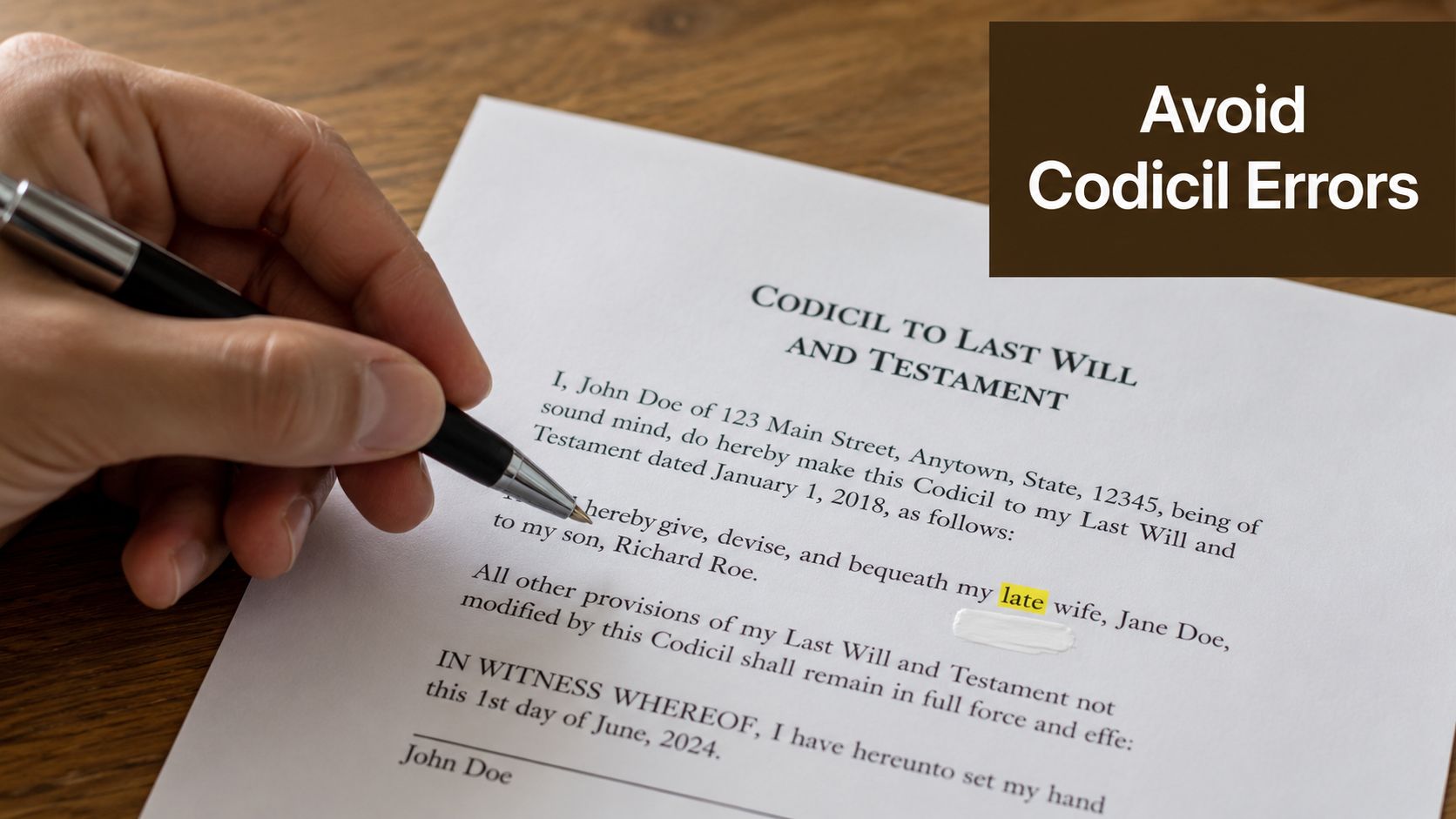
Mistake one: vague wording
A common problem is language that sounds understandable in conversation but becomes unclear on paper.
For example, someone writes that a beneficiary should receive “the house,” but by the time of death there has been more than one house, or the original property was sold and replaced. The family may know what was intended. The court still has to interpret the actual words.
Avoid this by using exact descriptions and by identifying the clause being changed. If you are replacing a gift, say which provision is revoked and what new language takes its place.
Mistake two: changing the will by marking up the old document
People often think they can draw a line through a paragraph, write in a margin, and initial the page. That may feel practical, but it creates uncertainty fast. Was the old clause revoked? Was the note signed properly? Was it added at the same time as the will or years later?
A separate codicil is cleaner because it shows the amendment as a formal act rather than an unexplained alteration.
Mistake three: signing without proper witnesses
This is one of the easiest ways to lose the intended amendment. The document may be drafted well but executed badly.
Common examples include:
- Late witness signatures where one person signs later in a different place
- Interested witnesses who may benefit from the change
- Casual ceremony where nobody can later explain who was present and what happened
The safer approach is to conduct one organized signing session and keep records consistent.
Mistake four: storing the codicil separately
A codicil only helps if the right people can find it. Sometimes the original will is in one folder, and the codicil is in a desk drawer, safe deposit box, or email attachment somewhere else. After death, one document is found and the other is not.
Store the codicil with the will, and make sure the nominated executor knows where both are kept.
A missing codicil can create almost as much trouble as an invalid one.
Mistake five: using a codicil for major changes
This mistake usually grows over time. What began as a small correction turns into a rewrite of beneficiaries, assets, and family roles. At that point, the codicil isn't simplifying anything. It's preserving an outdated base document and layering new instructions on top.
When the amendment starts changing the overall plan, the better solution is usually a new will that says everything once, clearly.
A Step-by-Step Guide to Drafting Your Codicil
If you decide a codicil is the right tool, the drafting process should be deliberate. The goal is clarity first, then proper execution.
Step one: identify the original will precisely
The document should clearly state that it is a codicil to your existing will and identify that will by date. That removes guesswork about which instrument you are amending.
A simple introductory clause might read:
I, [full legal name], declare this document to be a Codicil to my Last Will and Testament dated [insert date of original will].
That opening matters because probate courts need to connect the amendment to a specific will, not to your estate plan in a general sense.
Step two: state each amendment with precision
Don't describe the change loosely. Name the article, paragraph, or section you want to revise, and say whether you are deleting it, replacing it, or adding a new provision.
Sample language can look like this:
I hereby revoke Article [number] of my Last Will and Testament and replace it with the following provision: [insert revised language].
Or, if you are adding rather than replacing:
I add the following new provision to my Last Will and Testament as Article [number or label]: [insert added language].
Many “codocil to a will” searches lead people astray. They find examples that are too generic. A useful codicil has to match your actual will structure and wording.
Step three: reaffirm the rest of the will
A codicil should confirm that the remaining parts of the original will stay in effect. That tells the court you intended a limited amendment, not a wholesale replacement.
A standard reaffirmation clause may read:
In all other respects, I ratify and confirm my Last Will and Testament dated [insert date].
That one sentence often does a lot of work. It preserves the rest of the original document while isolating the new change.
Step four: execute it like a California testamentary document
Drafting alone isn't enough. The signing has to be handled carefully.
Use this checklist:
- Prepare the final version before signing. Don't make handwritten edits after witnesses arrive.
- Bring together the signer and two qualified witnesses. Avoid piecemeal signing.
- Sign and date the document clearly. Make the order of execution obvious.
- Have the witnesses sign in a proper formal setting. Treat the process seriously.
- Store the codicil with the original will. Keep the documents together.
The best codicil is one that a probate judge can read once and understand without guessing.
Step five: read it against the full estate plan
Before you sign, compare the codicil to the original will line by line. Ask a practical question: if a stranger had to administer this estate, would the change be obvious?
If the answer is no, stop and reconsider whether a new will would serve your family better.
If you need help deciding whether a codicil or a new will is the better choice under California law, schedule a free consultation with Tanner Law. Families in Orange County and Los Angeles can get clear, practical guidance on preparing estate planning documents that are designed to hold up in probate court.