Grant Deed vs Deed of Trust in California
A Yorba Linda couple signs a stack of closing papers and later asks a simple question: “Which document proves that we own the house?” Their file contains a grant deed and a deed of trust, both recorded with the county, both written in formal language, and both bearing the word “deed.” The confusion is understandable, but the legal answer is straightforward. The grant deed transfers ownership. The deed of trust secures repayment of a loan.
That distinction matters throughout the life of a California property. It affects the public title record, refinancing, trust transfers, probate, lien priority, reconveyance, and foreclosure. California families who understand the separate jobs of these documents are less likely to discover an avoidable title problem years after closing.
Table of Contents
- What Homeowners Get Wrong About These Two Documents
- How a California Grant Deed Transfers Title
- How a California Deed of Trust Secures a Loan
- Grant Deed and Deed of Trust Side by Side
- Foreclosure and Recording in California Practice
- Trust Transfers, Refinances, and Title Cleanups
- Practical Guidance for Owners, Investors, and Attorneys
- Common Questions and How Tanner Law Can Help
What Homeowners Get Wrong About These Two Documents
At a purchase closing, the escrow or title package may place a grant deed and a deed of trust next to each other. The deed of trust can look like a conveyance document because it contains a granting clause and describes the property in detail. Marketing materials and informal conversations also use “deed,” “title,” and “mortgage” interchangeably, even though California law treats the documents differently.
The grant deed is the instrument that moves title from the grantor to the grantee. Once properly executed and recorded, it becomes part of the chain of title and remains in the public record until a later conveyance changes ownership. The deed of trust does something else. It encumbers the owner's title to secure the borrower's obligation to the lender, with a trustee holding legal title in a limited security role.
Practical rule: If the question is “Who owns the property?”, start with the recorded conveyance. If the question is “What secures the loan?”, look for the deed of trust.
A homeowner's confusion often begins because both instruments are recorded together. In Orange County, the recorder's systems preserve long-running grantor and grantee property-document records, and Sacramento County describes grant deeds and deeds of trust as documents recorded there since 1850. Those public-record systems show how both instruments are embedded in California real estate practice, but recording both documents doesn't make them interchangeable. Orange County's RecorderWorks index provides a practical example of how parties trace recorded property documents.
The ownership document and the security document
A grant deed ordinarily completes the transferor's role after execution and recording, subject to any surviving promises or disputes. A deed of trust remains relevant for the life of the loan. When the debt is paid, the lender's security interest should be released through a reconveyance. If that release is missing, a paid loan can continue to appear as an unresolved lien during a later sale or refinance.
The distinction also controls what happens next. A title transfer may require a new grant deed, while a refinance generally requires a new deed of trust and a reconveyance or replacement of the old one. Probate and estate-planning transfers use conveyance documents, while foreclosure proceeds through the security instrument and the trustee's statutory process.
How a California Grant Deed Transfers Title
Under California law, a grant deed is a conveyance that transfers an interest in real property from one owner to another. California Civil Code sections 1105 and 1106 supply important implied protections, and the California Department of Real Estate reference book explains that certain promises arise from the use of grant language even when the deed doesn't spell them out.
The familiar statutory form carries limited implied warranties. In practical terms, the grantor promises that the property hasn't already been conveyed to someone else and that the grantor hasn't created undisclosed encumbrances through the grantor's own acts or omissions. California practice also addresses the grantor's marital status and the spouse's participation where community-property rights may be involved. These protections are narrower than a broad warranty against every title defect in the property's entire history.
Drafting the conveyance
A careful grant deed begins with identity and vesting. The grantor and grantee should be named consistently with the prior recorded deed and the intended ownership structure. The document should state whether the grantees will hold title as joint tenants, community property, community property with right of survivorship, or tenants in common, when that choice applies.
The granting clause identifies the transfer, the legal description identifies the land, and the habendum or holding language helps express the estate being conveyed. The deed also needs a proper signature and notarization. In most California recording settings, the submission includes an in-lieu-of-tax affidavit or equivalent transfer-tax documentation, along with the county's required ownership forms.
Recording matters because California follows a race-notice recording framework. A properly recorded instrument gives public notice and helps establish priority against later competing claims, subject to the detailed rules governing notice, recording, and competing interests. A deed that sits unrecorded in a desk drawer may reflect the parties' intent, but it creates avoidable uncertainty for later buyers, lenders, heirs, and title insurers.
Errors that create later work
The most common problems are practical rather than dramatic. A deed may state the wrong vesting, use an incomplete legal description, omit a necessary spouse, or arrive at the recorder without the required ownership report. Those errors can produce a mismatch between the deed, the assessor's file, and the title company's requirements. They can also contribute to supplemental tax reassessments or a cloud on title.
A grant deed should therefore be treated as a permanent title record, not a closing formality. The deed shows future purchasers how ownership moved, while the limited implied warranties tell them only what the grantor promised by operation of law.
How a California Deed of Trust Secures a Loan
California's deed of trust is a three-party security instrument. The trustor is the borrower, the beneficiary is the lender, and the trustee is the party authorized to act under the instrument, often a title or foreclosure company. Under California Civil Code section 2920, the deed of trust places the property in trust as security for repayment rather than serving as the ownership-transfer document.
The borrower signs a promissory note promising to repay the debt and signs the deed of trust pledging property as collateral. The trustor conveys bare legal title to the trustee for that limited security purpose. The borrower still possesses and uses the home, while the beneficiary holds the economic security interest created by the loan.
What the instrument contains
The deed of trust typically identifies the note and describes the property with the same care required in a conveyance. It contains a granting clause, default and acceleration provisions, insurance and tax obligations, and provisions allowing the lender to protect its collateral. It also includes in rem language, meaning the lender may enforce the security against the property itself, subject to California law and the borrower's rights.
A deed of trust doesn't change the owner shown by the grant deed. Instead, it gives the lender a defined enforcement path if the borrower fails to perform. California's system differs from the traditional common-law mortgage structure used in some jurisdictions because a trustee stands between the borrower and lender and may conduct a nonjudicial sale when statutory requirements are met.
Recording, priority, and reconveyance
The deed of trust is recorded in the county where the property sits. Recording gives public notice of the lien and establishes its position relative to later deeds of trust, judgment liens, and other recorded interests. A lender may later transfer the loan, and assignments or servicing records may follow, but the original security instrument remains an important part of the title history.
Once the note is paid, the trustee or beneficiary must arrange a reconveyance that releases the security interest from the public record. Missing assignments, outdated beneficiary information, or MERS-related recordkeeping can make that process harder to verify. A stale deed of trust can delay a sale or refinance even when the borrower believes the loan ended long ago.
Grant Deed and Deed of Trust Side by Side
The quickest way to understand the grant deed vs deed of trust distinction is to ask what each document changes. A grant deed changes the ownership record. A deed of trust changes the lender's rights against that ownership.
A California grant deed usually appears when property is sold, gifted, transferred into a revocable trust, or conveyed from a trustee to beneficiaries. A deed of trust usually appears when a lender finances a purchase or refinance. The two often record in the same transaction, but they occupy different legal layers.
Grant Deed vs Deed of Trust Comparison
| Category | Grant Deed | Deed of Trust |
|---|---|---|
| Parties | Grantor and grantee | Trustor, beneficiary, and trustee |
| Purpose | Transfers ownership or another real-property interest | Secures repayment of a loan |
| Warranties | Carries limited implied warranties tied to the grantor's conduct | Contains loan-security promises, not title-transfer warranties |
| Lifecycle | Usually records when ownership changes and remains in the title chain | Records with a loan, remains while the debt is secured, then should reconvey |
| Effect on title | Adds a conveyance to the chain of title | Adds a lien or security interest to the title record |
| Ownership result | Moves the present ownership interest to the grantee | Doesn't ordinarily transfer beneficial ownership to the lender |
| Default consequence | A clean recording documents the transfer | Default may lead to a trustee's sale under California's foreclosure framework |
| Public-record search | Found through grantor and grantee conveyance records | Found among recorded liens, deeds of trust, assignments, and reconveyances |
The lifecycle difference
A grant deed transfers the present interest held by the grantor. It is the document a title examiner follows to determine how ownership moved from one party to the next. A deed of trust encumbers that interest and addresses a future event, namely the lender's right to enforce its collateral if the debt isn't performed.
The practical distinction is visible in the county recorder's index. Search a property's records and you may find a grant deed at the time of purchase, another grant deed when the owner moved the property into a trust, and a later deed when the trust distributed it. Between those events, several deeds of trust may appear because the owner borrowed, refinanced, or modified secured debt.
Neither document replaces the other. A grant deed without the intended financing documents may leave a lender unsecured. A deed of trust without a valid ownership interest to encumber may leave the lender with a serious enforcement problem.
Foreclosure and Recording in California Practice
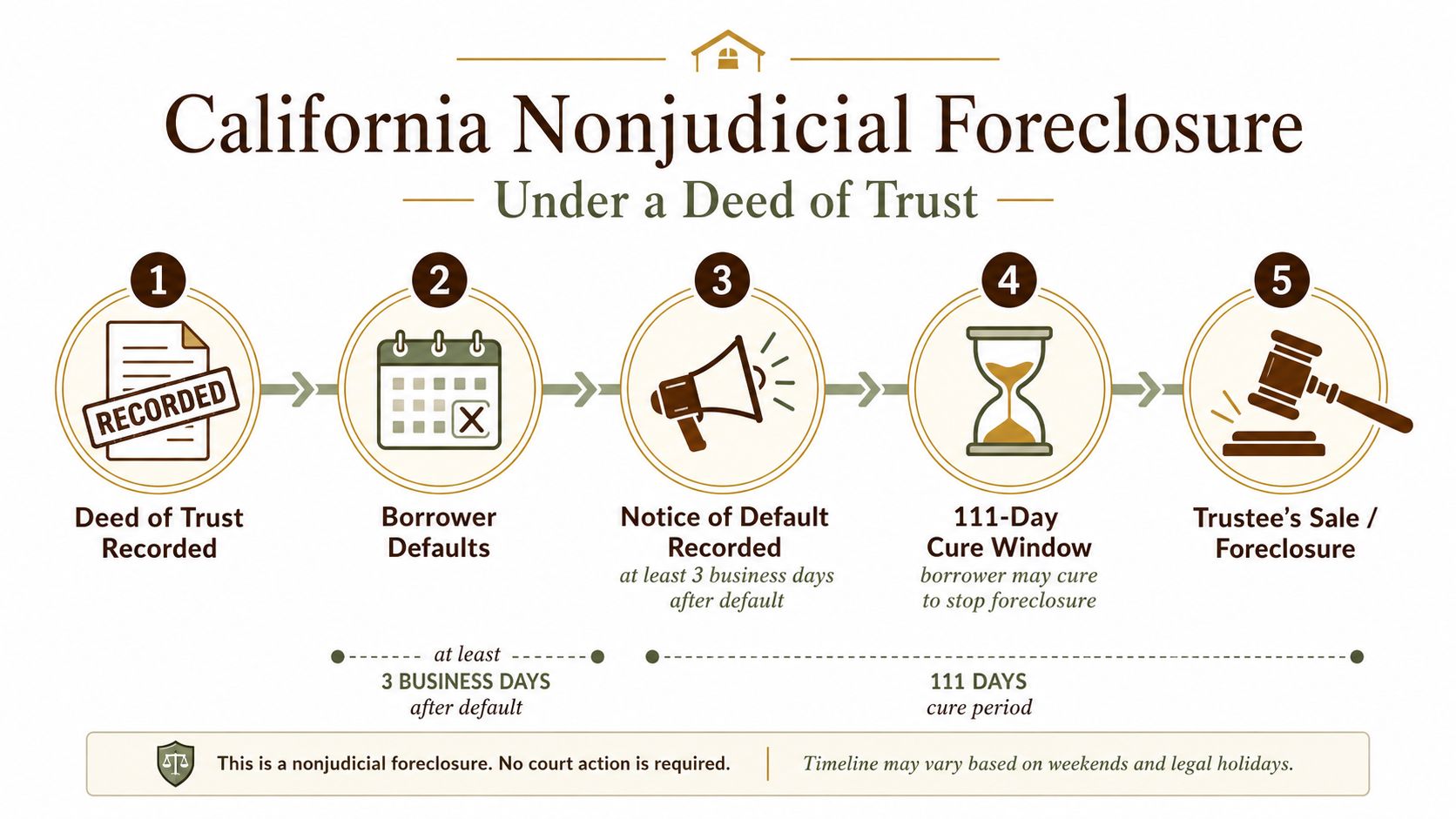
A deed of trust is central to California's nonjudicial foreclosure process because it establishes the trustee's authority to enforce the security instrument. The process begins with a borrower's default and proceeds through recorded notices before a trustee's sale can occur. California materials describe the statutory sequence as requiring at least three months between the recorded notice of default and the notice of sale, followed by at least 20 days before the trustee's sale. This California foreclosure flow chart illustrates the sequence.
The commonly used shorthand of a “three-business-day” threshold after default can be misleading. The legally important point is that the trustee must comply with the deed of trust, applicable notice rules, and California Civil Code requirements before recording a notice of default. The borrower then receives the statutory opportunity to cure before the sale process advances.
The foreclosure sequence
The practical sequence is:
- Deed of trust recorded: The lender's security interest enters the public record.
- Borrower defaults: The borrower fails to perform under the note or deed of trust.
- Notice of default recorded: The trustee or authorized party begins the formal process after the required conditions are met.
- Statutory cure period: The borrower may cure the default before the sale proceeds.
- Trustee's sale: The property may be sold, with title transferred through a trustee's deed upon sale.
The trustee has a neutral role in carrying out the statutory process. A defective notice, improper mailing, inaccurate beneficiary information, or failure to reconvey a paid loan can lead to disputes over foreclosure authority and title status. California Civil Code section 2924 governs key foreclosure mechanics, while section 2924k addresses the distribution of sale proceeds.
A grant deed follows a different path. If it records properly, it documents the transfer and becomes part of the chain of title. If the related loan has been paid but the deed of trust never reconveys, the owner may still hold title while the public record shows an apparently active lien. That mismatch often surfaces during a sale, refinance, probate administration, or quiet-title dispute.
Trust Transfers, Refinances, and Title Cleanups
An Orange County family may use both documents repeatedly without realizing how closely their records must match. Consider a parent who owns a home individually and decides to place it in a revocable living trust for estate-planning purposes. The transfer is commonly completed with a grant deed naming the trust, or the trustee acting under the trust, as grantee. The Orange County recorder's trust-transfer guidance reflects the practical need for a signed, notarized, recorded deed and the required transfer-tax or ownership documentation.
That first step changes the title record. It doesn't pay off or erase an existing loan. The existing deed of trust remains a separate security layer unless the lender reconveys it or the financing is replaced.
The refinance
When the trust later refinances, the lender must document the borrower and title arrangement correctly. A new deed of trust records against the ownership shown in the current title structure, often identifying the trustee or trust relationship in the vesting and loan documents. The earlier deed of trust should be reconveyed, substituted, or otherwise addressed so the title record accurately reflects which debt remains secured.
Families encounter avoidable delays. The trust transfer may have been recorded under a name that doesn't match the lender's underwriting file. The legal description may differ slightly from the prior instrument. Or the old lender may have been paid but never completed the reconveyance. A refinance can expose all three problems at once.
Unwinding the trust
At death, a successor trustee may need to distribute the home to heirs through a new grant deed. Divorce can require a conveyance to a former spouse or another owner. Probate set-aside work, a quiet-title action, or corrective instruments may be necessary if a prior transfer was incomplete, an heir disputes the trust, or the title record contains conflicting documents.
The most difficult cleanup files often involve a combination of issues rather than one defective paper. An unrecorded trust transfer, missing reconveyance, stale legal description, and unclear successor-trustee authority can each affect the next transaction. The grant deed moves title through the family's plan, while the deed of trust continues to follow the financing until the secured debt is properly released.
Practical Guidance for Owners, Investors, and Attorneys
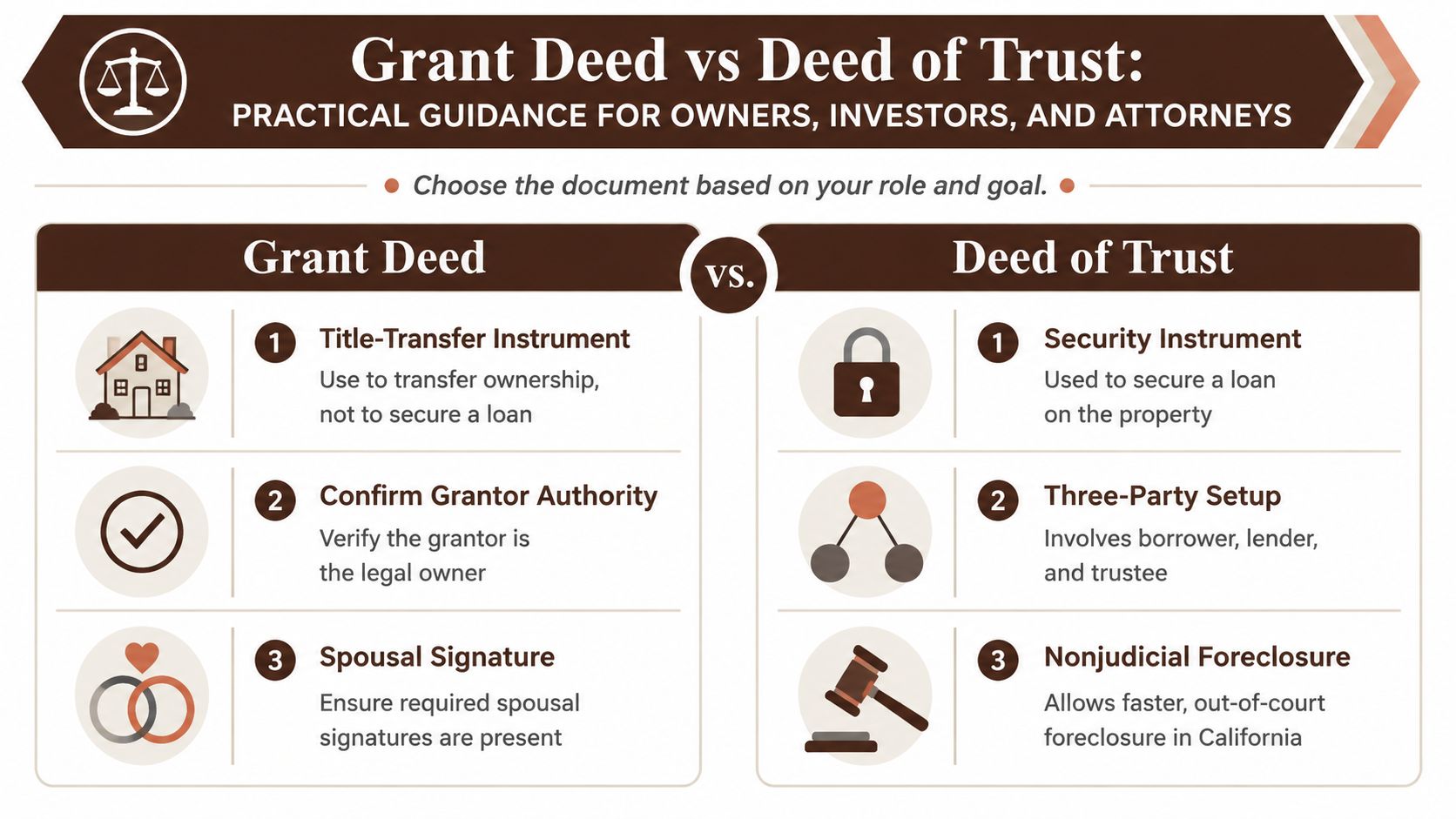
Choose the document based on the transaction's objective, not on the fact that both documents contain the word “deed.” A homeowner transferring ownership needs a grant deed. A lender securing repayment needs a deed of trust. A financed purchase generally requires both, with each document performing a separate job.
For homeowners and families
Before signing a grant deed, confirm the grantor's authority, the exact legal description, the intended vesting, and any required spouse participation. California Civil Code section 1092 makes spousal signature issues especially important where community-property rights may be affected. Record the deed with the appropriate county recorder and verify that the filed copy matches the intended transaction.
Before refinancing, obtain a current title review and confirm that prior deeds of trust have been reconveyed or will be handled through escrow. Don't assume the lender's payoff statement alone proves that the public lien has been cleared.
For investors and attorneys
An investor holding title through an LLC should confirm operating authority before changing the membership or transferring the property. The lender may also require separate acknowledgments, resolutions, or consent documents. The deed, entity records, and loan documents must tell the same story.
An attorney preparing a deed of trust should verify the trustor's identity, the legal description, the beneficiary information, and the notary acknowledgment. Recording defects can undermine the lender's intended priority and complicate reliance on California's nonjudicial foreclosure process under Civil Code section 2924.
Before recording, ask three questions: Is this changing ownership, securing debt, or releasing a prior lien? Does the signer have authority? Will the document match the existing title record?
Common problems include an unrecorded deed that creates a cloud, a missing reconveyance after payoff, a stale probate order that prevents a lender from recording, and an assumption clause that binds successors more broadly than the family expected. The right document depends on the ownership goal, financing structure, and planned exit.
Common Questions and How Tanner Law Can Help
Can a deed of trust be used without a grant deed? Not as a substitute for a conveyance. A deed of trust secures an interest in existing title. If ownership is changing, a separate transfer instrument must establish that change before the lender's security interest can be properly tied to the new ownership record.
Does a grant deed guarantee clear title? No. California grant language creates limited implied warranties, including promises concerning prior conveyance and encumbrances caused by the grantor. It isn't a guarantee that every historical title defect, lien, easement, or competing claim has been eliminated. A title search, title insurance, quiet-title action, or other corrective work may still be appropriate.
Can a trust transfer avoid property-tax reassessment? Parent-child and spousal exclusions under Proposition 13 may preserve the existing base-year value, and revocable-trust transfers often qualify, but the family should confirm the facts and filing requirements with the county assessor.
What if the grant deed records but the deed of trust is defective? The buyer may still hold the ownership interest shown by the grant deed, while the lender's lien or foreclosure rights may be impaired. The lender might need a corrective instrument or judicial enforcement, depending on the defect and circumstances.
Tanner Law reviews grant deeds, deeds of trust, trust transfers, reconveyance problems, probate-related title issues, and foreclosure disputes for California property owners, investors, and attorneys. Schedule a free consultation to identify the document problem before it becomes a sale, refinance, or ownership crisis.
Tanner Law can review your grant deed and deed of trust together, address trust-transfer and reconveyance issues, and advise on title disputes, probate-related transfers, or foreclosure concerns. Visit Tanner Law to schedule a free consultation for practical California real estate guidance.