Contract Breach Lawsuit: A California Property Owner Guide
A contractor took your deposit, removed part of your kitchen, and then stopped answering. Or a tenant left unpaid rent while a small landlord tries to understand whether the lease, payment history, and messages are strong enough to justify court. These disputes feel personal, but a contract breach lawsuit succeeds or fails on more practical questions: What exactly did the agreement require? Did the other party breach it? Can you prove the loss? And is court the right forum before the deadline expires?
California property owners, landlords, homeowners, and small investors should treat filing as a case-selection decision, not an automatic next step. Contract litigation remains common in federal courts. Lex Machina reported 10,253 contract cases filed in 2023, along with 6,654 commercial cases, and reported $13 billion in contract damages awarded from 2021 through 2023 in its contracts and commercial litigation report (Lex Machina's 2024 Contracts and Commercial Litigation Report). But volume doesn't make every claim worth pursuing. The contract language, evidence, remedy, deadline, and forum determine whether a dispute moves toward payment or becomes an expensive delay.
Table of Contents
- What a Contract Breach Lawsuit Is
- The Four Elements You Must Prove in California
- Remedies California Courts Can Award You
- California Filing Deadlines You Cannot Afford to Miss
- How Long a California Contract Case Really Takes
- Choosing the Right Forum for Your Dispute
- Common Defenses and How to Counter Them
- Practical Next Steps and When to Hire an Attorney
What a Contract Breach Lawsuit Is
A homeowner in Orange County hires a contractor to renovate a kitchen. The owner pays as required, provides access, and cooperates with the schedule. The contractor removes the cabinets, completes only part of the work, leaves materials throughout the house, and refuses to return the unused payment.
A negative review might warn other homeowners, but it will not recover the payment or complete the renovation. A breach of contract lawsuit asks a civil court to enforce the parties' agreement and award an available remedy for nonperformance. It is a civil claim, not a criminal prosecution. A breach by itself also does not establish fraud, negligence, or bad faith.
What the claim must connect
The owner generally must identify a contract, show the owner's own performance or a legally valid excuse, establish the contractor's failure to perform a contractual duty, and prove resulting damages. The agreement may be a signed construction contract, purchase agreement, lease, loan document, or service arrangement. Emails, proposals, invoices, payment records, photographs, and the parties' conduct can help establish both the agreed terms and what occurred afterward.
The requested remedy may include money damages, completion of promised work, restitution of payments, cancellation of the agreement, or specific performance. The contract language, the type of property or service, and the available proof all affect what a court can award. A claim for repair costs, for example, requires records that connect the unfinished or defective work to a reasonably supported loss.
Practical rule: A convincing story is not enough. Connect a specific promise to a specific failure, then connect that failure to a loss supported by records.
Filing is a case-selection decision, not an automatic first step. A focused demand letter may resolve a payment dispute. Mediation may preserve a business relationship and produce a workable solution. Arbitration may be required by the contract, while a licensing complaint or construction-related remedy may address a separate part of the dispute. The proper court or venue may depend on the property's location, the defendant's residence, or the agreement's terms.
Before choosing a forum, preserve the contract and every amendment, communication, invoice, photograph, inspection report, payment record, deadline, and requested remedy. Related claims may arise from the same events, but California law can impose different proof requirements and filing deadlines for each. The strength of that documentation should guide whether to demand payment, pursue an alternative process, or file a lawsuit.
The Four Elements You Must Prove in California
A homeowner may have photographs of unfinished work, a landlord may have an unpaid rent ledger, and a buyer may have a signed purchase agreement. None of those items alone proves a breach claim. California courts generally require four connected elements. A weakness in any one can affect dismissal, settlement value, or recovery.
First, establish a valid contract
Begin with the agreement and its terms. A real estate purchase contract should identify the property, price, closing duties, and relevant conditions. A construction agreement should describe the work, payment terms, materials, completion expectations, and change-order process. A lease should show the rent obligation, term, possession rights, and default provisions.
A signature helps, but it is not the only evidence. Proposals, emails, text messages, invoices, payment transfers, and the parties' conduct may establish what they agreed to do. The defendant may contend that negotiations never produced a final agreement or that important terms remained unresolved. Preserve the full communication history, not only the document with a signature.
Second, show your own performance
A buyer alleging seller breach should be ready to show payment, financing compliance, or readiness and ability to close when required. A homeowner suing a contractor should document access to the property, required payments, timely material selections, and conduct that did not prevent performance.
This element often reveals a case-selection problem. A party may focus on the other side's failure while overlooking an unpaid installment, missed approval, or defective notice. Collect cancelled checks, bank records, receipts, delivery confirmations, access messages, and inspection communications before asserting default. Those records may support the claim, expose a weakness, or show that a demand or negotiated resolution is more practical than filing.
Third, identify the breach precisely
Describe the promise, deadline, required standard, and act or omission that violated it. “Bad work” and “the deal fell apart” are conclusions, not a useful breach theory. A missed closing date, unpaid rent, failure to complete listed repairs, refusal to deliver title, or nonpayment of a loan installment gives the court a defined issue to decide.
Fourth, prove causation and damages
The breach must have caused the claimed loss. California model jury instructions describe breach as a “substantial factor” in causing harm, as explained in California Civil Jury Instructions on causation. A market shift, independent business decision, or third-party event may interrupt that causal chain even if a breach occurred.
Build the loss from contemporaneous records. Completion invoices, repair estimates, rent ledgers, receipts, payment histories, photographs, performance logs, and inspection materials can connect the contractual failure to the amount sought. The better question is whether the records prove each link: the promise, the failure, the causal effect, and the resulting loss. That documentation should guide whether to send a demand, use another dispute process, or file in court.
Remedies California Courts Can Award You
The remedy should match the loss and the contract. A property owner who paid for defective work may need completion or repair costs. A buyer deprived of a particular parcel may seek the property itself. A landlord may pursue unpaid rent, while a party who paid money under a failed agreement may seek restitution.
Money damages require disciplined proof
Compensatory damages generally seek to place the injured party in the position the party expected if the contract had been performed. Depending on the facts, that might include reasonable costs to complete unfinished work, repair defective construction, recover unpaid rent, address financing losses, or account for a provable reduction in property value.
Consequential damages can include foreseeable losses that follow from the breach, such as documented relocation or storage expenses. Reliance damages may address expenses incurred because the promise was made. These categories can't duplicate one another, and the plaintiff must separate losses caused by the breach from losses caused by later choices or outside conditions.
Contract damages usually require enough factual support for the factfinder to make a reasonable and probable estimate, rather than relying on an unsupported assertion of nonpayment or delay. The discussion of proof and causation in California contract damages analysis reflects why transaction-level documentation matters.
Equitable remedies have narrower uses
Specific performance may be appropriate when money can't adequately replace the promised performance. A particular parcel of real property is the classic example because another property may not be an equivalent substitute. The court won't rewrite an unfavorable bargain because one side regrets signing it.
Rescission and restitution may be available when an agreement is voidable, substantially unfair, fraudulent, or still largely unperformed. Rescission seeks to unwind the transaction, while restitution generally returns benefits transferred under it. A plaintiff who materially breached first, or whose conduct caused the failure, may lose access to contractual relief.
Attorney's fees aren't automatic in California. A contract or statute may authorize fee recovery, but the default rule often leaves each side responsible for its own fees. The complaint should request realistic alternative relief supported by the evidence, rather than listing every possible remedy without a factual basis.
California Filing Deadlines You Cannot Afford to Miss
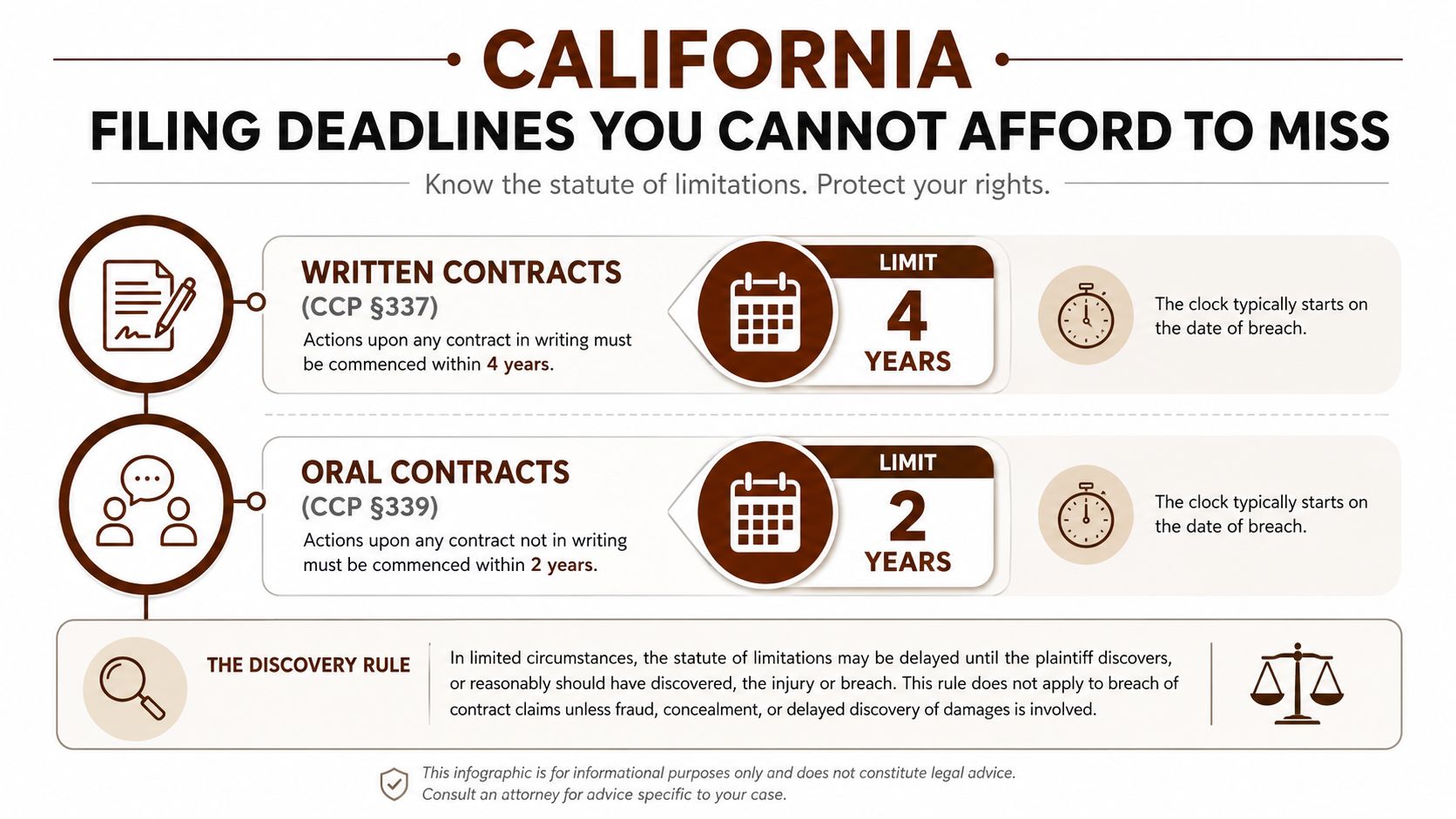
The first deadline question is whether the agreement is written or oral. In California, a lawsuit for breach of a written contract generally must be filed within four years, while a claim based on an oral contract generally must be filed within two years, as summarized in California statute of limitations guidance. The ordinary starting point is the date of breach, not the date you finally understand the financial consequences.
Classify the agreement carefully
A verbal promise may still leave a paper trail. A receipt, cancelled check, email, or other writing may help prove that an agreement existed, but the key question is often whether the promise was reduced to a signed written contract. California contract deadline guidance distinguishing written and oral agreements explains why scattered documents don't automatically convert an oral agreement into a written contract for limitations purposes.
Suppose a seller fails to close escrow under a signed purchase agreement. The filing analysis generally begins with the missed contractual performance. If a contractor fails to pay an unpaid invoice under a written agreement, the relevant date may depend on when payment became due and whether later conduct created a new enforceable promise. A verbal agreement to extend a lease presents a different classification and proof problem.
Don't assume tolling will save the claim
The discovery rule, equitable tolling, and fraudulent concealment doctrines can affect the filing analysis in limited circumstances, but they aren't substitutes for prompt legal review. A party who waits because the damage became clearer later may still face a limitations defense. Contract provisions, statutory requirements, notice clauses, and the requested remedy can also change the analysis.
A recorded notice of pendency may be important in a real property action seeking specific performance, but it doesn't replace evaluating the underlying statute of limitations or procedural requirements. Have counsel calculate the deadline from the contract, breach dates, notices, payment records, and any alleged concealment before relying on an exception.
How Long a California Contract Case Really Takes
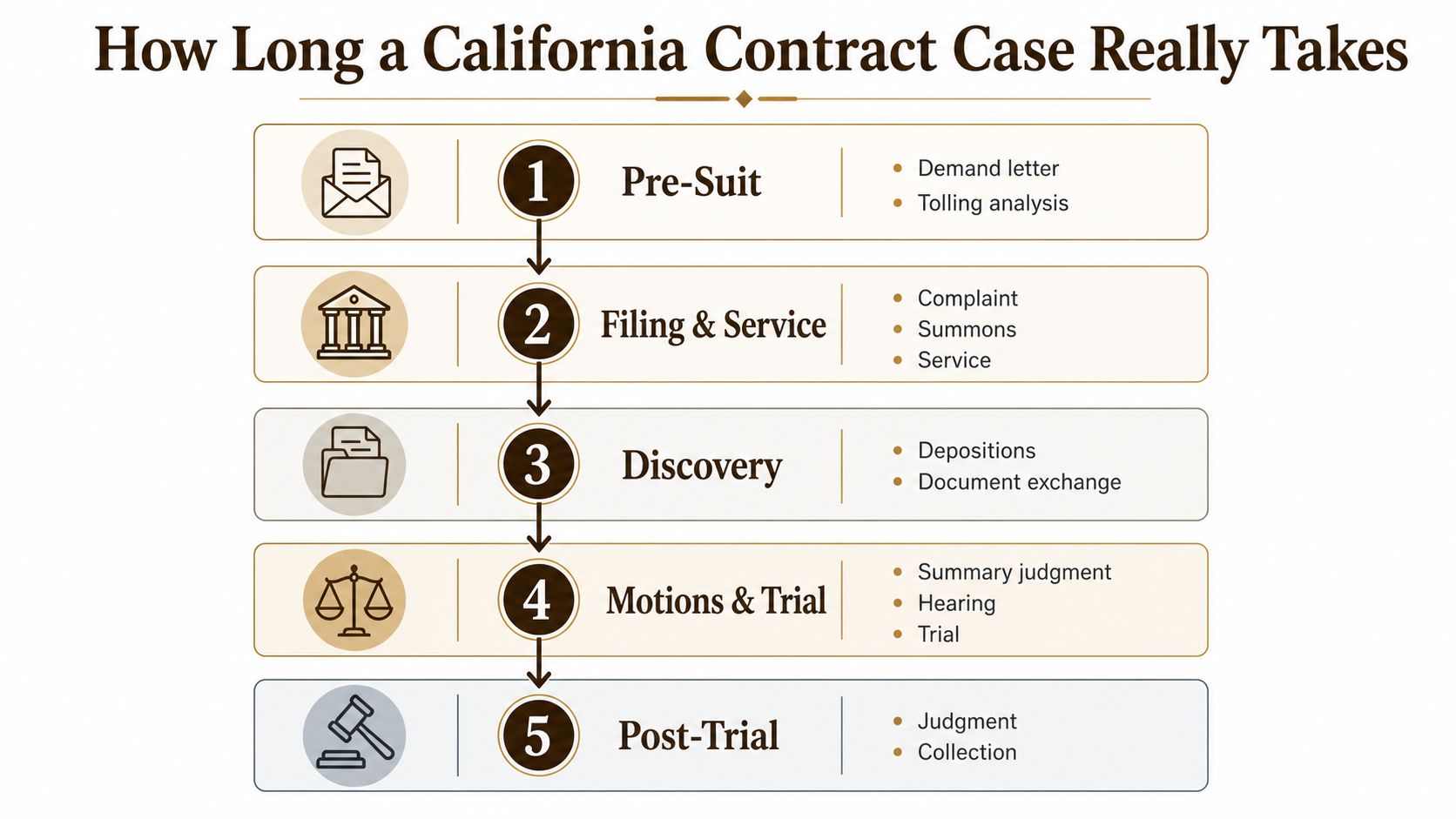
A California contract dispute often begins before anyone files. Counsel reviews the agreement, calculates the limitations period, checks notice and cure provisions, identifies the proper defendant, and sends a demand that states the requested cure or payment. That step can resolve a matter, but it can also reveal whether the opposing party has a factual defense worth addressing before litigation.
The court process unfolds in stages
After filing and service, the defendant responds, and the court schedules case-management activity. The parties exchange documents, answer written questions, take depositions, and retain experts when the dispute involves construction quality, valuation, accounting, or causation. Motions may narrow the issues or seek judgment without trial, but motion practice can add cost even when it improves settlement strength.
A federal benchmark involving 308,088 breach-of-contract matters found a median resolution time of 273 days, with 35% settling, 33% dismissed, and 20% reaching judgment (federal contract-case benchmark reported through Lex Machina). Federal and California state procedures differ, so the figures don't promise a timeline for an Orange County or Los Angeles Superior Court case. They do reinforce a practical point: many disputes resolve before trial, and early evaluation matters.
A case can be legally strong and still take long enough to affect refinancing, a sale, a tenant relationship, or a family's cash flow.
What pushes a matter longer
Multiple defendants, incomplete records, disputed contract formation, expert-heavy construction issues, discovery disputes, unavailable witnesses, counterclaims, and appeals can extend the process. Mediation or a judicial settlement conference may resolve the dispute earlier if both sides arrive with authority to make decisions and a realistic damages model.
An arbitration clause can move the dispute into a private forum with different procedures and limited appeal rights. It may reduce court involvement, but it doesn't eliminate preparation, evidence problems, or expense. The contract's dispute-resolution language should be reviewed before filing anywhere.
Choosing the Right Forum for Your Dispute
The proper forum depends on more than the amount claimed. A homeowner may value a fast, private resolution. A buyer seeking a particular property may need court authority for equitable relief. A small contractor may want a practical path for a modest unpaid balance, while a landlord may need to preserve an ongoing relationship with a tenant.
California options include Superior Court limited or unlimited jurisdiction, small claims court, mediation, and private arbitration. Court offers formal discovery and judicial remedies, but public filings and procedural expense can be significant. Mediation gives the parties control, but no result is imposed unless they reach and sign an agreement. Arbitration is private and binding in many agreements, yet appeal rights are limited and the arbitrator's authority comes from the contract and applicable rules.
| Forum | Max Claim Value | Typical Time to Resolution | Appeal Rights | Best Fit |
|---|---|---|---|---|
| Superior Court, unlimited jurisdiction | Claims above the limited-jurisdiction threshold or cases needing broader relief | Depends on pleadings, discovery, motions, and court availability | Available under applicable rules | Significant damages, complex evidence, or specific performance |
| Superior Court, limited jurisdiction | Claims within the court's limited-jurisdiction threshold | Often more streamlined than complex unlimited cases | Available under applicable rules | Moderate contract claims with ordinary money damages |
| Small claims court | Individuals and most businesses may generally claim up to $12,500, subject to California rules | Designed for a simpler process | Limited, and rules differ by party and appeal posture | Straightforward, lower-value disputes |
| Private arbitration | Controlled by the agreement and forum rules | Varies with the clause, arbitrator, and complexity | Usually narrow | Contracts requiring private adjudication |
| Mediation | No imposed claim ceiling | Depends on participant availability and negotiation | No appeal because the mediator doesn't decide the case | Confidential settlement, relationship preservation, and flexible terms |
A six-figure earnest-money dispute usually calls for a more formal forum than small claims. A straightforward contractor balance under $12,500 may fit small claims if the owner can prove the agreement, breach, and amount without complicated expert evidence. A lease containing a mandatory arbitration clause may remove the choice to litigate in court.
Decision test: Match the forum to the remedy you need, the evidence you have, the relationship you want to preserve, and the cost of being wrong.
Common Defenses and How to Counter Them
Defendants often challenge more than the amount of damages. They may argue that no enforceable agreement existed, that performance was excused, or that the plaintiff accepted the very conduct now labeled a breach. The response should begin with documents, not indignation.
| Defense | Legal Test | Countering Evidence |
|---|---|---|
| Impossibility | Performance became objectively impossible, rather than merely inconvenient | Contract language, project records, alternative-performance evidence, and communications about available options |
| Impracticability | Performance became excessively difficult or costly in a legally recognized way | Budgets, scheduling records, expert analysis, and proof that the claimed difficulty was foreseeable or manageable |
| Waiver | The plaintiff knowingly gave up a contractual right | Reservation-of-rights letters, timely notices, payment objections, and evidence that acceptance was conditional |
| Estoppel | The plaintiff's conduct reasonably induced reliance that makes the claim unfair | Complete email chains, reliance records, change orders, and proof that the defendant knew the original position remained contested |
| Unconscionability | The agreement or term is so procedurally and substantively unfair that enforcement is challenged | Negotiation history, contract presentation, bargaining facts, and comparison of the disputed term with the transaction |
| Failure of condition | A required event didn't occur, so the duty never became enforceable | Inspection reports, closing documents, approvals, notices, and evidence showing the condition was satisfied or waived |
Timing can change the defense
A landlord who repeatedly accepts late performance without reserving rights may face a waiver argument. A homeowner who approves changes orally and later insists on the original scope may create an estoppel dispute. The answer depends on what the parties said, what they did, and whether the contract required written modifications.
Preserve the original messages, not just screenshots. Keep written change orders, daily logs, invoices, payment histories, inspection results, photographs with dates, and expert opinions when technical performance is disputed. A clean chronology can show that the plaintiff objected promptly, allowed reasonable opportunities to cure, and never accepted a material departure from the bargain.
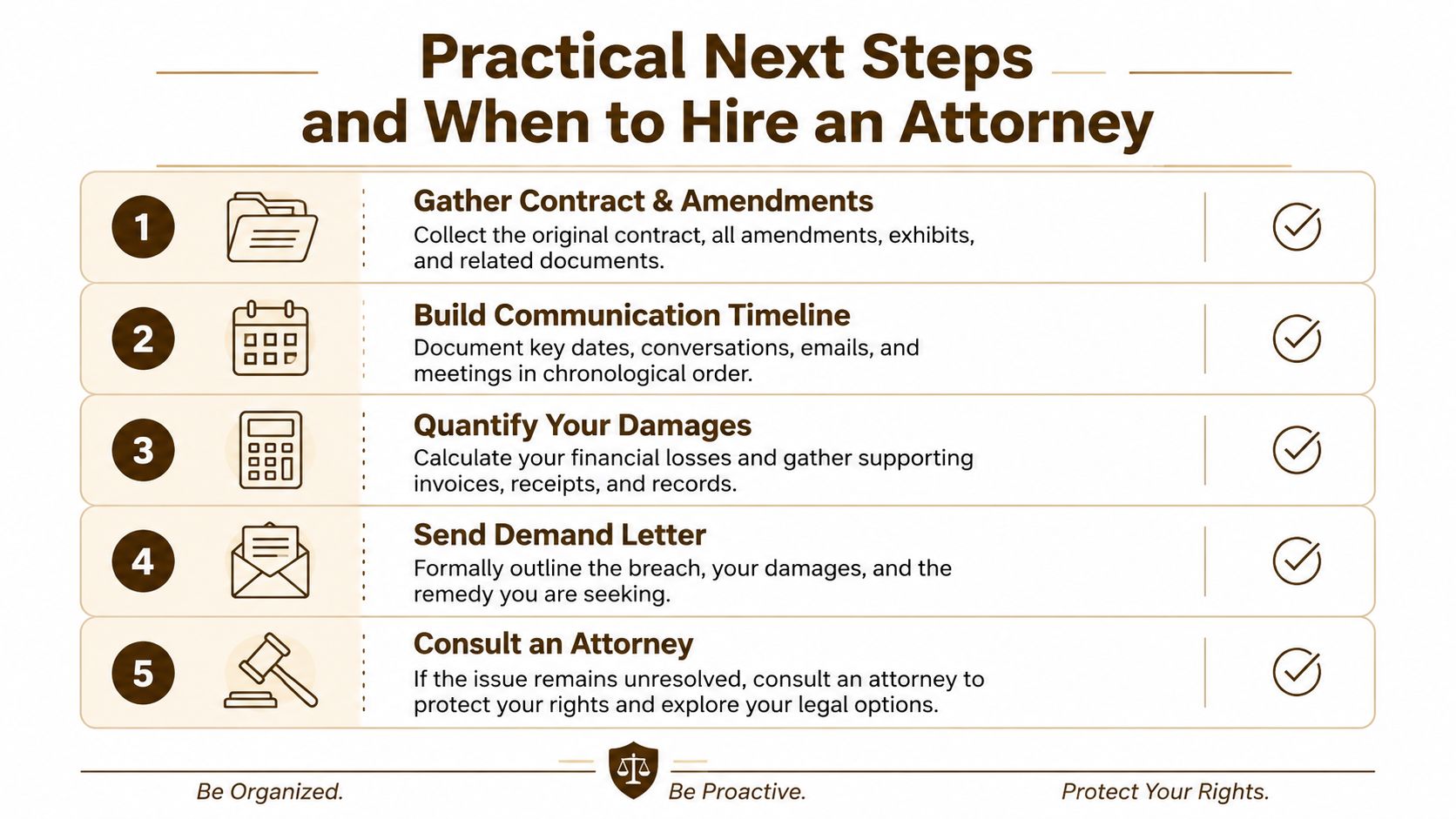
Practical Next Steps and When to Hire an Attorney
A property owner facing a possible breach should build the case before choosing the forum. Start with a focused file rather than forwarding every message to a lawyer without context.
Gather the complete agreement. Include exhibits, amendments, addenda, payment schedules, change orders, notices, arbitration provisions, attorney's-fee language, and governing-law clauses.
Create a dated chronology. List the promise, required performance, payments, missed deadlines, notices, explanations, attempted cures, and resulting loss. Link each event to a document.
Calculate actual damages. Separate unpaid amounts, replacement costs, repair expenses, storage or relocation costs, financing consequences, and other claimed losses. Remove duplicate or speculative categories. Causation is easier to defend when each amount has a receipt, invoice, estimate, or accounting record.
Review insurance and third-party remedies. A policy may address certain property damage or construction-related losses, although coverage depends on the policy and facts. Licensing or regulatory options may supplement, but won't automatically replace, a contract claim.
Send a precise demand. Identify the contractual term, explain the breach, state the amount or performance requested, comply with notice and cure provisions, and preserve the right to pursue available remedies.
Self-help may be reasonable for a straightforward dispute within California's small claims limit of $12,500, particularly when the evidence is simple and the requested remedy is money. Counsel becomes more valuable when the dispute involves real property rights, a substantial investment, competing experts, multiple parties, an arbitration clause, a difficult limitations question, or a need for specific performance or injunctive relief.
Review any fee-shifting clause before deciding that the claim is economically worthwhile. A lawyer can also evaluate whether hourly, limited-scope, contingency, or blended representation fits the dispute, depending on the claim and available recovery. During an initial consultation, bring the contract, chronology, damages file, and key communications so counsel can assess venue, deadlines, settlement options, and realistic remedies.
Tanner Law handles disagreements involving agreements and related real estate and civil disputes, including the practical questions of forum, evidence, deadlines, and recovery. Schedule a free consultation by visiting Tanner Law to discuss your California contract breach dispute and determine the next step before a filing deadline or contractual notice requirement creates avoidable risk.