Crummey Trust Notice Rules for California Families
You've just moved money into an irrevocable trust for your children or grandchildren, perhaps to pay life insurance premiums or build savings over time. The deposit cleared, so it's tempting to assume the gift is automatically tax free. For many California families, that assumption is where trouble starts, because a Crummey trust notice is the step that shows each beneficiary had a real chance to withdraw the money before it stayed in the trust.
Table of Contents
- What a Crummey Trust Notice Protects in 2026
- California Rules for Minors and Revocable Trusts
- What Each Notice Must Say and How to Send It
- Sample Notice Template and Final Checklist
- Common Notice Failures and How to Fix Them
- Decide Whether Counsel Should Review the File
What a Crummey Trust Notice Protects in 2026
Say two parents in Orange County add cash to an irrevocable life insurance trust for their adult daughter. They intend the trustee to keep every dollar in the trust and pay the policy premium. Before they can safely treat the gift as covered by the annual exclusion, the trustee has to tell the daughter, in writing, that the contribution arrived and that she may withdraw a stated amount for a limited time.
That letter is a Crummey trust notice. The temporary right it describes is called a Crummey power. In plain terms, the beneficiary must be able to take the money now, even if everyone hopes she won't. Tax law calls that a present interest. A right you can use only someday is a future interest, and the annual exclusion generally doesn't cover future interests.
Why a Notice Creates a Present Interest
The idea comes from Crummey v. Commissioner, 397 F.2d 82 (9th Cir. 1968), which recognized that a legally enforceable, temporary withdrawal right can make a trust contribution a present interest. The annual exclusion rule itself appears in 26 U.S.C. section 2503(b). The case didn't create one official IRS form or one nationwide deadline. It asked whether the withdrawal right was real and available under the trust terms.
That distinction matters in practice. A trustee can't protect the exclusion with a label alone. The trust must grant the power, the beneficiary must learn about it in time to use it, and the file must show what happened.
The 2026 Dollar Limits
For 2026, the IRS annual exclusion guidance sets the federal annual gift tax exclusion at $19,000 for gifts to each individual recipient, separate from the donor's lifetime basic exclusion amount. Two parents who each make a qualifying gift for one child can reach $38,000 for that child. California law doesn't create a separate California gift tax exclusion, so California families need federal tax compliance and California trust administration compliance at the same time.
Earlier amounts show why trustees can't reuse old numbers. The IRS gift tax FAQ table lists $16,000 in 2022 and $13,000 in 2011 and 2012, with $19,000 per recipient for both 2025 and 2026.
2026 annual exclusion capacity for Crummey gifts
| Scenario | Donors | Recipients | Exclusion capacity |
|---|---|---|---|
| One donor and one beneficiary in 2026 | 1 | 1 | $19,000 |
| Two parents and one child in 2026 | 2 | 1 | $38,000 |
| One donor and three beneficiaries in 2026 | 1 | 3 | $57,000 |
| Two donors and two recipients in 2026 | 2 | 2 | $76,000 |
| One donor and one recipient in 2022 | 1 | 1 | $16,000 |
| One donor and one recipient in 2011-2012 | 1 | 1 | $13,000 |
Treat those totals as ceilings, not guarantees. They work only if the trust grants effective withdrawal rights, the contribution is allocated correctly among beneficiaries, and the trustee administers the notice process consistently. Amounts above the annual exclusion may require Form 709 reporting and may use part of the donor's lifetime exemption.
The IRS estate and gift tax update notes the 2026 federal basic exclusion amount is $15 million, but that larger lifetime amount doesn't replace annual gift documentation. A family can have plenty of lifetime exemption left and still create an avoidable reporting problem by skipping notices. The next questions are who must receive the letter, what it must say, and how the trustee proves it was sent.
California Rules for Minors and Revocable Trusts
A notice only works if it reaches a person who can legally act on it. An adult beneficiary with capacity can read the letter and decide whether to withdraw. A young child can't do that, and mailing a withdrawal offer only to the child doesn't create a meaningful opportunity to use it.
For a minor or a beneficiary who lacks capacity, send the notice to a parent, guardian, or other legally authorized representative. Keep proof of that person's authority in the trust file, such as letters of guardianship, a court order, or the trust clause naming who may act for the beneficiary. The delivery receipt should match that representative, not just the household address.
The visual below reflects the practical point. A parent who receives and reviews the letter is the person who can exercise or decline the right for the child.

When California Sends Notice to the Settlor Instead
California adds a routing rule that many families miss. Under California Probate Code section 15802, while a trust is revocable and the person holding the power to revoke is competent, notice otherwise directed to a beneficiary is given to that person instead. In plain words, if Mom created the trust and can still revoke it, California law may direct the notice to Mom rather than to the eventual beneficiaries.
Most Crummey plans are irrevocable, meaning the settlor, the person who created the trust, can't take the trust back. Section 15802 usually won't reroute notices for a completed irrevocable Crummey trust. Families in Orange County and Los Angeles still run into the issue when they add gifts to a trust that remains revocable, is only partly funded, or mixes revocable and irrevocable shares.
Before copying every beneficiary, confirm whether the trust is still revocable and who holds the power to revoke it.
Edge Cases for California Families
Several common situations need extra care before the envelope goes out:
- Gift splitting between spouses: Both spouses may be treated as donors for part of one gift, so the notice and the tax return must tell the same story.
- Separate property gifts: One spouse's separate property contribution shouldn't be described as a joint gift unless gift splitting is elected and reported.
- Two donors, one trust: The trustee must track which donor funded which share, because the exclusion is calculated per donor and per recipient.
- Late December contributions: A contribution deposited near year end still needs its own notice and withdrawal window, and the trustee can't assume a January letter fixes the timing.
California trust law governs the trustee's duties to beneficiaries even though the annual exclusion is federal. A trustee who follows the tax idea but ignores California notice duties, or follows California routing but never creates a real withdrawal opportunity, has only solved half the problem.
Use one practical test for every contribution. Name the human who could have withdrawn the money during the window, then find the document that proves that person was told. If the trustee can't name that person and produce that proof, the notice plan isn't finished.
What Each Notice Must Say and How to Send It
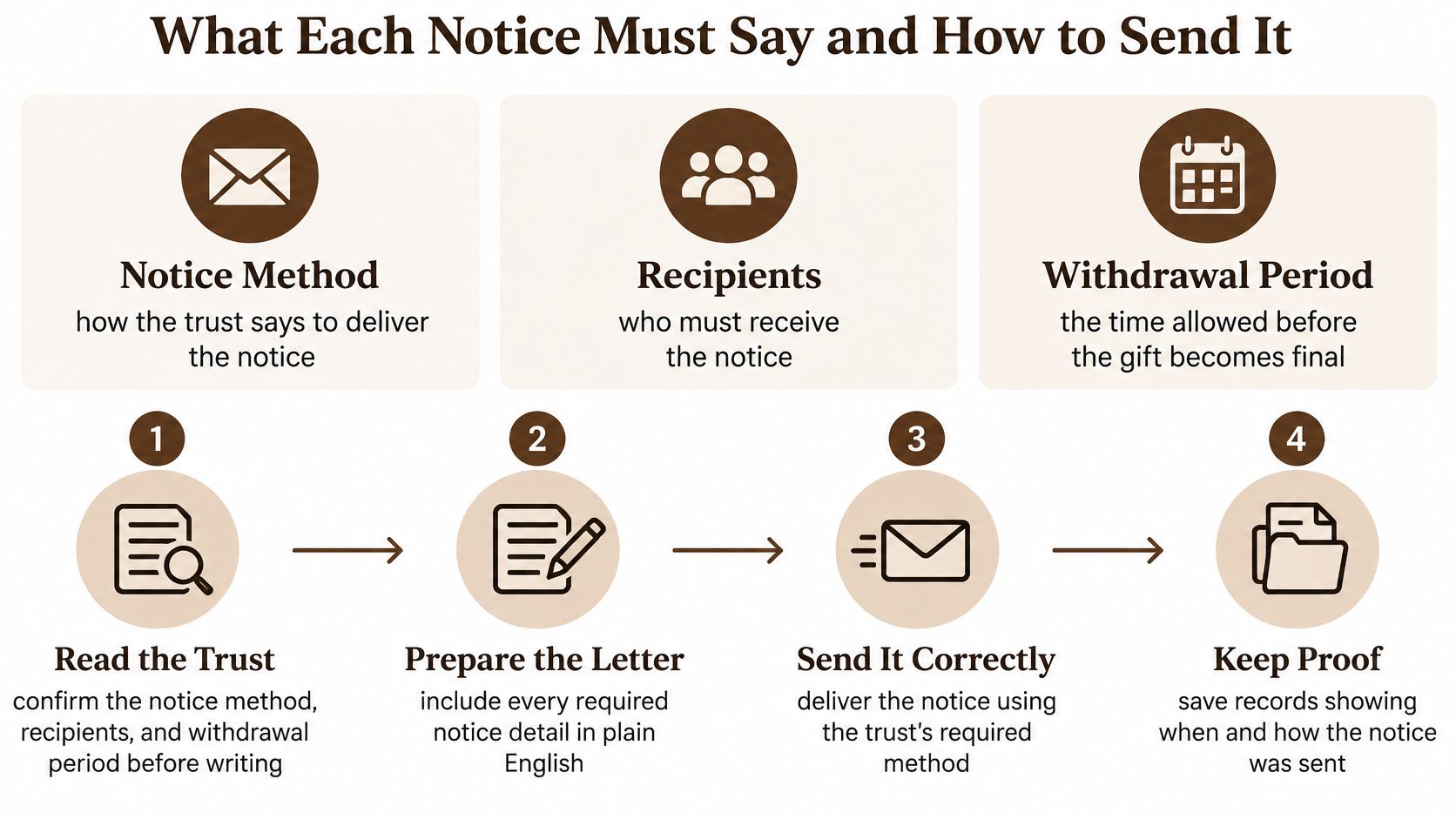
A strong notice starts as a lookup exercise, not a writing exercise. The trustee first finds three answers in the trust instrument, then matches the deposit to each beneficiary, then writes a short letter using those exact terms. The checklist image below summarizes the fields and the four part workflow.
Field by Field Contents
Proskauer guidance on Crummey administration treats the notice as a transaction specific legal control, not a generic annual letter, and says each transfer should be reconciled to a beneficiary schedule with a deadline that matches the trust's lapse provision. One drafting example in that guidance gives beneficiaries 30 days and limits annual withdrawals to the applicable exclusion amount. Your trust may use a different period, and that trust period controls.
What each Crummey trust notice must identify
| Notice item | Plain example | Where it comes from |
|---|---|---|
| Trust identity | The Garcia Family Irrevocable Trust dated June 1, 2020 | Trust instrument |
| Contribution | $19,000 received March 15, 2026 | Bank or brokerage record |
| Withdrawal amount | This beneficiary may withdraw $19,000 | Beneficiary schedule and exclusion cap |
| Window | Open March 16, 2026 through April 15, 2026 if the trust sets 30 days | Trust lapse clause |
| How to exercise | Written request delivered to the trustee before the end date | Trust instrument |
| Outcome if unused | The right lapses and the property stays in trust | Trust lapse clause |
Don't copy the sample dates into a real letter without checking the clause. Lapse means the withdrawal right expires. If the trust says the right lapses on a different date, or after a different number of days, the notice must use that date.
The Seven Step Workflow
Read the trust first. Confirm the required notice method, the recipients, and the withdrawal period before any letter is drafted. These answers prevent the trustee from using a polished template that contradicts the document the trustee is legally required to follow.
Match the deposit to a beneficiary schedule. Start with the bank or brokerage credit, for example $19,000 received March 15, 2026, then compute each person's withdrawal amount. Cap the amount at the annual exclusion unless the trust grants a larger present interest right that the donor is prepared to report.
Draft one notice per contribution. Name the trust, the contribution date, the total contribution, that beneficiary's dollar amount, the first and last day of the window, and how to request payment in writing to the trustee. One letter for several deposits makes it hard to prove which gift created which withdrawal opportunity.
Send it promptly by the required method. Use certified mail, a courier receipt, personal delivery with a receipt, or email with read confirmation only where the trust allows that method. Prompt delivery matters because a beneficiary needs a real chance to act before the right expires.
Ask for a dated acknowledgment. A signed acknowledgment that says "I received this notice" is useful evidence. A missing signature doesn't by itself prove the right never existed, so keep the delivery record even when a beneficiary doesn't return the form.
Calendar the lapse date and record the outcome. Note whether the beneficiary withdrew the money, waived the right in writing, or let it lapse. The trustee shouldn't spend or invest the contribution as if the outcome were final before the window closes, unless the trust and counsel clearly allow it.
File the complete packet before tax reporting. Keep the notice, contribution record, address used, delivery proof, acknowledgment, and any response in the trust file. Run a 100% contribution to notice reconciliation so every deposit has a matching notice before anyone prepares a gift tax return.
Legal commentary on notice for Crummey powers explains that written notice is the prudent control because the IRS position is that an uninformed beneficiary may hold a future interest rather than a present interest. Oral notice can sometimes show awareness, but a dated letter and delivery record create a much clearer audit and fiduciary duty paper trail. Fiduciary duty means the trustee's legal obligation to act loyally and carefully for the beneficiaries.
There's another reason to follow the instrument exactly. Even if a different delivery method might satisfy tax law, deviating from the trust's prescribed procedure can expose the trustee to a claim that the trustee breached California administrative duties. Tax compliance and trustee compliance aren't interchangeable.
The short video below gives another walkthrough of the notice idea for trustees who want to hear the sequence before they build their own checklist.
A Worked Example
Say a father contributes $38,000 to an irrevocable trust for two adult children, and the trust gives each child a withdrawal right over half of each contribution. The trustee doesn't send one family announcement saying "$38,000 arrived." Each child receives a separate notice stating that child's $19,000 withdrawal amount, the exact last day to request it, and the written request procedure.
If one child moved from Los Angeles to San Diego and the trustee used the old Los Angeles address, the file already has a weakness. The trustee should verify addresses before sending, not after a letter comes back undelivered. Returned mail should stay in the file too, because it shows what the trustee knew and when corrective action began.
File rule: If the deposit doesn't have a notice, proof of delivery, and a recorded outcome, the contribution isn't fully administered yet.
Keep the language plain. A beneficiary shouldn't need a lawyer to understand three basic points, money arrived, you may withdraw this amount, and you must ask in writing by this date. Precision helps the beneficiary first. It also helps the trustee years later if the IRS or a family member asks what opportunity was offered.
Sample Notice Template and Final Checklist
Use the template as a fill-in draft, then conform every bracketed field to your trust. Replace [Trust name], [contribution date], [beneficiary name], [donor name], [total amount], [beneficiary amount], [section of trust], and [last day of window] with accurate information from the deposit and the lapse clause.
Fill in Sample Notice
Dear [Beneficiary], On [contribution date], [Donor] contributed $[total amount] to the [Trust name]. Under Section [number] of the trust, you have the right to withdraw up to $[beneficiary amount] of this contribution. You may exercise this right by delivering a written request to the trustee on or before [last day of window]. If no request is received by that date, the right will lapse and the amount will remain in the trust. Please sign and return the enclosed acknowledgment, which confirms receipt only.
That final sentence is important. Signing an acknowledgment shouldn't be worded as a waiver of the withdrawal right unless the beneficiary intends to waive it and the trust permits that waiver. Receipt and waiver are different legal acts.
Witness and Acknowledgment Questions
Federal tax law doesn't require a witness for an ordinary Crummey trust notice. A signed acknowledgment is evidence of receipt, not a condition that makes the underlying withdrawal right valid. Still, check the trust itself. If the instrument requires a witness, notarization, or a particular signature form, follow it.
Before the notice leaves the trustee's hands, run this final checklist:
- Trust clause confirmed: The recipients, method, and withdrawal period match the instrument.
- Amount reconciled: The beneficiary's amount ties directly to the deposit record and schedule.
- Deadline checked: The last day matches the lapse clause, not a generic calendar entry.
- Address verified: The mailing or email address was confirmed within the past year.
- Delivery proof filed: The receipt, tracking record, or read confirmation is saved with the notice.
- Lapse date calendared: The trustee has a reminder to record withdrawal, waiver, or lapse.
Don't send a letter with bracketed fields still visible. Don't leave the dollar amount as "your share" when the schedule can state a number. Small drafting shortcuts create the exact ambiguity the notice is supposed to eliminate.
Common Notice Failures and How to Fix Them
The most tempting shortcut feels efficient. The trustee saves every 2026 gift for one December letter, lists the year's total contributions, and asks everyone to sign before the holidays. If the trust requires notice after each contribution, that batch letter can leave the earlier gifts without a timely, real withdrawal window.
Commentary questioning rigid Crummey notice assumptions makes a useful distinction. The core tax issue is whether the beneficiary received a legally enforceable, presently exercisable withdrawal right, not whether the trustee used a particular template or whether the beneficiary withdrew money. The same commentary notes that Rev. Rul. 83-108 is commonly discussed as supporting notice practices that give beneficiaries meaningful knowledge of the power.
That nuance cuts both ways. Perfect letter mechanics don't automatically guarantee the exclusion if the underlying right is blocked, illusory, or inconsistent with the trust. A sloppy file can also be hard to defend even when the right existed on paper, because the trustee may struggle to prove awareness and timing during an audit or family dispute.
Problems and File Repairs
Crummey notice problems and file repairs
| Problem | Why it matters | Repair |
|---|---|---|
| Notice only at year-end | Earlier gifts may lack a real window | Notice after each contribution |
| Late or missed notice | Beneficiary may hold a future interest | Counsel before Form 709; no backdating |
| Expired address | No proof of awareness | Confirm addresses before each gift |
| Dollar amount omitted | Right is unclear | State the reconciled withdrawal amount |
| Deadline mismatches the trust | Window may be invalid | Copy the lapse clause |
| Sent only to a minor | Child may be unable to act | Notice the parent or guardian |
| Ignored the trust's delivery method | Possible fiduciary breach | Follow the instrument |
| No delivery proof | Audit or dispute is hard to defend | Keep receipt and any acknowledgment |
Read the table as a diagnosis tool, not as a menu of automatic outcomes. A late notice doesn't always produce the same tax result, and a missing acknowledgment isn't the same as proof that no notice was sent. The facts matter, including the trust language, the beneficiary's actual knowledge, the remaining time in the window, and what records survive.
Weak proof is the problem. A beneficiary's ordinary decision to leave the money in the trust isn't a failure.
What Not to Do After a Mistake
Don't invent a backdated acknowledgment. Don't ask a beneficiary to sign a receipt dated months earlier if that's not when the letter arrived. A false paper trail can turn a fixable administration issue into a credibility problem in a tax controversy or California trust litigation.
Send a corrective notice only if the trust language and counsel say the window is still open or can still be honored. If the lapse date has already passed, stop and get advice before filing a return or asking beneficiaries to sign anything. The right repair may involve tax reporting, a trustee accounting, or a written explanation in the file, but it shouldn't involve rewriting history.
Prevention is simpler than repair. Update beneficiary addresses annually and before each planned gift. Reconcile every deposit before Form 709 is prepared. Keep exercised, waived, and lapsed outcomes, because a file that only preserves the "normal" years looks incomplete when someone later reconstructs the trust's history.
There's no reliable published success rate that tells a trustee when a file is good enough. Compliance is assessed on the facts. For California families, that means the same mistake can raise two questions at once, whether the gift qualified for the federal exclusion and whether the trustee met California duties to inform and administer the trust according to its terms.
Decide Whether Counsel Should Review the File
A routine file can stay on the trustee's checklist. One adult beneficiary, one on-time notice, a trust clause that clearly grants the withdrawal right, and a mailing receipt add up to a file the trustee can manage without fresh legal review for every deposit. The trustee should still keep the reconciliation current and ask for help if the trust, the beneficiary group, or the gift pattern changes.
A review at that point works like a title search on the notice file. It looks for the defect that could change the tax result or the trustee's defense, not for a gold star on routine paperwork.
Bring in a California estate planning or probate lawyer when a gift exceeds the annual exclusion for a donor, spouses want to split gifts, or a beneficiary is a minor or incapacitated. Do the same if the trust may still be revocable and the settlor's notice status is unclear, a notice was late or sent to an old address, or someone is about to sign Form 709. A beneficiary's demand for an accounting, or a claim that the trustee never offered the withdrawal right, also calls for counsel because the dispute can involve both federal tax treatment and California trust administration in Orange County or Los Angeles courts.
Tanner Law, the Santa Ana practice of William T. Tanner, handles probate matters alongside its property work and offers a free initial consultation by phone or email. The office is at 1913 E. 17th Street, Suite 212, Santa Ana, CA 92705. Before the meeting, gather the trust, the 2026 contribution records, copies of notices, delivery proof, and any beneficiary responses so the review can focus on gaps rather than guesswork.
Don't wait until tax filing forces a rushed answer. A short review while the withdrawal window or reporting choices are still open gives you more lawful options than a reconstruction after the lapse date has passed.
If your family has funded a California trust and you are unsure whether a missing, late, or unsigned Crummey trust notice will hold up, request a free consultation to have the trust clause, contribution records, and delivery proof reviewed before you file. Ask for that free initial consultation by phone or email to get clear next steps for your Orange County or Los Angeles probate or property matter.