Attorney for Inheritance in California: When You Need One
What if the size of the estate isn't what decides whether you need help at all? Most families start with a dollar figure, but in California the triggers are usually different. A modest estate with a house, an unpaid creditor, or two siblings who can't agree can need an attorney for inheritance matters more urgently than a larger estate with clean accounts and one heir.
That's the gap in conventional thinking. People ask how much the estate is worth, when they should be asking what's in it, who is owed money, and whether anyone disputes how it should be divided. Each of those answers ties to a concrete deadline, a court filing, or a cost that can reduce what heirs eventually receive.
Table of Contents
- Who Needs an Inheritance Attorney and Who Does Not
- What an Inheritance Attorney Actually Does
- Probate Steps and the Creditor Deadlines That Control Them
- What Probate Costs and How Long It Takes
- Property Disputes, Partition and Family Conflicts
- Choose the Right Attorney and Schedule a Consultation
Who Needs an Inheritance Attorney and Who Does Not
Estate size alone doesn't settle this. The asset mix, unresolved debts, and family disagreement matter more, because those are the factors that create court filings, title problems, and personal risk for the person in charge.
| Situation | Attorney Usually Needed? | Main Reason |
|---|---|---|
| Small estate of personal property under $184,500 (death on or after April 1, 2022) | Often not required | Affidavit procedure may transfer qualifying assets without full probate |
| Estate with real estate and no disputes | Recommended | Deeds, title and sale paperwork must be exact |
| Full probate of a larger estate | Yes | Court filings, notices and fiduciary duties |
| Will contest or challenge to capacity or undue influence | Yes | Litigation with strict deadlines and evidence requirements |
| Quiet title claim on inherited property | Yes | Clearing ownership defects through the court |
| Partition of co-owned inherited property | Yes | Court-ordered division or sale among co-owners |
| Unpaid creditor claim against the estate | Yes | Notice and claim deadlines decide what gets paid |
| Spousal or domestic partner property transfer | Often recommended | Court petition and notice requirements apply |
The Small Estate Route in California
Under California Probate Code section 13100, certain estates may avoid full probate through an affidavit or declaration for collection or transfer of personal property, and the California Courts small estate guidance identifies the applicable limit as $184,500 for a person who died on or after April 1, 2022. It was $166,250 for deaths before that date. The procedure generally concerns qualifying personal property, and the successor must satisfy statutory conditions, such as waiting the required period and providing information about the decedent, the property, and entitlement to receive it.
Don't assume every asset qualifies. Eligibility depends on the type of asset and the estate's gross value, so a bank account might transfer by affidavit while another asset can't. For families in Orange County and Los Angeles, a quick review of bank accounts, securities, and vehicles often determines whether you can reduce court involvement and still comply with California law.
Practical rule: The affidavit route works best when the estate is small, contains only qualifying personal property, and nobody disagrees about who should receive it.
When the Answer Changes
Real estate changes the answer even when everyone agrees. A house can't be sold or refinanced until title is clear, and a deed error made early can surface months later when a buyer or title company finds it. Debts change the answer too, because distributing property before valid claims are resolved can force heirs to give assets back.
Conflict changes it most. A will contest, a quiet title claim, or a partition action isn't something you manage with forms alone. Those cases involve court deadlines and evidence, and missing a deadline can end a claim before a judge ever hears the merits.
Ask yourself three questions before anyone signs or transfers anything.
- Is there real estate in the estate? If yes, title and deed work needs to be exact.
- Does anyone dispute the will or the division? If yes, you're in litigation territory, not routine paperwork.
- Are there debts or creditors that haven't been resolved? If yes, distribution timing becomes a legal risk.
A yes to any one of them means speaking with an attorney before property moves.
What an Inheritance Attorney Actually Does
Think of the attorney as the navigator and the executor as the driver. The navigator knows the court's route, its filing windows, and where cases get stuck. The driver, called the personal representative in California, still has to follow that route and answer for the estate's money and property.

The Day to Day Work
An attorney for inheritance matters prepares petitions, notices, and accountings, and guides the personal representative through each court requirement in order. That includes identifying and valuing assets, so nothing gets left out of the inventory, and tracking down accounts or property the family didn't know about. It also includes handling creditor claims, which means deciding what the estate owes before anyone gets paid.
The attorney coordinates tax filings with the closing of the estate, so final returns don't hold up distribution. During administration, counsel also helps protect property, for example by making sure insurance stays in place on a vacant house or that estate funds sit in a separate account rather than someone's personal account.
- Court filings: Petitions, notices, inventories, and accountings prepared and filed on schedule.
- Asset work: Locating, valuing, and documenting what the decedent owned.
- Creditor handling: Giving proper notice and evaluating claims before payment.
- Distribution: Transferring property to beneficiaries once debts and taxes are resolved.
Who the Attorney Represents
In most probate matters, the attorney represents the personal representative, not each heir. That surprises families. If you're a beneficiary and your interests conflict with the executor's, for example you think the executor is undervaluing a house or delaying a sale, you may need your own counsel rather than relying on the estate's attorney.
There are also limits to what counsel can do. An attorney can't change the decedent's wishes, override court rules, or make a will valid if it wasn't executed correctly in the first place. What counsel can do is make sure the valid wishes that exist are carried out through the correct California procedure.
An estate attorney doesn't rewrite the plan. The job is making sure the plan that exists survives the court process intact.
A Common Orange County Scenario
Say a family in Orange County inherits a house, a bank account, and one sibling lives out of state. The attorney files the petition in the right court, gets the personal representative appointed, and inventories both the house and the account so the values are documented for the court. Notices go to creditors, the out of state sibling receives documents and signs remotely where allowed, and the house isn't listed for sale until the representative has legal authority to sell it.
Without that sequencing, families often do things in the wrong order. They clean out the house, promise proceeds to relatives, or split the bank account before debts are known. Counsel usually pays off in three areas, deadlines met, paperwork done accurately, and disputes reduced before they harden into litigation.
Probate Steps and the Creditor Deadlines That Control Them
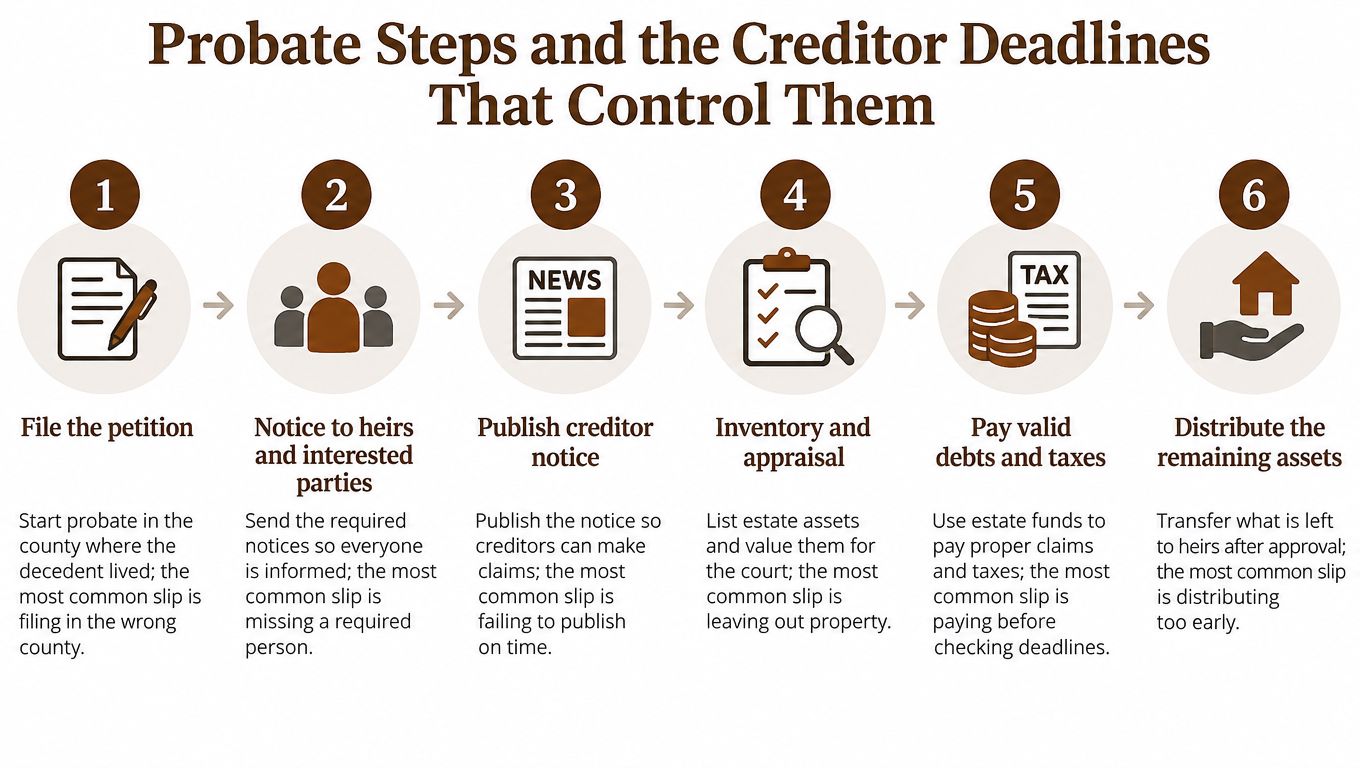
California probate follows a sequence, and creditor deadlines control when heirs can safely receive anything. Treat those deadlines as a distribution control mechanism, not a formality.
The Eight Steps
- File the petition in the county where the decedent lived. Orange County residents file with the Orange County Superior Court because venue decides which court hears the case. The common slip is filing where the property sits rather than where the decedent lived.
- Get appointed and receive letters. The court appoints the personal representative and issues letters, which are the legal authority to act on behalf of the estate. Without letters, banks and title companies won't work with you.
- Inventory and appraise assets, generally within four months of letters. The common slip is missing a bank account or vehicle that surfaces later and forces corrected filings.
- Notify creditors. Under Probate Code section 9100, the personal representative must provide notice to known or reasonably ascertainable creditors generally by the later of four months after letters issue or 30 days after learning of the creditor.
- Wait for creditor claims. A creditor's claim generally must be filed by the later of four months after letters or 60 days after the creditor receives notice. The common slip is paying beneficiaries before this window closes.
- Pay what's owed, including allowed debts, final income taxes, and administration expenses. Paying in the wrong order, or paying a claim that wasn't valid, creates problems at closing.
- Distribute to heirs only after the claim period and tax obligations are resolved. This is the hard cutoff, because assets may be needed to satisfy allowed claims before beneficiaries receive clear title.
- File the final accounting and petition for closing. The court reviews what came in, what went out, and what each heir receives.
If counsel fails to identify creditors, calendar deadlines, or properly serve documents, the estate may face delayed closing, disputed distributions, or personal exposure for the fiduciary. Keep a creditor matrix listing identity, notice date, four-month date, 60-day date, supporting documentation, and approval or rejection status. That single document prevents most deadline mistakes.
Late Claims and the Hard Cutoff
California allows narrow exceptions, and Probate Code section 9103 allows a court to permit a late claim when the personal representative failed to give proper and timely notice, provided the creditor petitions within 60 days after actual knowledge of estate administration. A separate exception may apply when the creditor lacked knowledge of the facts supporting the claim until shortly before the deadline, and the petition must then be filed within 60 days after learning both the claim-producing facts and the estate administration.
The creditor must show the defective notice or delayed discovery caused the miss. Relief is unavailable after the court orders final distribution, which makes distribution a hard procedural cutoff. Preserve proof of mailed notices, addresses used, delivery dates, returned mail, and creditor communications, because that record can determine whether an estate closes cleanly or reopens.
| Deadline or Rule | What the Rule Says | Who It Affects |
|---|---|---|
| Personal representative notice to creditors | Later of 4 months after letters issue or 30 days after learning of a creditor | Personal representative |
| Creditor claim filing | Later of 4 months after letters issue or 60 days after the creditor receives notice | Creditors |
| Late claim after defective notice (Prob. Code 9103) | Petition within 60 days after actual knowledge of the administration | Creditors |
| Late claim after delayed discovery | Petition within 60 days after learning the claim facts and the administration | Creditors |
| After final distribution | Late-claim relief is no longer available | Heirs and beneficiaries |
A simple estate with one account and no debts moves through these steps in a fairly straight line. Add real estate that must be sold or a dispute among heirs, and the same steps take longer because title, sale approval, and consent issues layer on top of the creditor timeline. Timing varies by court and asset mix, but the sequence doesn't.
What Probate Costs and How Long It Takes
California sets a statutory fee schedule for ordinary attorney services in probate, based on the value of the probate estate. Extraordinary work, such as litigation or a contested sale, is billed separately. The schedule below is a worked example so you can see the arithmetic rather than guess.
| Probate Estate Value | Statutory Fee (Ordinary Services) | How It Is Calculated |
|---|---|---|
| $500,000 | $13,000 | 4% of first $100,000 ($4,000) + 3% of next $100,000 ($3,000) + 2% of next $300,000 ($6,000) |
How the Fee Schedule Works
Under Probate Code section 10810, the schedule uses 4% on the first $100,000, 3% on the next $100,000, 2% on the next $800,000, and 1% on the next $9 million. For the $500,000 example, that's $4,000 plus $3,000 plus $6,000, for a total of $13,000 in ordinary attorney fees. The personal representative's compensation follows a similar schedule, so families should budget for both.
Treat the schedule as a reference point, not a guarantee of your total cost. Filing fees, appraisal costs, publication, and any extraordinary services sit on top of it. Ask for a written fee agreement and itemized billing so heirs can see exactly what the estate is paying for.
Budget honestly: If an estate includes a house that must be sold or a dispute that must be litigated, ordinary fees are the floor, not the ceiling.
How Long Probate Takes
Older California research gives a useful baseline, with a clear caveat about its age. A California Law Revision Commission study of probate administration reported that administrative expenses averaged approximately 6% of the probate estate and 4% of the gross estate, and that average probate proceedings lasted somewhat less than one and a half years, with larger estates taking substantially longer to close.
Current timing depends on the court, the quality of the filings, and whether real estate must be sold. A contested or property-heavy estate can add months, because each dispute or sale requires its own notices and hearings. Clean filings and early agreement among heirs are the two factors families control most.
- Filing quality: Incomplete petitions get continued hearings and lost weeks.
- Real estate sales: Listing, offers, and possible court confirmation extend the timeline.
- Disputes: A single contested issue can pause distribution for everyone.
A Short Tax Note
California has no separate state inheritance tax. At the federal level, the estate tax is charged on the estate itself rather than on what each heir receives, a distinction the IRS history of the federal estate tax traces to the modern tax that began in 1916 under the Revenue Act of 1916. For most estates, the practical tax work is final income tax filings, which your attorney coordinates with the closing so distribution isn't delayed.
Property Disputes, Partition and Family Conflicts
Inheritance disputes are often assumed to come from badly drafted documents. Often they don't. They come from expectation gaps that nobody addressed while the parent was alive, and the will becomes the place where those gaps collide.

The Three Contested Cases
A will contest challenges whether the document is valid, for example on grounds of capacity, undue influence, or fraud. These cases carry short filing deadlines and heavy evidence needs, including medical records and witness testimony. Waiting to see how things play out is usually a mistake, because the deadline doesn't wait.
A quiet title action asks a court to clear a defect in ownership, such as an unrecorded deed or unclear heirship. Until title is cleared, the property generally can't be sold or refinanced. A partition action lets co-owners ask a court to divide the property or order its sale when they can't agree, which is common when siblings inherit a house together and one wants to keep it while another wants cash.
The video below walks through how these property disputes typically develop in California probate.
Spousal Property Petitions
For a surviving spouse or domestic partner, California provides a petition process to confirm property passing to them. Alameda County Superior Court materials state that the petitioner uses Judicial Council form DE-221, interested persons generally must receive notice of the hearing at least 15 days before it occurs, and form DE-226, the Spousal Property Order, must be submitted to the clerk at least five days before the hearing.
The petition may often be resolved in a single hearing, but you still have to prove entitlement and characterize assets as community or separate property. Those form and notice figures come from Alameda County court materials, so confirm current forms and local rules with the Orange County or Los Angeles Superior Court before relying on them.
Why Expectations Matter
A 2025 Versta Research survey of U.S. parents aged 55 and older with at least $500,000 in investable assets, reported in the Versta Research inheritance study, found that 68% had not told their children what they would inherit. It also found that 43% of adult children expected to become caregivers, while only 12% of parents expected that outcome.
That mismatch is where litigation starts. A child who provided years of care expects recognition, a sibling expects equal shares, and neither expectation appears in any document. I would rather see a family have one uncomfortable conversation and keep clear records than litigate those assumptions later. Naming who gets what, and explaining unequal distributions while the parent can still explain them, prevents disputes no attorney can fully undo afterward.
Choose the Right Attorney and Schedule a Consultation
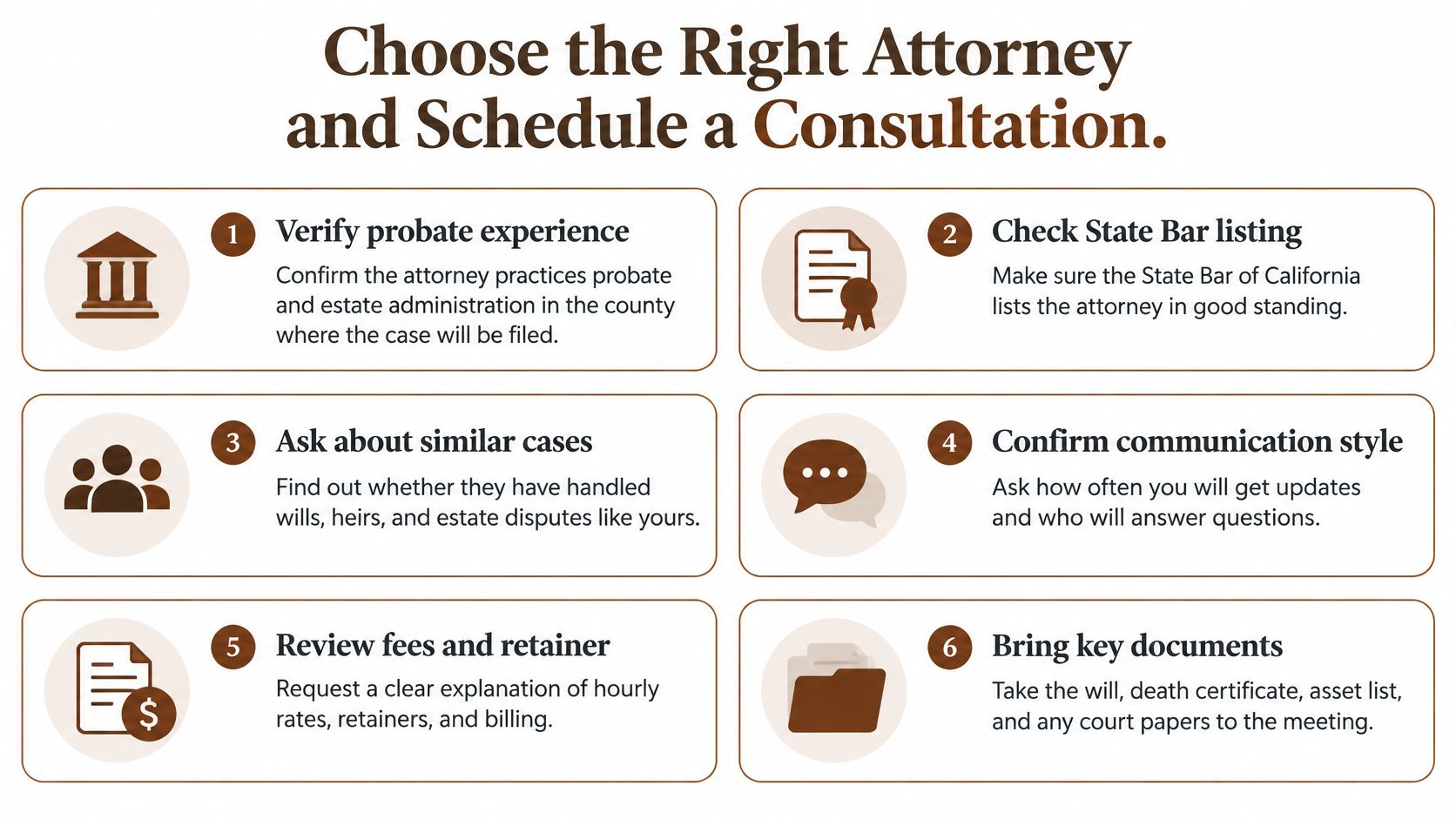
Verify a few things before you hire anyone. The right attorney for inheritance work in California should be able to answer each of these questions directly, without hedging.
What to Verify and Ask
- County experience: Does the attorney practice probate and estate administration in the county where your case will be filed?
- Specialist listing: Does the State Bar of California list them as a certified specialist in estate planning, trust and probate law?
- Fees in writing: How are they paid, and will you receive a written fee agreement with itemized billing?
- Who they represent: Will they represent the personal representative, or you as an individual heir?
- Deadline tracking: How do they track creditor and filing deadlines, and who maintains the calendar?
- Updates: How often will you hear from them, and who answers your calls between hearings?
Bring the will, the death certificate, a list of assets and debts, and any court papers you've received. An attorney who reviews those documents at the first meeting can tell you quickly whether you need full probate, a simplified procedure, or litigation counsel.
If an attorney can't explain who they represent and how they're paid in the first meeting, keep looking.
One Local Option
Tanner Law is one option for families in this area. The practice is led by an attorney and licensed real estate broker who handles probate alongside quiet title, partition, and real estate disputes, with experience in Orange County and Los Angeles courts. That combination matters when an inheritance includes a house that heirs can't agree on, because the probate case and the property dispute often run together.
Free initial consultations are available by phone or email. Whatever firm you choose, schedule that consultation before any property is distributed, sold, or transferred, so deadlines, creditors, and California procedure are checked first. Once assets move, fixing a mistake costs far more than preventing one.
If you're handling a California probate, an inherited property dispute, or a question about who should receive what, Tanner Law can review your documents, explain your deadlines, and outline your options in plain language. Schedule a free consultation before you sign, sell, or transfer anything by visiting Tanner Law today.