Chapter 7 vs 13 vs 11 Bankruptcy Explained for California
You're staring at bills, calling your mortgage servicer, and trying to figure out whether you can keep the house, protect the car, or just stop the collection calls long enough to breathe. In California, that choice is usually not “file or don't file.” It's which chapter fits your facts, your property, and your income.
Get this wrong, and you could face serious repercussions. Chapter 7, Chapter 13, and Chapter 11 are not interchangeable labels. They're different legal tools with different rules for property, debts, business operations, and how long the bankruptcy stays on your credit report. California families and small business owners need to look past the headline and focus on what each chapter does to a home in Orange County, an investment property in Los Angeles, or a small company that still has to keep operating tomorrow morning.
| Criterion | Chapter 7 | Chapter 13 | Chapter 11 |
|---|---|---|---|
| Main purpose | Liquidation | Repayment plan | Reorganization |
| Typical filer | Consumer with dischargeable unsecured debt | Individual with regular income who wants to keep property | Business or higher-debt filer needing restructuring |
| Property focus | Non-exempt property may be sold by a trustee | Catch up over time and keep assets | Reorganize while continuing to operate |
| Case length | Often 3 to 6 months | Usually 3 to 5 years | Varies with the reorganization |
| Credit report impact | Generally 10 years | Generally 7 years | Depends on the case and reporting rules |
| Common use in practice | Fast relief from unsecured debt | Saving a home or other property | Complex financial restructuring |
Table of Contents
- When Three Chapters of Bankruptcy Make Sense
- What Each Chapter Actually Does
- Side-by-Side Comparison of Chapter 7, 13, and 11
- How Each Chapter Handles Real Estate, Debts, and Co-Signers
- Costs, Fees, and Credit Impact You Should Plan For
- Which Chapter Fits Common California Situations
- Decision Factors and Next Steps for California Residents
When Three Chapters of Bankruptcy Make Sense
A couple in Santa Ana is behind on the mortgage, the credit cards are maxed out, and one spouse's income swings month to month. They're not asking whether bankruptcy is a moral failure. They're asking a better question, which chapter gives them the cleanest path to keep the house and stop the pressure.
That's the key decision point. In California, filing bankruptcy is sometimes the right move, but the chapter you choose determines whether you're liquidating, repaying over time, or reorganizing a more complicated financial mess.
Chapter 7 is the fast discharge route, but it can expose non-exempt property to a trustee. Chapter 13 is the payment-plan route, often used by people who have regular income and need time to catch up. Chapter 11 is the reorganization route, and courts treat it as the chapter for businesses, partnerships, and some individuals who need to restructure without shutting everything down, unlike Chapter 7's liquidation model or Chapter 13's consumer repayment framework, as explained by the U.S. courts in their bankruptcy guidance (U.S. Bankruptcy Court for the Northern District of California).
Practical rule: if the wrong chapter would force a sale, stretch payments far beyond what you can sustain, or create avoidable damage to your credit, don't guess.
For Orange County and Los Angeles residents, the decision often turns on three things, home equity, monthly income, and whether a business still needs to operate. A homeowner with meaningful equity may need one chapter, while a sole proprietor with multiple obligations may need another. A wage earner with steady income but too much unsecured debt may have a very different answer than a landlord or LLC owner holding several properties.
The right chapter is the one that fits your assets and your real-world cash flow. Not the one that sounds simplest on paper.
What Each Chapter Actually Does
Chapter 7 means liquidation, fast
Chapter 7 is the straightest path to wiping out qualifying unsecured debt. The court appoints a trustee, and non-exempt property can be sold to pay creditors, which is why this chapter is often called liquidation bankruptcy. For someone buried in credit cards or medical bills and not trying to save complicated assets, that speed is the point.
In plain English, Chapter 7 is for the person who needs a reset, not a long payment project. U.S. courts describe it that way, and the filing volume shows how common it is. In 2024, 310,631 Americans filed for Chapter 7, which was 60% of all personal bankruptcies, and Chapter 7 derogatory marks generally remain on credit reports for 10 years (personal bankruptcy statistics).
Chapter 13 means repay over time
Chapter 13 is for an individual with regular income who wants to keep property and pay through a court-approved plan. Instead of selling off assets right away, the debtor proposes a repayment structure and uses future income to catch up on arrears, often while holding onto a home or car.
The key difference is control. The filer keeps working, keeps making payments, and gets a framework that can save property that would be vulnerable in Chapter 7. Credit-report impact is generally 7 years from the filing date, shorter than Chapter 7, and the case usually runs 3 to 5 years (MoneyLion bankruptcy overview).
Chapter 11 means reorganize and keep operating
Chapter 11 is structurally different. It's the reorganization chapter, not a consumer liquidation chapter or a simple wage-earner repayment plan. Courts explain that Chapter 11 lets corporations, partnerships, and some individuals reorganize without liquidating all assets, and it's used when the financial situation is too complex for the other chapters to handle cleanly (U.S. Bankruptcy Court for the Northern District of California).
If Chapter 7 is a hard stop and Chapter 13 is a structured crawl, Chapter 11 is the operating-room approach. It's not the first answer for a family with credit-card debt. It's the right answer when the business or asset structure is too serious to tear down.
Side-by-Side Comparison of Chapter 7, 13, and 11
If you own a home in Orange County or Los Angeles, the question is not which chapter sounds simpler. It is which chapter protects the equity, income, and business value you have at risk. California exemptions drive that answer, especially the California homestead exemption and the wildcard exemption, because those protections can change whether Chapter 7 is safe or whether Chapter 13 or Chapter 11 is the better fit.
| Criterion | Chapter 7 | Chapter 13 | Chapter 11 |
|---|---|---|---|
| Who it fits | Individuals with dischargeable unsecured debt | Individuals with regular income who need a repayment plan | Businesses, partnerships, and some individuals with complex restructuring needs |
| Property treatment | Non-exempt assets can be sold by the trustee | Debtor usually keeps property while catching up | Debtor generally continues operating while reorganizing |
| Debt treatment | Qualifying unsecured debt can be discharged quickly | Debts are repaid through a plan over time | Debts are restructured through a court process |
| Case structure | Trustee-centered liquidation | Court-approved repayment plan | Court-supervised reorganization |
The real California divide is property protection
Chapter 7 works only if your exempt property covers what you own. If you have meaningful home equity, extra vehicle equity, or business assets that fall outside the exemption scheme, Chapter 7 can put those assets in play. That is why many California homeowners do not start with Chapter 7, even when their unsecured debt is severe.
Chapter 13 is the cleaner choice for many wage earners with property to protect. It lets you keep assets while using a repayment plan to deal with arrears and unsecured debt. For a homeowner in California, that often means the chapter lines up with the exemption picture instead of fighting it.
Chapter 11 is the restructuring chapter for cases that are too layered for the consumer chapters. It fits when the debtor has multiple properties, business operations, liens, or debt relationships that need a broader court-supervised reset. That is why Chapter 11 matters in California real estate and small-business cases, not just corporate filings.
Debt type changes the chapter choice
Chapter 7 is the fastest route for wiping out qualifying unsecured debt. Credit cards, medical bills, and similar debts usually drive that filing. If those debts are the main problem and the assets are protected, Chapter 7 is usually the straight answer.
Chapter 13 handles those same debts through the plan instead of erasing them at the front end. The debtor pays what the court-approved plan requires, and the rest of the unsecured balance may be treated later under the bankruptcy rules. That setup matters when the filer needs time, especially if catching up on secured debt is part of the goal.
Chapter 11 takes a different path. It restructures debt at a higher level of complexity and is not limited to the simple consumer fact pattern. If the debt load is tied to a business, rental properties, or a larger asset stack, Chapter 11 gives the court a framework that Chapter 7 and Chapter 13 often cannot match.
Co-signers change the risk
Families often suffer consequences if they guess. A filing can leave a co-signer exposed even when the debtor receives relief, and the outcome depends on the chapter and the type of debt involved.
Chapter 7 may clean up the filer's liability quickly, but it does not erase the co-signer's practical exposure on the outside debt. Chapter 13 can be better when the goal is to slow collection pressure and keep a repayment structure in place while sorting out joint obligations. Chapter 11 can address co-signed and business-linked obligations inside a broader restructuring, but it is not the chapter to use casually.
California homeowners should focus on equity first
The wrong chapter for a homeowner is usually the one that ignores equity. If the home has protected equity under California law, that can make Chapter 7 workable. If the equity picture is too tight, Chapter 13 often makes more sense because it gives the debtor a repayment structure while protecting the property.
For real estate investors, the analysis is even less forgiving. Multiple properties, liens, operating debt, and rental income can push the case into Chapter 11 territory because the debtor needs a restructuring tool, not just a discharge or a payment plan.
The cleanest way to compare them
Chapter 7 is the liquidation chapter for the debtor who needs relief now and does not have exposed assets worth saving. Chapter 13 is the repayment chapter for the person with steady income who needs to protect property and cure arrears. Chapter 11 is the restructuring chapter for a business owner, investor, or individual with a more complicated balance sheet.
The official courts describe Chapter 7, Chapter 11, Chapter 12, and Chapter 13 as different bankruptcy tracks with different purposes, and that is exactly how California residents should read them, by function, not by label (U.S. Bankruptcy Court FAQ).
How Each Chapter Handles Real Estate, Debts, and Co-Signers
California property questions drive a lot of bankruptcy decisions, especially in Orange County and Los Angeles where home equity can change the analysis fast. The California homestead exemption and the wildcard exemption matter because they can protect equity that would otherwise be vulnerable, but the way those protections work depends on the chapter and the rest of the asset picture.
Homes and mortgages
Chapter 7 is risky if there's non-exempt equity in the home. If the property is protected by exemptions, that's one thing. If not, the trustee may have a sale issue to examine. Chapter 13 is usually the more practical chapter for homeowners who are behind and want time to catch up while keeping the property.
Chapter 11 can also protect a home through reorganization, but that's usually reserved for more complex cases, not a standard consumer mortgage problem. For real estate investors, the analysis changes again because the debtor may be dealing with multiple properties, liens, and business debt at once.
Cars, credit cards, and co-signed debt
Chapter 7 generally discharges qualifying unsecured debts like credit cards and medical bills quickly, which is why many consumers use it as the fast reset. In Chapter 13, unsecured debts are handled through the plan, and the court focuses on what the debtor can pay over time. Chapter 11 restructures those obligations at a higher level of complexity.
Co-signers are where families get surprised. If a parent, spouse, or relative co-signed a debt, the filing can affect that person differently depending on the chapter and the creditor's rights. That issue is too important to guess on.
California homeowners also need to know that Chapter 13 can sometimes be used to rescue underwater property through cramdown or lien-stripping concepts, depending on the debt structure and the court's treatment of the liens. Those tools can change a bad mortgage situation into something workable, but they need a careful legal review.
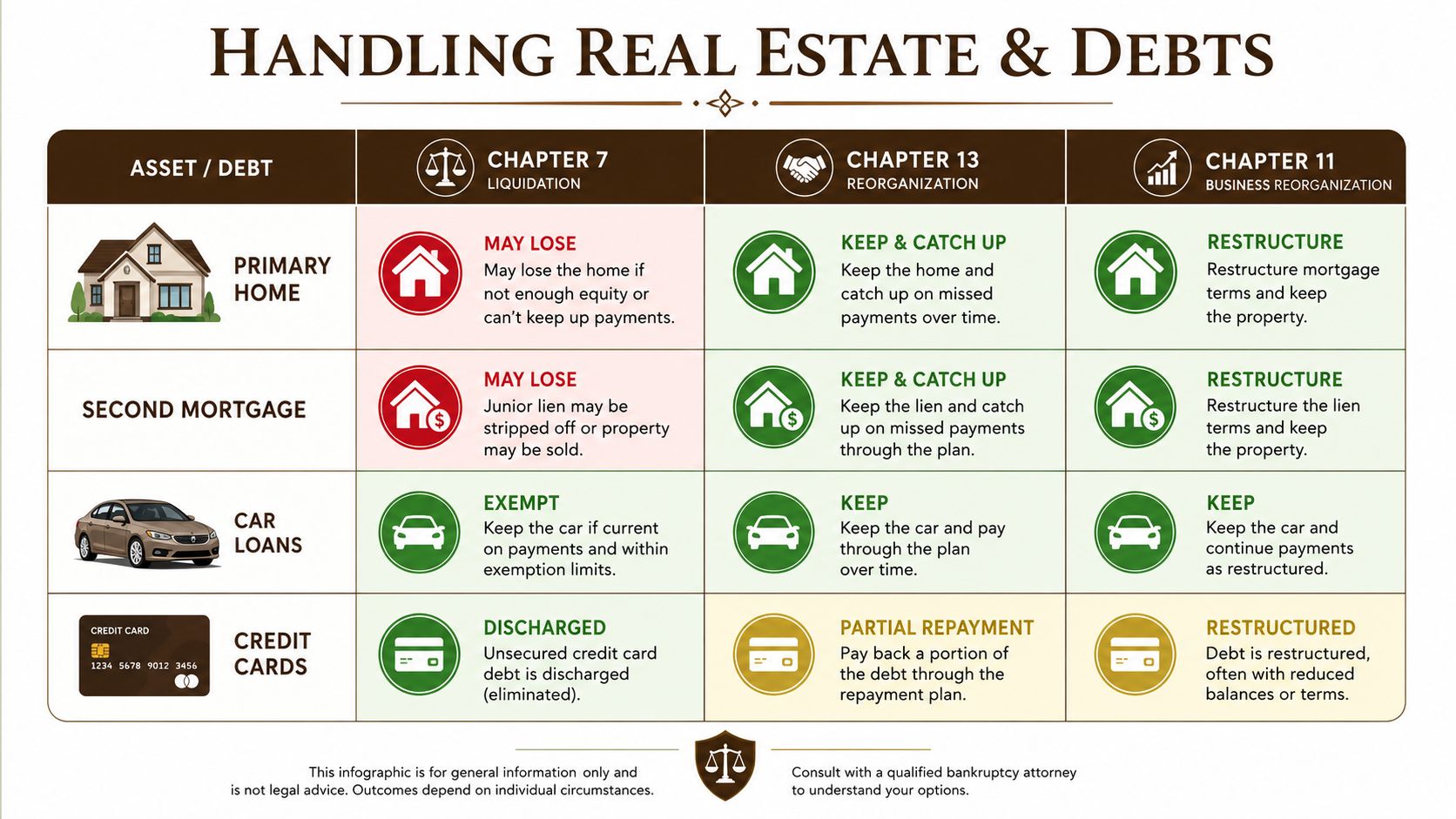
If the house matters, don't treat all chapters as equal. Chapter 13 is often the consumer homeowner's best shot at keeping property while fixing arrears. Chapter 7 is better when the core problem is unsecured debt and there's little protected equity at risk. Chapter 11 belongs in the conversation only when the debt stack and property mix are too complicated for the other two chapters.
Costs, Fees, and Credit Impact You Should Plan For
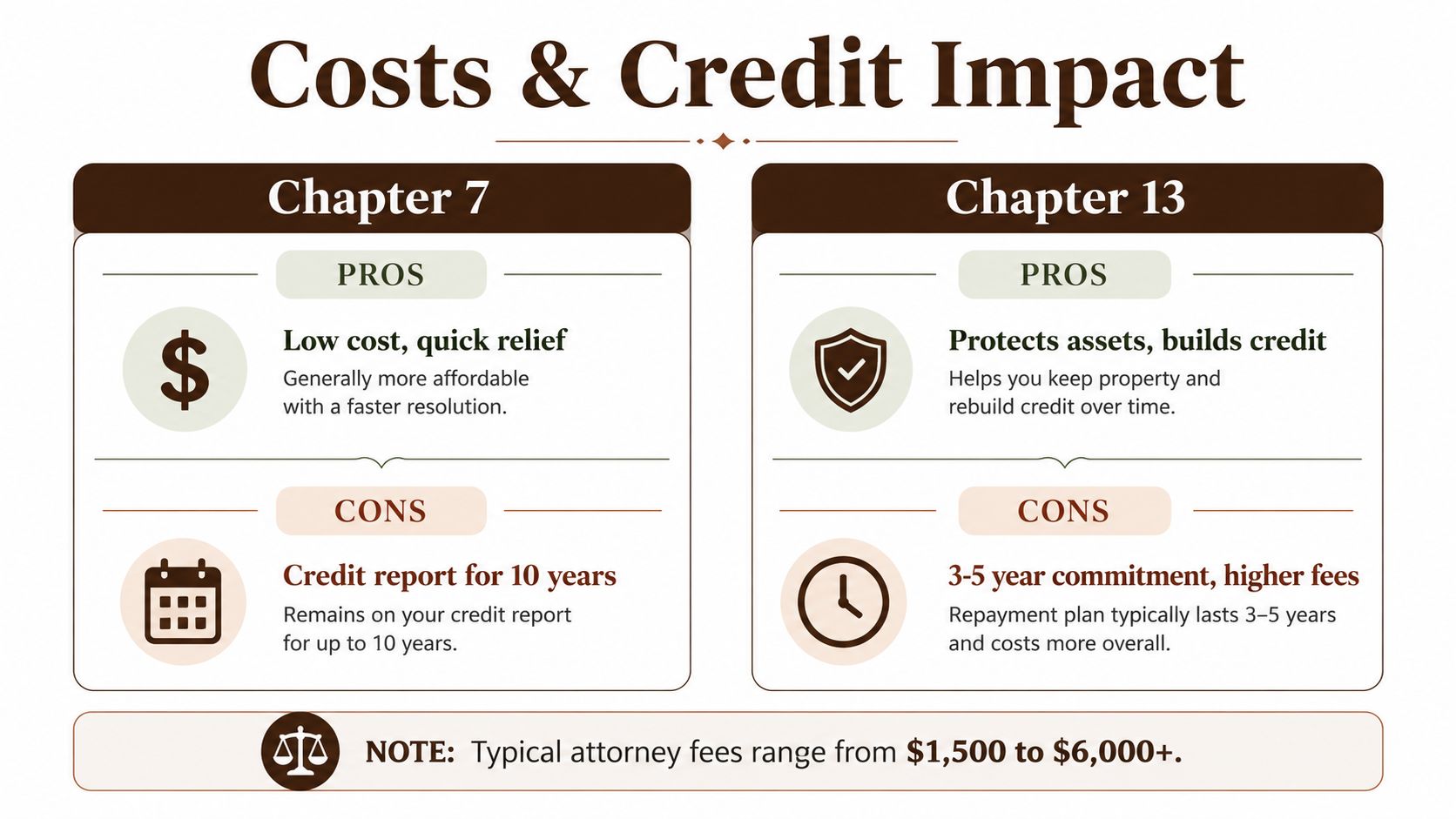
People ask about price and credit damage before they ask anything else, and that's smart. Bankruptcy is not free, and the cost includes attorney fees, court costs, required counseling, and the discipline needed to keep the case on track.
Attorney fees vary by chapter and by how much work the case requires. Chapter 7 is usually the least expensive because it is built for a faster, simpler filing. Chapter 13 costs more because the lawyer has to prepare a repayment plan, deal with plan objections, and stay involved while the case runs through the court. Chapter 11 usually costs the most, because the filing is heavier, the reporting is more demanding, and the reorganization work is more involved.
You also need to budget for the required credit counseling and debtor education courses. Those are not optional, and they are part of the price of getting a discharge. In California cases, there can also be extra expenses tied to valuations, mortgage arrears, plan modifications, or other issues that come up when a home or business asset is part of the filing.
Rule of thumb: if you cannot afford to prepare the case correctly, you cannot afford to file it casually.
The smart comparison is not cheap versus expensive. It is whether you are paying for the chapter that fixes the problem. A Chapter 7 case can be the better value when unsecured debt is the main burden and there is little protected property at stake. A Chapter 13 case can be worth the higher cost if keeping a house or car matters more than getting the lowest upfront fee. Chapter 11 only makes sense when the debt structure is too complex for the other chapters and the extra expense buys you a workable reorganization.
Credit rebuilding starts the day the case is filed, not when the case is over. Keep every post-filing payment current, especially rent, mortgage, car payments, and utilities. Use secured credit carefully, keep balances low, and do not open new accounts just because someone says you need “fresh credit.” You need clean payment history, stable income, and patience. That is what lenders look at after the filing, and that is what starts to move the file in your favor.
For California residents, the point is simple. Pay for the chapter that solves the problem you have, not the one that merely sounds manageable in the moment. Tanner Law handles Chapter 7 and Chapter 13 bankruptcy matters for clients who need help sorting out debt and property concerns, but the chapter decision still has to fit the facts.
Which Chapter Fits Common California Situations
A Los Angeles renter with credit cards, medical bills, and no meaningful property is a Chapter 7 case. A family in Orange County with home equity may be a different story. California exemptions decide a lot of these cases, especially the homestead and wildcard protections, so the same debt load can point to a different chapter depending on what the client owns.
When Chapter 7 is the right call
Choose Chapter 7 when unsecured debt is the main problem, there is little non-exempt property to lose, and speed matters more than a repayment plan. It fits the person who is buried under cards, medical bills, and collection calls, but does not have much exposed equity in a home, vehicle, or savings account.
A concrete example helps. A single debtor in Los Angeles with about $60,000 in credit card and medical debt, no business, and only a small checking balance is usually looking at Chapter 7, not a repayment case. If that same person owns a modest car and ordinary household goods, California exemptions often protect enough that Chapter 7 still makes sense. If the person has significant cash, a second property, or other non-exempt assets, Chapter 7 stops being the easy answer.
When Chapter 13 earns its keep
Use Chapter 13 when the client has regular income and needs time to catch up on mortgage arrears, car arrears, or tax debt while keeping property. That is the chapter for homeowners who are behind but can fund a plan, and for wage earners who need protection from foreclosure or repossession without giving up the asset.
In Orange County, this often comes up with a family that has equity protected by California's homestead exemption but is behind on the mortgage. If the home has around $250,000 of equity and the exemption can shelter that amount, Chapter 13 may let the family keep the house and pay arrears over time. If the equity is well beyond what the exemption covers, Chapter 13 can still work, but the plan has to account for that exposure instead of pretending it does not exist.
When Chapter 11 belongs on the table
Pick Chapter 11 when a business or a complicated investment structure needs reorganization instead of liquidation. Small business owners, real estate investors, and some high-debt individuals should be looking at Chapter 11 when Chapter 7 would wipe out value that should be preserved and Chapter 13 does not fit the size or mix of the debt.
A Los Angeles investor with several rental properties and equity spread across multiple parcels is the type of client who may land here. If the portfolio is too large for Chapter 13 and too messy for Chapter 7, Chapter 11 gives the breathing room to restructure while trying to keep the assets in play. That is a business-driven choice, not a default option.
A married couple needs coordinated advice before anyone files. Joint debts, separate paychecks, and co-signed obligations can turn a simple filing into a problem for the other spouse if the property picture is not mapped out first. California's community property rules and exemptions matter here, and they matter fast.
Here is the practical way to decide. If the case is mostly unsecured debt and the exposed property is limited, Chapter 7 is the cleanest path. If the debtor has steady income and needs to protect a home, car, or tax situation while catching up over time, Chapter 13 is the better tool. If the debt picture is tied to a business, several properties, or other moving parts that do not fit neatly anywhere else, Chapter 11 belongs in the conversation.
Decision Factors and Next Steps for California Residents
A California filing should start with paperwork, not guesswork. Before you meet with counsel, gather your last 6 months of pay stubs, a full list of property equity, the names of any co-signers, and a debt inventory that separates credit cards, medical bills, taxes, secured loans, and any business debt.
That package gives a lawyer the full picture fast. It also forces the hard questions to the front. If your income is steady, Chapter 13 may give you the room to catch up. If your income is irregular or too low, Chapter 7 may be the cleaner answer. If you own a business or hold meaningful real property equity, Chapter 11 may need to be on the table.
Do not wait to review deadlines. Collection timelines, foreclosure activity, garnishment efforts, and the statute of limitations on certain debts can change the pressure in a hurry, and California residents often lose options by sitting on the problem too long. If a lawsuit, trustee sale, wage levy, or tax issue is already in motion, the timing of the filing matters just as much as the chapter choice.
California exemption law matters here too. A serious review should cover the homestead exemption, the wildcard exemption, and any lien or mortgage issue tied to your home before a filing goes in. Orange County and Los Angeles cases often turn on equity, title, and how much protection the property has under state law.
You do not need to guess. Bring the numbers, the property information, and the co-signer details to a lawyer who handles California bankruptcy cases every day, then get a straight answer about Chapter 7, Chapter 13, Chapter 11, or a non-bankruptcy fix. The right filing is the one that fits your assets, your income, and the deadlines already hanging over you.
[plain paragraph] A CTA for Tanner Law. If you're in Orange County or Los Angeles and trying to decide between Chapter 7, Chapter 13, and Chapter 11 under California law, schedule a free consultation with Tanner Law at (714) 760-4088, email william@tannerlaw.org, or visit 1913 E. 17th Street, Suite 212, Santa Ana, CA 92705.