Can a Trust Be Contested? Grounds Explained
Yes, a trust can be contested in California, but you generally have only 120 days after receiving formal notice to file a challenge, and success depends on proving specific legal grounds like undue influence or lack of capacity. The deadline may begin with service of statutory notice, not the day you personally discover suspected wrongdoing.
You may be sitting at a kitchen table in Orange County with a trust document that changes everything you thought you knew about your family's estate. A sibling may have received the house, a caregiver may have influenced a parent, or a late amendment may have appeared when your loved one was already confused. The immediate reaction is understandable: Can a trust be contested?
California law does allow a trust contest, but dissatisfaction with the result isn't enough. A viable case usually requires proof that the trust was created or changed through a legally recognized defect, and the procedural deadline can be just as important as the underlying facts.
Table of Contents
- Understanding When a Trust Can Be Challenged
- Legal Grounds for Contesting a Trust in California
- California Deadlines and Who Has Standing to Challenge
- Evidence That Wins Trust Contests and Defenses You Will Face
- What Happens After Filing a Trust Contest
- When to Consult an Orange County Trust Litigation Attorney
Understanding When a Trust Can Be Challenged
Suppose your parent dies, and the trustee sends you a copy of a revocable trust. You expected the estate to be divided among the children, but the document leaves nearly everything to one sibling. You also remember that a caregiver had become heavily involved in your parent's finances and appointments during the final period of illness.
That situation raises legitimate questions, but it doesn't automatically establish a contest. California trust litigation focuses on whether the trust reflects the settlor's valid, informed decision. A settlor is the person who created the trust. The court may examine that person's mental capacity, the circumstances surrounding the document, and whether required formalities were followed.

A trust can be challenged on the same core grounds as a will, including lack of capacity, undue influence, fraud, forgery, mistake, and failure to follow required formalities, as explained in this California trust contest overview. For a revocable trust in California, the modern contest window is typically the earlier of 120 days after a beneficiary receives notice and a copy of the trust, or 3 years after the settlor's death.
The threshold question isn't whether the distribution feels unfair. It is whether you can connect a recognized legal defect to the actual trust terms. A family argument, unequal inheritance, or difficult relationship may provide context, but courts need evidence that the document resulted from incapacity, coercion, deception, falsification, or defective execution.
Practical rule: Start by identifying the defect, not by describing the unfairness. “My brother received everything” is an outcome. “The amendment was signed when my mother couldn't understand her property or the document” points toward a legal theory.
That distinction matters because a trust contest can consume substantial time, money, and emotional energy. A careful early review can reveal that the issue is trustee misconduct, lack of an accounting, or a disagreement over administration rather than a challenge to the trust's validity.
Legal Grounds for Contesting a Trust in California
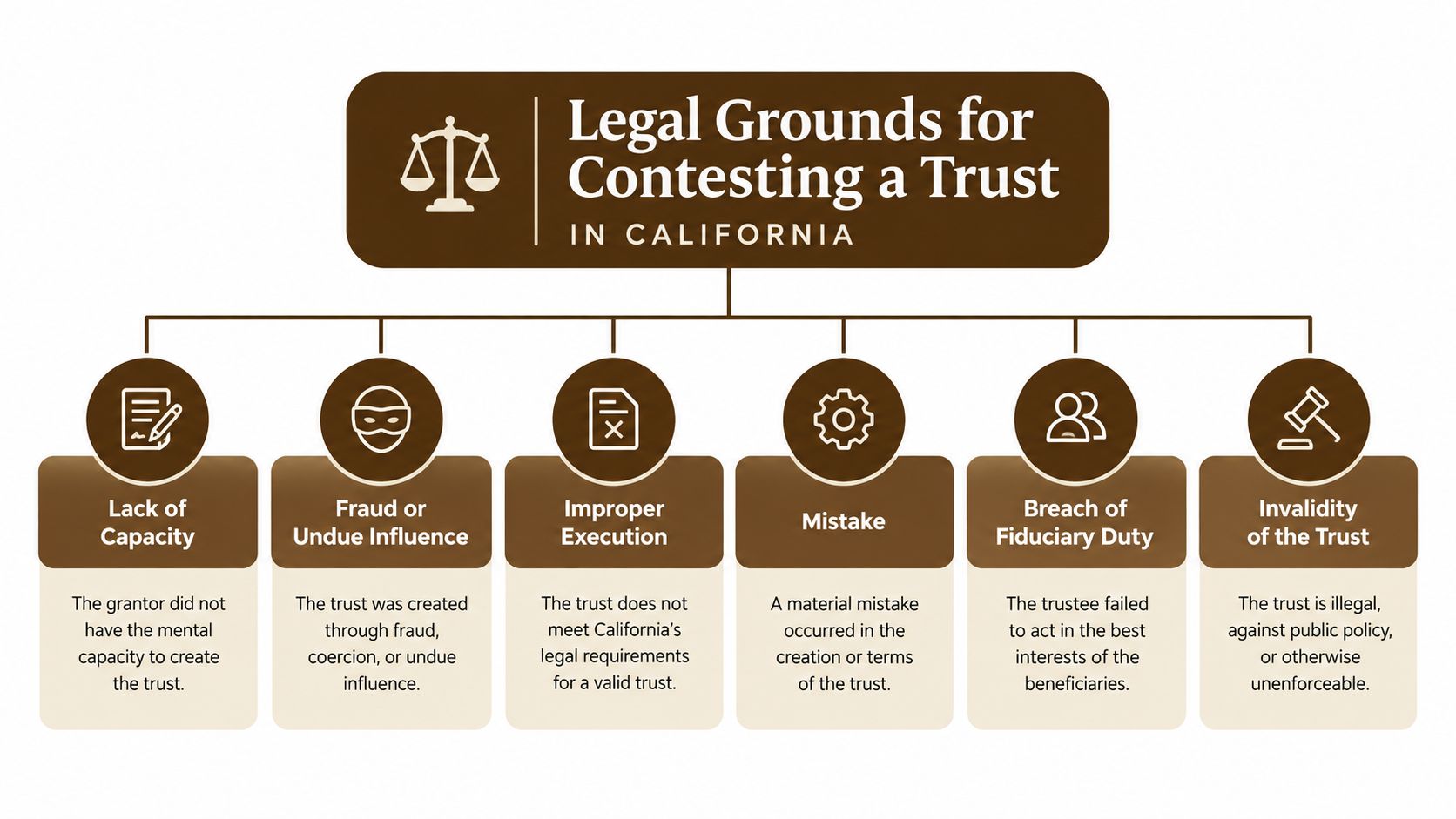
A trust contest usually succeeds, if it succeeds at all, because the challenger proves a specific defect in formation or execution. The practical issue is causation. You must connect the alleged incapacity, pressure, deception, or defect to the terms that now control the estate, rather than relying only on family conflict or suspicion, as discussed in this plain-language explanation of trust contests.
Lack of capacity
Capacity asks whether the settlor understood the nature and extent of their property, the people who would naturally be considered beneficiaries, and the effect of signing the trust or amendment. A dementia diagnosis alone may not resolve the issue. The important question is the settlor's understanding when the document was executed.
Medical records, medication information, statements from treating professionals, and testimony from people who interacted with the settlor around signing can matter. Evidence showing confusion near execution is more useful than general observations made much later.
Undue influence
Undue influence involves pressure or manipulation that overcomes the settlor's free choice. It can arise where a vulnerable person depends on a caregiver, relative, or adviser who controls access, information, transportation, or finances.
A confidential relationship combined with active participation in preparing or obtaining the document can be important. In some circumstances, once the challenger presents evidence of coercion or that kind of relationship and participation, the burden may shift toward the person defending the trust.
Fraud and forgery
Fraud may occur when someone misrepresents the document, its contents, or the circumstances of signing. For example, a person might tell the settlor that a paper is a routine bank form when it changes beneficiaries.
Forgery is different. It involves a signature or document that isn't genuine. Handwriting evidence, execution witnesses, drafting files, electronic records, and document history may help establish what happened.
Mistake and improper execution
A mistake may involve a serious misunderstanding about the document or the property being transferred. Improper execution concerns failures to satisfy required legal formalities. A trust may be vulnerable if the signing process did not comply with applicable California requirements or if the document presented as the operative trust isn't the document the settlor intended to execute.
The strongest cases usually rely on contemporaneous proof. Later family narratives can explain why people are concerned, but they often need support from records created near the signing.
This video provides additional background on the legal grounds that may arise in a trust contest:
California Deadlines and Who Has Standing to Challenge
The most dangerous timing mistake is assuming the clock starts when you first learn that the trust exists or when you become convinced something was wrong. In California, the relevant deadline commonly begins with formal statutory notice.
California court materials explain that beneficiaries generally have 120 days from service of the required notice, or 60 days from the date a copy of the trust is mailed or served during that 120-day period, whichever is later, to challenge the trust. The California court guidance on probate and trusts illustrates why the notice and delivery dates must be reviewed together.
Check the notice before evaluating the merits
Keep the envelope, email, attachments, proof of service, and every version of the trust you received. A lawyer will need to determine whether the notice was legally sufficient, when it was served, and whether the accompanying trust documents were complete.
Do not rely on a trustee's statement that “you have plenty of time.” Calculate the deadline from the actual service information and obtain advice promptly.
Standing is a separate question
Standing means having a legally recognized interest that allows you to bring the challenge. A current beneficiary may have standing. An heir who would have inherited under an earlier estate plan or under intestacy may also have a legally relevant interest. A relative who is merely disappointed may not.
The analysis can become complicated when amendments change the class of beneficiaries or when a person claims the challenged document eliminated an interest they previously held. The court generally needs to see how the challenger would be affected if the trust were invalidated or altered.
Timing matters twice: You need both a legally recognized interest and a timely filing. A strong factual complaint doesn't overcome the absence of standing or an expired limitation period.
Pre-death challenges are unusual, especially when the trust remains revocable. But California appellate developments recognized that a beneficiary who already suspects incapacity may sometimes need to act during the settlor's lifetime rather than wait until death. A guardian or similar representative may also have a role in limited circumstances. These cases require immediate jurisdiction-specific advice because the procedural posture can determine whether a court will hear the claim.
Evidence That Wins Trust Contests and Defenses You Will Face
Trust litigation is won with evidence that shows what happened near the time of execution. The most persuasive records often come from people and institutions that had no reason to shape the inheritance.
Strong evidence versus weak evidence
| Evidence that can support a contest | Evidence that usually needs more support |
|---|---|
| Medical records close to signing | A general diagnosis without timing evidence |
| Drafting communications and file notes | Family suspicion based only on the final distribution |
| Testimony from witnesses to the signing | A later disagreement about what the settlor “would have wanted” |
| Account activity near execution | Proof that one beneficiary was simply disliked |
| Earlier and later estate documents | An unequal gift without evidence of a legal defect |
Medical records may help establish cognition and vulnerability. Drafting communications may reveal who gave instructions, who selected the lawyer, and whether the settlor received independent explanation. Bank activity can show unusual transfers or control over accounts, while witness testimony may clarify who was present and how the signing occurred.
A successful undue influence theory often depends on more than showing that one person had access to the settlor. The evidence should show a relationship of trust or dependence, active involvement in the transaction, and a connection between that involvement and the terms being challenged.
Defenses that can change the risk
The trustee or beneficiary defending the trust may argue that the settlor understood the document, received independent advice, expressed consistent intentions, and signed voluntarily. They may produce drafting notes, witness declarations, medical opinions, prior statements, or records showing that the challenged disposition was planned before the alleged influencer became involved.
A no-contest clause can also affect the risk. California Probate Code section 21310 defines such a clause as a provision in an otherwise valid instrument that penalizes a beneficiary for filing a court pleading. Under Probate Code section 21311, the clause is enforceable only in limited circumstances, including a direct contest brought without probable cause, a property-ownership challenge when the clause expressly covers it, and a creditor's claim or action based on such a claim, as explained in this California appellate discussion of no-contest clauses.
That doesn't mean every contest causes a beneficiary to lose an inheritance. It does mean the proposed claims should be evaluated before filing, with attention to probable cause, the exact wording of the clause, and the type of relief requested.
What Happens After Filing a Trust Contest
Filing a petition starts a legal process, not an immediate decision about who receives the estate. The court may address notice, pleadings, document production, subpoenas, depositions, expert opinions, and motions before the central issues are ready for trial.
In Orange County probate litigation, mediation can provide a structured setting for resolving the dispute while preserving more control than a trial. Settlement may involve a distribution, a trustee change, an accounting, a release of claims, or another practical arrangement. The right resolution depends on the evidence, the assets involved, the family's priorities, and the risk of continuing.
A realistic litigation picture
A large 2026 empirical study reported that 39% of petitions settled, 34% disappeared from the docket without a merits ruling, 12% ended in petitioner wins, and 5% resulted in partial remedies. The study of trust litigation also reported an average matter length of 481 days, or about 16 months, and found that 97% of petitions involved revocable trusts.
Those figures describe why a trust contest requires a measured strategy. A case may end through settlement, dismissal, procedural resolution, or partial relief rather than a complete victory at trial. A party who files only to pressure relatives may spend significant resources without receiving a merits ruling.
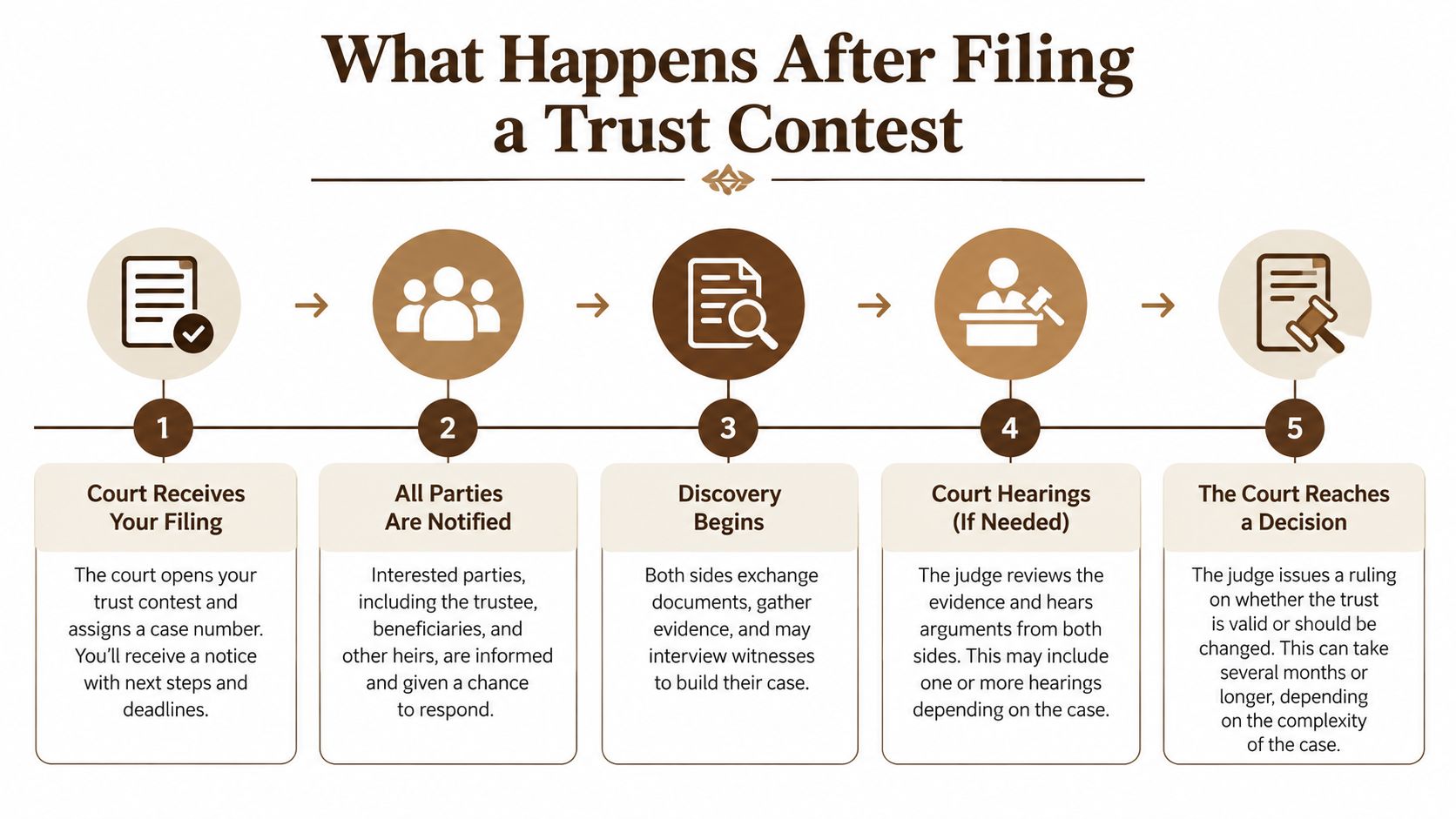
The practical roadmap
- Preserve the deadline. Confirm notice, service, and the operative trust documents before negotiations consume time.
- Define the claim. Separate capacity, undue influence, fraud, forgery, execution defects, and administration complaints.
- Collect targeted evidence. Seek records that address the signing period, not every document in the family history.
- Assess settlement value. Compare the likely benefit of litigation with legal fees, delay, family consequences, and the risk of losing.
- Prepare for more than one outcome. A negotiated distribution or partial remedy may resolve the underlying problem even if the trust isn't completely invalidated.
Contingency arrangements may be available in some matters, but many trust litigation firms bill hourly because the outcome, asset pool, and work required remain uncertain. Ask about billing, discovery costs, experts, mediation, and potential fee exposure before authorizing litigation.
When to Consult an Orange County Trust Litigation Attorney
You should seek advice promptly if a trustee sends formal notice, produces a late amendment, refuses to provide the complete trust, or says the challenge deadline has already passed without showing how the date was calculated. The same applies when a caregiver, relative, or adviser became heavily involved in finances and estate planning while the settlor was vulnerable.
Bring the documents you have, even if the set is incomplete. Useful materials include:
- Trust documents: Copies of the current trust, amendments, notices, and related wills.
- Timeline records: Dates of illness, hospitalizations, moves, caregiving changes, and signing events.
- Financial information: Bank statements, property records, transfers, and account changes near execution.
- Witness details: Names of people who saw the settlor, attended meetings, or discussed the estate.
- Earlier plans: Prior trusts, wills, beneficiary designations, and written statements about intended distributions.
A lawyer should first determine whether you have standing, whether the notice triggered a deadline, and whether the evidence supports a recognized ground. The next question is remedy. You may be seeking to invalidate an amendment, restore an earlier trust, obtain an accounting, challenge a transfer, or address trustee conduct. Those are different objectives and can require different procedures.
Tanner Law offers civil litigation guidance for trust-related disputes, probate matters, and connected property conflicts in Orange County and Los Angeles. The firm provides direct attorney access, cost-conscious representation, and free initial consultations by phone or email from its Santa Ana office at 1913 E. 17th Street, Suite 212, Santa Ana, California 92705.
Don't wait to see whether the trustee becomes cooperative or whether other beneficiaries volunteer the records you need. Once formal notice is served, delay can put a potentially valid claim beyond the court's reach.
Tanner Law can review the trust documents, notice history, evidence of capacity or undue influence, and the property issues connected to the dispute. Visit Tanner Law to schedule a free consultation by phone or email before the California deadline expires.