
Can a Seller Cancel a Real Estate Contract in CA
A seller generally cannot cancel a signed real estate contract in California because they changed their mind or received a better offer. The lawful paths usually depend on a specific contract contingency, buyer default, or a mutual written agreement, not on market conditions or seller's remorse.
A homeowner may sign an offer on Monday, arrange movers, and then receive a stronger proposal on Tuesday. An investor may discover that the agreed price no longer feels attractive after rates change. A family handling a probate sale may face new concerns about timing, taxes, or where beneficiaries will live. In each situation, the first question is the same: can a seller cancel a real estate contract without creating a breach?
California law generally treats a fully executed purchase agreement as binding. That means a seller usually can't walk away merely because the property now appears underpriced, a better buyer has appeared, or the transaction has become inconvenient. The answer turns on the exact contract language, the status of contingencies, the buyer's performance, and the notices required before cancellation.
Table of Contents
- The Legal Reality of Canceling a Signed Purchase Agreement
- Valid Legal Grounds for Seller Cancellation
- California Contingency Rules and Written Deadlines
- Buyer Remedies and the Cost of Unauthorized Breach
- Market Volatility and the Illusion of Easy Exits
- Practical Steps for Navigating Contract Disputes
- Protecting Your Property Rights with Tanner Law
The Legal Reality of Canceling a Signed Purchase Agreement
Consider a seller in Orange County who accepts an offer and signs the California Residential Purchase Agreement. Before closing, another buyer offers more money. The seller wants to cancel the first transaction and accept the new offer. That instinct is understandable, but it doesn't ordinarily create a legal right to terminate the existing agreement.
Once both parties have executed and delivered the contract, the seller has obligations. A seller generally cannot cancel just because of a change of heart. Unilateral termination typically requires a contract-based contingency, buyer default, mutual release, or another legally recognized ground, as explained in this guidance on backing out of a purchase agreement.
Why a better offer usually doesn't help
A later offer may improve the seller's negotiating position in an ordinary listing situation. It doesn't automatically erase the first contract. Accepting a second offer while refusing to perform under the first can expose the seller to a claim that the original agreement was breached.
The same principle applies when market conditions change. A seller who believes the home would now command a higher price still must examine the existing agreement before taking action. The property may be unique to the buyer, and the buyer may seek a remedy that goes beyond reimbursement.
The contract controls the exit path
The practical review should begin with the executed agreement, not with online forms or informal advice. The seller, agent, and attorney should identify:
- Seller obligations: Determine what the seller promised regarding title, possession, disclosures, repairs, and closing.
- Buyer deadlines: Check deposit, financing, investigation, appraisal, and contingency-removal requirements.
- Seller protections: Look for a replacement-home condition, minimum net-proceeds provision, title condition, or other negotiated right.
- Notice procedures: Confirm whether the seller must issue a notice to perform, provide an opportunity to cure, or use a specified cancellation form.
Contract failures occur in real transactions, but that practical frequency doesn't make seller cancellation unrestricted. The law distinguishes between a transaction that fails because the buyer didn't perform and one the seller abandons without contractual authority. That distinction matters for families, investors, and personal representatives handling property in Orange County or Los Angeles.
Valid Legal Grounds for Seller Cancellation
A lawful seller termination usually fits within a defined category. The seller's desire to exit is not enough by itself. The agreement must give the seller a right to terminate, or California law must recognize a basis for doing so.
A seller may have a valid path when the buyer defaults. Examples can include failure to provide a required deposit, failure to satisfy a contractual financing obligation, or failure to complete a required performance step by the stated deadline. The seller still needs to follow the agreement's notice process. A missed buyer deadline doesn't always authorize an immediate cancellation without notice.
A second possibility is an unmet seller-specific contingency. A contract might allow the seller to proceed only if a replacement residence is found, or only if the transaction produces a specified minimum net amount. These protections must be written into the agreement. A seller generally can't invent a new condition after signing because circumstances have become uncomfortable.
The cleanest outcome is often a mutual written cancellation. If both sides agree that the transaction should end, they can document the release, address the earnest-money deposit, and clarify whether either party retains claims. A conversation between agents may begin the negotiation, but it shouldn't substitute for a signed written agreement.

Lawful termination versus breach
California guidance identifies the core distinction clearly. A seller generally can't cancel a signed residential purchase agreement because the seller changed their mind or received a better offer. Termination is ordinarily tied to a contract-based default, an unmet seller contingency, or a mutual written cancellation, as described in this California-specific explanation of seller cancellation.
The seller should also consider whether the alleged default is material and properly documented. A minor disagreement may not justify the remedy the seller wants. If the contract requires a notice and cure period, skipping that step can turn a potentially valid position into a disputed breach.
Practical rule: A seller should identify the exact paragraph authorizing cancellation before sending any notice. If no paragraph or recognized legal ground supports the decision, assume the risk is substantial until a California real estate attorney reviews it.
California Contingency Rules and Written Deadlines
Contingencies are not vague escape buttons. They are contractual conditions with defined deadlines, forms, and procedures. In California, sellers and buyers must treat those mechanics as seriously as the underlying condition.
For example, a seller may believe that the buyer failed to remove an inspection or financing contingency. That belief doesn't necessarily answer whether the seller can cancel. The contract may require a written notice, a chance to perform, or another step before termination becomes available.
Read the deadline and the notice clause together
A seller should review the relevant contingency in four parts:
- Condition: What event must occur, and who benefits from it?
- Deadline: On what date or under what trigger must the party act?
- Written action: What form or signed document removes, confirms, or rejects the contingency?
- Cure process: Must the other party receive notice and an opportunity to correct the issue?
California Department of Real Estate materials state that contingency removals must be in writing and are typically handled through the C.A.R. Contingency Removal form, as reflected in the California Department of Real Estate reference material. An oral statement from an agent, a text message, or the mere passage of time may not accomplish what the contract requires.
Why missed deadlines can change the analysis
A seller may possess a contractual right that disappears if it isn't exercised properly. If the agreement requires notice by a particular date and the seller misses that date, the seller may have waived the claimed termination right. The answer depends on the wording, the parties' conduct, and applicable California law, so the timing should be reviewed before anyone sends a cancellation notice.
This issue appears frequently in probate and trust-related sales. A personal representative or trustee may be coordinating appraisals, beneficiary approvals, title work, and occupancy concerns while the purchase agreement continues moving forward. Internal delays don't automatically extend the contract. The representative should preserve a written record of every deadline, notice, response, and requested extension.
An oral understanding may feel practical during a stressful transaction, but it can leave everyone arguing about what was actually agreed. Put material changes, extensions, and releases in writing before relying on them.
Buyer Remedies and the Cost of Unauthorized Breach
A seller who cancels without a valid basis may face two broad categories of exposure. The buyer may ask the court to require the sale, or the buyer may seek money for losses caused by the breach. Those remedies create very different pressures, and a seller shouldn't assume that paying back a deposit ends the dispute.
Specific performance asks a court to require the seller to transfer the property under the contract. Real estate can be difficult to replace with an equivalent asset, particularly where the buyer chose a specific home, location, lot, or investment property. If the buyer can establish the necessary elements, a court may consider an order compelling completion rather than treating money as the only solution.
Money damages address the buyer's economic loss. For a California seller who refuses to close, Civil Code section 3306 may support claims that include the purchase price paid, title and document expenses, the difference between the contract price and the property's value at breach, preparation expenses, consequential damages, and interest. The available remedy depends on the facts and the evidence, as described in this discussion of California seller breach remedies.
Restoring value in an equitable dispute
Some disputes involve rescission, which seeks to unwind the transaction rather than force performance. The basic idea is restoration of the status quo before the agreement or transaction. That can require returning money or other value received, while accounting for matters such as possession, occupancy value, payments, and timing.
The seller should compare the remedies rather than focus only on the immediate frustration of closing. A forced sale can eliminate the hoped-for flexibility. A damages claim can create an evidentiary dispute over value and consequential loss. A rescission dispute can require detailed accounting. None of these outcomes is automatic, but each is more serious than canceling escrow.
The right response to a cancellation notice also depends on which side you're on. A buyer should avoid signing a release without understanding the claims being surrendered. A seller should avoid treating a unilateral form as proof that the contract has ended. Escrow personnel generally cannot resolve the underlying legal disagreement merely because one party wants the file closed.
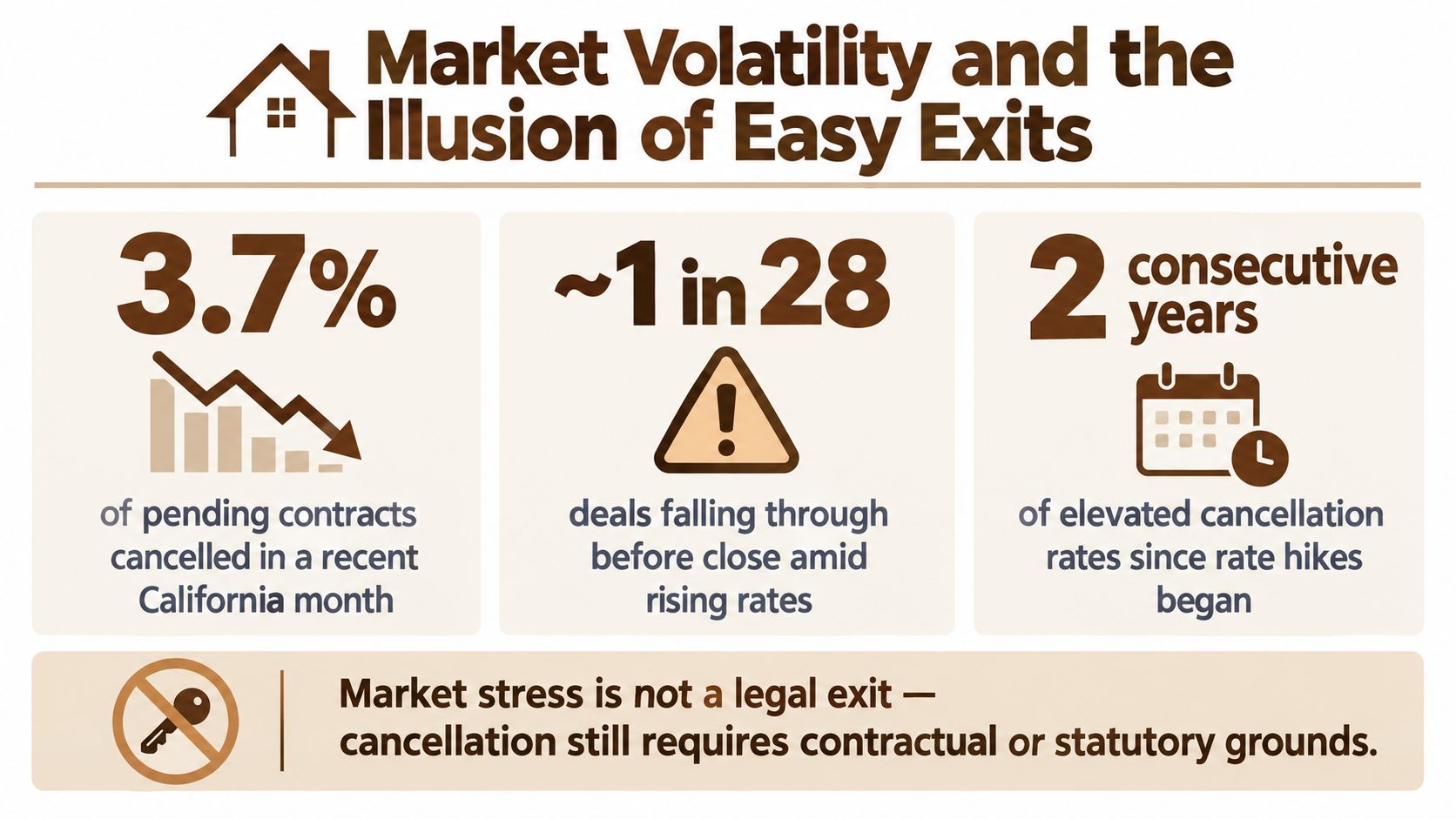
Market Volatility and the Illusion of Easy Exits
Market pressure changes behavior, but it doesn't rewrite the purchase agreement. A seller may face a lower appraisal, a buyer whose financing has weakened, or a new offer that makes the signed price look unattractive. Those facts may justify a conversation about timing or a negotiated release. They don't independently establish a right to cancel.
Recent housing data show why the question arises so often. Redfin reported that about 42,000 home-sale agreements fell through in February 2026, representing 13.7% of homes that went under contract that month, and later reported that the July 2026 cancellation rate reached 14%, the highest seasonally adjusted share in nearly three years, according to its February 2026 contract-cancellation report.
Failed buyer financing is not seller permission
A buyer's inability to close may create a seller remedy if the buyer has breached the agreement and the seller follows the required process. That is different from a seller deciding that the buyer's financing appears uncertain and using the concern as a reason to terminate first.
The same distinction applies to a low appraisal. The appraisal may trigger a contractual renegotiation, a financing contingency, or a buyer decision to proceed. Unless the contract gives the seller a specific right, the seller can't simply declare the deal over because the valuation is disappointing.
Renegotiation may work where cancellation won't
In a volatile rate environment, practical solutions can include an extension, revised closing terms, a credit negotiated within the contract, or a mutual release. Each option has consequences. An extension can preserve the sale but prolong carrying costs. A price change may solve a financing gap but reduce proceeds. A release may free the property while requiring agreement about deposits and claims.
The National Association of Realtors reported that 6% of contracts were terminated in the prior three months in mid-2025, while the highest share in its dataset occurred in April 2020 at 12%. It also reported that termination rates generally ranged from 4% to 7% since March 2023, as shown in its analysis of terminated contracts. Those figures demonstrate that failed transactions are part of the market, not that every seller has a market-based exit.

Practical Steps for Navigating Contract Disputes
A seller who wants to cancel should slow down before sending a message that may be treated as a repudiation. The safest process begins with preserving options, not announcing a conclusion.
Start with the documents
Collect the fully signed agreement, counteroffers, addenda, disclosures, escrow instructions, notices, deposit records, inspection communications, and financing updates. Keep the original emails and attachments. A lawyer needs the complete timeline because a single addendum or written extension can change the analysis.
Then create a deadline chart. Record each contingency date, notice date, response, and claimed default. Don't rely on calendar entries alone. Compare the dates against the actual contract language and any signed amendments.
Separate negotiation from termination
Ask whether the immediate objective is cancellation, more time, revised terms, or protection against a buyer default. These are different legal and business goals.
- For a negotiated exit: Seek a mutual written release that addresses the deposit, possession, expenses, confidentiality if relevant, and any surviving claims.
- For a suspected buyer default: Follow the agreement's notice and cure procedure instead of sending an immediate cancellation statement.
- For a closing problem: Consider whether an extension or documented amendment solves the issue without ending the transaction.
- For a disputed contingency: Obtain a legal review before asserting that the condition failed or that the right to cancel remains available.
Don't ask an escrow officer to decide whether a breach occurred. Escrow can follow properly authorized instructions, but it generally isn't the forum for resolving competing legal positions.
Get advice before taking an irreversible step
A California real estate attorney can evaluate whether the seller has a valid contractual basis, whether a deadline was missed, and whether a proposed notice could trigger damages or specific performance litigation. That review is especially important for probate estates, trusts, co-owned property, and transactions involving multiple beneficiaries or decision-makers.
If the buyer is willing to resolve the matter, document the agreement completely. If the buyer isn't willing, a seller should understand the likely consequences before refusing to close, relisting the property, or signing a second contract.
Protecting Your Property Rights with Tanner Law
The short answer to can a seller cancel a real estate contract in California is usually no, not merely because the seller changed their mind, received a better offer, or dislikes the economics of the deal. A lawful cancellation ordinarily requires a contract provision, buyer default, unmet seller contingency, mutual written release, or another recognized legal ground.
That rule becomes more important when the property involves a family estate, trust administration, probate court, co-owners, or an investment strategy that has changed. The person signing the cancellation may not be the only person affected. Beneficiaries, lenders, tenants, heirs, and prospective buyers can all become part of the dispute.
Tanner Law represents property owners and other parties in Orange County, Los Angeles, Riverside, and San Bernardino courts. William T. Tanner combines courtroom advocacy with transactional experience in matters involving breach of real estate contracts, quiet title actions, partition disputes, and ownership rights. That combination matters when a client needs both a realistic contract analysis and a plan for negotiation or litigation.
A careful review should answer practical questions: Is there a valid termination clause? Did the buyer really default? Was a contingency removed in writing? Did the seller miss a notice deadline? Would a mutual release protect the estate or investment better than a contested cancellation? The sooner those questions are addressed, the more options the parties may preserve.
Tanner Law offers practical guidance for sellers, buyers, families, investors, and probate clients facing a disputed California real estate contract, including contract review, negotiation, and property litigation strategy. Schedule a free consultation by visiting Tanner Law to discuss your situation before sending a cancellation notice or signing a release.