Per Stirpes Definition: A California Estate Planning Guide
Per stirpes means estate assets pass by family branch, so a deceased child's share goes to that child's own children. The term comes from Latin and means “by roots” or “by branch,” which is why it matters so much when you're deciding how your family should inherit.
If you're reviewing a will, updating a trust, or filling out a beneficiary form in Orange County or Los Angeles, this issue may feel surprisingly personal. Many California families want a simple result: “If one of my children dies before I do, I want that child's kids to receive that share.” The problem is that legal documents don't reward assumptions. They follow the words on the page, and under California law, the default rule is not always the same as a strict per stirpes instruction.
That's where confusion begins. Parents often assume their grandchildren are automatically protected. Sometimes they are. Sometimes they aren't, at least not in the way the family expected. In probate and trust disputes, I often see the fallout from one missing phrase or one form that was never updated after a death, remarriage, or birth in the family.
A clear per stirpes definition helps you avoid that mistake. It also helps you understand how California's own inheritance rules work when your documents are silent, outdated, or ambiguous.
Table of Contents
- What Per Stirpes Means for Your Family's Inheritance
- The Per Stirpes Definition Explained with a Family Tree
- Per Stirpes vs Per Capita A Critical Distinction
- Per Stirpes in California Law and Your Estate Plan
- Sample Language for Your Will or Trust
- Common Pitfalls and Litigation Risks to Avoid
- Securing Your Legacy with Clear Estate Planning
What Per Stirpes Means for Your Family's Inheritance
A common California estate planning question sounds simple: “If my daughter dies before I do, will her children receive her share?” If your document says per stirpes, the answer is usually yes. If it doesn't, the answer may depend on the exact wording of the will, trust, or beneficiary designation, and on California Probate Code rules.
That's why this term matters so much. It isn't decorative legal language. It's an instruction about where your property goes when life doesn't unfold in a straight line.
In plain English, per stirpes protects each family line. Instead of cutting out a deceased child's descendants, it keeps that child's share within that branch of the family. For many parents and grandparents, that matches their instincts about fairness. They don't want one branch of the family to lose everything just because a child died first.
Why this matters in real families
In Orange County and Los Angeles, many families own a mix of assets. A home, retirement accounts, life insurance, a brokerage account, or a living trust. Each asset may pass under a different set of rules.
A few practical questions make the issue clearer:
- If one child dies early: Do you want that child's children to stand in their parent's place?
- If one child has no children: Should that branch receive nothing, or should the share be redistributed?
- If your family is blended: Are stepchildren included, or only biological and adopted descendants under California law?
- If your documents conflict: Which instruction controls the trust, the will, and the beneficiary forms?
Practical rule: Estate planning works best when your documents answer family questions before your family has to ask them in court.
California law is especially important here because California's default inheritance approach is generally per capita by representation, not a strict per stirpes system. That distinction can change outcomes. If you want one particular distribution method, your documents should say so clearly.
The Per Stirpes Definition Explained with a Family Tree
The classic per stirpes definition begins with its Latin roots. The term means “by roots” or “by branch”, and historically it establishes that estate distribution occurs at the generation closest to the deceased so that each family branch receives an equal share, with a deceased heir's share passing to that heir's descendants rather than returning to surviving siblings or the general estate, as explained in the Per stirpes legal overview.

Per stirpes means an inheritance is divided by family branch, so if a child dies before the parent, that child's descendants receive that child's share.
Why family branches matter
The easiest way to understand the rule is to stop thinking about individuals first and start thinking about branches of a family tree.
Suppose a parent has three children:
- Child A is living.
- Child B died before the parent and left two children.
- Child C is living.
Under a per stirpes instruction, the estate is first divided at the children's generation. Each child's branch receives an equal share. Child A gets one branch share. Child C gets one branch share. Child B's branch also gets one branch share, but because Child B is no longer living, that share passes down to Child B's children.
That's the key point. The branch survives even if the person in that branch has died.
A simple example with children and grandchildren
Here is the process in steps:
- Find the first generation below the deceased person. In many estate plans, that means the children.
- Create equal branch shares at that level.
- Check whether each person in that generation is living.
- If a person has died but left descendants, that branch share passes down within that line.
So if a grandparent's will leaves property to their children per stirpes, and one child died earlier leaving two children of their own, those two grandchildren divide only their parent's branch share. They don't automatically share equally with all grandchildren in the family.
That's why people sometimes say per stirpes lets descendants “step into their parent's shoes.” It preserves the parent's position in the distribution line.
A short comparison helps:
| Situation | Result under per stirpes |
|---|---|
| Child is living | Child receives that branch share |
| Child died, leaving descendants | Descendants divide that child's branch share |
| Child died, leaving no descendants | That branch may be disregarded, depending on the governing rule and document language |
This branch-based approach is often what parents intend when they say they want things divided “fairly.” But fairness has to be defined. In estate law, “fair” might mean equal by child, not equal by every living descendant.
Per Stirpes vs Per Capita A Critical Distinction
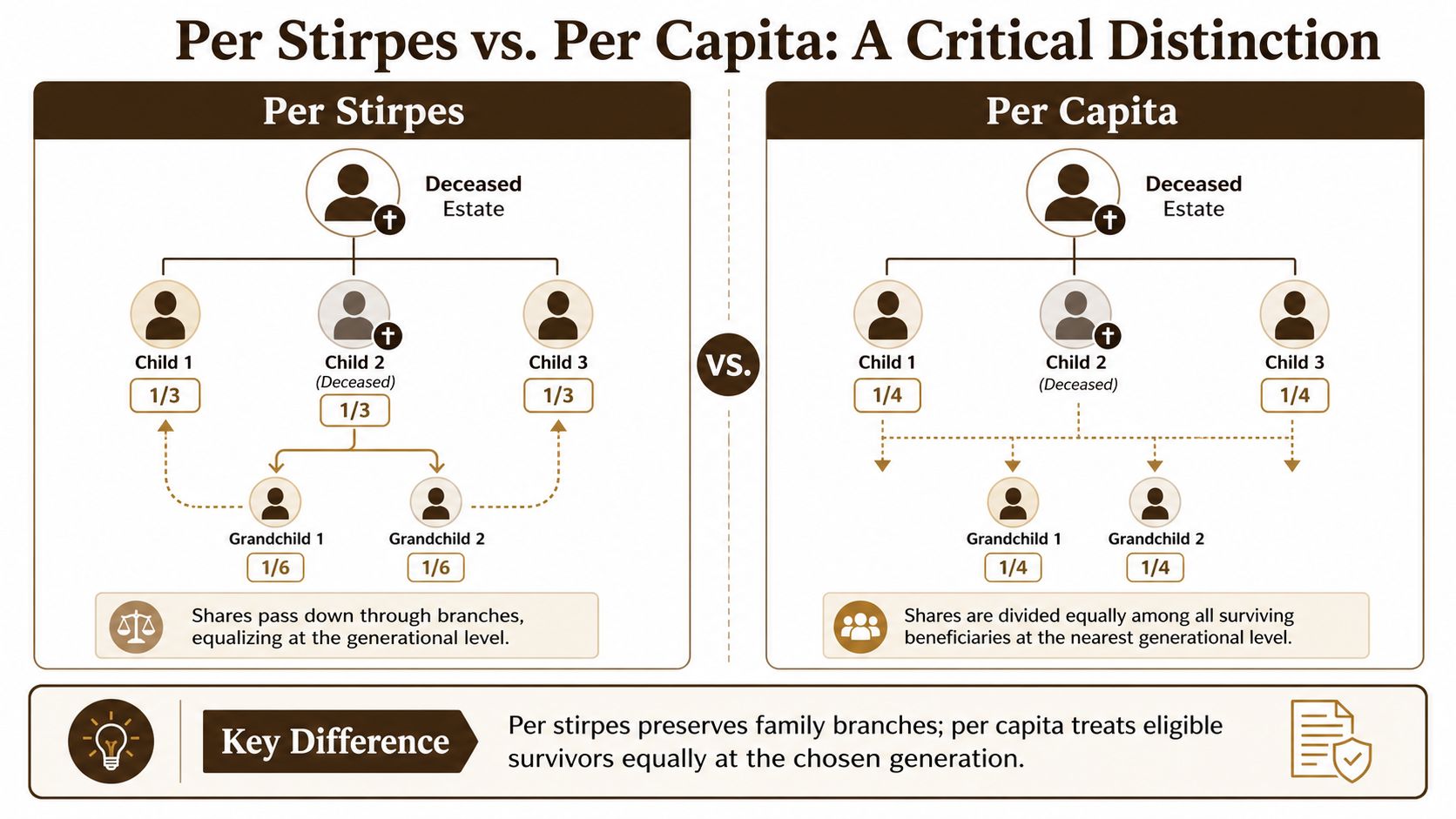
Two phrases that sound similar can produce very different results: per stirpes and per capita. That difference becomes even more important in California, where readers often encounter another phrase, per capita by representation.
Same family, different result
Use the same family tree:
- Parent has three children.
- One child dies before the parent.
- That deceased child leaves children of their own.
Under a branch-based system, the deceased child's line still takes that branch share. Under a pure per capita system, the focus shifts away from branches and toward equal shares among people at the relevant generational level.
That distinction is why families can be shocked by the final result. They thought they were protecting grandchildren in one branch, but the actual wording spread the inheritance differently.
Under modern statutory descriptions of per stirpes, the property is divided into equal shares based on the surviving issue in the nearest generation with living members and deceased issue in that same generation who left surviving issue, treating the deceased ancestor's share as a transferable unit; if a child dies first, that child's share passes to their descendants, while a child who died without living descendants is disregarded for the primary count, as stated in New York Estates, Powers and Trusts Law § 1-2.14.
Why California families get tripped up
California adds another layer. The state's default rule for intestate succession and many representation issues is generally called per capita by representation. That is not always the same as a strict per stirpes model.
Here's the practical difference:
- Strict per stirpes starts at the children's generation and keeps each branch fixed there.
- Per capita by representation can start at the nearest generation with living takers, then divide in a way that produces a different allocation among descendants.
A single phrase can decide whether a grandchild inherits through a deceased parent's branch or whether the estate gets divided among living descendants under a different formula.
Homemade estate plans often fail, with someone using “equal shares to my descendants” in one paragraph, “to my children” in another, and “per stirpes” nowhere. After a death, surviving relatives read those words very differently.
For Orange County and Los Angeles families, the safest approach is precision. If you want strict per stirpes, say so. If you want California's default representation system, that should be clear too. Ambiguity is what fuels probate petitions, trust contests, and sibling disputes.
Per Stirpes in California Law and Your Estate Plan
California law matters because your documents don't exist in a vacuum. If a will or trust is unclear, California Probate Code rules shape the outcome. In California, the default approach is generally per capita by representation, often tied to Probate Code sections 240, 246, and 247, which is not the same as strict per stirpes.

California does not use strict per stirpes as the default
That point surprises many people. They assume “my kids, and if one dies then their kids” is automatic. California sometimes reaches a similar result, but not always by the same path, and not always with the same allocation.
If you want a strict per stirpes result in California, your attorney should draft that instruction explicitly in the will or trust. The same goes for sub-trusts for children, staggered inheritance terms, and backup beneficiaries.
This matters in several settings:
- Wills: A probate court reads the exact language used.
- Revocable living trusts: Distribution terms control what happens after death.
- Amendments and restatements: Later documents can unintentionally create inconsistencies.
- Pour-over wills and trust schedules: Supporting documents should match the core plan.
A useful comparison comes from other jurisdictions. Florida Statutes §732.104 codifies a “strict per stirpes” system in which the estate is divided at the children's level and a deceased child's share passes to that child's descendants in equal portions, as described in this per stirpes legal glossary discussing Florida and beneficiary designations. California families shouldn't assume that same strict rule applies here without express drafting.
Where this shows up beyond wills and trusts
Beneficiary designations deserve special attention. Retirement accounts, life insurance, and similar assets often pass outside probate and outside the trust unless they are coordinated correctly.
That same legal glossary notes that a per stirpes designation is frequently used in retirement accounts and in Federal Employees' Group Life Insurance, where the U.S. Office of Personnel Management defines it to allow a named beneficiary's children, and sometimes later lineal descendants, to take if that beneficiary dies before the insured. In practice, that means the form itself can control a major asset.
A short checklist helps:
- Review each beneficiary form: Don't assume your trust controls everything.
- Match names and relationships: “Children” and “descendants” aren't always interchangeable.
- Watch for predeceased beneficiaries: Old forms often create avoidable confusion.
- Check plan options: Some institutions offer per stirpes elections, while others use their own wording.
This overview may help if you want a visual explanation of beneficiary language in practice.
For California families, the planning lesson is straightforward. Don't rely on default rules if your real intention is more specific than the default.
Sample Language for Your Will or Trust
The wording in an estate plan has to fit the family, the assets, and California law. Still, it helps to see simple examples.
Simple examples for educational purposes
A common clause might read:
“I leave the residue of my estate to my then-living descendants, per stirpes.”
Another version in a trust might say:
“Upon my death, the trust estate shall be distributed to my children, per stirpes.”
Those clauses are short, but they carry a lot of weight.
Here's what the pieces usually mean:
- “Residue of my estate” refers to what remains after debts, expenses, taxes, and specific gifts are handled.
- “Then-living descendants” identifies who must be alive at the relevant time.
- “Per stirpes” gives the branch-based distribution instruction.
- “Children” is narrower than “descendants,” and in California that distinction can matter.
A more customized document may need additional language to answer questions such as:
- Are adopted children included?
- Are stepchildren included?
- What happens if an entire branch has died out?
- Should minors inherit outright, or through a trust?
These sample clauses are for education only. A valid California will or trust should be drafted and reviewed by an attorney who understands your family structure, your assets, and how your beneficiary designations interact with the plan.
That warning isn't formality. A sentence that works for one family can create a dispute in another.
Common Pitfalls and Litigation Risks to Avoid
Most inheritance disputes don't start because someone intended to create chaos. They start because the document left room for competing interpretations. In probate litigation, that's often enough.

Blended families and unclear labels
Blended families are one of the most common trouble spots in California estate planning. A parent may think “my children” includes a stepchild raised from infancy. Under California law, that assumption can fail unless the document defines the term or the legal relationship supports inheritance rights.
Watch for these problem areas:
- Stepchildren: They usually need clear inclusion if you want them treated as beneficiaries.
- Adopted children: California law generally treats adopted children as children, but the document still needs consistent wording.
- Children from different relationships: One vague residue clause can set up a fight between branches of the family.
- Former spouses: Old beneficiary forms can override newer estate planning intentions.
When a family branch ends or minors inherit
Another common problem arises when an entire branch dies out. If a child dies before the parent and leaves no living descendants, the handling of that branch depends on the governing language and California rules. Families often assume they know the answer. Litigation starts when two interpretations both seem plausible from the face of the document.
Minors create a different kind of risk. A straightforward per stirpes gift may send assets to a young child who cannot manage property outright. That can trigger a guardianship, custodianship, blocked account, or further court supervision unless the estate plan already provides a trust structure.
A practical review should ask:
| Issue | Why it matters |
|---|---|
| Predeceased child with descendants | Determines whether that branch inherits |
| Predeceased child without descendants | May change the share calculation |
| Minor beneficiaries | May require a trust or court-managed arrangement |
| Mixed beneficiary forms and trust terms | Can send assets in conflicting directions |
Clear drafting is cheaper, faster, and less painful than asking a probate judge to reconstruct what a parent probably meant.
For families in Los Angeles and Orange County, the stakes often include a house, rental property, or accounts that are vital to the next generation. When documents are unclear, conflict doesn't stay abstract. It delays administration, increases costs, and damages family relationships.
Securing Your Legacy with Clear Estate Planning
The core idea is simple. Per stirpes means inheritance passes by branch, so a deceased child's share goes to that child's descendants. The hard part isn't understanding the phrase. The hard part is making sure your California estate plan uses the right language in the right places.
That's where many families need careful guidance. California's default rules generally use per capita by representation, which may or may not match what you intend. A will, trust, or beneficiary form that is silent, outdated, or inconsistent can produce a result your family never expected.
Clear estate planning is one of the most practical ways to care for your family. It reduces uncertainty, protects family branches you want protected, and lowers the risk of probate or trust litigation later. For many clients, a primary goal isn't just tax planning or document signing. It's making sure children and grandchildren aren't left arguing over what the parent “must have meant.”
If you're reviewing your plan, creating one for the first time, or dealing with a probate issue in Orange County or Los Angeles, California-specific advice matters.
If you want to make sure your will, trust, and beneficiary designations reflect your actual wishes under California law, schedule a free consultation with Tanner Law. William T. Tanner serves families in Orange County and Los Angeles with clear, practical guidance on estate planning, probate, and related property issues.