Quiet Title Action California: Your 2026 Guide to Clear
A lot of families discover a title problem at the worst possible moment. A parent has passed away. The house in Orange County or Los Angeles is supposed to move through probate or trust administration. Everyone assumes the property can be sold, refinanced, or transferred without much trouble. Then the preliminary title report arrives, and suddenly there is an old deed, an unexpected claimant, a lien that should have been cleared years ago, or a legal description that doesn't match what the family thought it owned.
That kind of problem feels unfair because it often looks simple on paper. If the family has lived there for years, paid the mortgage, paid the taxes, and maintained the home, why should ownership still be in question?
Under California law, title problems aren't solved by assumptions. They're solved by records, proof, and, in some cases, a court judgment. A quiet title action is the lawsuit used to settle who holds the legally superior interest in real property and to remove competing claims from the record. For families dealing with probate, inherited homes, co-owner disputes, or old recording mistakes, that lawsuit can be the difference between a property that is usable and marketable and one that remains stuck in legal limbo.
Table of Contents
- Securing Your Legacy When a Property Title Is Unclear
- What Is a Quiet Title Action in California
- Common Scenarios That Require a Quiet Title Action
- The Quiet Title Process and Timeline in California
- How to Win Your Quiet Title Case The Burden of Proof
- Quiet Title vs Other Solutions Partition and Corrective Deeds
- Frequently Asked Questions About Quiet Title Actions
Securing Your Legacy When a Property Title Is Unclear
A family home can carry two kinds of value at once. There's the financial value of the property itself, and there's the personal value built from holidays, milestones, and years of ordinary life. When title is unclear, both are at risk.
A common probate situation goes like this. A son or daughter is handling a parent's estate and believes the home will pass cleanly to the heirs. Then a title document shows an old co-owner who was never removed, or a deed from years ago was recorded incorrectly, or a long-paid debt still appears in the chain of title. The family expected paperwork. Instead, they're facing a dispute over ownership.
Why these problems feel so frustrating
Most title defects don't look dramatic. They look technical. That's why people underestimate them.
A cloud on title is like a knot in the middle of a rope. From a distance, the rope still looks usable. But when you try to pull weight through it by selling, refinancing, or transferring the property, everything catches. Buyers hesitate. Lenders hesitate. Title companies hesitate.
Practical rule: If a title issue can stop a sale or refinance, it's already serious enough to evaluate right away.
Why California families often need court help
In California, some title problems can be fixed with cooperation and corrected documents. Others can't. If there are competing claims, missing heirs, disputed interests, or a defective chain of title, a court order may be the only durable fix.
That's why quiet title matters. It isn't just about winning an argument. It's about getting a judgment that settles ownership in a form future buyers, lenders, and title professionals can rely on.
For families in probate, that stability can protect both inheritance value and peace of mind. If you're dealing with uncertainty over who owns a home, who should sign transfer documents, or whether an old claim can block the estate, it's smart to get legal guidance early. Schedule a free consultation to understand your rights and options under California law.
What Is a Quiet Title Action in California
A daughter in Orange County is trying to sell the house her mother left behind. Everyone in the family agrees it should be sold. Then escrow opens, the title report comes back, and an old deed or missing transfer raises a basic question no one expected. Who legally owns this property right now?
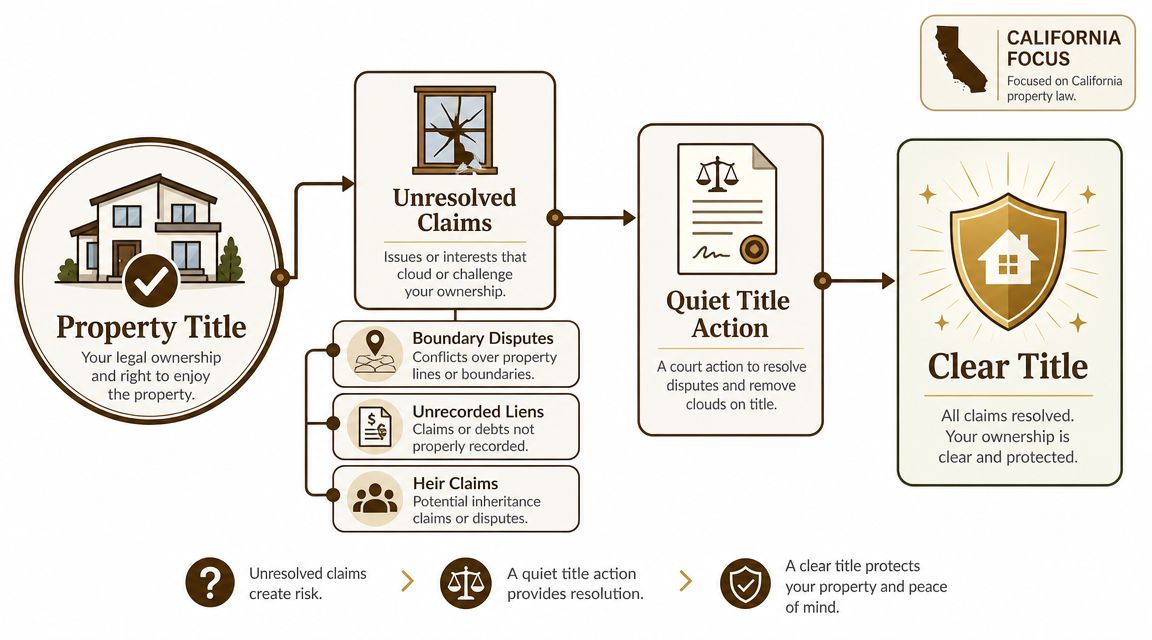
A quiet title action is the court process used to answer that question with a binding judgment. In California, it is a lawsuit that asks the court to decide who holds title to real property and to rule against competing claims. The governing statute is California Code of Civil Procedure section 760.020.
Title works like the property's legal chain of custody. Families often know the history in everyday terms. Mom lived here. Dad intended the house to go to the children. One sibling paid the taxes for years. The court, however, looks for the legal record that proves ownership. If the paper trail is inconsistent, incomplete, or disputed, quiet title is the tool used to straighten it out in a form that buyers, lenders, and title insurers can rely on.
What the lawsuit actually does
A quiet title case does not merely state, "I believe this property is mine." It asks the court to declare title as of a specific date and to identify whose claimed interest is valid and whose is not.
That distinction matters. A signed family agreement may settle emotions. A court judgment settles the public record.
For Southern California families dealing with probate, this is often the overlooked difficulty. On paper, the solution can look simple. File something. Sign something. Record something. In practice, title problems become hard when a deceased owner left an incomplete transfer, an heir is missing, an old lien was never cleared correctly, or the chain of title skips a step from years ago. The family's understanding may be sincere and unanimous, but title companies and courts still need legal proof.
Why quiet title can be harder than people expect
Quiet title cases are technical because the court is not fixing a vague problem. It is deciding rights in a specific piece of land.
Under California procedure, a quiet title complaint must be verified and filed in the superior court for the county where the property is located. As explained in this discussion of California quiet title procedure, the complaint also needs to identify the property, state the basis for the plaintiff's claimed title, and describe the adverse claims.
That means the case usually rises or falls on details such as:
- The legal description of the property. A street address helps identify the home, but the legal description controls.
- The source of the plaintiff's ownership claim. The court needs the deed, inheritance path, court order, or other legal basis.
- The people or entities claiming an interest. Known claimants must be named, and unknown claimants may need to be addressed too.
- The date for which title is being determined. Quiet title is tied to ownership as of a stated point in time.
A useful comparison is a survey map. If one line is off, the whole boundary can be questioned. Quiet title works in a similar way. If the complaint leaves out a claimant, misstates the legal description, or skips over a break in the chain of title, the judgment may not solve the actual problem.
What this means for a family dealing with inherited property
Many clients come in believing the issue is fairness. Courts look first at proof.
If your parent intended you to have the home but never recorded the right deed, intention alone may not clear title. If siblings agree about who should inherit, that agreement may still be insufficient if the record title is in a deceased grandparent's name or if probate left an ownership question unresolved. Quiet title is often the process that turns family understanding into a judgment the outside world accepts.
That is why this kind of case can feel surprisingly difficult. The family sees one house and one history. The legal system sees signatures, dates, recorded instruments, heirs, notice requirements, and competing claims that must all line up.
Common Scenarios That Require a Quiet Title Action
Quiet title cases arise from ordinary life events. Death in the family. A sale years ago that wasn't documented properly. A long-standing fence line. A paid debt that never disappeared from the record. The legal issue is title, but the human story is often probate, inheritance, or a family property that no one examined closely until a transaction forced the issue.
Inherited property with a broken paper trail
This is one of the most common situations for California families.
A parent may have intended to transfer the property but never completed the deed correctly. A deceased relative may have inherited from an earlier generation without cleaning up title. Sometimes one sibling has lived in the house for years while title remained in an older family member's name. When probate starts, the family learns the record title doesn't match the family understanding.
That mismatch creates real problems. Who has authority to sell? Who are all the heirs? Did a prior owner leave behind an unresolved interest? Quiet title may be necessary when the estate needs a court-backed answer rather than family consensus alone.
Boundary and access disputes between neighbors
Not every quiet title case begins inside a family. Some begin with a fence.
A fence might sit several feet off the legal boundary. A driveway may cross land one owner believed was shared, while the record suggests otherwise. An old access route may have been used openly for years without a clear written easement. These conflicts often stay dormant until one side plans construction, refinance, or sale.
What makes these disputes difficult is that both sides usually have something that feels persuasive. One side points to use and history. The other points to a survey, deed, or recorded map. Quiet title puts the dispute into a legal framework so the court can determine which interest is superior.
Old liens and defective deeds
Another frequent scenario is the stale document that never should have survived.
A prior mortgage may have been paid off, but no proper release was recorded. A deed may have a misspelled name, an incomplete legal description, or a signing problem that weakened the chain of title. In more serious cases, a deed may be challenged as defective or unauthorized.
Here's where people often get tripped up. They think, “If everyone knows the debt was paid,” or “If the typo is obvious,” the title company will ignore it. Usually it won't. Title professionals are evaluating risk in the public record, not family memory.
Sudden claims by heirs or co-owners
Property disputes often become urgent after someone dies or after a deal is about to close. That's when a previously silent heir, former partner, or co-owner appears and asserts an interest.
Sometimes the claim is legitimate. Sometimes it's weak. Either way, the existence of the claim can stall everything.
A quiet title action may be the only path when the parties cannot agree on ownership and a recorded judgment is needed to move forward.
The cases that look easiest on paper often hide the hardest questions. Who must be named, who must be served, and whose interest must be cut off for the judgment to matter in the real world?
If any of these situations sound familiar, that doesn't automatically mean quiet title is the only answer. It does mean the issue deserves careful review under California law before the family spends time and money on the wrong fix.
The Quiet Title Process and Timeline in California
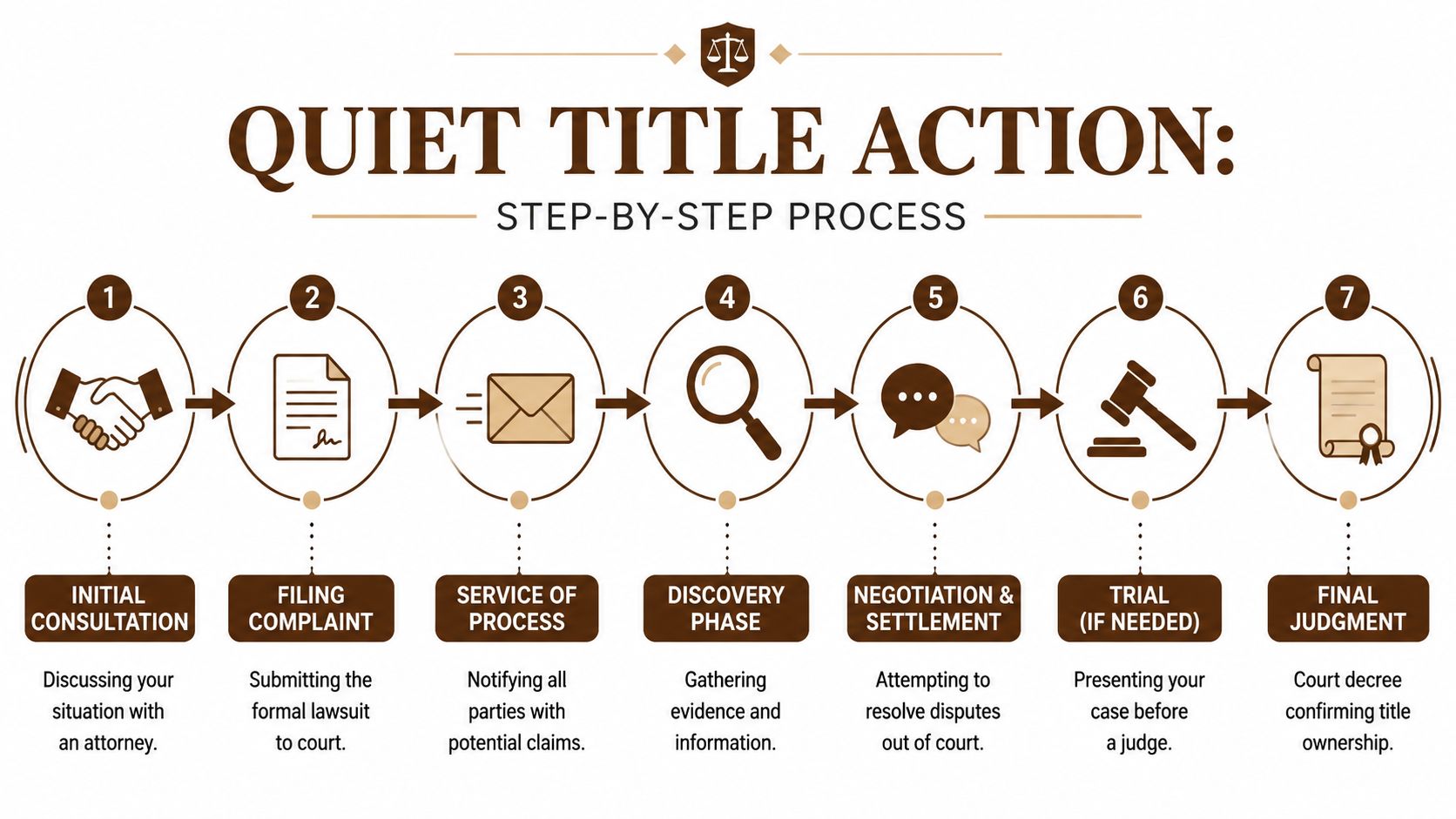
Most clients feel better once they understand the path. Quiet title is still demanding, but the process becomes less intimidating when you can see the sequence and know where delays usually happen.
A straightforward overview helps. This visual lays out the major stages.
Step one through filing
The case usually starts before anything is filed. The owner and counsel gather deeds, probate records, trust documents, loan papers, title reports, tax records, maps, and any correspondence that explains the claimed defect.
Then comes the first major filter: identifying everyone who may claim an interest. In quiet title work, missing a party can undermine the value of the final judgment. A judgment is powerful against parties to the case, but its practical reach depends heavily on accurate title work and complete joinder.
After that investigation, the complaint is drafted and verified. Because California requires a more specific pleading structure, the complaint needs to identify the property, the plaintiff's claim, the adverse claims, and the date for which title is sought.
For many families, this is the point where the case stops feeling informal. The story has to be converted into legally precise allegations.
A short video can help you visualize how the lawsuit fits into the broader property dispute process.
Service proof and court review
Filing the complaint doesn't clear title. Service matters just as much.
Known defendants must be served properly. Unknown claimants may require additional steps depending on the facts and procedural posture. This is one reason a case that looks uncontested can still become slow. The court needs confidence that interested parties were brought in correctly before entering a judgment that affects land ownership.
Then comes the proof problem. Even if a defendant never responds, the plaintiff still needs an affirmative evidentiary showing. Quiet title isn't a default-driven shortcut.
Typical work in this stage includes:
- Document assembly: Deeds, probate orders, title records, payment history, maps, and supporting declarations.
- Claim analysis: Determining whether the issue is ownership-based or could be solved another way.
- Hearing preparation: Organizing evidence so the judge can enter a judgment that is legally sufficient and recordable.
Some of the longest delays come from issues clients didn't know existed at the start, such as a missing heir, a bad legal description, or uncertainty about an older deed in the chain of title.
How long it usually takes
A quiet title action in California is often worth pursuing only when the ownership issue is significant, because the process can be both slow and expensive. This California quiet title cost and timing discussion notes that straightforward, uncontested cases commonly take 3 to 9 months and involve about $1,500 to $5,000 in legal fees, with filing fees commonly around $300 to $500 and attorney rates often in the $200 to $400 per hour range. The same source explains that contested matters can run 12 to 18 months or longer.
That data reflects an important truth. Quiet title is designed for finality, not speed.
Here is a practical snapshot:
| Case posture | What to expect |
|---|---|
| Uncontested case | Often shorter, but still requires proper pleading, service, and evidence |
| Contested case | Usually longer because the court must resolve competing factual or legal claims |
| Probate-related case | May involve added complexity if title history and heirship records are incomplete |
For families in Southern California, the takeaway is simple. If a title issue threatens a pending sale, a refinance, or estate distribution, don't wait until the last minute. A quiet title action can solve the problem, but it rarely solves it instantly.
How to Win Your Quiet Title Case The Burden of Proof
Many people think filing the lawsuit is the hard part. Often it isn't. Proving the case is harder.
In California, a quiet title plaintiff may need to prove superior title by clear and convincing evidence, which is a higher standard than the usual civil preponderance standard. This explanation of California's burden of proof in quiet title cases also notes that the action is equitable, there is no right to a jury trial, and judgment is not automatic even if defendants default. The court still requires an affirmative evidentiary showing.
Why simple facts are not enough
Clients often say some version of the same thing: “I've lived there forever,” “My mother left it to me,” or “The debt was already paid.” Those facts may matter, but they don't decide the case by themselves.
Quiet title asks a narrower legal question. Can the plaintiff prove a title interest that is superior to the adverse claim? That usually requires a chain of documents and testimony that fit together cleanly.
A judge will want more than a believable story. The judge will want reliable proof that explains how title moved from one person to another, where the defect occurred, and why the plaintiff's claim should control over any competing interest.
What judges usually want to see
The strongest cases usually combine several categories of evidence rather than relying on one item alone.
- Recorded title documents: Deeds, releases, probate orders, and other recorded instruments often form the backbone of the case.
- Estate and trust records: In inheritance disputes, wills, trust documents, and court orders can help explain who succeeded to the property interest.
- Financial and possession records: Mortgage payments, tax payments, insurance, and maintenance history can support the factual background, even if they don't replace title documents.
- Witness testimony or declarations: Family members, prior owners, neighbors, or professionals may help explain gaps or mistakes in the record.
A quiet title case is won when the evidence tells one consistent ownership story and leaves little room for a competing version that survives scrutiny.
Common ways cases weaken
Some cases fail or stall because the proof is incomplete, not because the client is wrong.
Watch for these recurring problems:
- The wrong defendants were named. A strong claim can still produce a weak judgment if interested parties were omitted.
- Service was incomplete. Courts are cautious about entering title judgments without confidence that notice was handled correctly.
- The legal description is inconsistent. If the property itself isn't described precisely, the remedy may not match the problem.
- The evidence shows possession, not title. Living in a property and caring for it are not always enough to establish superior legal title.
That's why a quiet title action in California can be difficult even when the facts seem one-sided. The court isn't just resolving a family disagreement. It is entering a judgment meant to affect the chain of title itself.
Quiet Title vs Other Solutions Partition and Corrective Deeds
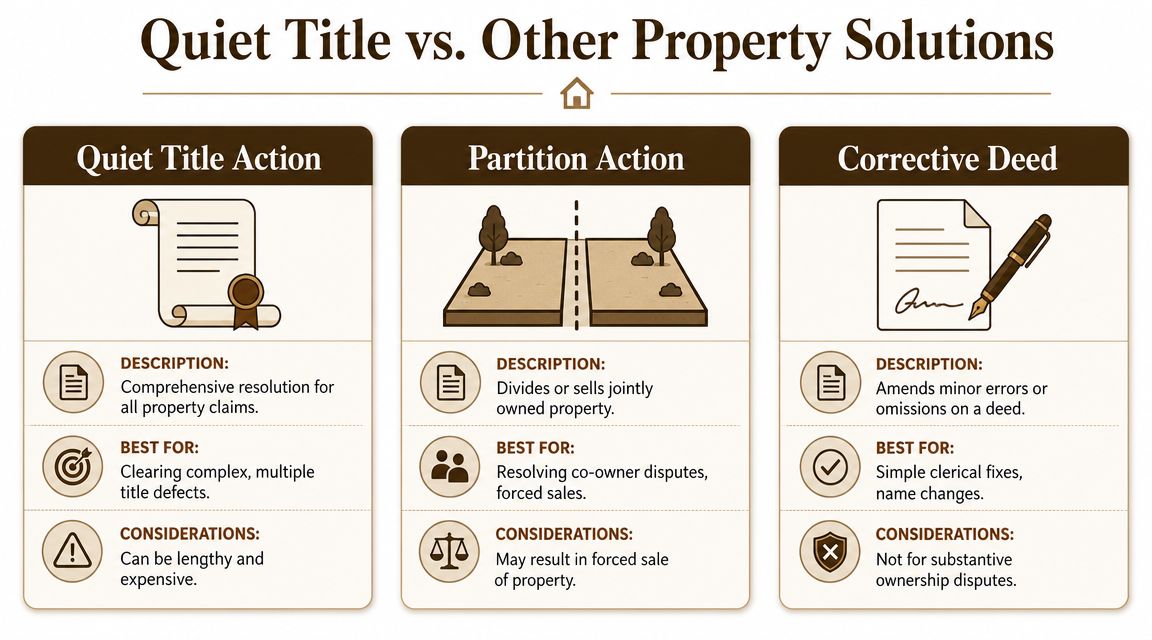
A quiet title action is powerful, but it isn't always the first or best move. Some disputes need a narrower tool. Others need a different lawsuit entirely.
Families often save time, cost, and frustration by asking one question early: Is the problem a defective record, a disagreement over ownership, or a dispute between co-owners about what to do with the property?
When a corrective deed may be enough
Sometimes the issue is clerical, not adversarial.
If everyone agrees on ownership and the problem is a misspelled name, a minor recording error, or another straightforward defect that the proper parties can voluntarily correct, a corrective deed may solve the problem without a full quiet title lawsuit.
That option only works when cooperation exists and the defect is limited. It doesn't work well when one signature is unavailable, one claimant disputes ownership, or the title company sees a deeper break in the chain.
When partition is the real dispute
Partition is different because the dispute usually isn't “Who owns it?” The dispute is “We both own it, but we can't agree what happens next.”
That situation appears often with inherited California property. Siblings or relatives may all have interests, but one wants to sell, another wants to keep the home, and another has been living there without a clear agreement. In that setting, a partition action may be the better vehicle because it addresses co-ownership deadlock rather than title clarity alone.
A practical decision guide
Here's a plain-language way to think about the options:
| Problem | Often the better fit |
|---|---|
| Minor deed error and everyone agrees | Corrective deed |
| Co-owners agree on ownership but not on use or sale | Partition action |
| Competing claims, broken chain of title, disputed interest | Quiet title action |
One overlooked point matters here. A quiet title action may be slower and more expensive than a narrower fix when the defect is documentary rather than ownership-based. Strategic lawyering isn't about choosing the biggest tool. It's about choosing the right one.
If you're facing an inherited property problem, don't assume the answer is automatically quiet title. Sometimes it is. Sometimes a cleaner path exists.
Frequently Asked Questions About Quiet Title Actions
A family in Southern California often reaches this section after months of frustration. The house is still in a parent's name. One sibling wants to sell. Another is living there. The title company says there is a problem, and everyone asks the same question: if we know whose house this really is, why is fixing the title so hard?
Because title problems are rarely just paperwork problems. They are proof problems. They are notice problems. They are sometimes family history problems that finally surface when someone dies, a refinance is denied, or a sale falls apart.
Can I file my own case
California allows self-representation, but quiet title is one of the harder property cases to handle without counsel.
The complaint must be verified and detailed. It usually needs the correct legal description of the property, a clear statement of how you claim title, and identification of every person or entity that may claim an adverse interest, including unknown claimants when appropriate. That is where many self-filed cases start to wobble. A street address is not enough. A family understanding is not enough. A stack of partial documents is often not enough.
The true test comes later. A quiet title judgment needs to solve the title problem in a way a title company, buyer, or lender can use. If the wrong party was served, if probate records do not line up with the deed history, or if the evidence leaves gaps in the chain of title, you can spend months in court and still end up with a result that does not fully clear the property.
In probate-related cases, this happens more often than families expect.
What happens in local Southern California courts
Orange, Los Angeles, Riverside, and San Bernardino Superior Courts apply the same California statutes, but the day-to-day experience can still differ. Hearing availability, filing preferences, courtroom procedures, and judges' expectations about declarations and exhibits are not always identical.
That matters in practical ways. Quiet title cases often look simple on paper, especially when no one in the family expects a fight. Courts do not decide these cases based on family consensus alone. Judges want an orderly record that shows how title moved from one person to another, who received notice, and why the court has a legal basis to enter judgment.
A helpful comparison is a chain with one weak link. Even if every other link is strong, that one gap can keep the whole chain from doing its job. In court, one missing heir, one defective deed description, or one unexplained transfer can create the same problem.
What about taxes and the final judgment
The lawsuit does not stop the ordinary burdens of owning or controlling real estate. Property taxes, insurance, mortgage payments, maintenance, and security issues still need attention while the case is pending. If the home is part of a probate dispute, families also need to be realistic about who is paying expenses and whether everyone agrees on possession and upkeep.
The judgment is the goal, but it is not magic. It works like a court-issued reset of the ownership record for the claims and parties covered by the case. If the record going in is sloppy, the result may be narrower than the family expected. If the investigation is careful and the right parties are brought in, the judgment can put the property in a much better position for sale, refinancing, settlement, or estate planning.
That is why quiet title often feels harder than it “should” be. The court is not just accepting your story. The court is testing whether the public record can be corrected in a way that holds up later.
If you're dealing with a title problem involving probate, inherited real estate, a co-owner dispute, or a cloud on title in California, Tanner Law can help you evaluate whether quiet title is the right solution or whether a narrower path may work better. Schedule a free consultation to discuss your property, your documents, and your options under California law.