Will Execution Checklist: 8 Steps for California
You've printed the will, gathered the family, and assumed a signature will finish the job. Then probate starts, and the court asks a different question. Was this document signed correctly, witnessed correctly, and preserved as an original under California law?
An Orange County family learns that lesson when a typed will sits unsigned in a drawer. The wishes are clear on the page, but an unsigned typed document can't control distribution the way a properly executed will can. A Los Angeles family in a similar position plans the signing in advance, preserves the original, and tells the executor where to find it, avoiding a costly search and delay.
A useful will execution checklist does more than remind you to sign. California Probate Code Sections 6100, 6110, 6111, 6120, 6240, and 8200 work together on capacity, signatures, witnesses, revocation, self-proving affidavits, and custody after death. The eight steps below follow that sequence in plain language, so you can prepare the document, run the signing, and spot the points that need an attorney's review before anyone picks up a pen.
Table of Contents
- 1. Testamentary Capacity and Age Requirement
- 2. Written Form and Proper Signature by the Testator
- 3. Two Qualified Witnesses for a Typed or Non-Holographic Will
- 4. Holographic Will Requirements
- 5. Self-Proving Affidavit and Attestation Clause
- 6. Dating, Revoking, and Updating Prior Wills and Codicils
- 7. Secure Storage and Locating the Original Will
- 8. Avoiding Interested Witnesses, Undue Influence, and Fraud
- Will Execution Checklist: 8-Point Comparison Guide
- Protect the Document Before Probate Begins
1. Testamentary Capacity and Age Requirement
A California will starts with the person, not the paper. The testator, meaning the person making the will, must be at least 18 years old and of sound mind under California Probate Code Section 6100. In plain terms, that person should understand they're making a will, know in general what they own, know who their family members and likely beneficiaries are, and understand how the will gives property away.
Capacity is judged at signing, not months before or after. That's why timing matters for someone with fluctuating health, medication changes, or memory problems. A clear-headed morning signing with contemporaneous notes is far easier to defend than a late-night signing during illness.
Consider a 79-year-old client in Orange County who meets her attorney alone first. She answers open-ended questions about her children, her home, and her investment accounts in her own words, and the attorney records those answers. In a Los Angeles contest after a late-stage illness, by contrast, medical records from the signing week become central because the family disputes whether the testator understood the document at that moment.

How to document capacity at signing
- Schedule at the testator's best time: Choose a time when alertness is strongest, often earlier in the day.
- Ask for an explanation, not yes answers: Have the testator describe what they own and who receives it.
- Record neutral observations: Note demeanor, coherence, and apparent understanding without coaching legal conclusions.
- Address health concerns promptly: If capacity may be questioned, consider a physician's letter close to the signing date.
- Avoid impaired signing: Don't proceed if medication or illness appears to affect judgment that day.
This evidence doesn't replace legal advice or a medical assessment. It preserves what people observed while memories are fresh.
2. Written Form and Proper Signature by the Testator
California requires a will to be in writing and signed. An oral statement about who should inherit isn't a substitute, and printing a polished template doesn't make it effective by itself. The signature is the act that gives the document legal effect, and it should be tied to the final version you intend to operate.
The testator signs personally where possible. California also allows another person to sign at the testator's direction and in the testator's presence when the testator can't sign. The United Kingdom's long-standing model in section 9 of the Wills Act 1837 uses that same directed-signature idea and requires an apparent intention that the signature give effect to the will. It's a useful historical comparison, not California law, and it shows why intent and presence are separate checklist items.
Version control before anyone signs
A Santa Ana resident types a will, prints it, and signs alone at home. For a typed, non-holographic will, that missing witness step can leave the document invalid and push the estate toward intestacy, meaning California's default distribution rules for people who die without a valid will. A client who cannot hold a pen presents the opposite problem. Her directed signature can work if the statutory steps are followed precisely and documented at the time.
Mark drafts as drafts and bring only the final version to the signing table. Number pages in a format such as Page 3 of 7, consider initials on each page as a practical safeguard against page substitution, and use the signature the testator normally uses on legal documents. California doesn't strictly require initials on every page, but they help prove which pages were present.
A short review of the final printout catches mismatched names and missing pages before they become probate exhibits.
3. Two Qualified Witnesses for a Typed or Non-Holographic Will
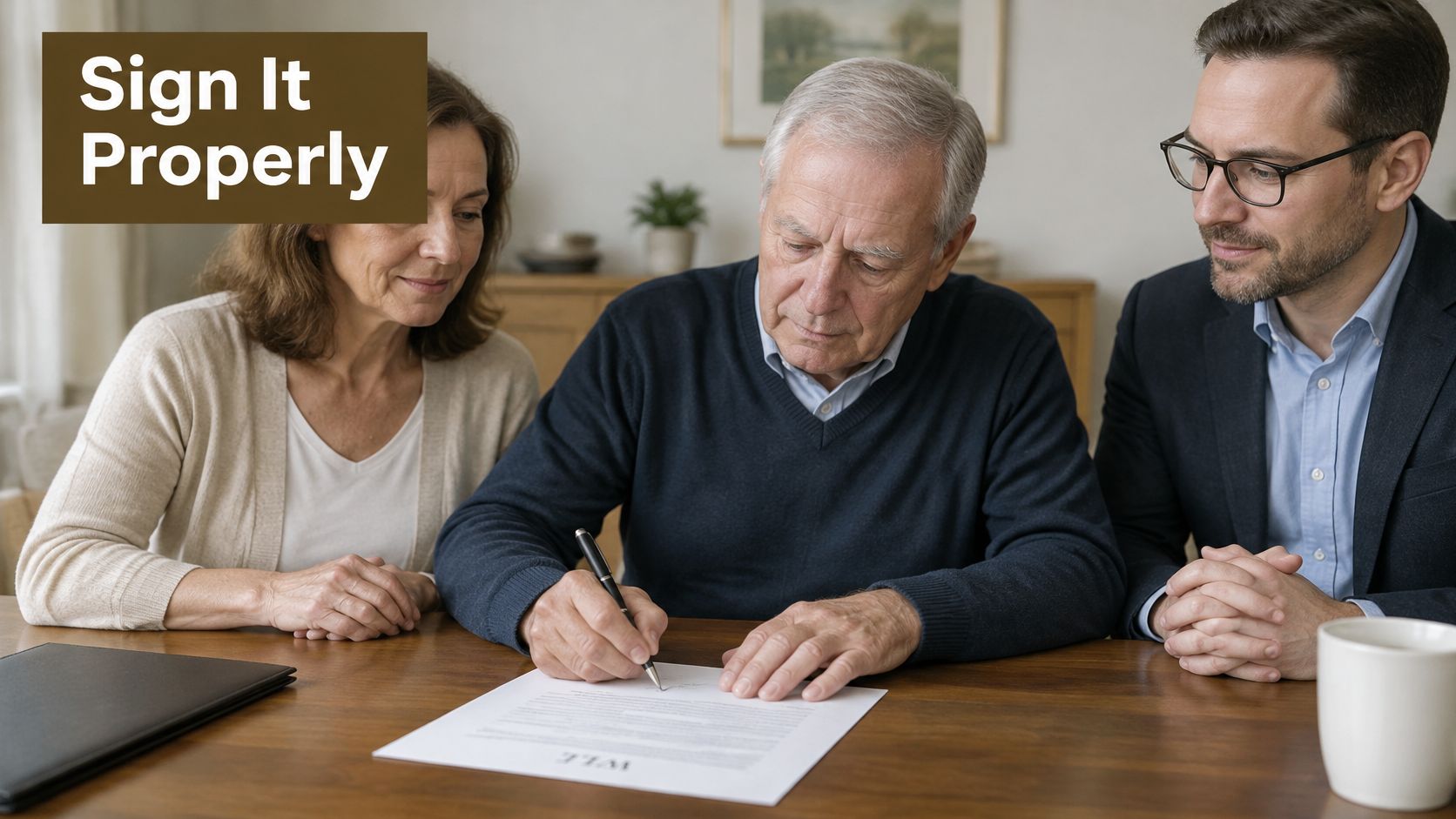
For a standard witnessed will, California's core rule is specific about sequence and presence. Under California's witnessed will statute in Probate Code Division 6, the will must be signed by at least two people who are present at the same time, and each witness must observe the testator sign or receive the testator's acknowledgment of the signature or of the will. Each witness must also understand the document is the testator's will.
That means two signatures collected on different days don't automatically equal compliance. Your will execution checklist should confirm the final document, simultaneous presence, signing or acknowledgment in front of both witnesses, and witness signatures after they understand what they're witnessing.
The video below is a helpful visual reminder of why the signing should be run as one coordinated event, not a series of hallway signatures.
In a Los Angeles estate, a kitchen-table will signed with only one witness present is found defective, and property passes under intestacy instead of the testator's plan. A law firm signing avoids that risk by using two staff members with no interest in the estate, both present throughout, who print their names and current addresses beside their signatures.
Practical rule: Keep both witnesses in the room from acknowledgment through their own signatures, and record their full contact details that day.
Witnesses don't need to read the will or know its contents. They do need to be identifiable later, which is why legible printed names, addresses, and phone numbers in the file matter as much as the signatures themselves.
4. Holographic Will Requirements
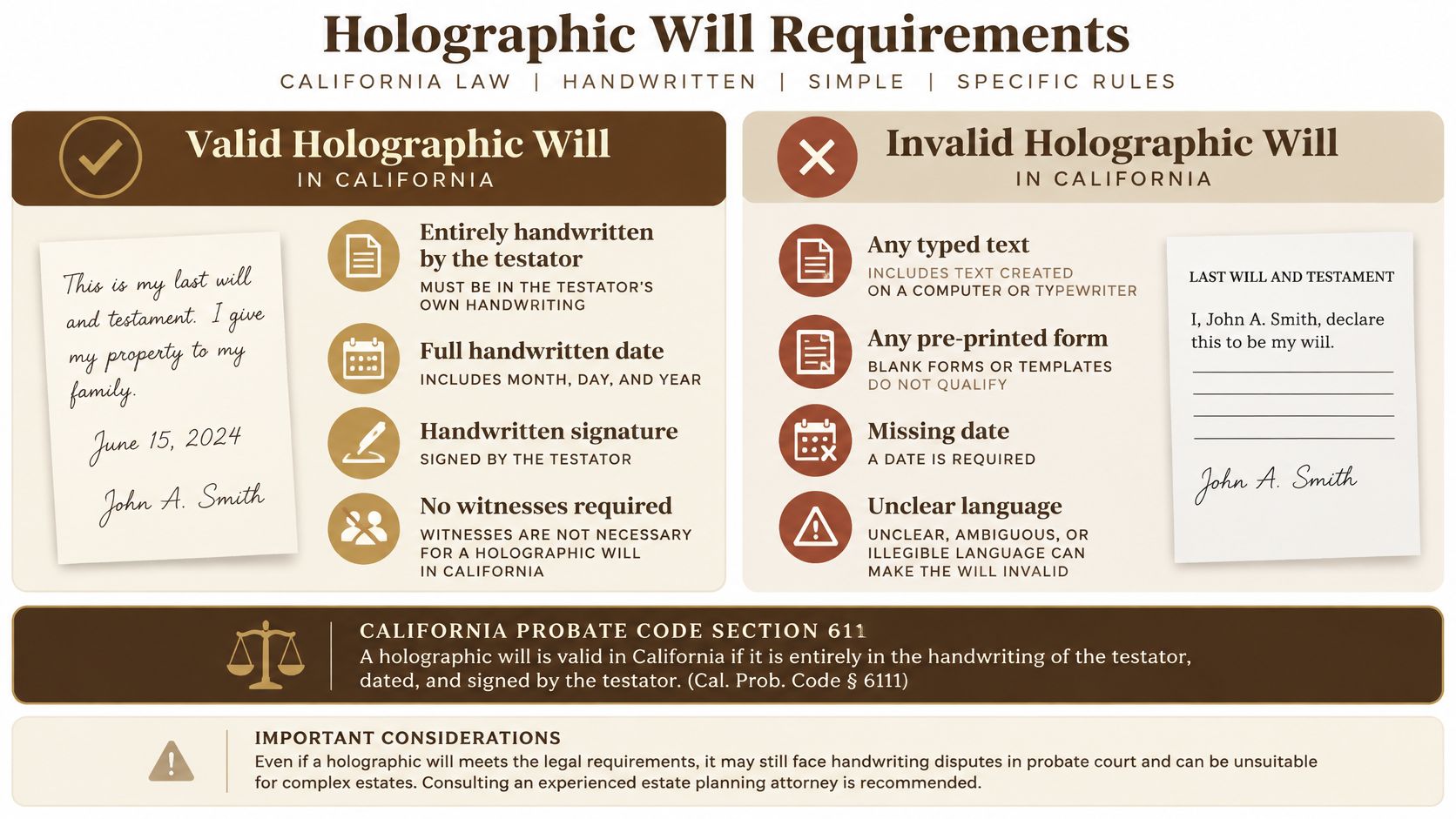
A holographic will is California's handwritten exception. Under Probate Code Section 6111, the material provisions, signature, and date should be in the testator's handwriting, and witnesses aren't required for that route. The trade-off is proof. Without witnesses, the court and family may need handwriting evidence, and vague language can create disputes a formal will would have avoided.
Don't mix procedures. California's statutory will form is a separate route. Under California's statutory will provisions, a person who is at least 18 and of sound mind completes the appropriate blanks and signs, and each witness observes the signing and then signs in the testator's presence. Printing or notarizing that form alone doesn't make it effective.
Where handwritten wills succeed and fail
A man handwrites a one-page will, dates it, signs it, and leaves his savings to his sister. A California court may admit it even without witnesses because the handwritten requirements are met, although relatives can still contest authenticity or capacity. A woman who prints an internet form and fills in blanks faces greater risk because printed text can undermine treatment as a holographic will.
- Write it entirely by hand: Include the date and signature in the same handwriting and don't rely on printed text.
- Use a complete date: Write the month, day, and year so later documents can be sorted by time.
- Store and disclose the location: Tell a trusted person where the original is kept.
- Replace it when you can: A formal witnessed will is usually clearer and easier to prove.
A holographic will can be a valid emergency bridge. It shouldn't be the long-term plan for real estate, minor children, or blended families in Orange County or Los Angeles.
5. Self-Proving Affidavit and Attestation Clause
An attestation clause is the statement near the signatures describing that the testator signed and the witnesses attested. A self-proving affidavit goes further. It's a sworn statement signed by the testator and witnesses under penalty of perjury confirming proper execution, and Probate Code Section 6240 is the California provision commonly associated with that affidavit language in the statutory will context.
The practical payoff appears years later. If witnesses have moved, died, or cannot be located, a properly completed affidavit can help the will move through probate without first tracking those witnesses down to testify. A Los Angeles family probating a father's will benefits when the affidavit is attached and complete. An Orange County estate faces less delay for the same reason when both witnesses now live out of state.
Treat each statutory element as its own control point. In David Horton's study of 2,453 Alameda County estates filed between 2008 and 2010, summarized in Horton's research on will formalities and harmless error, California's 2009 partial harmless-error rule had only a minimal effect on litigation rates. Don't plan to be rescued by harmless error. Mark each item completed, not applicable, or escalated for attorney review.
Use reviewed affidavit language rather than improvising your own. Have the testator and both witnesses sign during the same session, include printed names and addresses, and keep the affidavit attached to the original. Separating those pages creates an avoidable authenticity question.
6. Dating, Revoking, and Updating Prior Wills and Codicils
Dates decide which document controls when a family finds three versions in three places. Put a clear execution date on the will, state what happens to earlier documents, and keep a private inventory of prior wills and where they're stored. A new will should usually say, in substance, I revoke all prior wills and codicils.
Under Probate Code Section 6120, revocation can occur through a later will or codicil that expressly revokes the earlier document or is inconsistent with it. Physical destruction with intent to revoke is another route, but it's fact-sensitive and can generate exactly the kind of dispute you're trying to prevent. A written revocation clause is cleaner evidence.
A codicil is a formal amendment, not a note in the margin. It must satisfy the signing requirements that apply to a will. Handwritten arrows, crossed-out names, and undated sticky notes on the original are a reliable way to create litigation over whether a change was intended, completed, or later revoked.
Two version problems families actually face
A Santa Ana client signs a will in 2010 and another in 2019 expressly revoking the first. The court can apply the later document with confidence. Another testator writes unsigned changes in a margin years later, and the court leaves the original provisions in place because those marks weren't executed as a codicil.
Remote and electronic methods add another version risk. As a state-by-state guide to signing a will online explains in background terms, video witnessing, electronic signing, and a paper original are legally distinct issues, and rules vary materially by state. Recent 2025 to 2026 developments moved in different directions across jurisdictions, so don't combine another state's electronic procedure with a California probate plan.
Review the will after marriage, divorce, a birth, a death in the family, or a real estate purchase. Small changes deserve a formal codicil. Major changes usually justify a new will.
7. Secure Storage and Locating the Original Will
Execution isn't finished when the ink dries. Probate usually needs the signed original, and a clean copy in an email folder isn't the same thing. Scan the executed will for reference, log where the original went, record who has custody, and make sure a later draft cannot replace it in the file.
Under Probate Code Section 8200, a person who has custody of a deceased person's will must deliver it to the proper court or the named executor without unreasonable delay after learning of the death. That duty is hard to satisfy if nobody knows the document exists. Tell the executor and one trusted family member where the original is, how to access it, and which attorney holds a copy.
Research on 443 San Francisco probate administrations, available through empirical research following estates from drafting through distribution, supports focusing on whether intent, authenticity, and compliance are easy to prove. A custody log, controlled PDF copy, witness contact sheet, and documented storage location make that proof faster.
A Los Angeles family spends weeks searching after a mother's death because the only original is in a safe deposit box only she could access. An Orange County client avoids that bottleneck by storing the original in an attorney vault and giving his executor written retrieval instructions.
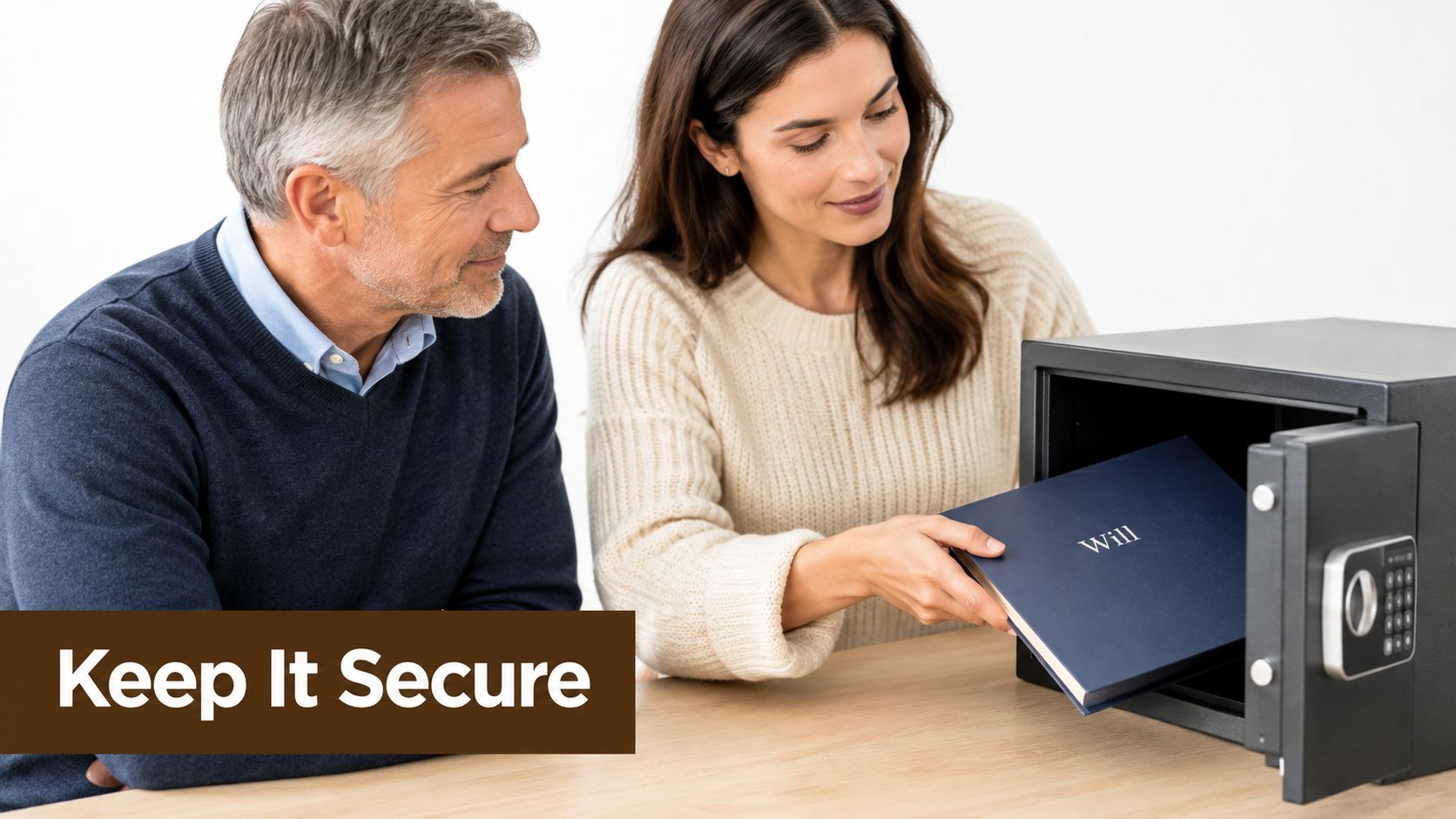
Use a fireproof home safe or attorney vault the executor can reach. Don't remove staples or pages from the original, because altered fastening can raise questions about substitution.
8. Avoiding Interested Witnesses, Undue Influence, and Fraud
Formal compliance alone doesn't end risk. A will can be signed and witnessed yet still face claims of undue influence, fraud, duress, forgery, or incapacity. Undue influence means pressure that overcomes the testator's free will. It isn't proved merely because a distribution is unusual or one child receives more than another.
Beneficiary witnesses create a separate problem. Under Probate Code Section 6112, a beneficiary who also serves as a witness may lose part or all of that gift unless enough other disinterested witnesses sign. The simplest control is to use two disinterested adult witnesses who receive nothing under the will and aren't carrying out a beneficiary's instructions.
Preserve evidence about the surrounding circumstances, not just signatures. Guidance collected in the Australian Law Reform Commission discussion of wills and elder abuse identifies capacity and knowledge of contents as core issues and highlights missing information about interpretation and understanding. For multilingual families in Los Angeles and Orange County, record who interpreted, what language was used, and whether the testator explained the document back accurately.
A properly witnessed will can still become expensive litigation if nobody documented who was present, who gave instructions, and whether the testator acted freely.
A Riverside County testator changes her will after a new companion begins managing finances, controlling rides, and attending appointments. That involvement supports a later undue influence challenge. In an Orange County matter, a beneficiary serves as a witness without two other disinterested witnesses, putting that beneficiary's gift at risk.
Keep beneficiaries out of private instruction meetings. Meet the testator alone, ask for reasons behind major gifts or exclusions, and obtain independent advice when a caregiver or new relationship benefits. Under Probate Code Section 6104, a will procured by undue influence isn't valid, so independence should be visible in the file.
Will Execution Checklist: 8-Point Comparison Guide
| California Will Requirement | 🔄 Implementation Complexity & Resources | ⭐ Expected Outcome & Key Advantage | 📊 Main Risk or Limitation | 💡 Ideal Use Case / Practical Tip |
|---|---|---|---|---|
| Testamentary capacity and age (Probate Code §§ 6100, 6100.5) | Moderate; testator must be at least 18 and understand the will, property, and likely beneficiaries when signing. | Establishes a sound basis for the will and helps defend against capacity challenges. | Capacity may be disputed, especially if health or cognition fluctuates. | Sign during a clear-headed period; consider documenting the testator's understanding. |
| Written will and proper signature (Probate Code § 6110) | Low to moderate; prepare a written document and have the testator sign it correctly. | Records the testator's wishes clearly; page initials are a useful safeguard. | An unsigned or improperly signed document may be ineffective; oral wills generally do not qualify. | Use a final written version and follow the required execution steps. |
| Two qualified witnesses for a typed will (Probate Code § 6110) | Moderate; two adults generally need to witness or acknowledge the signing and sign in each other's presence. | Provides independent evidence of proper signing and voluntariness. | Missing or improperly participating witnesses can jeopardize validity. | Choose disinterested adult witnesses and record their names and addresses. |
| Holographic will (Probate Code § 6111) | Low immediate effort; the will must be entirely handwritten, dated, and signed by the testator. | Can be made without witnesses, including in an emergency. | Printed or typed text, unclear terms, or handwriting disputes may complicate probate. | Consider only when a formal witnessed will is impractical; replace it when possible. |
| Self-proving affidavit and attestation clause (Probate Code §§ 6240, 8220) | Moderate; testator and witnesses complete the applicable affidavit together; notarization is not required in California. | Can allow probate without witness testimony, saving time and effort. | Does not prevent challenges based on capacity, fraud, or undue influence. | Use the statutory form and keep it attached to the original will. |
| Dating, revoking, and updating wills or codicils (Probate Code §§ 6120, 6121) | Moderate; date new documents, expressly revoke prior wills, and execute codicils with required formalities. | Clarifies which document reflects current wishes; codicils can make limited amendments. | Multiple versions or informal handwritten changes can create disputes. | Review after major life changes and state expressly that prior wills and codicils are revoked. |
| Secure storage of the original will (Probate Code § 8200) | Low to moderate; use secure storage while ensuring the executor can locate and access the original. | Protects the document and can help avoid delays in probate. | The original may be lost, damaged, or inaccessible; copies are generally not a substitute. | Tell the executor where it is stored and avoid relying on a restricted safe deposit box. |
| Avoiding interested witnesses, undue influence, and fraud (Probate Code §§ 6104, 6112, 21380) | Moderate to high; use disinterested witnesses and protect the testator's privacy and independence. | Helps preserve the testator's choices and reduce the risk of a will contest. | Improper influence or beneficiary-witness issues may invalidate a will or affect gifts. | Keep beneficiaries out of private planning and signing discussions; consider independent legal advice. |
Protect the Document Before Probate Begins
The strongest will execution checklist ends with a result your executor can prove, not merely a signature your family hopes a court will accept. Before the signing, confirm the testator is at least 18, appears to have capacity, and has reviewed the final version in a language the testator understands. Check beneficiary names against identification and property records where appropriate, confirm the nominated executor is willing to serve, and decide in advance whether you're executing a typed witnessed will, a statutory form, or a holographic will. Mixing those routes mid-signing is where avoidable defects begin.
During the signing, slow down. Confirm everyone's identity, keep the required witnesses present together, and follow the signing or acknowledgment sequence without side conversations that distract from who observed what. The testator signs the intended final document, witnesses understand it's the testator's will, and witnesses sign with printed names and addresses. If an attestation clause and self-proving affidavit are included, complete them in the same session and keep every page together. If someone must sign at the testator's direction, if an interpreter is used, or if capacity or influence concerns appear, stop treating the appointment as routine and document the exception for attorney review.
Afterward, treat custody as part of execution. Scan the signed original, label copies as copies, and log the original's exact location. Record the execution date, document version, witness contact information, and delivery instructions in one place the executor can find. Tell the executor and a trusted family member how to retrieve the original after death, because California custody duties under Section 8200 are difficult to meet when the document is effectively hidden. Don't place the only original in a safe deposit box nobody else can access, and don't make handwritten edits on it later.
Finally, calendar the review. A will that fit before a marriage, divorce, birth, death, business sale, or home purchase may not fit afterward, and informal notes won't reliably update it. Use a properly executed codicil for a limited change or a new will with an express revocation clause for a broader revision. California law gives families workable routes, but each route has its own formalities, and probate judges see the paper record long after the testator can explain it.
Tanner Law assists families throughout Orange County and Los Angeles with California will execution, probate, and related estate-planning and real estate concerns. Schedule a free consultation to have your document, witness plan, affidavit, and storage arrangements reviewed before the original is signed.
If you're preparing to sign a California will in Orange County or Los Angeles, Tanner Law can review the final document, witness procedure, self-proving affidavit, and storage plan before a preventable defect reaches probate. Visit Tanner Law to schedule a free consultation and discuss your will, probate, or estate-planning questions directly.