What Is an Undivided Interest in California Property Law
An undivided interest means each co-owner has rights to possess and use the entire property, not a physically carved-out room, lot, or parcel. Under California law, co-owners may hold different percentage shares while still owning the whole property concurrently.
A common Orange County probate dispute begins with a family home. A parent dies, two siblings inherit the property, and one sibling moves into the house while the other lives elsewhere. The sibling in the house may feel that occupancy gives them control. The sibling outside may believe their inherited share entitles them to a specific bedroom, garage, or portion of the land. Neither assumption is automatically correct.
The deed, the form of co-ownership, the probate documents, and California partition law determine what each person can do. Those rules affect whether an owner can transfer an interest, how an inheritance passes, who must contribute to expenses, and whether a court can order a sale or other resolution.
For families and investors in Los Angeles and Orange County, the practical questions are usually direct:
- Who owns what?
- Can one owner sell without the others?
- Can an owner live in the property or rent it out?
- What happens when someone dies?
- Does a percentage interest equal the same percentage of the property's cash value?
- Can an owner force a buyout, division, or sale?
Understanding the answers early can prevent a disagreement from becoming probate litigation or a partition lawsuit. California law provides established ways to address shared ownership, but the right strategy depends on the title documents and the parties' conduct.
Table of Contents
- Introduction to Undivided Interests for California Co-Owners
- What an Undivided Interest Means Under California Law
- How Undivided Interests Work in Tenancy in Common and Joint Tenancy
- Rights and Responsibilities of Owners Who Share an Undivided Interest
- Valuation and Financial Realities of Fractional Undivided Interests
- California Rules for Taxes Probate and Subdivided Lands
- Protecting Your Ownership Rights and Next Steps in California
Introduction to Undivided Interests for California Co-Owners
Families often encounter undivided interests during emotionally difficult transitions. A Los Angeles parent may leave a residence to several children. An Orange County couple may purchase property with relatives. Investors may acquire one property together without physically dividing the land. In each situation, the owners can hold separate legal interests in one undivided asset.
The word “undivided” describes the property, not necessarily the percentage. A person can own a smaller percentage interest and still have rights that extend across the entire property. The Cornell Legal Information Institute's explanation of undivided interests states that the interest “encompasses the whole property” rather than a separate physical part.
That distinction matters most when owners have different expectations. One heir may think a larger percentage gives them an exclusive right to the primary bedroom. Another may assume that living elsewhere means they gave up possession. Without a written agreement or court order, those conclusions may not match California's rules governing concurrent ownership.
Why probate creates confusion
When a deceased owner held property as a tenant in common, that person's interest generally becomes part of the estate and may pass under a will or through intestate succession. The surviving co-owners don't automatically receive that interest merely because they already own the same property. Joint tenancy can produce a different result because it includes a right of survivorship, but the deed must be examined carefully.
The family also has to address practical matters, including mortgage payments, property taxes, insurance, repairs, occupancy, and possible sale. A personal representative may need to protect the estate's interest while communicating with the other owners.
Practical perspective: Title determines the starting point, but written agreements, payment records, occupancy, and communications often shape the dispute that follows.
This guide explains the concept in plain English, compares tenancy in common with joint tenancy, outlines the rights and duties of co-owners, and addresses valuation, California property tax treatment, probate, and subdivided-land rules. Owners who understand those pieces can make a more informed decision about cooperation, a negotiated buyout, or partition.
What an Undivided Interest Means Under California Law
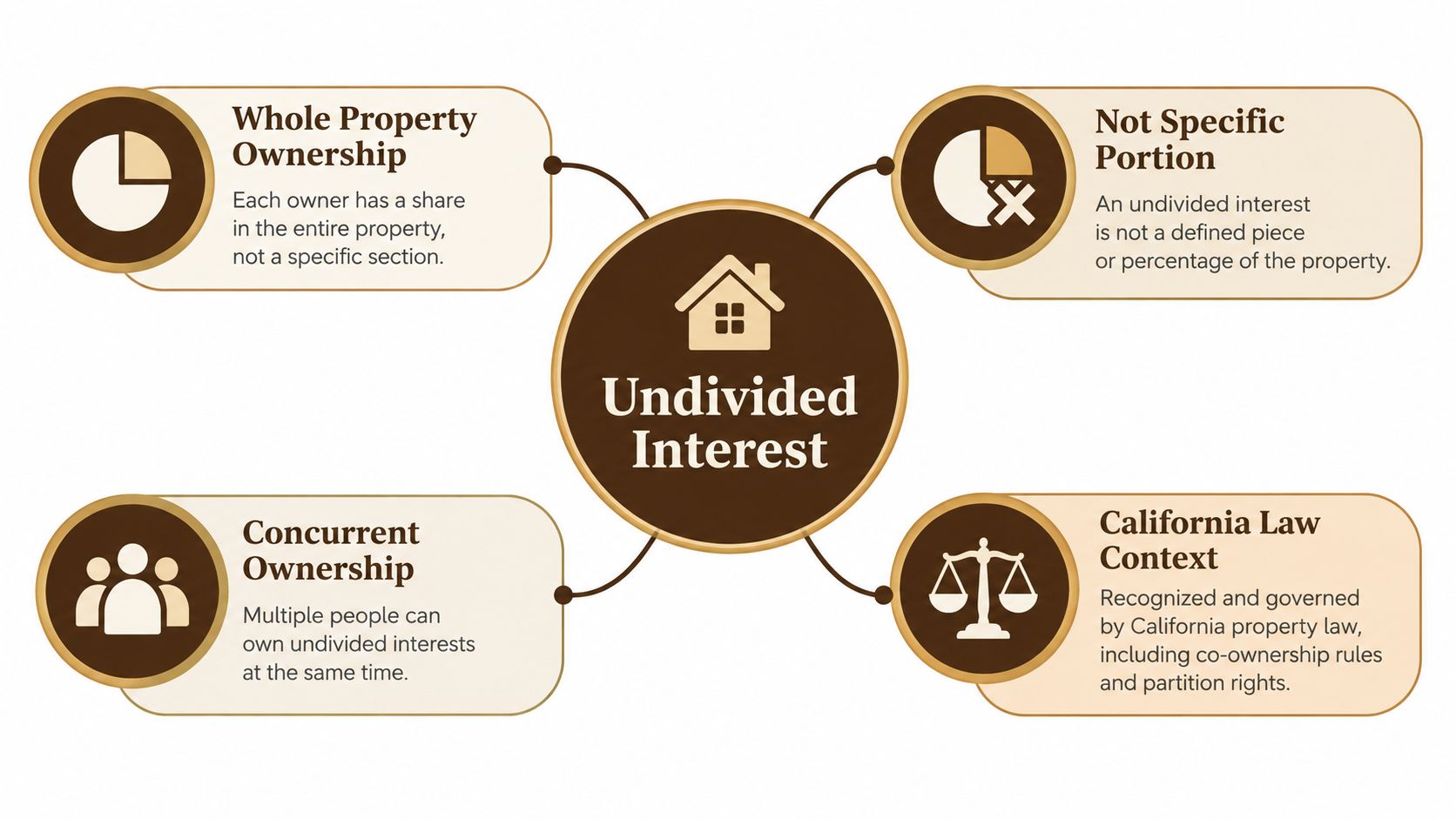
Think of a property as one whole pie. An undivided interest gives each owner a legal interest in the entire pie, not ownership of a physically separated slice. The owners may have unequal percentages, but the land itself hasn't been divided merely because the title lists different shares.
California property law treats an undivided interest as a right connected to the whole property. The Cornell Legal Information Institute explains that an undivided interest “encompasses the whole property” and isn't divided into physical parts. That means an owner generally can't claim exclusive ownership of a particular room, driveway, lot segment, or boundary because that location seems to correspond with their percentage.
Percentage ownership is not physical possession
Separate the concept into two questions:
- What percentage does each owner hold? This can affect economic distributions, responsibility for expenses, and the share received after a sale or partition.
- What part of the property may each owner use? Each co-owner generally has a right to possess and use the whole property, subject to the equal rights of the others.
For example, if siblings own a house with unequal interests, the larger-interest sibling doesn't automatically receive exclusive use of the larger bedroom or a particular section of the yard. The smaller-interest sibling still holds rights in the entire house and lot. The owners can change that practical arrangement through a valid agreement, but the percentage alone doesn't create a physical boundary.
Why the distinction matters
An undivided interest can exist even though no survey has created separate parcels. A transfer of one owner's interest also doesn't automatically divide the land. The buyer steps into the transferring owner's legal position and acquires an interest in the whole property, subject to the rights of the other co-owners.
This principle supports both tenancy in common and joint tenancy. The two forms differ in important ways, especially at death and upon transfer, but both involve concurrent ownership of the whole property. A deed review is therefore essential before anyone promises a room, accepts a buyout figure, or signs a sale agreement.
How Undivided Interests Work in Tenancy in Common and Joint Tenancy
California co-owners most often need to distinguish between tenancy in common and joint tenancy. Both involve undivided possession rights, but they produce different consequences when an owner transfers an interest or dies.
Historically, the underlying idea has deep roots in English common law. Joint tenancy was identified as early as the early 13th century and included an undivided interest in the entire estate plus survivorship rights. The historical discussion of undivided ownership and joint ownership also describes later developments, including the Law of Property Act 1925 in England and Wales.
| Feature | Tenancy in Common | Joint Tenancy |
|---|---|---|
| Ownership shares | May be equal or unequal | Generally equal shares are associated with the joint-tenancy structure |
| Possession | Each owner has rights to possess the entire property | Each owner has rights to possess the entire property |
| Transfer during life | An owner may generally sell, gift, or devise their interest independently | A transfer may affect the joint tenancy, so the deed and transaction require careful review |
| Death | The deceased owner's interest generally passes through a will or intestate succession | The right of survivorship generally sends the deceased owner's interest to the surviving joint tenants |
| Physical division | No physical division occurs merely because shares differ | No physical division occurs merely because the joint tenancy exists |
| Estate planning effect | The interest can become part of the probate or trust plan | Survivorship may control the disposition outside the deceased owner's estate plan |
Tenancy in common
A tenant in common owns a separate legal share, but that share remains undivided across the property. One owner may hold a greater percentage than another, yet both retain concurrent possession rights. A tenant in common can generally transfer their interest without first physically subdividing the land.
This form often appears in family inheritance and investment arrangements. It can also create disputes when a deceased owner's heirs become new co-owners with relatives who were already on title.
Joint tenancy
Joint tenancy includes the right of survivorship. When one joint tenant dies, the surviving joint tenants generally take the deceased owner's interest under the survivorship arrangement rather than through ordinary inheritance. That result can conflict with a person's expectations if they assume a will controls every interest in the property.
The deed's exact language matters. A title search should confirm whether the owners hold as joint tenants, tenants in common, or under another arrangement. A family shouldn't rely on verbal statements or assumptions based only on who paid the down payment.
Rights and Responsibilities of Owners Who Share an Undivided Interest
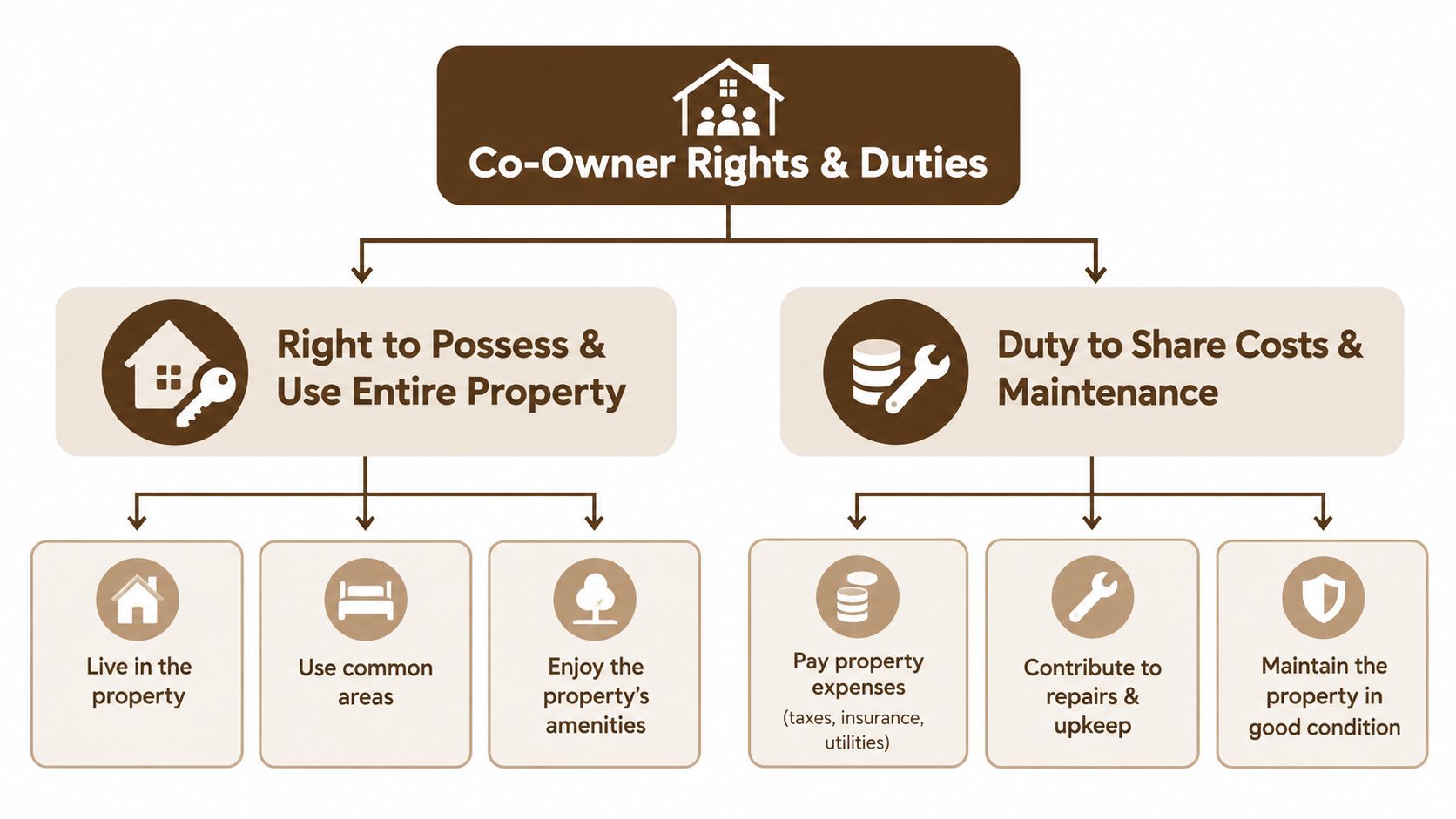
Concurrent ownership gives every co-owner meaningful rights, but it also requires cooperation. Each owner generally may possess and use the entire property, while respecting the equal possession rights of the others. One owner can't lock out another owner because they hold a smaller percentage or because they pay more of the expenses.
The University of Houston property-law materials on undivided interests describe the central practical tension: an interest can be transferred or partitioned even while possession remains shared. That combination makes undivided ownership flexible, but it can also make conflict difficult to manage.
Use, access, and exclusion
An owner may live in the property, enter it, and use shared areas, subject to the other owners' rights. If one person occupies the property alone, the parties should document whether that arrangement is temporary, whether rent or an occupancy credit applies, and how expenses will be handled.
A co-owner who excludes another without a valid agreement may create a serious legal issue. The details matter, including whether the excluded owner requested access, whether locks changed, and what communications occurred.
Expenses and property decisions
Owners should keep records for:
- Property taxes and insurance
- Mortgage and other secured debt
- Necessary repairs and maintenance
- Utilities and operating costs
- Rental income or other proceeds
- Improvements approved or rejected by the co-owners
The ownership percentage may matter when allocating money, but it doesn't automatically give one owner unilateral authority over the entire property. A written co-ownership agreement can establish decision procedures, occupancy terms, reimbursement rules, and sale conditions.
Shared ownership requires shared records. Keep invoices, canceled checks, bank statements, rental agreements, photographs, and written approvals in one organized file.
Transfers and partition
A tenant in common can generally sell, gift, or devise an undivided interest. That transaction transfers the legal interest, not a particular physical section of the property. The new owner becomes part of the co-ownership relationship and may acquire possession rights that affect everyone.
When cooperation fails, partition is the principal legal exit. Partition can involve a physical division when appropriate or a sale followed by distribution of proceeds. California practice also recognizes a structured buyout path under the Partition of Real Property Act, which may provide a way for eligible co-owners to purchase another owner's interest rather than proceeding directly toward an outside sale. The precise procedure depends on the property, title, pleadings, and applicable law.
Valuation and Financial Realities of Fractional Undivided Interests
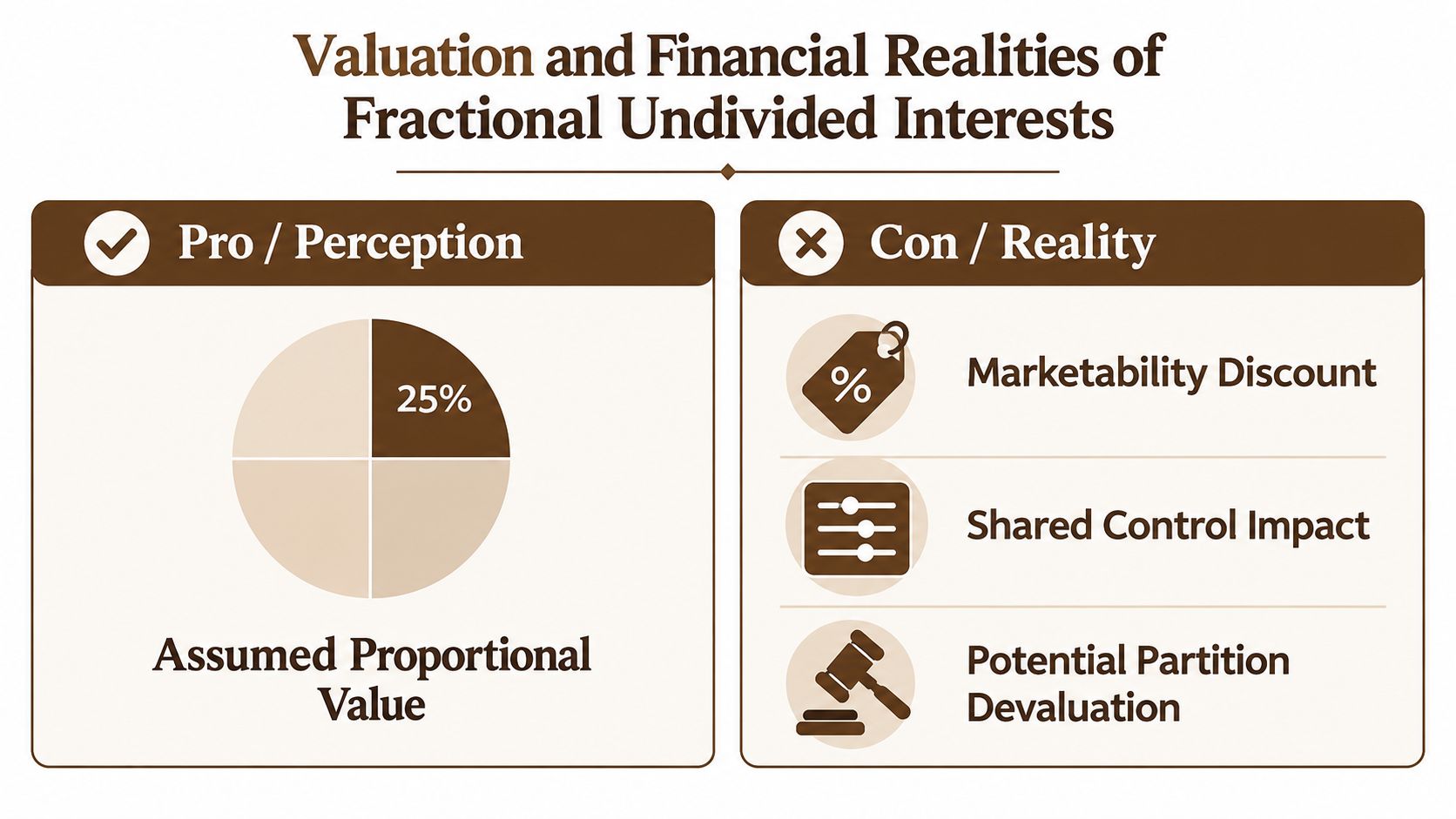
A percentage on a deed doesn't always translate into the same percentage of the property's unrestricted market value. A person may assume that a 25% undivided interest equals exactly 25% of the property's sale value, but a buyer evaluating only that fractional interest may consider practical limitations that don't apply to a buyer acquiring the entire property.
The discussion of undivided-interest valuation identifies marketability, shared control, and partition risk as factors that can affect pricing. Those factors matter in California probate, family settlements, trust administration, and negotiated buyouts.
Why a fractional interest may sell differently
A buyer of a fractional interest may not control:
- Whether the property is sold
- How the property is managed
- Which repairs are approved
- Whether another owner occupies the property
- How quickly the buyer can obtain liquidity
Those limits can reduce the pool of willing buyers. A buyer may also evaluate the cost and uncertainty of negotiating with co-owners or pursuing partition. The result isn't automatic, and no single discount applies to every property or transaction.
Probate and buyout negotiations
An appraisal for the entire property may be a necessary starting point, but it may not answer the buyout question by itself. The parties should identify whether they are valuing the whole property, a specific undivided interest, or the economic result after costs, liens, expenses, and a potential sale.
A personal representative also has fiduciary responsibilities to the estate. They shouldn't accept or reject a buyout without understanding the title, the estate's obligations, available valuation evidence, and the interests of all beneficiaries.
Tax and liquidity questions
Tax treatment can differ from private-market value. A county assessor may reassess a transferred portion under California rules, while the parties' negotiated price reflects control and marketability concerns. Owners should coordinate with a qualified appraiser and tax professional before relying on a percentage calculation for a probate distribution or estate plan.
California Rules for Taxes Probate and Subdivided Lands
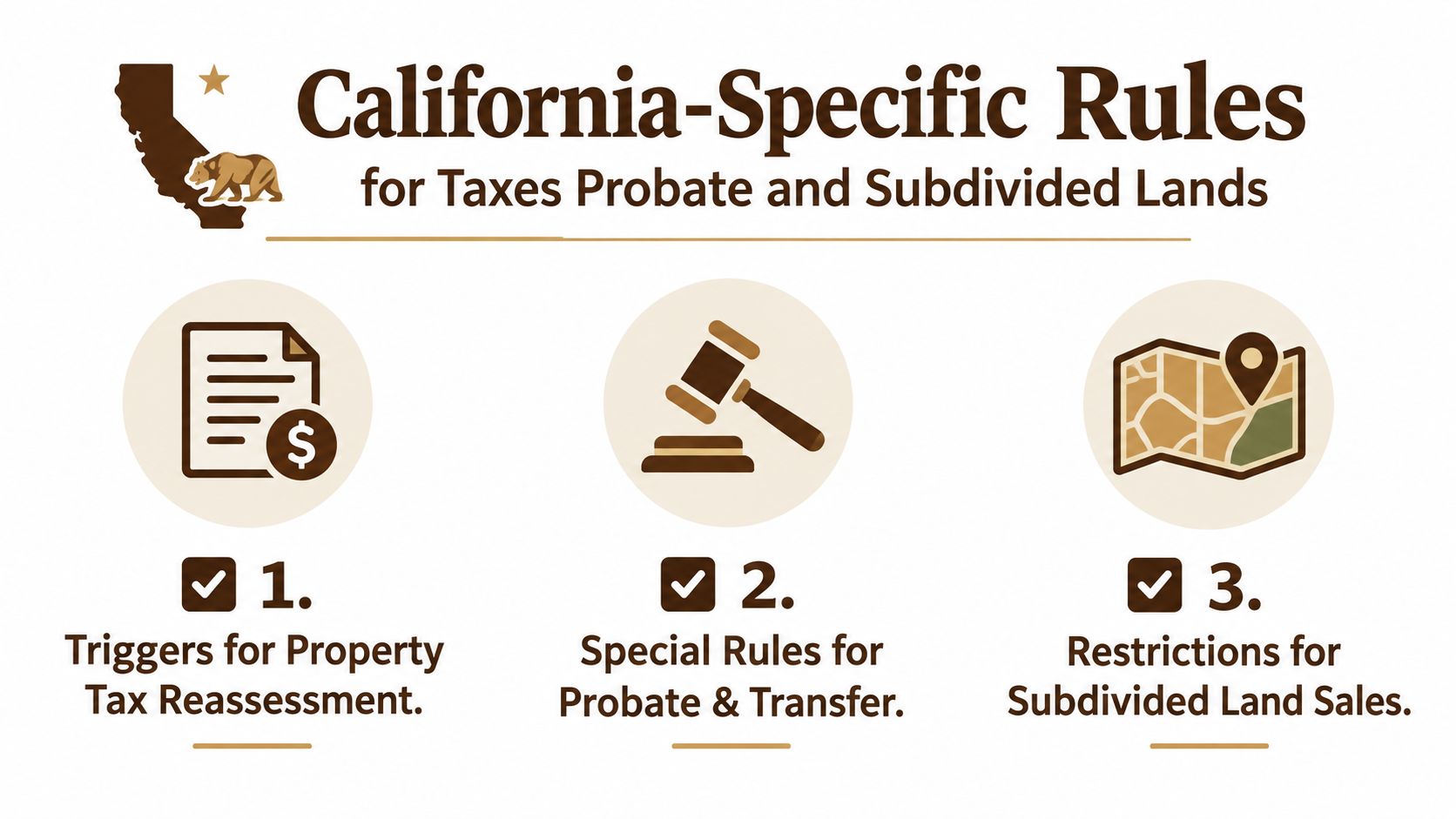
California law treats undivided interests through several different systems. Property tax assessment, probate administration, and the regulation of subdivided land each address a different risk. Combining them can produce mistakes, especially when a family transfers interests informally.
Property tax reassessment
California property tax guidance states that a transfer of an undivided interest generally causes reassessment of only the portion transferred. The California property tax guidance on transferred undivided interests identifies an exception when the transferred interest is less than 5% of the total property value and worth under $10,000. It also states that a 1% undivided interest is reappraised when its value is at least $10,000.
Those thresholds can make a seemingly small transfer legally significant. Before signing a deed, the owner should ask how the transaction will be reported and whether a parent-child, trust, or other exclusion could apply based on the specific facts.
California guidance also explains that a tenant in common can't compel a separate assessment of their undivided interest, and the assessor isn't required to separately assess every cotenant's share. The California assessment annotation on cotenancy addresses that treatment.
Probate partition
If a decedent leaves an undivided interest, California Probate Code section 9823 allows the personal representative to bring or face a partition action involving the property. The California Probate Code provision on partition during administration means probate doesn't always preserve the property as one family asset. A court proceeding may divide the property or result in a sale, depending on the circumstances.
Subdivided lands
California's Business and Professions Code includes within “subdivided lands” and “subdivision” a parcel in which five or more undivided interests are created or proposed for sale, lease, or financing. The California statute addressing subdivided lands and undivided interests also provides an exemption pathway for purchases by no more than 10 people who sign a statement acknowledging risks and waiving protections. Another exemption applies when interests are created by a valid court order or decree.
These rules make professional review important before marketing or creating fractional interests. A transaction that looks like a private family arrangement may still raise regulatory questions.
Protecting Your Ownership Rights and Next Steps in California
Start with the title documents. Obtain the current deed, identify every owner, confirm each recorded interest, and review any trust, probate order, loan document, or co-ownership agreement affecting the property. A title report can reveal liens, transfers, and recorded restrictions that informal family records won't show.
Then document the practical relationship. Write down who occupies the property, who pays taxes and repairs, whether anyone receives rent, and whether the parties want a sale, continued ownership, or a buyout. Avoid relying on oral promises about a bedroom, driveway, rental income, or future inheritance.
A practical decision path
- Cooperation remains possible: Use a written agreement covering access, expenses, repairs, insurance, income, and decisions.
- One owner wants to leave: Obtain an appraisal that addresses the interest being transferred, not just the property as a whole.
- An heir wants a buyout: Confirm authority to negotiate, account for liens and expenses, and document the final transfer.
- Owners cannot agree: Evaluate partition, including whether a structured buyout procedure may apply.
- A transfer is planned: Review California reassessment and subdivided-land rules before recording or marketing the transaction.
California law offers mechanisms to resolve co-ownership disputes, but a rushed deed or unsupported valuation can create additional litigation. Owners in Orange County and Los Angeles should obtain advice before excluding a co-owner, accepting a fractional-interest offer, or filing a partition action. Tanner Law handles real estate disputes, partition matters, probate issues, and related ownership conflicts, so the right legal and practical questions can be addressed together.
Tanner Law offers direct guidance on California undivided-interest disputes, including title review, probate-related ownership questions, negotiated buyouts, and partition litigation. Visit Tanner Law to schedule a free consultation about your Orange County or Los Angeles property situation.