What Is a Probate Claim and How It Works in California
A probate claim is a creditor's formal demand for payment from a deceased person's estate. In California, it generally must be filed with the probate court and served on the personal representative, not merely mailed to the family.
Suppose a contractor finishes work for a homeowner, a doctor provides treatment, or a lender is waiting for repayment, and the person who owed the money dies. The creditor may feel that the debt is obvious, but the family usually can't write a check from estate property. The estate must identify valid debts, address competing claims, and follow California probate procedures before assets are distributed.
A probate claim creates that formal record. It gives the personal representative an opportunity to evaluate the debt, gives the court a way to monitor the process, and helps prevent heirs from receiving property before legitimate obligations are addressed. Filing a claim does not guarantee payment. The estate may reject it, or it may lack enough money to pay every approved creditor.
Table of Contents
- Understanding What a Probate Claim Really Is
- How the Filing Process Works Step by Step
- California Deadlines Every Creditor Must Know
- Allowance, Rejection, and What Each Result Means
- When the Estate Cannot Pay Everyone
- Common Claim Types and the Documentation That Matters
- How a California Probate Attorney Helps at Every Stage
Understanding What a Probate Claim Really Is
A contractor completes work, sends an invoice, and then learns that the homeowner has died. The contract may establish a valid debt, but payment must still pass through the estate's claims process. A probate claim is a creditor's formal demand for payment from a deceased person's estate. In California, the creditor generally files it with the probate court and provides a copy to the court-appointed personal representative, rather than sending a bill to the decedent's relatives. The California Probate Code section 9100 provides the governing filing framework.
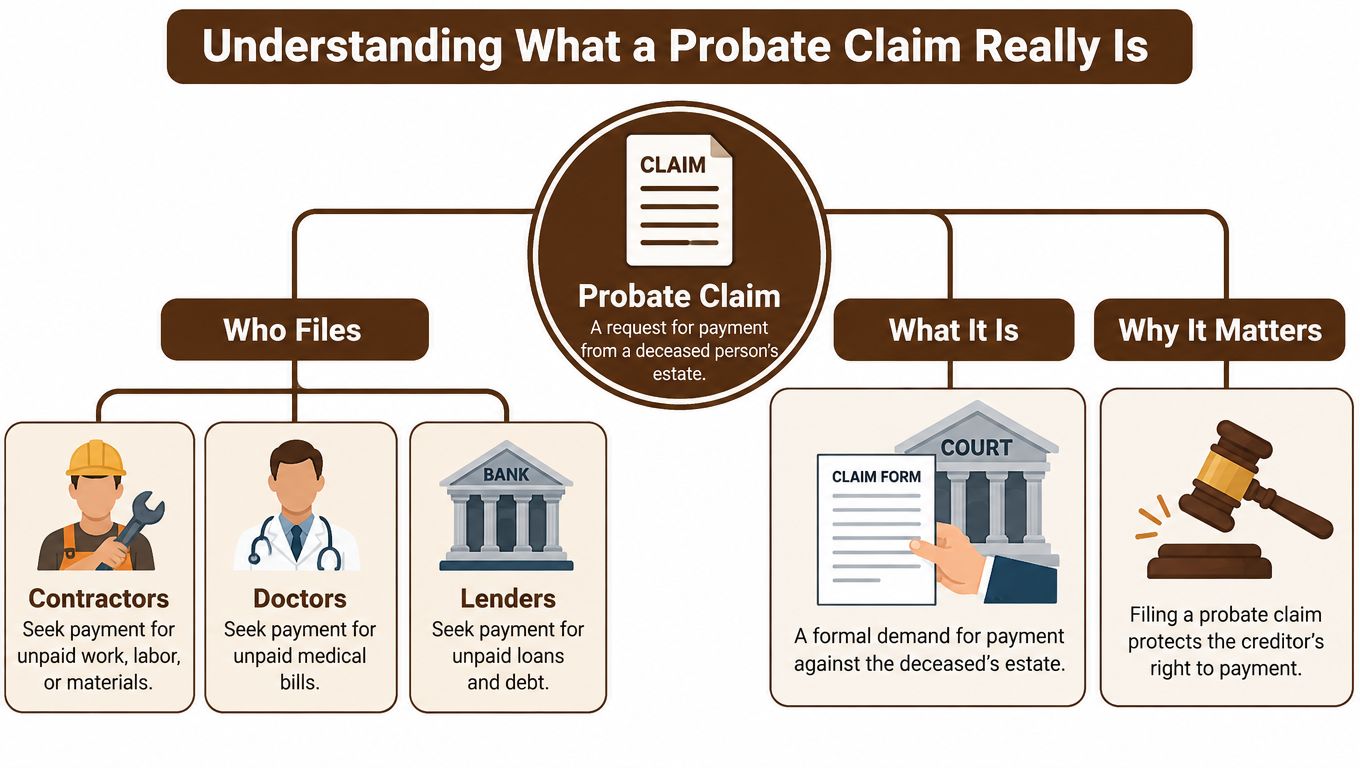
The same process can apply to an unpaid loan, medical bill, lease obligation, judgment, or another legally enforceable debt that belonged to the decedent. The claim creates a formal record and gives the estate a defined way to examine the obligation.
Why the court process matters
The personal representative, sometimes called an executor or administrator, gathers estate property, reviews debts, and handles distributions. The representative must evaluate each claim on its legal merits, including whether the evidence supports it, whether the amount is accurate, and whether the estate has enough assets to pay it.
This screening system serves both creditors and heirs. A legitimate creditor receives a structured opportunity to seek payment. Heirs receive protection against distributions made before valid debts are addressed.
Practical rule: A bill sent to the family is not the same thing as a properly filed probate claim.
If the representative allows the claim, the debt may be paid from estate property under California's payment rules and subject to available assets. If the representative rejects it, the creditor generally must pursue the dispute through a separate lawsuit. Allowance therefore addresses whether the estate recognizes the debt, while payment also depends on priority and solvency. A filed claim can secure a place in that review without guaranteeing that money will be available.
How the Filing Process Works Step by Step
California generally uses Judicial Council form DE-172 for a creditor's claim. The claimant must identify the legal basis of the debt, itemize the charges, state when the obligation arose, and specify the amount requested. The official California creditor's claim form DE-172 also helps identify the supporting information the estate needs to review the demand.
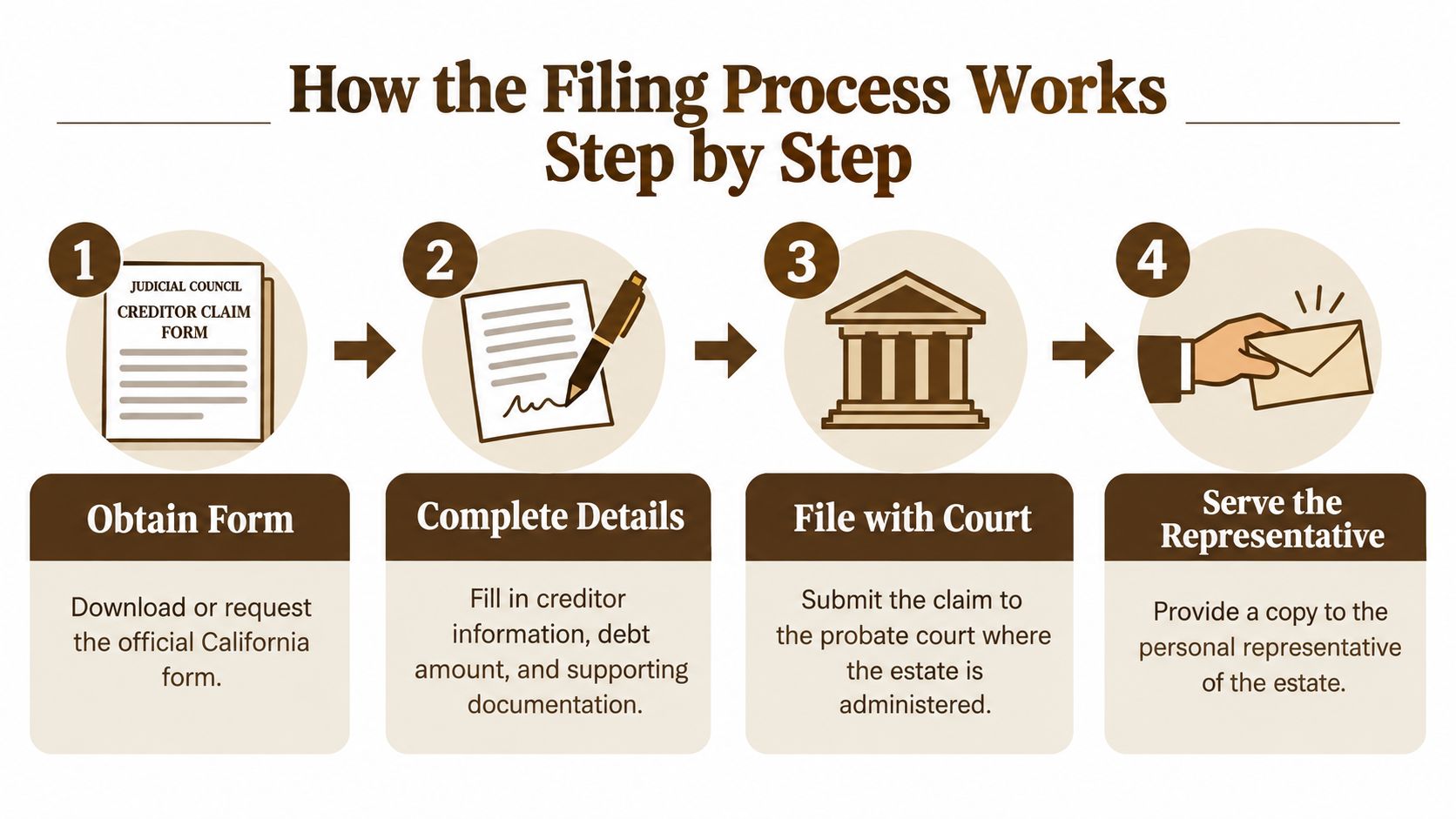
A careful filing usually follows this sequence:
Confirm the estate and the debt: Find the probate case, identify the personal representative, and determine the legal basis for the obligation. A creditor should distinguish the decedent's debt from expenses incurred after death, because most post-death debts aren't included in the ordinary claim process, with funeral claims treated differently.
Complete DE-172 accurately: State who the creditor is, what the decedent owed, when the obligation arose, and how the balance was calculated. An unexplained total makes it harder for the representative to determine whether the amount is valid.
Attach useful evidence: Include contracts, invoices, account statements, payment histories, proof of performance, and relevant correspondence. If the debt is based on a note or another written instrument, the claimant should attach the original or a copy and explain why the original isn't available.
File and serve the claim: File the completed claim with the probate court and deliver a copy to the personal representative and the representative's attorney. Filing without the required delivery can leave the claim defective.
The distinction between filing and service matters. California law treats both as part of presenting the claim. A creditor should keep stamped copies, delivery records, and proof showing when the representative and counsel received the documents.
The form doesn't replace legal analysis. A lender may need to address security for a loan. A contractor may need to show completed performance. A medical provider may need records supporting the balance. Clear documentation lets the representative evaluate the validity, amount, and priority of the demand rather than guessing what the creditor is claiming.
For a visual explanation of the paperwork and sequence, this California probate claim filing video provides an additional practical reference.
California Deadlines Every Creditor Must Know
A creditor may have a valid debt and still recover nothing if the claim arrives late. California treats probate claims as a court-regulated screening process. The deadlines determine whether the personal representative and court will consider the claim, while the estate's available assets and payment priority determine whether an allowed claim is paid.
Under California Probate Code section 9100, the main filing deadline generally falls on the later of two dates:
- Four months after letters are first issued to a general personal representative.
- 60 days after notice of administration is mailed or personally delivered to the creditor.
The creditor must also serve the claim as required. Filing and service work together, so missing either requirement can make the claim invalid. This timing rule does not extend another applicable statute of limitations or revive an underlying claim that was already barred.
Filing is only the first deadline
The calendar continues after submission. If the personal representative rejects the claim, the creditor generally has three months from the rejection date to file a lawsuit, subject to an outside one-year limit from the decedent's death under the applicable California procedure. The rejection date should be recorded carefully because it can start a separate deadline for court action.
California law provides limited relief for some late claims. Probate Code section 9103 may allow a court to consider relief when required notice was not provided or when the creditor did not learn facts giving rise to the claim until shortly before the deadline. Relief is not automatic, and it is unavailable after the court orders final distribution. The California statute addressing late claims shows why a creditor should act as soon as the debt becomes known.
| Trigger | Deadline | Source |
|---|---|---|
| Letters issued to a general personal representative | Later of four months after issuance or the notice-based date | Probate Code section 9100 |
| Notice of administration mailed or personally delivered | 60 days after the creditor receives notice, when this is the later controlling date | Probate Code section 9100 |
| Claim rejected | Generally three months to file suit, subject to the outside limit stated above | Probate Code section 9150 |
| Final distribution ordered | Late-claim relief is no longer available | Probate Code section 9150 |
A practical deadline log should include the date letters issued, the date notice was received, the filing and service dates, and any rejection date. These dates can overlap, and a missed deadline may reduce or eliminate recovery even when the debt itself is genuine.
Allowance, Rejection, and What Each Result Means
After a claim is filed, the personal representative must allow or reject it, in whole or in part, in writing. The decision must be filed with the court clerk, and notice must be given to the creditor. California Probate Code section 9250, summarized in the statutory provisions governing allowance and rejection, requires the written decision to contain important estate and claim information.
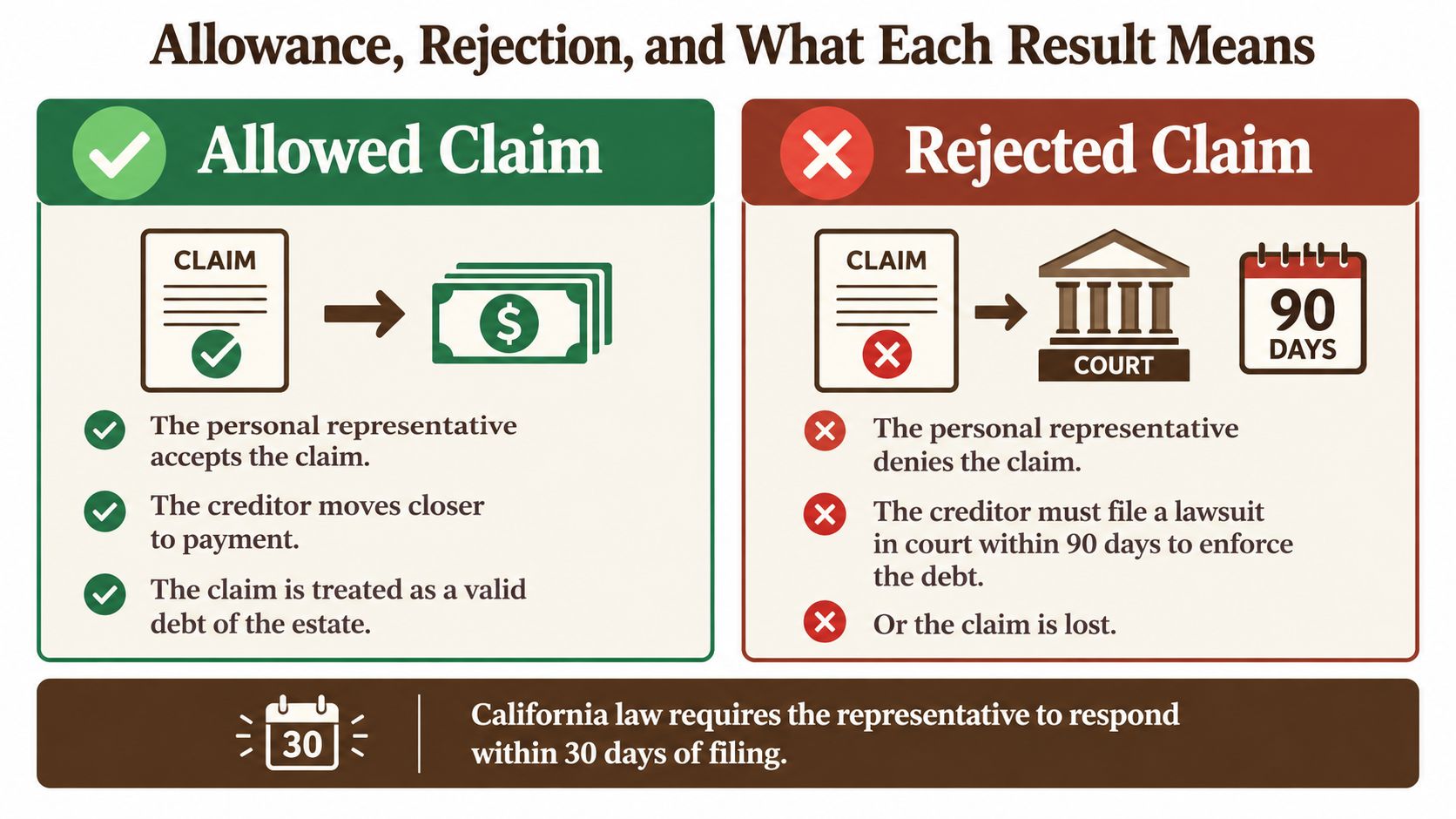
The practical outcomes differ:
| Result | What it means | What the creditor should consider |
|---|---|---|
| Allowed in full | The representative accepts the claim as presented. | Payment still depends on estate assets and payment priority. |
| Allowed in part | The representative accepts only some of the claimed amount. | Review the calculation and preserve the right to challenge the unpaid balance. |
| Rejected | The representative disputes all or part of the claim. | The creditor generally must act in court within the applicable statutory period. |
| No timely action | The representative, court, or judge fails to act within the statutory response period. | The creditor may elect to treat the inaction as a rejection on the 30th day. |
The written allowance or rejection identifies the creditor, total claim, date letters were issued, date of death, estimated estate value, amount allowed or rejected, and whether the representative has authority under the Independent Administration of Estates Act. It also states that the creditor has 90 days to act on a rejected claim under section 9250.
Silence isn't acceptance. If the representative or court fails to act within 30 days after filing, the creditor may elect to treat the inaction as a rejection on the 30th day. That choice should be handled carefully because the creditor's next step may involve litigation, settlement discussions, or both.
A rejection isn't the end of the debt. It is the point at which the creditor must protect enforcement rights through the correct procedural response.
When the Estate Cannot Pay Everyone
An allowed claim isn't a promise that money will arrive. California court guidance explains that when an estate lacks enough money to pay every claim, state law determines the payment order, and an allowed claim may remain unpaid if the estate is insolvent. The Orange County Superior Court's probate guidance addresses this practical limitation.

Think of probate as a payment queue, not a check-writing exercise. The representative may need to identify and sell estate property, account for administration expenses and taxes, and determine which creditors have priority. A secured creditor may have rights connected to collateral that an ordinary unsecured creditor doesn't have, while an unsecured creditor generally looks to the remaining estate assets after higher-priority obligations are addressed.
What insolvency changes
If the estate has insufficient value, several questions become important:
- Is the debt secured or unsecured? A lien or other security interest may affect how the creditor seeks recovery.
- What expenses come first? Administration expenses and taxes can affect what remains for ordinary creditors.
- Must property be sold? Real estate or other assets may need to be liquidated before the representative can determine distributions.
- Did someone pay estate expenses personally? A family member who advanced funds may have a separate reimbursement claim, but the legal basis and timing require review.
- Should a rejection be challenged now? Waiting may allow the litigation deadline to expire, even if the estate's asset picture is still developing.
A creditor should not assume that approval places the claim ahead of other debts. Nor should a representative pay one familiar creditor just because the debt is undisputed. Payment decisions must account for California's priority rules and the possibility that paying one claimant prematurely could prejudice others.
The right strategy depends on the estate's inventory, available cash, secured interests, tax obligations, and the strength of each claim. A lawyer can help determine whether negotiation, a formal objection, a lawsuit, or a property-related remedy is appropriate.
Common Claim Types and the Documentation That Matters
Probate claims arise from ordinary financial relationships. A lender may submit a claim for an unpaid personal loan. A landlord may claim unpaid rent under a lease. A medical provider may seek payment for treatment provided before death, while a judgment creditor may assert an enforceable court debt. Credit card balances and other contract obligations can also become part of the estate's review.
The category matters because the proof should match the debt. A lender should preserve the promissory note, payment ledger, and evidence of the remaining balance. A contractor should keep the contract, invoices, change orders, proof of performance, and communications about payment. A medical provider or collection claimant should be able to explain the account history and identify payments or credits.
Evidence is part of the claim
California's Judicial Council form calls for the legal basis, charges, date incurred, and amount claimed. Supporting records make those answers verifiable rather than conclusory. If the obligation is secured by a note or other written instrument, the claimant should attach the original or a copy and explain why the original isn't available.
California Probate Code section 19151 addresses creditor affidavits presented to a trustee and shows the level of factual detail California law may require in estate-related debt matters. Under the text of Probate Code section 19151, the affidavit must state that the claim is just. For a due claim, it must explain the supporting facts and amount and confirm that payments and offsets have been credited. Similar factual information is required when a claim is contingent, not yet due, or not yet ascertainable.
That means a claimant shouldn't submit a round number without an account history. The estate needs to know what was owed, what has been paid, what credits apply, and why the remaining balance is legally recoverable.
Documentation principle: Preserve the records before filing. Reconstructing a debt after a rejection is harder than presenting a complete account at the start.
Most debts incurred after death aren't ordinary probate claims, except for funeral claims. That distinction matters when a family member, service provider, or property manager incurs expenses during administration. The person who paid may need to analyze a separate reimbursement theory rather than placing every post-death bill on the decedent's account.
How a California Probate Attorney Helps at Every Stage
A California probate attorney can screen a claim before filing. The review identifies the correct estate, personal representative, applicable limitation period, security interests, offsets, and defects that could defeat recovery. It also separates the probate filing deadline from deadlines tied to the original contract, tort, judgment, or secured obligation. That distinction matters because filing preserves a position in the estate, but it does not guarantee payment or priority.
Counsel can prepare DE-172, organize evidence, coordinate filing and service, and preserve proof of delivery. The attorney can also track the four-month and 60-day rules, then calendar response periods after an allowance, partial allowance, rejection, or deemed rejection.
Legal help after filing
The representative may ask for more information, negotiate a lower payment, allow only part of the demand, or reject it. An attorney can test the estate's reasoning, evaluate whether settlement is practical, challenge an unsupported reduction, and file or prosecute a lawsuit within the applicable window.
Late-claim relief is limited and not automatic. A claim cannot be allowed after final distribution, under California's late-claim statute. Early advice can preserve choices that disappear after a rejection or missed deadline.
In Orange County probate departments, scheduling and local filing practices can affect how quickly a rejected claim moves to litigation, so include that timing in the calendar. Claims involving a home, competing ownership interests, or disputed title may also require real-estate litigation. Bring the contract or account records, court notices, death and estate information, payment history, and correspondence with the representative.
Tanner Law handles California probate matters, creditor disputes, and related real-property conflicts. Visit Tanner Law to discuss deadlines, documentation, and next steps with an Orange County attorney.