Your Guide to a Real Estate Partition Lawsuit in CA
You may be dealing with this right now. Three siblings inherit a house in Orange County. One wants to keep it because it feels like home. One wants to sell because probate is over and the carrying costs keep coming. The third has been living there, paying some expenses but not all, and everyone has a different memory of who paid what. Months pass, then years. Nothing moves.
Or maybe the property wasn't inherited at all. An unmarried couple bought a home together and later split up. A business partnership dissolved. Two friends invested in a rental and now disagree about whether to sell, refinance, or hold. Different facts, same problem. Co-ownership works until it doesn't.
When that happens, California law provides a structured answer: a real estate partition lawsuit. This isn't an informal demand that someone "buy me out." It's a court-supervised process used to untangle shared ownership when the owners can no longer agree. For many families, hearing the word "lawsuit" feels hostile. In practice, partition is often the legal mechanism that finally moves a stalled situation forward.
A lot of articles stop at the definition. That leaves out the two issues that usually matter most in real life. First, who gets what after the court accounts for mortgage payments, taxes, repairs, rent, and improvements. Second, what changes when the property is inherited and tied to probate, trust administration, or family expectations. Those are the points that usually create the most confusion, the most resentment, and the biggest financial surprises.
Table of Contents
- When Co-Owners Can No Longer Agree
- What Is a Partition Action and Who Can File One
- The Two Main Outcomes Partition in Kind vs Partition by Sale
- The Step-by-Step Partition Lawsuit Process in California
- Accounting and Offsets Where the Real Fight Often Lies
- Special Rules for Inherited Property and Family Homes
- Understanding the Costs Timelines and Need for an Attorney
When Co-Owners Can No Longer Agree
Most partition cases don't start with dramatic misconduct. They start with paralysis.
A family inherits a house in Los Angeles County and can't agree whether to sell it. One owner wants to wait for the market. Another needs cash now. A third thinks the others should reimburse years of expenses before any sale happens. Everyone believes they're being reasonable. No one can get unanimous agreement.
That's where California partition law matters. It gives co-owners a legal path to end a shared ownership arrangement that has become unworkable. A real estate partition lawsuit is not a declaration that one owner is morally wrong. It's a request for the court to separate property rights in a way the parties couldn't accomplish on their own.
Practical rule: If the property is stuck because co-owners can't agree on sale, use, occupancy, repairs, or buyout terms, partition is often the remedy that breaks the deadlock.
That point is important for families. People often delay action because they don't want to "sue my brother" or "take my daughter to court." But the legal question isn't whether the relationship is strained. The legal question is whether continued co-ownership still works.
Why families feel trapped
The emotional pressure usually comes from three places:
- Sentimental attachment: A house may represent a parent, a marriage, or a family history.
- Unequal use: One owner lives in the property while another receives no practical benefit.
- Unequal contributions: One person paid the mortgage or taxes, while someone else did little or nothing.
Those facts don't make partition improper. They make it common. California law recognizes that people shouldn't be forced to stay in a co-ownership arrangement forever just because title was once shared.
What partition really does
A partition action asks the court to do what the owners can't do for themselves. Depending on the property and the facts, the court may divide the property physically or order a sale and later divide the net proceeds. The accounting issues often matter just as much as the sale itself, and inherited property cases can involve extra layers of title, probate, or trust administration.
That combination is exactly why many families need clear legal guidance early, before positions harden and records disappear.
What Is a Partition Action and Who Can File One
A partition action is a lawsuit brought by a co-owner of real property asking a California court to end the co-ownership through division of the property or sale of the property. In plain language, it's the legal exit door when shared ownership has become impossible to manage by agreement.

The people who usually file these cases are the people you'd expect. Siblings who inherited a home. Former partners who bought together. Investors who no longer trust one another. In California, if you hold an ownership interest, you may have the right to ask the court for partition.
Who counts as a co-owner
Two common forms of co-ownership come up again and again:
- Joint tenants: Co-owners hold title together, often with survivorship rights.
- Tenants in common: Co-owners hold separate ownership shares in the same property, which may be equal or unequal.
Non-lawyers often focus on the label. In practice, the more important point is simpler. If you own an interest in the property, you may be able to seek partition. But the lawsuit doesn't involve only the people whose names are on the deed. Other parties with recorded interests may need to be included too, because the court needs a full picture of title before it can untangle ownership fairly.
What has to be in a California complaint
California doesn't treat partition as an informal dispute. It is a formal court process with pleading requirements. A California real estate litigation summary explains that a partition complaint must include five key elements: a description of the property, the plaintiff's interest, all other known interests, the specific estate being partitioned, and a request for partition. If sale is requested, the complaint must also explain why physical division isn't practical. The same summary notes that in Los Angeles County, partition actions will almost always be filed in Los Angeles Superior Court, and that a lis pendens must also be filed and recorded with the county, as described in this California partition lawsuit overview.
A partition case is about title, possession, and fairness. The court can't sort those issues out if the complaint is vague about who owns what.
That formal structure protects everyone involved. It forces the filing party to identify the property and the competing interests with specificity. It also puts the other owners and interested parties on notice that the court is being asked to resolve the dispute.
Why this right matters
Many people hesitate because they assume a court will tell them to keep trying to work it out. Courts generally want parties to resolve disputes, but partition exists precisely because some ownership relationships can't be salvaged. If one owner wants out and the others refuse to cooperate, California law provides a procedure to move the matter toward resolution.
The difficult part usually isn't whether a case can be filed. It's deciding the smartest strategy before filing, especially when inherited property or contribution disputes are involved.
The Two Main Outcomes Partition in Kind vs Partition by Sale
California partition cases usually move toward one of two results. The property is either physically divided or sold, and the proceeds are later distributed. Those two outcomes sound simple. The choice between them is where many owners get confused.
Partition in kind
Partition in kind means the court divides the property itself. Think of a large piece of vacant land that can be split into separate parcels without destroying its usefulness. In that setting, physical division may be realistic.
Historically, California law favored this kind of result when feasible. Older California partition rules preferred division over sale if a physical split was possible. But that historical preference doesn't mean every property can be chopped into pieces sensibly.
Partition by sale
Partition by sale means the property is sold and the owners receive shares of the net proceeds after the court handles accounting and approval issues. For a single-family residence in Orange County or Los Angeles, this is often the more practical outcome. One house usually can't be divided the way raw land can.
A useful comparison comes from New York procedure. A New York partition action is filed in the Supreme Court in the county where the property is located, and after the court decides the parties' rights, it issues an interlocutory judgment appointing commissioners to divide the property or a referee to sell it. Once the court concludes that fair physical division would be impracticable, sale becomes the economic remedy and the proceeds are later distributed by ownership share after court confirmation, as described in this New York partition action explanation. California cases differ procedurally, but the practical logic is similar. If the property can't be divided fairly, sale often follows.
How courts think about fairness
California's modern framework asks whether physical division would cause great prejudice. That phrase matters. It means the court isn't asking only whether a surveyor could draw lines on paper. The court is asking whether division would unfairly harm the owners' interests.
For example, dividing an undeveloped parcel may preserve value. Dividing a single-family house may destroy it as an economically useful asset. A duplex, mixed-use parcel, or rural property may fall somewhere in the middle and require closer analysis.
| Aspect | Partition in Kind | Partition by Sale |
|---|---|---|
| Basic result | The property itself is divided among the owners | The property is sold and the proceeds are divided |
| Best fit | Larger land or property that can be separated without unfairness | Single-family homes and property that can't be split without value loss |
| Main court concern | Whether division is practical and fair | Whether sale is the more equitable remedy |
| Common family reaction | "Can we each keep a piece?" | "If no one can buy the others out, it may need to be sold" |
| Typical challenge | Drawing fair boundaries and preserving value | Valuation, sale management, and later accounting over credits and offsets |
For most urban residential property, the real question isn't whether anyone wants a sale. It's whether a fair physical split is actually possible.
That distinction matters because many owners enter a real estate partition lawsuit believing they can force a half-house result. Courts don't do symbolic solutions. They look for workable ones.
The Step-by-Step Partition Lawsuit Process in California
A partition case feels less intimidating once you see the sequence. The process has moving parts, but the overall path is straightforward.
Before filing
Many cases begin with attempted negotiation. One owner proposes a buyout. Another asks for an agreed listing. The parties exchange deeds, mortgage information, tax records, or repair receipts. If those conversations fail, filing may become necessary.
Even before suit, good lawyers usually focus on evidence. Title documents, payment history, occupancy facts, and valuation issues often shape settlement advantage long before the first hearing.
Filing the case and recording notice
Once litigation begins, the complaint must be filed in the proper California court. In Los Angeles County, partition actions will almost always be filed in Los Angeles Superior Court, as noted earlier. The filing party also records a lis pendens, which is a notice of pending action tied to the property. That recording tells the world the property is in litigation.
A lis pendens matters because it protects the integrity of the case. If one owner tries to transfer or encumber the property without dealing with the lawsuit, the recorded notice helps prevent a later buyer or lender from claiming ignorance.
Court review and the modern California framework
California's Partition of Real Property Act, enacted in 2022 as described by the California Lawyers Association, modernized partition practice. For certain properties, it created a formal buyout process and clarified that before a court orders physical division, it must evaluate whether the split would cause great prejudice by weighing specified statutory factors under the current framework explained in this California Partition of Real Property Act discussion.
That matters in inherited-property and family-home cases because the process is no longer just a blunt request for sale. There may be staged decisions about notice, valuation, buyout rights, and the method of disposition.
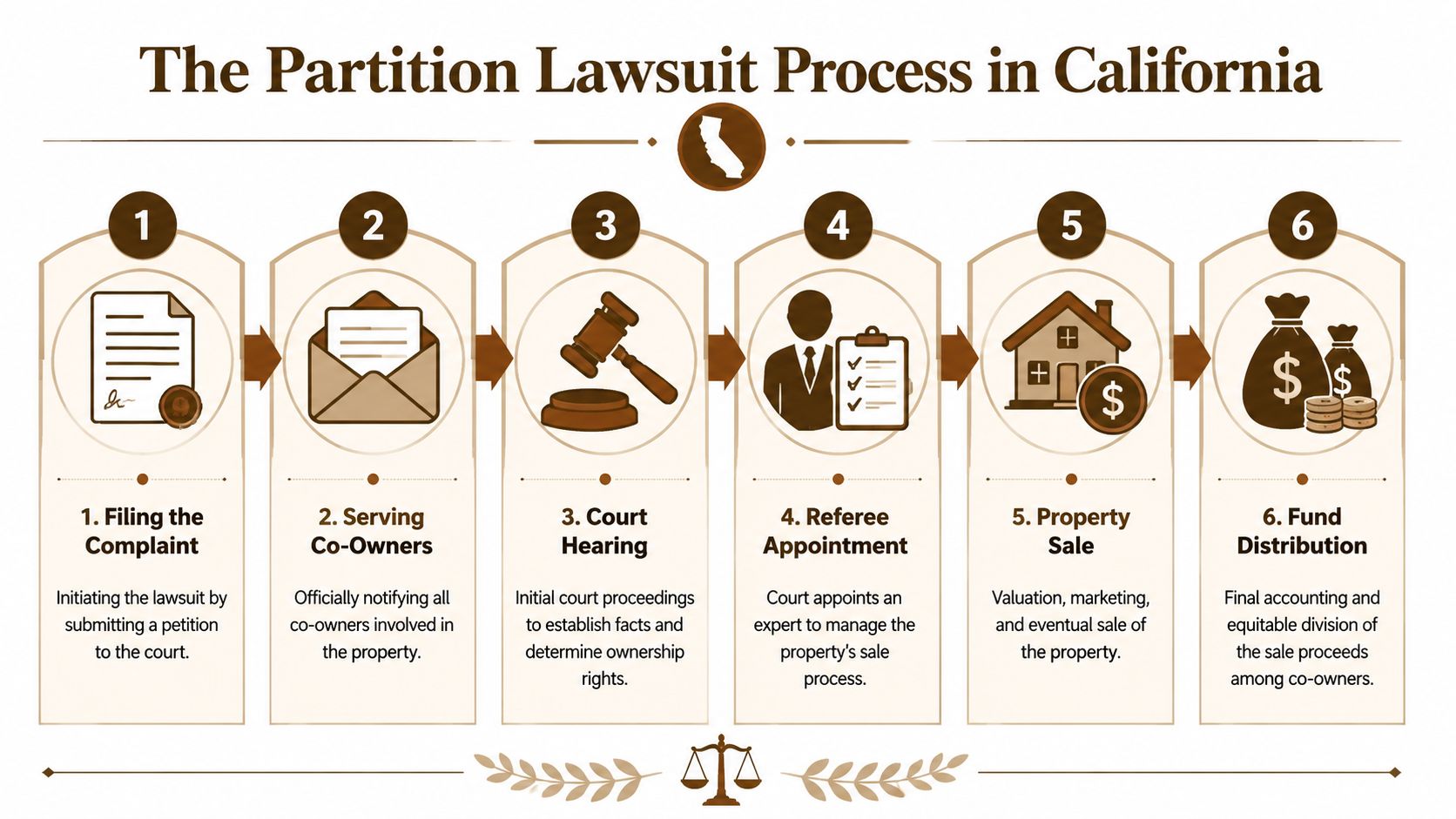
The usual flow of a California partition case
Complaint is filed
The lawsuit identifies the property, the co-owners, and the interests claimed.All necessary parties are served
Co-owners and other interested parties receive formal notice and a chance to respond.The court determines rights and the appropriate remedy
The court considers whether the property should be divided physically, sold, or handled through a buyout process where applicable.A referee may be appointed
In many cases, the court appoints a neutral referee to help manage valuation, marketing, creditor issues, and sale mechanics.Sale or division occurs under court supervision
If a sale is ordered, the referee often plays a central operational role.Final accounting and distribution
The court resolves credits, offsets, and the final division of proceeds.
The sale isn't the finish line. The finish line is the court's final order distributing the money after it resolves competing financial claims.
Why referees matter
The referee is often misunderstood. This person is not the judge and not an advocate for either side. The referee is typically a neutral appointed to carry out the court's order in a practical way. That can include working with valuation, marketing the property, dealing with sale logistics, and reporting back to the court.
That neutrality can help break deadlock. It can also add cost and time. Families often expect that once a sale is ordered, the case is almost over. In reality, implementation still requires oversight, documentation, and final approval.
Accounting and Offsets Where the Real Fight Often Lies
Many owners assume the hardest issue is whether the property will be sold. Often it isn't. The deeper fight is over who gets what after the sale.

A deed may say two people own property equally. That doesn't automatically mean the net money will be split equally. California recognizes that co-owners often contribute unequally over time. One paid the mortgage. Another paid property taxes and insurance. One funded repairs. Another lived in the house without paying fair rental value to the others. Those facts can shift the final distribution.
The accounting phase
Under California Code of Civil Procedure section 872.410, all partition actions involve a final accounting where the court adjusts compensation based on contributions toward mortgage, taxes, repairs, and other costs. California practitioner guidance also notes that the court may address inequity through liens affecting a co-owner's share, as discussed in this California partition accounting analysis.
This is why families are often shocked at the end of a case. They spent months arguing about sale versus no sale, only to learn that the actual economic issue is reimbursement, surcharge, or offset.
Common credits and common charges
A court may examine issues such as:
- Mortgage payments: If one owner made payments that preserved the property, that may matter.
- Taxes and insurance: These carrying costs often become part of the accounting.
- Necessary repairs: The court may distinguish between necessary work and disputed upgrades.
- Improvements: Some improvements add value, some don't, and proof matters.
- Exclusive occupancy: If one co-owner had the benefit of sole use, that can become part of the fairness analysis.
- Income and rent: If the property produced income, that may need to be accounted for too.
Why documentation changes outcomes
People remember contributions very differently. Courts prefer records.
If you paid expenses, keep bank statements, invoices, canceled checks, tax bills, insurance statements, contractor receipts, and written communications. If another owner occupied the property exclusively, preserve evidence showing when that began and what the arrangement was. If repairs were necessary, gather photographs, bids, and proof of payment.
Evidence beats memory. In a partition accounting, the owner with organized records usually presents the cleaner story.
That doesn't mean every claimed expense will be reimbursed. It means your position is much stronger if the court can verify it. A family member's belief that "I paid for everything" is not the same as proof.
A simple example
Suppose two siblings each own half of a house. One sibling has made the mortgage and tax payments for a long period while the other contributed little. If the property is sold, the court may not treat the gross proceeds as a simple half-and-half split. It may first sort out what reimbursements or offsets are justified.
That is why the accounting phase often drives settlement. Once both sides see the likely credits and charges, the case becomes more concrete. Emotion still matters, but documents start to lead.
Special Rules for Inherited Property and Family Homes
Inherited property creates a different kind of partition case. The dispute is rarely just about money. It's about memory, entitlement, succession, and whether the family home should leave the family at all.
Families also face extra legal layers. Title may still be moving through probate. A trust may hold the property. Some heirs may be on record title while others believe they have an equitable claim. Those complications are exactly why inherited-property partition cases need careful analysis under California law.
Why heirs' property is different
Reform-focused legal materials explain that the Uniform Partition of Heirs Property Act, now reflected in California law, was designed to address the unique problems of inherited family property. It adds notice, appraisal, and buyout protections to reduce the risk of involuntary loss of family-owned real estate, as described in this discussion of historic partition law reform and heirs' property protections.
Those protections matter because inherited property doesn't behave like a routine investment dispute. Heirs may have unequal financial means, different levels of attachment, and very different expectations about whether the property should be sold.
Questions families often miss
Inherited property cases commonly turn on threshold questions such as:
- Is partition available yet: If probate or trust administration is incomplete, timing may matter.
- Who must be included: Heirs, beneficiaries, trustees, personal representatives, or lienholders may all matter.
- What interest does each person hold: Family assumptions often don't match record title.
- Is there a buyout path that keeps the property in the family: California's modern framework may create opportunities before an open-market sale.
A short overview can help if you're dealing with a family home and don't know where the process leads.
Why appraisal and buyout protections matter
For many families, the most important question isn't "Can someone force a sale?" It's "Can we keep the house if one heir wants out?" Modern California law gives that question more structure than older partition practice did.
That doesn't guarantee the property stays in the family. It does mean the law recognizes that inherited homes deserve more protection than a simple race to liquidation. Formal notice, appraisal procedures, and buyout opportunities can give other co-owners a real chance to respond before the property is lost to the market.
Inherited property cases are often part title dispute, part probate problem, and part family conflict. Treating them like ordinary sale disputes is a mistake.
Understanding the Costs Timelines and Need for an Attorney
The first two practical questions are always the same. How long will this take, and how much will it cost? The honest answer is that partition cases vary, especially when title is disputed or accounting issues are heavy. Some move steadily. Others slow down because the parties fight over records, valuation, occupancy, reimbursements, or the terms of sale.
California practice guidance notes that costs in a partition action are often driven by attorney fees and the fees of a court-appointed referee, who may handle valuation, marketing, and sale administration. That same guidance explains that discovery is sometimes limited, but evidence like deeds, financial records, and appraisals can still be central, and disputes over costs and accounting can prolong the matter. It also emphasizes the strategic advantage created by early valuation proof and documented contribution history in this California partition timeline and referee overview.
Why trying to handle it alone is risky
A real estate partition lawsuit looks deceptively simple from the outside. File papers, ask the court to sell the house, and split the money. Such legal matters are more technical. The complaint must be pleaded correctly. Necessary parties must be identified. A lis pendens must be handled properly. The accounting phase can materially change the payout. In inherited-property cases, probate or trust issues may affect who has authority and what rights are being partitioned.
If you miss one of those issues, the case can become more expensive, more delayed, and less fair. That's why legal strategy matters early, not just at trial. A lawyer who understands California partition law can often spot settlement opportunities, documentary weaknesses, and title issues before they become expensive problems.
If you're facing a co-ownership dispute in Orange County or Los Angeles, and especially if the property is inherited or the contribution history is unequal, getting advice early can protect both your rights and your financial outcome.
If you're considering a real estate partition lawsuit under California law, or you're being threatened with one, Tanner Law can help you understand your options clearly and protect your ownership interest. Whether the dispute involves an inherited family home, a probate-related property issue, or a fight over credits and offsets, schedule a free consultation to discuss the facts of your case and the best path forward.