Prudent Investment Rule: A California Trustee’s Guide
You're handed the trust keys on a weekend call. The account statements show stocks, bonds, maybe a rental property, and a sibling who already wants to know why the money isn't sitting in cash. That's the moment the Prudent Investment Rule stops being a legal phrase and becomes a real fiduciary duty under California law.
If you're a successor trustee in Orange County or Los Angeles, you don't get to improvise. California trustees must manage trust assets under a legal standard that looks at the trust as a whole, the trust's purpose, and the beneficiaries' needs. Miss that standard, and you can create personal exposure for yourself even if you were trying to do the right thing.
Table of Contents
- When You Inherit a Trust Portfolio
- What the Prudent Investment Rule Requires
- From the Prudent Man Rule to Modern Portfolio Theory
- California Statutes and Key Court Decisions
- Practical Compliance Strategies for Trustees
- Real World Examples and Client Explanations
- Protect Your Trust and Your Family
When You Inherit a Trust Portfolio
A son or daughter becomes successor trustee, opens a file cabinet, and finds a mix of brokerage accounts, a family home, maybe a rental, and cash that's already being eaten by holding costs. The instinct is usually to do something fast, because everyone wants certainty. That's where families make mistakes.

The prudent investment rule applies to trustees and other fiduciaries who control trust assets. In California, that means your job is not just to “be careful.” Your job is to manage the trust with a legally defensible process that fits the trust's terms and the beneficiaries' interests.
The first mistake families make
Too many trustees think the safest move is to freeze everything. That can be just as risky as making a reckless trade. A trust portfolio still needs attention, because real property, securities, and cash all carry different risks, costs, and income consequences.
The legal question is simple. Did the trustee act prudently when the decision was made, in light of what was known at the time? If the answer is yes, a later loss does not automatically mean the trustee did something wrong under New York's codified version of the standard, which reflects the broader principle that the rule is judged on the facts and circumstances existing when the decision was made New York's codified prudent investor rule.
Practical rule: If you can't explain why a decision made sense when you made it, you probably didn't document it well enough.
In Orange County and Los Angeles, that matters because trust administration often happens under family pressure, not ideal conditions. Beneficiaries want updates. Real estate needs maintenance. Marketable assets need oversight. The prudent investment rule gives you a legal framework, but only if you use it.
What the Prudent Investment Rule Requires
A trustee who inherits a trust portfolio is judged by process, not by luck. The modern prudent investment rule asks whether the trustee acted like a prudent investor would, using judgment that fits the trust's purposes and the beneficiaries' needs. California trustees should treat each decision as part of a larger plan, because the standard looks at the entire trust portfolio, not one asset in isolation Cornell Law School summary and AALS discussion of portfolio-level review.
Think portfolio, not souvenir pieces
A concentrated rental property, a closely held stock, or a large cash balance cannot be reviewed as if each item lives on its own island. The right question is whether the mix of assets, taken together, serves a sound strategy for income, preservation, liquidity, and beneficiary timing.
A trustee who ignores portfolio balance invites trouble. A trustee who keeps one asset because it feels familiar, or sells one asset without considering the tax and income effect on the rest of the trust, is not following the rule. California families see this mistake often when a successor trustee clings to the house, the brokerage account, or the family business interest without documenting why that choice fits the trust.
What compliance looks like
A prudent trustee does three things every time.
- Reviews the whole portfolio. The decision must make sense across all trust assets, not just one holding.
- Ties the decision to the trust's purpose. Income for a surviving spouse, long-term growth for younger beneficiaries, or preservation for a later distribution all point to different choices.
- Writes down the reasons. Beneficiaries, attorneys, and judges all look for the same thing, a clear record of what the trustee knew and why the trustee acted.
That record matters because the rule is a standard of conduct, not a guarantee of outcome. A trustee can lose money and still act properly if the decision was disciplined when made. California's statutory approach follows that same idea, the trustee is measured by prudence in light of the circumstances at the time, not by hindsight after the market moves New York statutory standard.
The trust instrument can also change the default rule. The FDIC's fiduciary-law excerpt explains that the prudent investor rule may be expanded, restricted, eliminated, or otherwise altered by the trust's terms, and that a trustee can rely on those terms if the reliance is reasonable FDIC fiduciary-law excerpt. That is why careful drafting matters. If the trust gives the trustee broad discretion, say so clearly. If it limits certain investments or requires a particular income focus, spell that out in plain language so the trustee is not left guessing.
From the Prudent Man Rule to Modern Portfolio Theory
A trustee standing at the kitchen table with a stack of brokerage statements does not need theory first. The first question is whether the portfolio was managed with the right level of care for the trust's actual purpose. The old prudent man rule answered that question in a narrow way. Cornell Law School explains that the rule was first articulated in 1830 in Harvard College & Massachusetts General Hospital v. Amory, and the older approach focused on individual investments and capital preservation Cornell Law School summary. Trustees were judged asset by asset, which pushed many of them into overly cautious decisions.
Old rule versus modern rule
That older model encouraged trustees to treat growth assets with suspicion even when the trust called for a broader mix. A portfolio built under that mindset often ended up rigid and defensive. In trust administration, that kind of rigidity can hurt beneficiaries when it ignores income needs, inflation, and the long-term structure of the trust.
The modern standard took hold after the 1992 Restatement (Third) of Trusts and the 1994 UPIA, and Harvard Law School's summary says all states replaced the old prudent man rule with the modern prudent investor rule over roughly the last 25 years Cornell Law School summary. That change lined trust law up with Modern Portfolio Theory, which evaluates risk and return across the portfolio as a whole instead of treating each holding as its own verdict AALS discussion of Modern Portfolio Theory alignment.
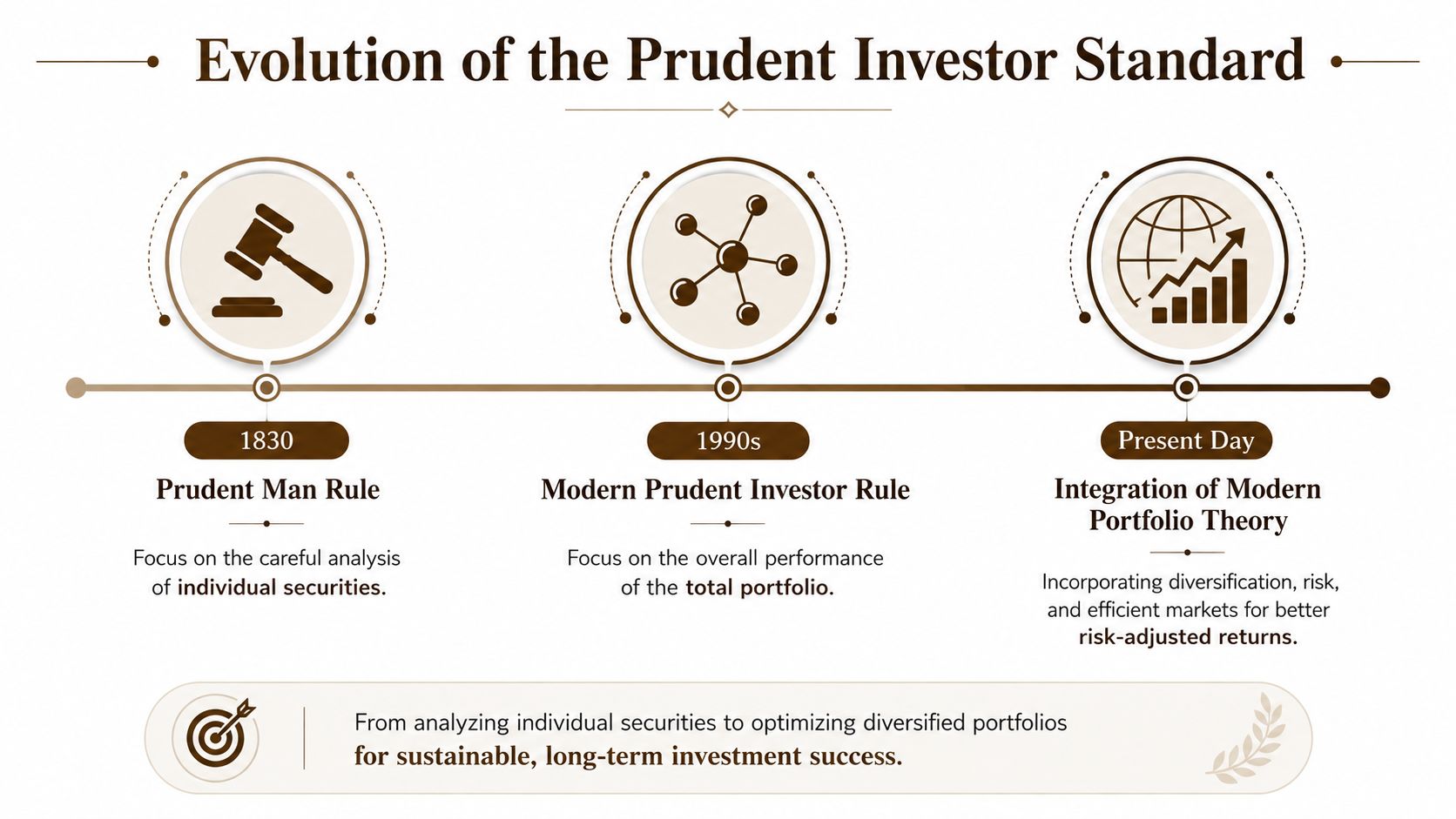
The legal shift did not relax fiduciary discipline. It raised the standard of judgment. Trustees have more room to invest sensibly, but they also have to show a disciplined process, written reasons, and a portfolio-level view that fits the trust. California follows that modern framework, so trustees should stop asking whether each asset looks “safe” in isolation and start asking whether the entire portfolio is built soundly for the beneficiaries and the trust instrument.
A trustee who understands portfolio risk usually makes better decisions than one who chases the appearance of safety.
California Statutes and Key Court Decisions
A California trustee who treats the prudent investor rule as a vague slogan will get into trouble fast. The standard is built into the California Probate Code, and courts judge the trustee by the quality of the decision-making process, the trust terms, and the way the portfolio fits the beneficiaries' needs.
What California trustees have to weigh
California Probate Code § 16047 requires a trustee to invest and manage trust assets as a prudent investor would, using reasonable care, skill, and caution. California Probate Code § 16048 adds the portfolio standard, so the trustee must look at the trust property as a whole, not one asset at a time. California Probate Code § 16049 tells the trustee to consider the trust's purposes, the terms of the trust, distribution requirements, general economic conditions, the possible effect of inflation or deflation, the expected tax consequences, and the role each asset plays in the portfolio.
Those statutes matter because they force a trustee to document a real investment judgment. A family trust that holds a rental property, a concentrated stock position, and liquid reserves should be reviewed as one portfolio, with each piece serving a defined purpose. California Probate Code § 16043 also matters because it requires impartial administration. A trustee cannot tilt the portfolio to make one beneficiary happy while leaving another exposed.
Why hindsight loses in court
California courts do not decide prudence by staring at a bad outcome after the fact. They look at what the trustee knew, what the trust said, and whether the trustee used a sound process at the time of the decision. A later decline in value does not prove breach by itself.
Estate of Collins is the kind of California authority trustees should keep in mind. The point of that line of cases is simple, courts focus on the trustee's conduct and judgment, not on whether an investment later turned sour. A trustee who can show review of the trust terms, beneficiary needs, and portfolio-level risk is in a much stronger position than a trustee who guessed and hoped for the best.
The trust instrument can also change the default rules. If the document authorizes retention of a family business, directs the trustee to keep a home in the family, or limits diversification in a specific way, those instructions matter and should be followed precisely. As noted earlier, the written trust controls more than many families expect.
A trustee who ignores the instrument and improvises invites a dispute.
Practical Compliance Strategies for Trustees
Good trustees do not just make decent decisions. They build a record that proves those decisions were decent. In California trust administration, that paper trail is often the difference between a clean administration and a messy claim of breach.
Build a decision file, not just a memory
Start with a written investment policy, or at least a written record of the trust's goals. If the trust owns real estate, marketable securities, or concentrated family assets, note how each item fits the overall plan. When you change course, explain why.
Keep records of:
- The trust terms you relied on.
- The beneficiary needs you considered.
- The reasons you chose one option over another.
- Any professional advice you obtained.
- The dates of review and any follow-up decisions.
That kind of documentation helps if a beneficiary later challenges the administration. It also keeps the trustee disciplined, because you cannot pretend to have done analysis you never performed.
Use the trust document as your starting point
The prudent investor rule is a default rule, not a one-size-fits-all command. The trust instrument may expand, limit, or alter the trustee's investment powers and duties. If the trust says the trustee may hold a family business longer than usual, or keep certain assets intact, that language matters. The trustee's job is to follow the written instructions first and make every investment choice fit those instructions.
Review the portfolio like a fiduciary, not a fan
A trustee should look at diversification, liquidity, tax impact, and beneficiary time horizons. If the trust owns a rental property and liquid securities, do not ask whether each asset “feels” appropriate. Ask whether the mix works for income, preservation, and anticipated distributions.
A trustee should also look at the whole picture before making a change. Selling one asset may solve a short-term problem and create a tax or liquidity problem somewhere else in the portfolio. A paper trail that shows the trustee considered those tradeoffs is far stronger than a handwritten note that says the decision seemed reasonable at the time.
Practical rule: If you do not understand an investment, do not pretend you do. Get help, document the help, and keep moving.
Professional advice is not a sign of weakness. It is often the prudent move. A trustee who seeks guidance from an investment professional, CPA, or trust attorney and records that advice is usually in a stronger position than a trustee who guesses.
Make the trust instructions work in real life
Drafting matters. Families and estate planners should be specific about whether a trustee may retain a concentrated asset, delay a sale, or keep a sentimental holding even when a broader allocation would otherwise point in another direction. Vague language invites disputes later, especially when beneficiaries read the trust very differently from the trustee.
Successor trustees should also check whether the trust calls for a special result, such as keeping a business in the family or treating a particular asset as a long-term hold. When those instructions exist, the trustee should document how the investment plan respects them. That makes the administration easier to defend and much easier to explain.
Keep the explanation simple enough for beneficiaries
A trustee should be able to explain the strategy in plain English. Beneficiaries do not need a lecture on legal theory. They need a clear answer about why the trust is being managed the way it is, what risks were considered, and how the decision fits the trust as a whole.
If the trustee cannot explain the decision plainly, the trustee probably has not documented it well enough.
Real World Examples and Client Explanations
A trustee with a mixed portfolio has to explain decisions in plain English, because beneficiaries rarely care about legal labels. They care about whether the trust is being managed fairly and whether someone is making thoughtful choices.
A rental property and a stock portfolio
Suppose the trust owns a rental in Los Angeles and a brokerage account. The trustee doesn't have to treat the rental as an isolated problem or the portfolio as a separate universe. The correct analysis is whether holding, selling, or refinancing the property fits the trust's overall risk, income, tax, and liquidity needs.
If beneficiaries ask why the property stayed in place, the trustee should answer directly. The explanation might sound like this, “The property is part of the overall trust strategy right now because it supports the trust's income goals and fits the written terms of the trust.” That's better than a vague defense like “I just thought it was best.”
A family business or concentrated asset
Now assume the trust holds a family business. The trustee may be tempted to keep it because it's familiar or emotionally important. That is not enough. The trustee has to consider whether the business concentration is prudent in light of the rest of the trust portfolio and the beneficiaries' needs.
The best client-facing explanation is simple. “We're not preserving an asset for its own sake, we're managing the trust for all beneficiaries under California law.” That language helps reduce confusion and keeps the trustee focused on fiduciary duty instead of family politics.
Income beneficiaries and remainder beneficiaries
Conflicts often show up when one beneficiary wants income now and another wants long-term growth. A trustee should not pick favorites. The correct approach is to manage the portfolio impartially, document the reasoning, and explain how the trust terms support the decision.
Beneficiaries usually accept decisions faster when they understand the process. They may not agree with every outcome, but they're less likely to accuse the trustee of favoritism when the trustee gives a clear, documented answer.
Protect Your Trust and Your Family
The Prudent Investment Rule protects families when trustees respect it and exposes trustees when they ignore it. California law expects a trustee to think in terms of portfolio-level prudence, trust terms, beneficiary fairness, and documented reasoning. That's not complicated, but it is serious.
If you're serving as trustee, get legal help early, before a mistake hardens into a dispute. A trust review, investment policy review, beneficiary communication strategy, and document audit can prevent expensive problems later. That's the right move whether the trust holds cash, securities, rental property, or a family business.
Tanner Law helps California families, trustees, and beneficiaries handle trust administration, probate, and property issues with clear guidance and direct attorney access. If you need help evaluating trust investments, interpreting trust terms, or responding to beneficiary concerns, schedule a free consultation with Tanner Law and get practical advice before a small mistake turns into a costly dispute.