Construction Defect Attorney Guide for California Homeowners
You're staring at a crack that wasn't there last month, a ceiling stain that keeps spreading, or a door that suddenly won't latch. Don't talk yourself out of it, and don't wait for the damage to “settle.” In California, those first days after discovery matter because a construction defect attorney is often doing more than filing suit; their essential job is protecting your timing, your proof, and your negotiating position before the other side gets ahead of you.
If you own in Orange County or Los Angeles, especially in a newer home, condo, or planned development, assume the problem is more than cosmetic until someone qualified tells you otherwise. California defect work sits at the intersection of real estate law, contract claims, insurance issues, and construction procedure, so the mistake most homeowners make is treating every crack or leak like a simple repair problem. That approach can destroy evidence, confuse the timeline, and weaken the claim before it ever starts.
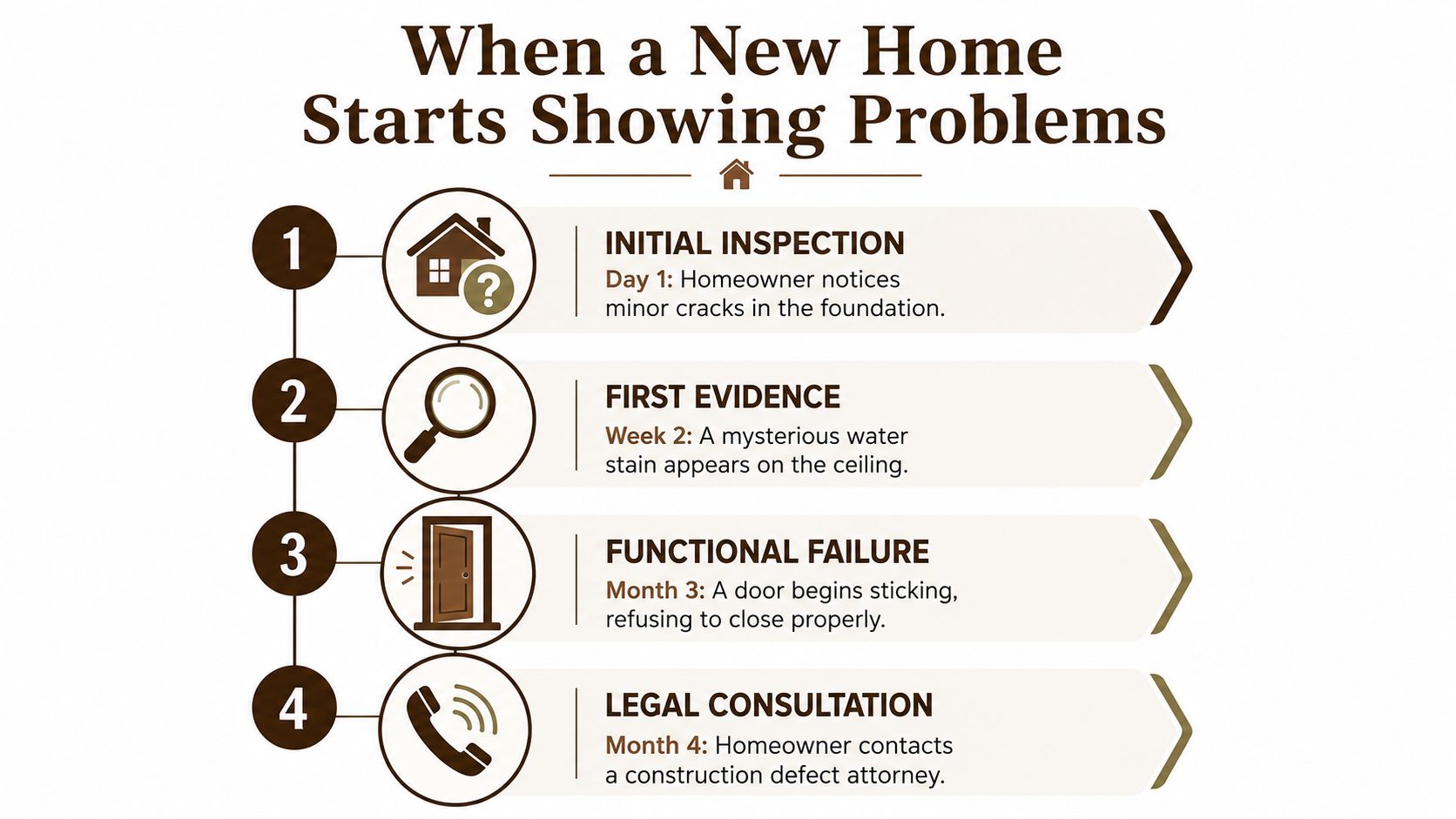
Table of Contents
- When a New Home Starts Showing Problems
- What Counts as a Construction Defect in California
- California Deadlines That Decide Your Case
- Who Can Be Held Responsible for a Construction Defect
- How a Construction Defect Case Typically Moves
- Evidence and Experts That Strengthen the Claim
- Choosing the Right Construction Defect Attorney
- Common Questions and How to Move Forward
When a New Home Starts Showing Problems
The first clue is rarely dramatic. It's a hairline crack in the slab, a water mark that appears after rain, or a sticky door you keep blaming on weather. Those are the moments when a homeowner needs to stop guessing and start documenting, because the building may be telling you where the failure lives.
Treat the symptom as a warning, not the whole story
A leak in the ceiling doesn't automatically mean the roof is the only issue. It could come from flashing, a window installation problem, a waterproofing failure, or a design flaw in the building envelope. The visible damage is often just the last place the problem shows up.
Practical rule: take photos the same day you notice the issue, then keep a simple written log of every new development, every repair attempt, and every conversation with the builder or HOA.
That record matters because California defect disputes are built on chronology. A homeowner who can show when the problem appeared, how it changed, and who was notified is in a much better position than someone relying on memory months later. If your home is in a condo or HOA community, that paper trail becomes even more important because board communications, maintenance records, and notice letters can all shape the claim.
What Counts as a Construction Defect in California
Defects in California fall into distinct categories, design defects, material defects, construction defects, and subsurface or code-compliance defects. The category matters because it changes what proof you need and which parties may be responsible.
A construction defect is a failure in how the home was designed, built, or made to perform. California practice treats that problem seriously because the source of the failure often points to a different trade, a different professional, or a different layer of responsibility.
Patent defects and latent defects are not the same thing
A patent defect is visible on a reasonable inspection. A latent defect stays hidden until the home starts moving, leaking, or failing in a way a homeowner could not have caught earlier. That distinction affects deadlines and strategy, so do not dismiss a problem just because the damage only became obvious later.
The home itself is a set of connected systems. The roof, building envelope, foundation, plumbing, electrical, and HVAC systems each have their own failure points, and one problem can spread into another. A leak in the envelope can lead to mold, framing damage, and ruined interior finishes, while the legally responsible party may still be the trade that caused the original failure.
The defect has to affect function, code, or structure
A scratch in a cabinet door is a warranty issue. A repeated water intrusion problem, a cracked foundation, or a settlement issue affecting the structure belongs in a defect claim. California homeowners should focus on whether the issue affects the home's intended performance, safety, or code compliance, because that is where these cases become real.
If you are unsure which category your problem fits, do not over-explain it to the builder in a way that narrows the claim. Get the facts organized first, then let counsel sort out the legal label.
California Deadlines That Decide Your Case
Deadlines in California construction defect work are not background details. They're the case. The most dangerous mistake is assuming that because the damage still looks manageable, the law will wait with you. It won't.
The calendar starts running before most homeowners realize it
For most latent residential construction defect claims, California's primary statute of repose is 10 years after completion, and the 4-year limitations period for patent defects starts when the homeowner discovers, or should have discovered with reasonable diligence, the defect California construction defect timing summary. That means a homeowner can lose rights even while the home still looks occupied and intact.
California's Right to Repair Act, SB 800, also requires written notice and gives the builder a chance to inspect and respond before many residential defect lawsuits move forward SB 800 prelitigation process overview. In practice, that notice stage can be the most important part of the case, because it often determines whether the builder repairs, postures, or finally starts negotiating.
A timing checklist beats a panic response
| Stage | Deadline | Trigger |
|---|---|---|
| Notice to builder under SB 800 | Before filing many residential claims | Written defect notice to the builder |
| Patent defect limitation period | 4 years | Discovery, or when discovery should have happened with reasonable diligence |
| Latent defect repose period | 10 years | Completion of the project |
The homeowner who waits for the “right time” usually waits too long. The better move is to preserve the claim while the facts are still fresh.
If your case involves an HOA or multiple units, don't assume the same timeline applies in a simple, one-house way. The notice process and the parties involved can change how the claim moves, and California deadlines are unforgiving when a homeowner guesses instead of confirming.
Who Can Be Held Responsible for a Construction Defect
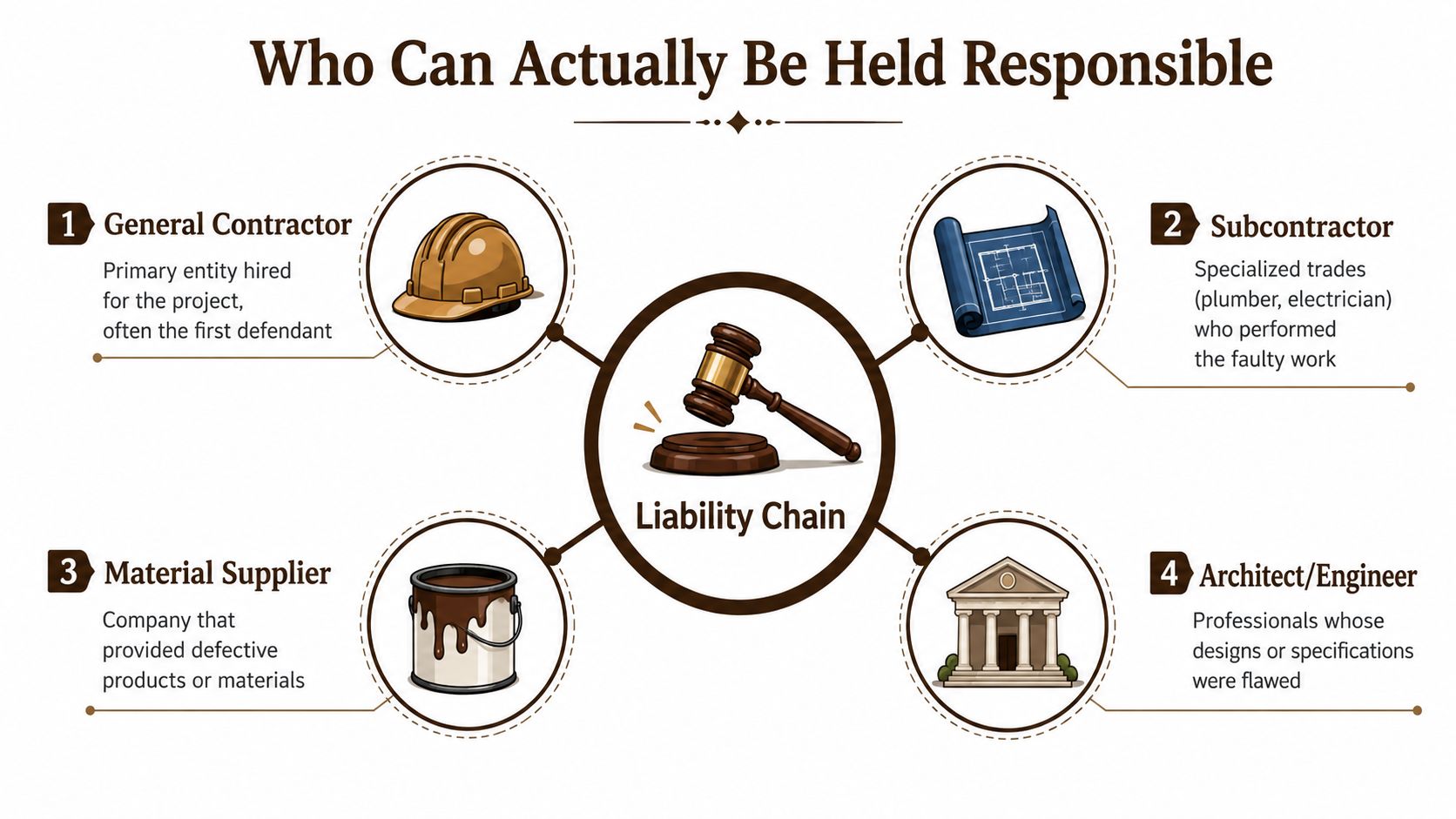
The builder is usually the first name homeowners blame, and sometimes that is the right place to start. In many California defect cases, though, the source of the problem sits one step or two steps deeper in the project chain. A leaking roof can trace back to the general contractor, the roofer, the window installer, a flawed design detail, or a defective product supplied into the project. If you focus only on the visible damage, you can miss the party that caused it.
Follow the failure, not the headline
California defect claims can involve owners, general contractors, subcontractors, architects, engineers, product manufacturers, suppliers, insurers, and sometimes HOAs or property managers construction defect liability chain. That matters because the person who sold you the home is not always the person who caused the defect, and the party with the deepest insurance coverage is not always the one who performed the work.
A smart attorney maps the damage to the trade that created it. A roof leak caused by a failed membrane product points to a different claim than a roof installed incorrectly by the roofer. If the problem starts in the building envelope, the design professional may carry as much responsibility as the installer.
Why liability mapping changes settlement leverage
The right defendant brings the right insurer into the case. That changes the defense posture, the settlement discussion, and the documents you can demand. It also shapes the theory of the case, whether it turns on construction negligence, design responsibility, or product liability.
The practical lesson is simple. Do not let the builder point at the subcontractor, and do not let the subcontractor blame the design team without evidence. A construction defect attorney should identify every plausible responsible party early, because leaving one out can leave money on the table later.
How a Construction Defect Case Typically Moves
California's pre-suit process is where most defect cases are won or lost. The courtroom matters, but the builder's response, the inspection record, and the repair proposals usually decide the case first.
The first call sets the tone
The initial consultation is where you lay out the facts, the photos, the notices, and any repair history you already have. A good lawyer is looking for the defect pattern, the timeline, and the parties involved, not just the visible damage. If the facts are strong, the next move is usually a controlled notice process, not a rushed lawsuit.
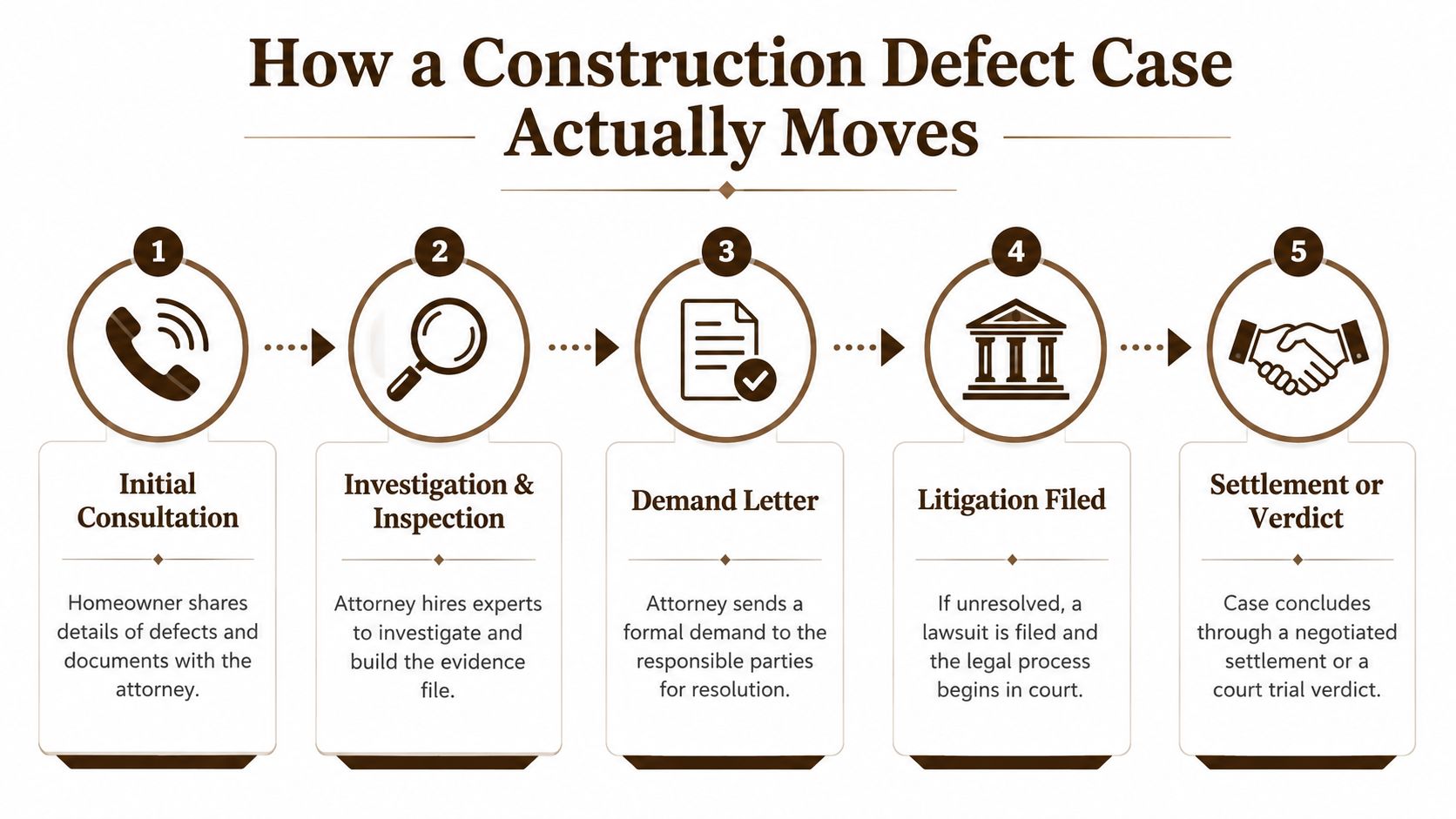
Then comes inspection and expert review. Specialists inspect the site, review the project documents, and may test materials to identify the defect mechanism and measure damages expert construction defect workflow. In higher-value matters, that work can involve structural, mechanical, civil, geotechnical, and forensic accounting experts.
Many cases resolve before trial if the procedure is handled correctly
That does not mean the case is weak. It means the builder had enough information, and enough exposure, to deal. California construction defect work has long been a specialized litigation niche, and a 2000 Insurance Journal report described a major plaintiff-side practice with 50-plus employees in five offices, with each office handling 50 to 100 cases at a time; it also reported typical settlements between $1 million and $2 million, with the largest reported settlement at $34.5 million Insurance Journal report. The point is not to chase the numbers, it is to understand how financially serious these disputes have been for decades.
If repairs are offered, the question is whether they solve the problem or just create another round of damage later. If the repair is inadequate, the case moves into litigation, discovery, mediation, and possibly trial. Courts may award the reasonable cost to repair, but if tearing out the structure would be unreasonable or wildly disproportionate, a court can use a diminished-value or other alternative measure instead damages in construction defect cases.
Evidence and Experts That Strengthen the Claim
A defect case is only as strong as the proof behind it. Homeowners often believe the damage itself will speak for them, but courts and insurers want a clean record that connects the defect, the cause, the scope of repair, and the dollars involved. That takes organization.
Gather the paper trail before it disappears
Start with the purchase contract, builder disclosures, plans, inspection reports, warranty documents, repair invoices, and every photograph or video you have of the damage. Add a simple timeline of when each problem first appeared and when it got worse. If you've already hired someone to patch the issue, keep those records too, because failed repairs can be evidence.
- Original Construction Documents: blueprints, contracts, and warranty terms define what the builder promised.
- Photographic and Video Evidence: time-stamped visuals show how the defect progressed.
- Inspection Reports: early findings help anchor the problem before memories fade.
- Expert Witness Reports: engineers and specialists turn symptoms into causation.
The expert has to match the defect
A roof leak doesn't call for the same expert as a foundation movement claim. Structural engineers, civil engineers, geotechnical engineers, licensed architects, waterproofing specialists, and mechanical contractors each bring different pieces of the puzzle. The right professional can show whether the issue is a design failure, a workmanship failure, or a material problem.
Useful rule: don't hire experts to “confirm” what you already believe. Hire them to test the theory, because a weak theory won't survive document review or cross-examination.
For California homeowners, the goal is not a stack of disconnected reports. It's a unified story that shows what failed, who caused it, and what it costs to fix. That's the work a serious construction defect attorney coordinates behind the scenes, long before anyone sees a courtroom.
Choosing the Right Construction Defect Attorney
A defect case can fall apart long before anyone files a complaint. The lawyer you hire has to understand the notice process, the expert work, and the timing rules that decide whether your claim stays alive. You need counsel who can control the sequence, because in California the pre-suit phase often matters more than the courtroom fight.
Questions to Ask During Your Initial Consultation
Start with the lawyer's actual experience. Ask whether they have handled SB 800 claims, whether they know California's 10-year repose and discovery rules, and how they coordinate with experts. Ask who will handle your file day to day, and whether the firm understands how construction disputes can overlap with real estate and title issues. Those questions cut through the sales pitch and show whether the lawyer understands the claim, the deadlines, and the practical work that has to happen before suit.
Pay attention to the answers. You want a clear fee structure, a specific pre-suit plan, and a lawyer who can explain the defect process in plain English. Be wary if the attorney talks only about filing fast, avoids the subject of experts, or seems uncertain about the notice rules that can shape the case before it is ever filed. That is where problems start, and a homeowner needs straight answers.
A homeowner should hire the lawyer who can protect the claim before the lawsuit starts, because that is where many California defect cases are won or lost.
In Orange County, Los Angeles, and the surrounding California courts, local familiarity still matters. Procedures, judges, and settlement practices affect real results. Tanner Law handles real estate disputes and can also evaluate construction defect matters in that broader property context, which is often useful when the problem touches title, ownership, or related civil issues.
Common Questions and How to Move Forward
Homeowners usually ask four things first. Should I repair now or wait. How long will this take. Can I use small claims court. What does it cost. The honest answer is that California defect claims are rarely a small claims problem, and the cheapest move is usually the one that preserves evidence and deadlines.
California's pre-suit notice rules can help if they're handled correctly, because they can open the door to inspection and repair without a full-blown lawsuit. But don't guess at the process, and don't assume the builder will volunteer the right solution. Get advice before the deadlines get tight.
If your home is cracking, leaking, or moving, schedule a free consultation before you send a notice letter or accept a repair offer you don't fully understand. The right move now can protect your California construction defect claim later.
Tanner Law helps California homeowners evaluate construction defect problems in the context of real estate rights, deadlines, and practical remedies. If you're dealing with cracks, leaks, or structural movement in Orange County, Los Angeles, or nearby communities, visit Tanner Law to schedule a free consultation and get a clear read on your options before time starts working against you.