Can You File Bankruptcy for Back Taxes in California?
You're behind on taxes, the phone keeps buzzing, and the letters don't stop. Maybe the IRS is in the stack, maybe the California Franchise Tax Board is too, and maybe there's a recorded lien sitting on your home title in Orange County or Los Angeles that's making refinancing or a sale harder than it should be. The short answer to can you file bankruptcy for back taxes is yes, but only sometimes, and only with the facts lined up the right way.
Bankruptcy is not a magic eraser for tax debt. In California practice, the question is which tax year, what kind of tax, whether the return was filed, when the IRS or FTB assessed it, and whether any lien already attached to real property. Get those pieces wrong, and filing can leave you with the same tax bill after the case closes. Get them right, and bankruptcy can be a serious tool for getting control back.
Table of Contents
- The Reality of Owing Back Taxes in California
- The 3-2-240 Rule Explained in Plain English
- Which Tax Debts Almost Never Get Discharged
- Chapter 7 Versus Chapter 13 for Back Taxes
- Unfiled Returns and Substitute-for-Return Problems
- Federal and California Tax Liens on Real Property
- Alternatives Worth Comparing Before You File
- Practical Next Steps and Warning Signs to Act On
The Reality of Owing Back Taxes in California
A typical California tax client doesn't walk in with one clean problem. They come in with a stack of problems. A Southern California homeowner lost a job, went through a divorce, or had a medical setback, and now years of federal and California tax debt are sitting next to mortgage arrears, credit card balances, and a title report that shows a lien nobody expected.
Once tax debt gets old, the collection tools get more aggressive. The IRS can levy bank accounts and garnish wages, and the California Franchise Tax Board can do the same under state law practice. If a lien is recorded against real estate, it can cloud title and make a sale or refinance much harder, especially when the property is in a market like Orange County or Los Angeles where owners often need equity to move, settle an estate, or rearrange their finances.
Practical rule: tax debt usually gets worse by waiting, not better. Penalties and interest keep building, and the balance can feel like it doubled by the time the homeowner finally asks for help.
The common myth is that bankruptcy wipes taxes out automatically. It doesn't. Most back tax debt is not automatically erased by bankruptcy, and discharge depends on the chapter, the tax type, and whether the debt is a prepetition debt under federal bankruptcy rules, as the IRS explains in its bankruptcy guidance for taxpayers who are trying to sort out what can be discharged. Older income taxes can sometimes come off the books, but only if the timing and filing history fit the rules.
That's the honest starting point. Bankruptcy can help with back taxes, but it's not a blanket tax wipeout, and California residents need to think about both the IRS and the FTB before they file anything.
The 3-2-240 Rule Explained in Plain English
For federal income taxes, the core discharge test is usually called the 3-2-240 rule. It's simple to say and very easy to miss in real life. All three timing tests must be met for that tax year to qualify, and if one prong fails, that year generally stays alive after the bankruptcy.
The three timing checks
First, the return had to be due at least 3 years before the bankruptcy filing. Second, the return had to be filed at least 2 years before the bankruptcy filing. Third, the IRS had to assess the tax at least 240 days before the filing. That's the whole test for qualifying federal income tax debt, and it applies only to qualifying income taxes, not every tax debt.
A simple example helps. Suppose a 2020 federal income tax return was due in April 2021, the taxpayer filed that return in May 2021, and the IRS assessed the tax in June 2021. If the bankruptcy is filed after April 2024, after May 2023, and after the 240-day assessment window runs, that year may qualify. If the taxpayer filed the return late in 2024, that same tax year likely fails the second prong even if the debt is old enough.
Key takeaway: one missed date breaks the whole discharge analysis for that tax year.
Interest and penalties tied to a qualifying income tax year usually follow the underlying tax. That matters because people often focus only on the tax principal and forget the add-ons that make the balance feel so heavy. Bankruptcy lawyers pull IRS account transcripts because the assessment date often decides the case, not the taxpayer's memory or the notice sitting in a desk drawer.
Which Tax Debts Almost Never Get Discharged
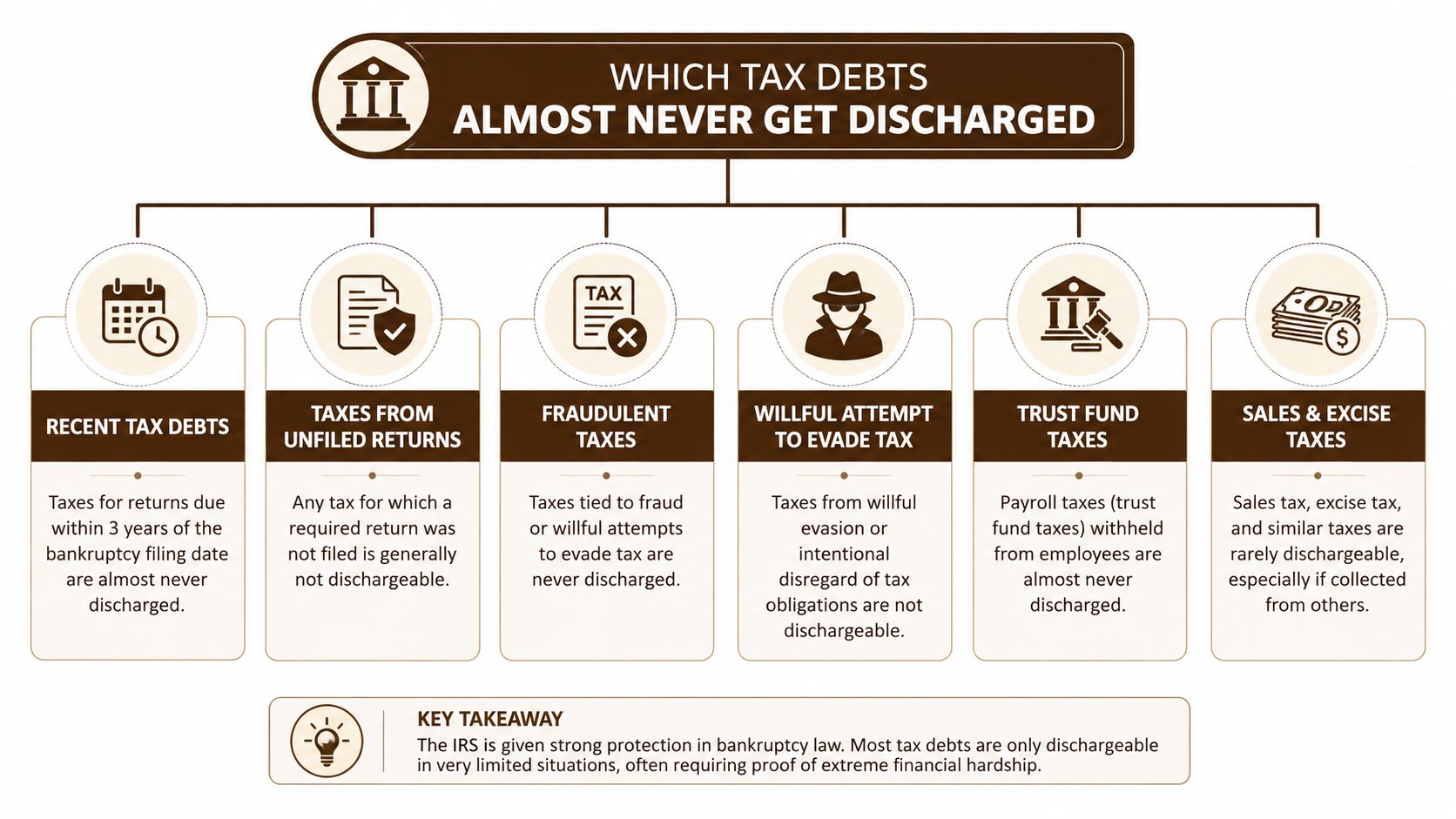
Timing helps only if the tax is the kind bankruptcy can reach. A lot of disappointed filers learn that the hard way after they've already built a plan around “old tax debt” without separating the categories. In practice, the age of the debt is only one part of the analysis, not the whole answer.
The categories that usually stay collectible
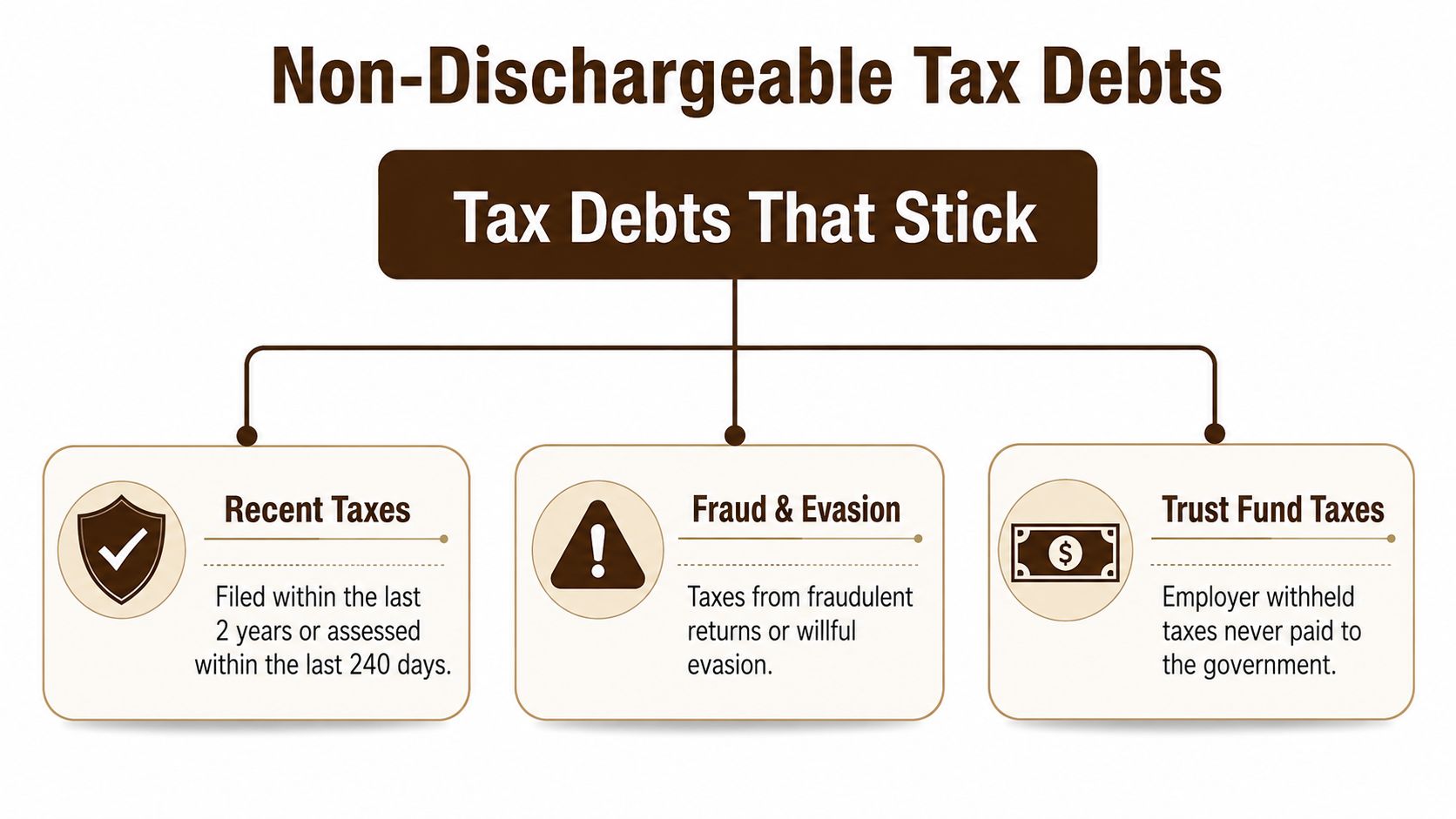
Payroll taxes are the first major problem. If you were an employer and withheld money from workers' paychecks, bankruptcy usually does not wipe that out. Trust fund recovery penalties are treated just as harshly, because the government views withheld taxes as money that was supposed to be turned over, not spent elsewhere.
Fraud penalties and debt tied to willful evasion are another hard stop. If the filing was fraudulent, income was hidden, or taxes were intentionally evaded, discharge is generally off the table even when the debt is old. That same problem can show up with recent property taxes and sales taxes, which are generally not dischargeable either.
A late return can also wreck an otherwise promising case. A substitute-for-return filing, or a return filed too late, can prevent discharge even where the tax is old enough to satisfy the first timing prong.
Chapter 7 Versus Chapter 13 for Back Taxes
A taxpayer with back taxes does not get the same result in every bankruptcy chapter. In California, the right chapter depends on which tax years are in play, whether returns were filed, whether liens already attached, and whether the debt is old enough to qualify for discharge. Most back tax debt is not automatically erased by bankruptcy. Chapter choice determines whether that debt disappears, gets folded into a repayment plan, or survives the case entirely.
Where Chapter 7 fits
Chapter 7 is the cleaner option for older income taxes that meet the bankruptcy rules. If the tax year qualifies, the case can wipe out your personal liability when it closes, and the IRS or FTB cannot keep collecting that discharged debt from you personally. If the tax does not qualify, Chapter 7 leaves it in place, and the IRS or FTB can resume collection after the case ends.
Where Chapter 13 fits
Chapter 13 works better when the tax picture is tangled. It stops collection as soon as the case is filed and gives you a court-supervised plan to pay over time. That makes it a strong choice for older taxes that cannot be discharged, for mixed tax years, and for California filers who need time to deal with IRS debt, FTB debt, and home-related lien problems in one case.
| Tax Situation | Chapter 7 Outcome | Chapter 13 Outcome |
|---|---|---|
| Qualifying older federal income tax | Personal liability may be discharged if the timing rules are met | Can be paid through the plan, with remaining qualifying debt handled under the plan rules |
| Recent or nonqualifying tax | Usually survives discharge and remains collectible | Usually gets paid through the plan if it's a priority claim |
| Mixed years, some old and some recent | Old qualifying years may be discharged, others survive | Lets you deal with both categories in one structure |
| Tax debt with active collection pressure | Ends only if the debt qualifies | Stops collection immediately upon filing |
California residents often get more value from Chapter 13 when they are trying to protect home equity or control lien trouble while dealing with tax debt. Chapter selection controls the outcome. Pick the chapter that matches the age and type of the debt, then use the case to deal with the rest on terms the court can enforce.
Unfiled Returns and Substitute-for-Return Problems
The biggest bankruptcy mistake I see with back taxes is simple. People assume old debt and missing returns are the same problem, and they're not. A tax year with no valid return filed can be treated very differently from a tax year where the return was filed late but still qualifies under the rules.
Why missing returns change the result
When the IRS prepares a substitute for return, it does that because the taxpayer didn't file. That substitute doesn't solve the two-year filed rule. So even if the tax is old enough and the assessment date is old enough, the discharge can still fail because there was no valid return in place at the right time.
That matters in California too, because the FTB has its own collection machinery and its own substitute-for-return process. A taxpayer can be dealing with both agencies at once, and the federal filing history doesn't magically clean up the state side.
The safest move is to fix the filing record first, then look at bankruptcy timing.
The practical sequence usually runs like this. Gather the missing returns, file them, confirm they're treated as valid returns, and then wait out the needed time before filing bankruptcy if discharge is the goal. Filing a cluster of old returns inside the two-year window can push those tax years out of discharge range. That's why transcript review matters before anyone files a bankruptcy petition or starts guessing at dates.
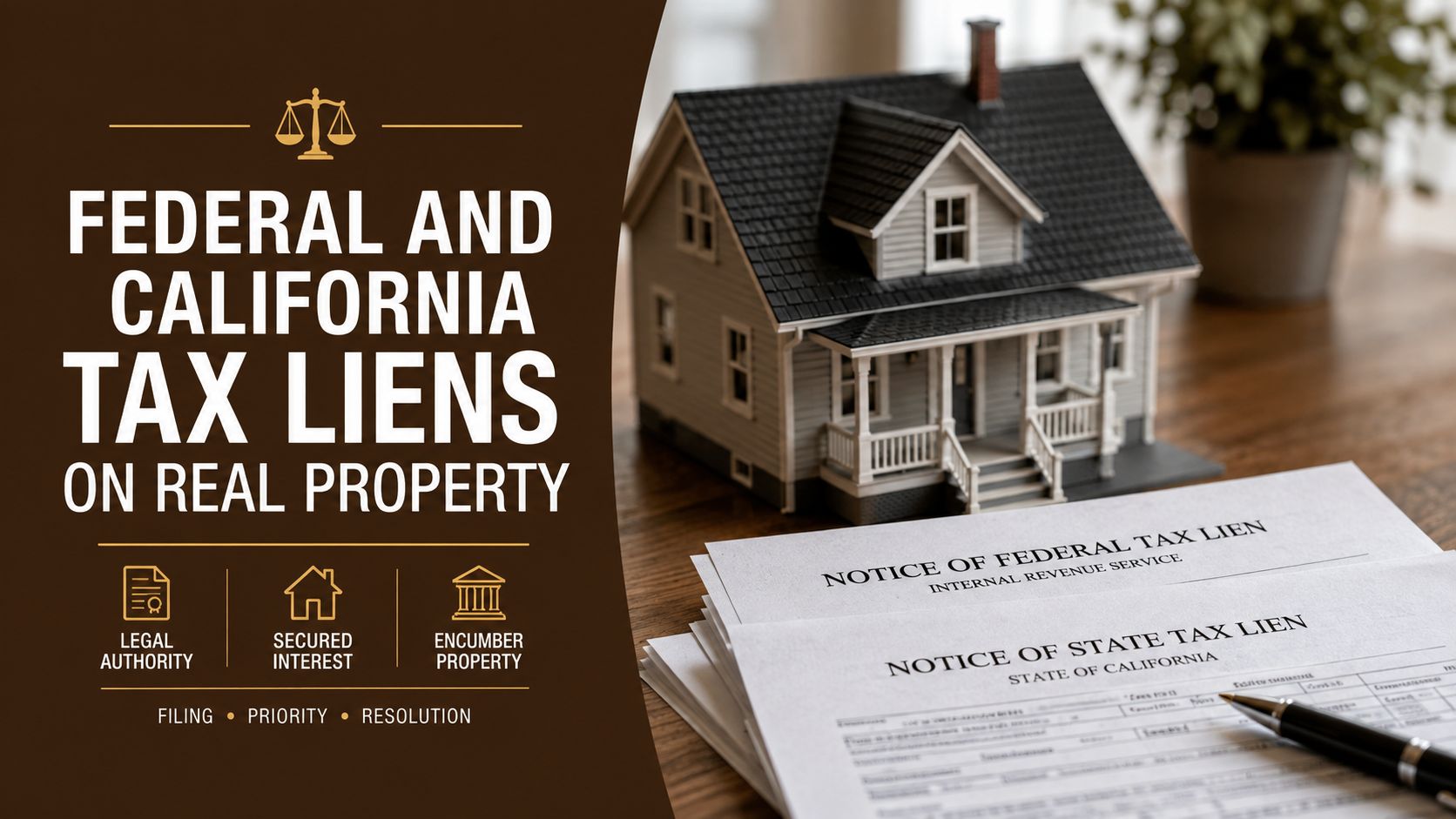
Federal and California Tax Liens on Real Property
A discharge of personal liability is not the same thing as a lien release. That distinction matters a lot for homeowners in California, because a tax lien can sit on real estate even after the underlying debt changes form in bankruptcy. If your home is in Orange County or Los Angeles, that lien can affect title, closing, refinancing, and estate administration.
Federal and state liens are not the same thing
The IRS can record a Notice of Federal Tax Lien, which secures the government's claim against property. California's FTB also uses lien tools that can attach to assets and create practical problems for real estate transactions. The mechanism is different, but the result feels the same to the owner, because the title company sees a cloud and slows the deal down.
A Chapter 7 discharge can remove your personal responsibility for a qualifying tax debt, but it generally does not erase a lien that has already attached to property. Chapter 13 can sometimes offer more room to deal with lien-related issues, including treatment of junior liens in the right case, but that still depends on the property, the debt, and the chapter rules.
For homeowners, the key is usually to deal with the debt first and then push for lien release or resolution. No title company likes ambiguity, and no buyer wants to wait for a tax issue to be sorted after escrow opens.
Alternatives Worth Comparing Before You File
Bankruptcy is not the only answer, and smart clients compare the non-bankruptcy options before choosing a chapter. For many taxpayers, the better result is not “erase everything,” it's “stop the bleeding and solve the collection problem without making the next year worse.” That's especially true when the debt is mostly current, the returns are filed, and the taxpayer has cash flow but not enough to pay in one shot.
The non-bankruptcy menu
IRS installment agreements let you pay over time, but the debt stays alive and interest and penalties keep running. Offers in compromise can settle for less in the right case, but they require detailed financial disclosure and strict qualification. Currently not collectible status can pause enforcement, yet it doesn't erase the debt, and it doesn't make the balance disappear.
California taxpayers have state-level versions of these ideas through the FTB, including installment agreements and compromise tools for eligible cases. The hard truth is that none of those options works automatically, and none of them has the clean finality of a discharged debt when bankruptcy is the right fit.
If the debt is old, the returns are filed, and collection is active, Chapter 13 is often the best hybrid, because it can stop collection while paying what has to be paid over time.
That's also where fraud matters. If a taxpayer filed a fraudulent return, hid income, or otherwise intentionally tried to evade taxes, bankruptcy usually won't erase the debt even if the timing rules are met. That's not a technicality. It's the line that ends the discharge analysis.
Practical Next Steps and Warning Signs to Act On
Start with records, not guesses. Pull your IRS and FTB account transcripts, confirm the due dates, check the assessment dates, and verify whether every return was filed. If you own property in California, check for recorded liens before you assume a bankruptcy filing will clear the title problem.
A tax case gets messier fast when the paperwork is incomplete. Missing returns can change the discharge result, and a recorded lien can keep following the home even after the personal debt is gone.
What to gather before you make a move
- Filed and unfiled returns: assemble every year you can find, because missing returns can change the discharge result.
- Tax notices and transcripts: use them to confirm the timing facts instead of relying on memory.
- Property records: check whether any federal or state lien has already been recorded against the home.
- Collection letters: keep bank levy notices, wage garnishment papers, and substitute-for-return notices in one place.
The warning signs are plain. If a bank account has already been levied, if the FTB is garnishing wages, if a lien is affecting a home sale, or if a substitute return is pending, waiting usually makes the case harder. California homeowners also need to think about probate and real estate issues, because a tax lien can complicate a sale, a refinance, or an inherited property transfer just as much as it complicates personal finances.
Bankruptcy filings stay common because households use them as a serious debt tool when unsecured obligations get out of control. The IRS reports that annual U.S. bankruptcy filings totaled 574,314 in the year ending December 2025, up from 517,308 in the prior year, and consumer cases accounted for 484,845 filings in 2024, as reported in federal bankruptcy data. If your tax problem includes missing returns, old balances, and a lien on California property, that is the point to get specific legal advice instead of guessing.
Tanner Law helps Californians sort out the tax, title, and debt issues that usually show up together, especially when a home, an inheritance, or a property sale is on the line. If you are trying to figure out whether bankruptcy can help with back taxes, visit Tanner Law and schedule a free consultation so your specific tax years, returns, and lien records can be reviewed before you file anything.