Breach of Contract Remedies in California Real Estate
In California real estate, breach of contract remedies often favor specific performance because land is treated as unique and money may not fully replace it. Most other contract disputes start with damages, but a missed closing on a home, duplex, or investment property can put you in a very different legal position.
A seller backs out after signing. A buyer cannot fund on time. A broker or developer changes course after everyone has already committed money, time, and trust. When that happens, the first question is simple, what can I do now, and the answer usually comes down to two families of remedies, money damages or equitable relief.
Table of Contents
- What Happens When a California Real Estate Contract Falls Apart
- How California Measures Contract Damages
- Types of Monetary Damages in Real Estate Disputes
- When Specific Performance Is Available for Land
- Rescission and Injunctive Relief as Alternatives
- Steps to Pursue Breach of Contract Relief in California
- Litigation or Settlement Which Path Fits Your Case
- Protect Your Rights After a California Real Estate Contract Breach
What Happens When a California Real Estate Contract Falls Apart
A familiar Orange County scenario starts with a signed purchase agreement, a scheduled closing, and a buyer who has already ordered inspections and lined up movers. Then one side misses a deadline, financing stalls, or the other party announces they are walking away. At that point, the problem is not just broken expectations, it is deciding which legal remedy fits the facts.

The basic choice is between monetary damages and equitable relief. In common-law contract doctrine, damages are the primary remedy, while equitable orders like specific performance are secondary and used when money is not enough. That general framework traces back to milestones such as Slade's Case in 1602, Hadley v. Baxendale in 1854, and the Uniform Commercial Code's Article 2, drafted in 1952 and later adopted in 49 states, all of which helped shape the damages-first model in contract law (source material on contract remedies history).
California real estate pushes harder toward land-specific relief than many readers expect. A home, parcel, or commercial site is not treated like a mass-produced good, and that distinction matters when a court is deciding whether money really fixes the harm.
Practical rule: if the property is the deal, not just the price, a California court may look beyond dollars and ask whether forcing the sale is the fairer remedy.
The question is not whether someone breached, it is what remedy is available under California law and how quickly you act after the breach.
How California Measures Contract Damages
California starts with a clear statutory rule. Under California Civil Code section 3300, damages are measured by the amount that will compensate the injured party for all detriment proximately caused by the breach, or that would likely result in the ordinary course of things. California also limits recovery to losses that are clearly ascertainable in nature and origin, which keeps speculative losses out of a contract claim (California Civil Code section 3300 summary).
That matters in a home sale because not every disappointment becomes a recoverable dollar figure. If a buyer thinks they lost a dream house, the law still asks what the provable financial harm was, not just how frustrated they feel. A seller claiming the deal fell through must connect the loss to the breach itself, not to market swings, unrelated delays, or guessed future profits.
What the damages rule does in practice
The California measure is narrower and more concrete than a broad sense of fairness. You need proof that the breach caused the loss, and you need enough facts to show the loss can be measured. In a real estate dispute, that usually means contracts, escrow records, repair estimates, replacement purchase papers, or other documentation that shows what happened after the breach.
This also helps explain the difference between California practice and the general common-law hierarchy. The common-law model historically puts damages first and equitable relief second, while California real estate law recognizes that land can make damages an incomplete substitute. That is why the same breach can look ordinary in one setting and highly consequential in another.
Good evidence matters more than loud complaints. If you cannot show when the loss happened, what caused it, and how it can be measured, the damages claim gets weaker fast.
For families dealing with probate, inherited property, or a sale tied to a trust or estate, this rule can matter even more. The legal system wants a clean line between what the breach caused and what would have happened anyway.
Types of Monetary Damages in Real Estate Disputes
California real estate cases usually turn on three money-based ideas, expectation damages, reliance damages, and consequential damages. They sound technical, but each one answers a plain question about loss. What did the deal promise, what did you spend because you trusted it, and what additional harm followed?
Expectation damages
Expectation damages try to put the injured party in the position they would have been in if the contract had been performed. In a home sale, that often means comparing the contract price with the market value or replacement cost at the time of breach. If a buyer was supposed to receive a property at a set price and the seller refused, the legal focus becomes the bargain itself.
Reliance damages
Reliance damages cover money spent preparing for performance. Think inspection costs, loan application expenses, moving deposits, or other out-of-pocket amounts made in reliance on the contract. These losses matter when proving the full benefit of the bargain is hard, but the preparatory spending is easy to document.
Consequential damages
Consequential damages are secondary losses that flow from the breach, and they must satisfy the foreseeability limits tied to Hadley v. Baxendale. They can include things like temporary housing, storage, or other downstream costs, but only when those losses were reasonably within the parties' contemplation. The injured party also has a duty to mitigate, meaning they cannot let avoidable losses pile up and expect the breaching party to cover them (practice note on remoteness and mitigation)).
A simple way to think about it is this, the court will often ask whether the loss was part of the deal, part of the preparation, or part of the fallout. Those categories are not interchangeable, and they do not all get treated the same.
| Damage type | What it covers | Real estate example |
|---|---|---|
| Expectation | The benefit of the bargain | Difference between the contract deal and the replacement transaction |
| Reliance | Costs spent getting ready | Inspection, application, or escrow-related expenses |
| Consequential | Foreseeable downstream losses | Temporary housing or storage costs that can be tied to the breach |
Document everything early. If you wait too long to gather receipts, replacement offers, and mitigation efforts, the loss can become harder to prove and easier to challenge.
When Specific Performance Is Available for Land
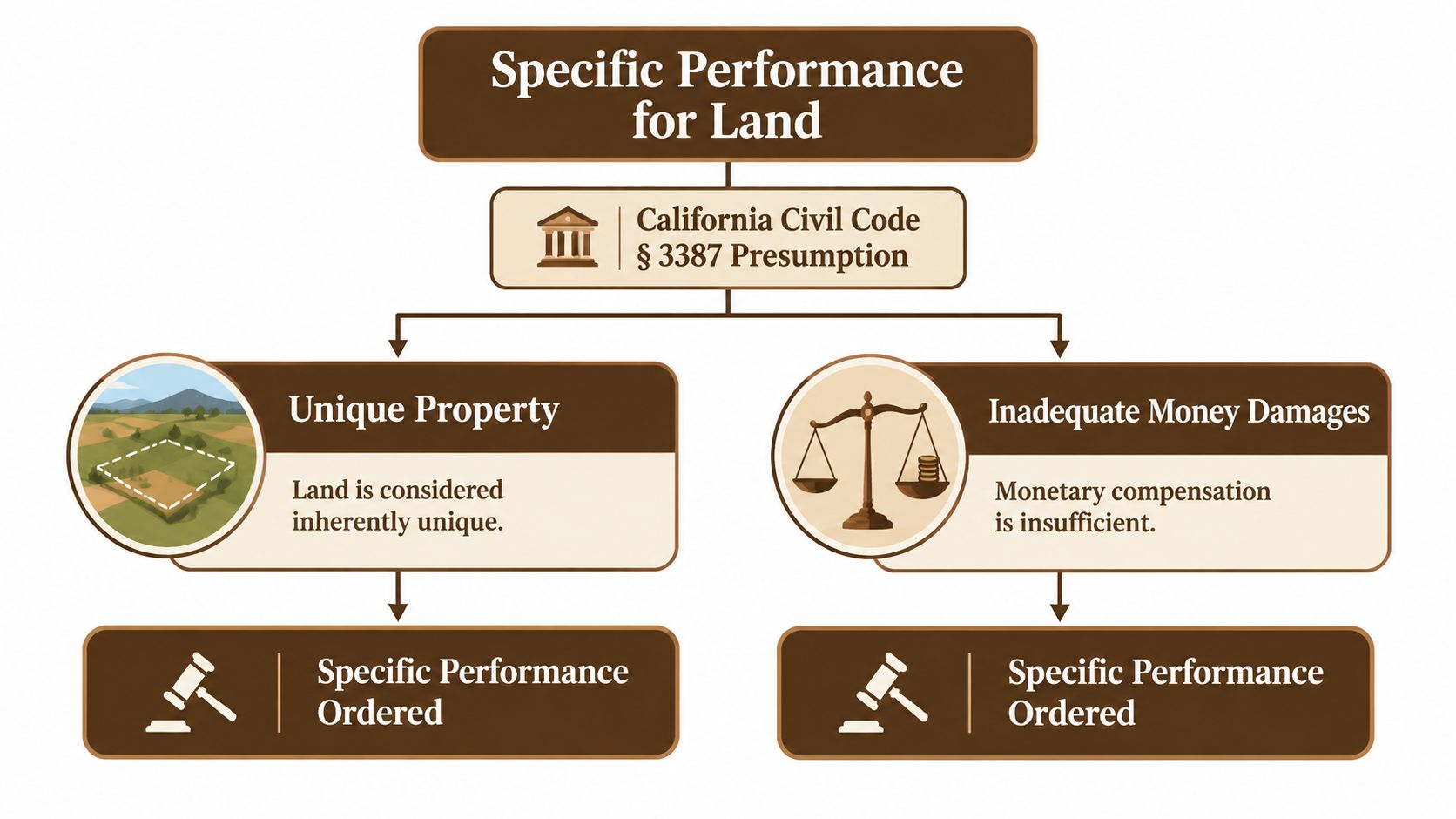
Specific performance is the remedy many people mean when they say they want the other side to “do the deal.” Instead of paying money, the court orders the breaching party to complete the transaction. In California, that remedy is especially important for land because Civil Code section 3387 creates a presumption that monetary damages are inadequate for real property contracts (California real property remedy guidance).
How the remedy works
For a buyer or seller, the logic is straightforward. Land is unique, so a substitute parcel may not replace the property that was promised. California law reflects that reality by making specific performance a natural fit in many real property disputes, especially where the contract itself is clear and the property can still be transferred.
That does not mean every land case wins automatic specific performance. Practitioner guidance emphasizes that courts can still refuse the remedy if damages are adequate, if the order would require continuing supervision, or if forcing performance would be too burdensome to manage. The core issue is not just whether the property is unique, it is whether a judge can administer the order cleanly (practitioner analysis of specific performance limits).
Why California is different
A lot of general contract guides talk about specific performance as a rare exception. California real estate is different because the law already starts from a presumption against money as a full substitute for land. That makes the remedy much more practical in home sales, vacant lots, and other property transfers than readers usually expect.
California also recognizes that the other side's promise doesn't always have to be specifically enforceable on its own, so long as the remedy is otherwise appropriate and the counterperformance has been substantially performed or can be secured to the court's satisfaction (California Civil Code section 3386 text).
That combination is why a well-drafted and well-timed real estate claim can put real pressure on the breaching party. A court may not just calculate numbers, it may order the deed to move.
Rescission and Injunctive Relief as Alternatives
Not every breach should be forced forward. Sometimes the cleanest result is to unwind the contract and put both sides back where they started. That is the role of rescission, which can make sense when the breach goes to the heart of the deal or when continuing the relationship would only deepen the dispute.
When rescission fits
Rescission is often the better option when the contract was built on a mistake, a serious failure of performance, or a deal that no longer makes practical sense. In real estate, that can matter where the property issue is intertwined with trust administration, family ownership, or disclosure problems. The point is not to punish, it is to stop the deal from operating as if it never should have moved forward.
When injunctions matter
Injunctive relief works differently. It does not unwind the whole contract, and it does not force final performance. Instead, it stops a party from doing a specific act, such as selling the same property to someone else, violating an exclusive listing, or taking steps that would make the eventual judgment meaningless.
A preliminary injunction can be especially useful when delay would make the case harder to fix later. That is why timing matters so much in California civil practice. If the property changes hands, gets encumbered, or is otherwise altered, the court's options can narrow quickly.
Choosing the right equitable tool
The choice often comes down to the harm. If you want out of the deal, rescission may be the cleaner path. If you want to preserve your position while the case is pending, injunctions can protect that right. If you want the property itself, specific performance stays at the center of the analysis.
For Orange County and Los Angeles homeowners, investors, and families handling inherited property, that choice can shape the entire case. California law gives real room to tailor the remedy to the facts, but only if the claim is framed carefully from the start.
Steps to Pursue Breach of Contract Relief in California
The first moves after a breach often matter as much as the lawsuit itself. Preserve the signed contract, escrow emails, texts, inspection reports, notices of default, and anything else that shows who promised what and when the deal broke down. If you are dealing with a real property dispute, each missing document can make later proof harder.
The early sequence
Start with a formal demand letter that identifies the breach and states what remedy you want. That letter can help show you acted promptly and reasonably, which matters for both damages and equitable relief. It also gives the other side a chance to cure the problem or make a settlement offer before the dispute hardens.
Then evaluate whether the situation needs immediate court action. If the property might be sold to someone else or the order would be difficult to enforce later, a request for preliminary relief may be necessary. After that comes the usual litigation path, complaint, discovery, mediation, and trial if the case does not settle.
What clients should keep in mind
- Preserve evidence fast: Save every email, contract version, and closing document before anything disappears.
- Track mitigation efforts: Keep records of replacement housing, substitute transactions, or other steps taken to limit loss.
- Watch deadlines: Delay can weaken equitable claims because the court may see the remedy as less workable.
- Stay consistent: What you say in writing, and what your documents show, should match the remedy you are seeking.
Practical rule: if you want a court to order performance, act like time matters from day one, because it usually does.
That is especially true in California, where the remedy you pursue can depend on whether the court believes the property can still be transferred in a fair and manageable way. The longer the delay, the more room there is for the other side to argue that money is enough now.
Litigation or Settlement Which Path Fits Your Case
Some disputes need a courtroom. Others need a negotiated exit. The better path usually depends on the strength of your documents, how urgent the remedy is, and whether the other side is willing to resolve the matter without forcing you through trial.
| Factor | Litigation | Settlement |
|---|---|---|
| Cost | Usually higher because it requires pleadings, discovery, and court appearances | Usually lower because the parties can resolve the matter earlier |
| Certainty | A judge or jury can decide the issue, but the outcome is less predictable | The parties control the result, but each side gives up something |
| Speed | Often slower because the case moves through procedure | Often faster if both sides negotiate in good faith |
| Relationship impact | Can strain an already tense property or family situation | Can preserve a working relationship if that still matters |
| Remedy fit | Better when specific performance or formal findings matter | Better when a practical payment or adjusted closing solves the problem |
When litigation makes sense
Litigation is often worth considering when the contract and the breach are well documented, when the property is unique, or when the other side is refusing to engage. It also becomes more attractive when specific performance may be available and money would not solve the problem. For clients in probate or trust-related property disputes, that can be a major advantage.
When settlement makes more sense
Settlement can be the smarter choice when the disputed amount is modest, the evidence is messy, or the parties want to avoid the cost and delay of court. It can also be the right move when the remedy you want is already within reach through negotiation, such as a new closing date or a credit that resolves the dispute without a full lawsuit.
Tanner Law handles contract disputes as part of its broader real estate practice, and that kind of mixed experience can help when the facts involve both property rights and enforcement strategy. If the issue is real, ask early whether the case is strong enough for court or better positioned for a negotiated result.
Protect Your Rights After a California Real Estate Contract Breach
California gives homeowners, buyers, sellers, and families a real set of options after a property contract falls apart. The key questions are simple, even if the law is not. Do you need money, do you need the deal enforced, or do you need the contract unwound before the damage gets worse?
The answer depends on the facts, the paperwork, and how fast you act. Mitigation, causation, and the feasibility of equitable relief all affect the value of the claim. In land disputes, California's presumption that money is inadequate for real property can be a major advantage, but only if the case is handled early and with the right remedy in mind.
For Orange County and Los Angeles clients, especially those dealing with probate property, inherited homes, or a sale tied to family ownership, those choices are too important to guess at. A careful review can show whether damages, specific performance, rescission, or injunctive relief fits the situation best.
Tanner Law helps clients sort out real estate contract disputes with clear advice, direct attorney access, and practical litigation strategy. If you're dealing with a breach of contract in California and need to understand your options, visit Tanner Law to schedule a free consultation and discuss the next step.