Adverse Possession Requirements in California
A neighbor's fence is sitting a little farther onto your lot than it used to. Or maybe a family member has been using the side yard, the driveway strip, or an unused parcel next door for years, and now everyone is asking who really has rights to it. In California, those questions can turn into an adverse possession dispute, and the answer depends on more than just how long someone has been there.
The law looks past casual use and asks for strict proof. A claimant has to show the right kind of possession, for the right length of time, and in California that usually means five years plus proof that all assessed property taxes were paid during that period. If any part of that proof is missing, the claim can fail even when the facts feel obvious to everyone involved.
Table of Contents
- What Adverse Possession Actually Means
- The Five Core Elements Every Claimant Must Prove
- California's Five-Year Rule and the Tax-Payment Requirement
- Supporting Doctrines That Can Make or Break a Claim
- Proving the Claim and Defending Against One
- Practical Steps for Claimants and Property Owners
- Frequently Asked Questions and When to Call an Attorney
What Adverse Possession Actually Means
A homeowner in Orange County notices that a neighbor has been parking on a narrow strip of driveway for years. No one objected at first. Then, after a sale, the new owner wants the space back and learns that long use can sometimes support a claim of ownership.
That's the basic idea behind adverse possession. It is not a magic shortcut that transfers title the moment someone uses land long enough. It is a court-tested doctrine that can move ownership only if the claimant proves the legal elements and, in California, clears the tax-payment rule too.
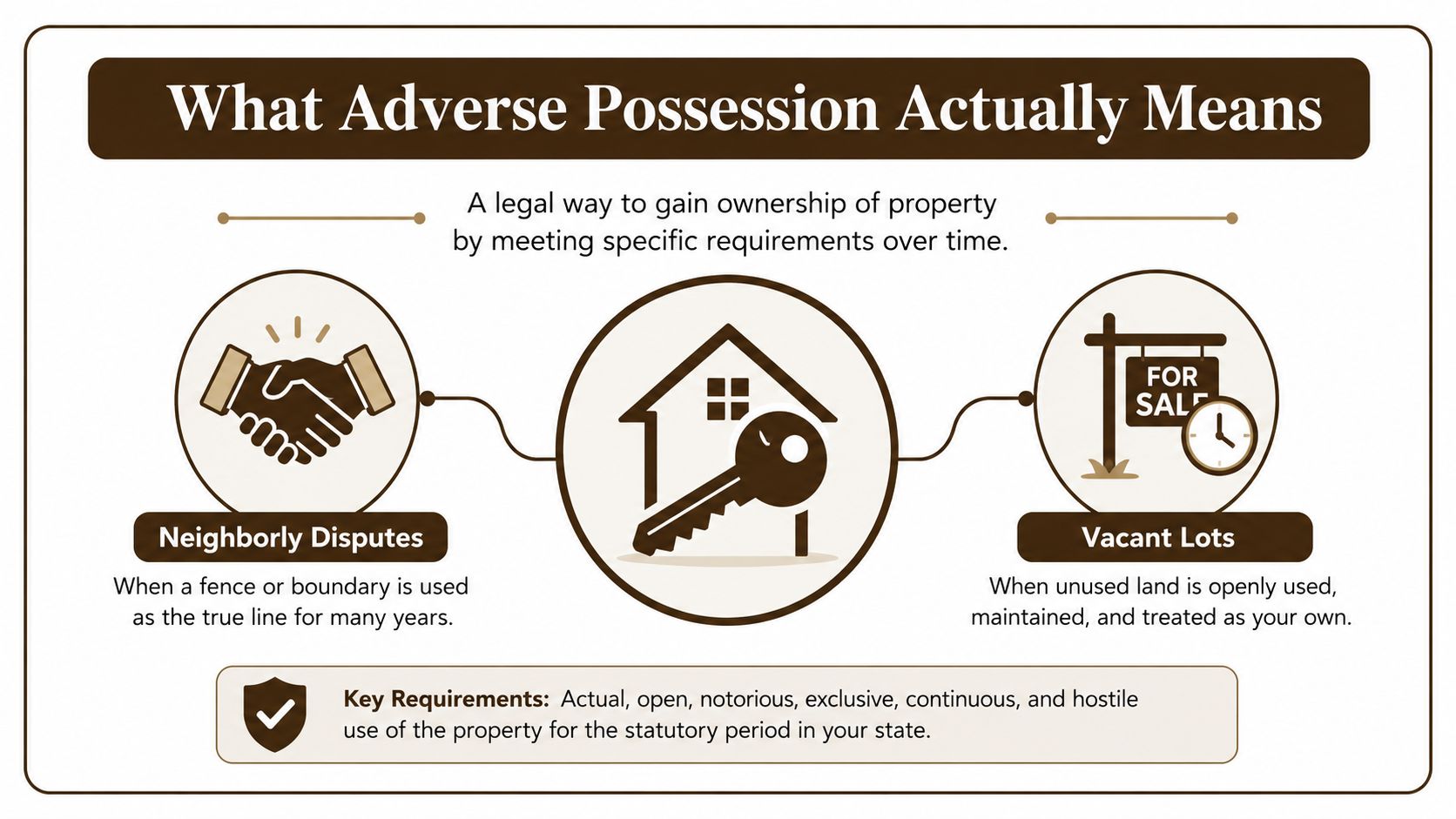
Why the doctrine exists
Courts treat adverse possession as a way to reward land that has been used like an owner would use it, while also forcing record owners to pay attention to their property. That tension is why the doctrine keeps showing up in real disputes, not just textbook examples. An academic survey found 5,046 adverse-possession cases in the United States over 55 years from 1960 to 2015, averaging 92 cases per year, and a separate empirical study spanning 32 states and 200 years found claimants won 44% of cases (CFRA research PDF).
The point for California families is simple. Long use can matter, but only if the use is the kind of use the law recognizes. Quiet, permissive, or shared use usually won't do it.
Why this is a courtroom issue, not a self-help rule
A person doesn't become the owner just because they've acted like one. The usual path is a quiet title case, where a judge decides whether the claimant's possession was legally sufficient. That's why these cases are so evidence-heavy, and why a casual assumption can put title, probate plans, or a family's sale timeline at risk.
Practical rule: if the record owner never received clear notice through visible, exclusive use, the claim gets harder, not easier.
Adverse Possession at a Glance
| Item | Standard Rule |
|---|---|
| Core idea | A person may try to claim ownership by possession, not just by deed |
| Basic proof | Actual, open and notorious, exclusive, hostile, and continuous possession |
| California time period | Five years |
| Extra California requirement | Payment of all assessed real property taxes during that period |
| Usual outcome | A court decides the claim, it is not automatic |
The Five Core Elements Every Claimant Must Prove
Courts do not look for one big fact. They look for five separate facts that fit together. Miss one, and the whole claim can collapse.
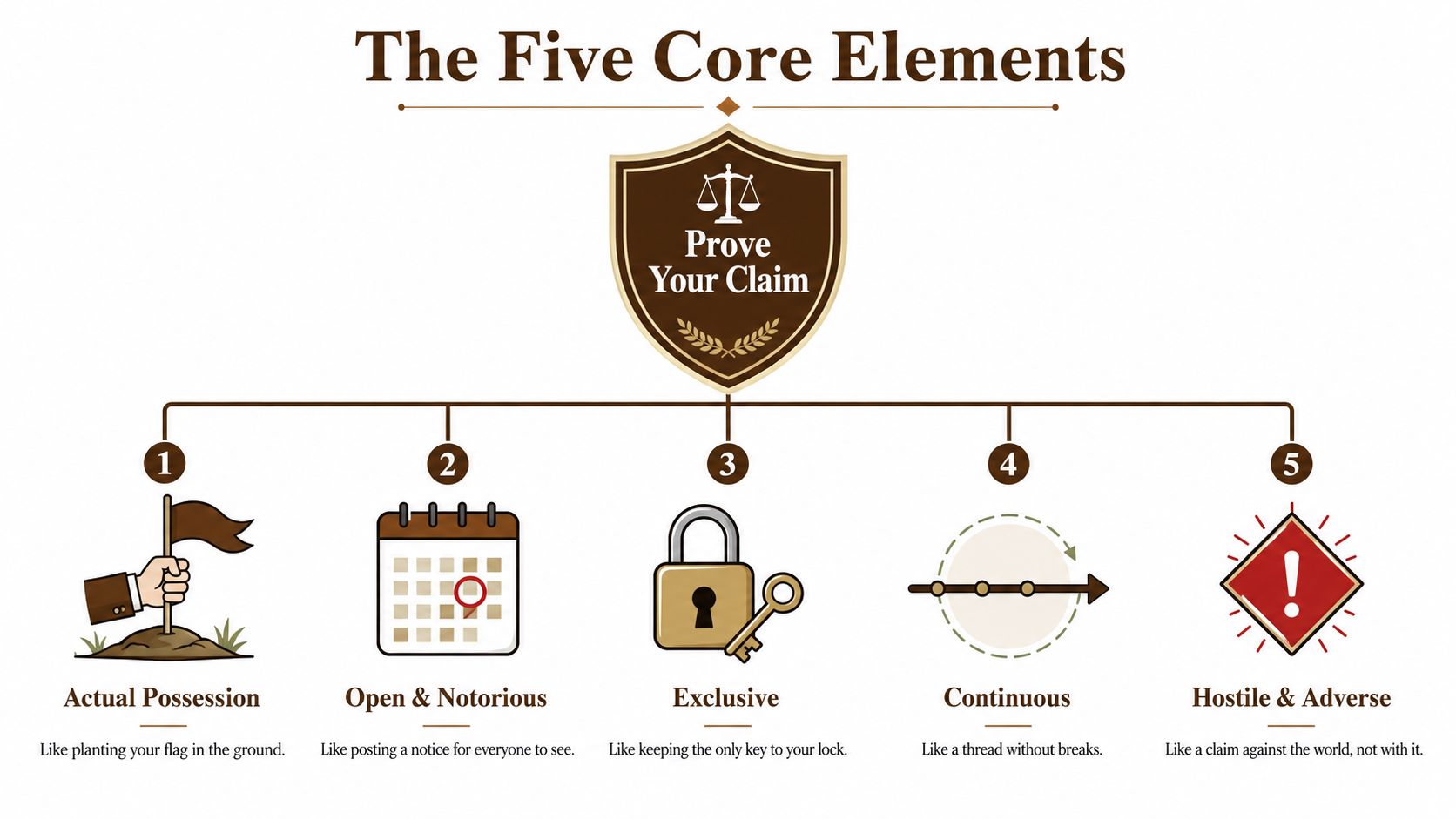
Actual, open, and exclusive possession
Actual possession means the person is really using the property, not just talking about it. Think mowing the strip, fencing it, storing equipment there, or making improvements that a true owner would make.
Open and notorious means the use is visible enough that the owner could notice it. A person who occupies land in plain view is very different from someone who uses it in secret. Exclusive possession means the claimant is not sharing the space in a way that looks like common or joint use.
The cleanest way to picture this is a house with the lights on and the curtains open. The law wants possession that announces itself, not possession that hides in the shadows.
Hostile and continuous possession
Hostile doesn't mean angry. It means the possession is without the owner's permission. If the owner gave a lease, written easement, or rent agreement, the hostile element usually fails because the use started with consent (Investopedia's explanation of hostile possession).
Continuous means there isn't a break in the required possession during the full statutory period. A few temporary absences may not matter, but a real interruption can reset the clock. California readers often get tripped up here because a property can look occupied for years without meeting the legal standard the whole time.
The law cares about conduct that is consistent enough to look like ownership, not just convenience.
The basic test is also summarized in a legal overview that says the five elements, actual, open and notorious, exclusive, hostile, and continuous, are what convert ordinary trespass into legally cognizable possession (Justia overview).
What evidence usually supports these elements
A claimant trying to build a real case usually gathers proof that matches each element:
- Photos and video: show fences, landscaping, structures, or long-term use.
- Witness statements: neighbors can explain what they saw and when.
- Utility or service records: may help show who controlled the space.
- Surveyor reports: can identify the exact strip or area in dispute.
- Maintenance records: support the idea that the possessor treated the land as their own.
If the facts show permission, shared use, or sporadic visits, the claim gets much weaker. If the facts show visible, exclusive, owner-like control for the whole period, the claim becomes more plausible.
California's Five-Year Rule and the Tax-Payment Requirement
A California adverse possession claim can look strong on paper and still fail at the finish line if the tax records do not match. The state requires more than long use and visible control. The claimant generally must prove five years of continuous and exclusive possession, and must also show payment of all assessed real property taxes during that same five-year period (Schorr Law).
That tax requirement is where many claims break down. A person may fence the land, maintain it, and use it like an owner for years, yet lose the case if the assessment history does not line up with the claimed parcel. In inherited-property disputes, the problem often comes from scattered paperwork, assessment notices in one file, old bills in another, and relatives who remember the land differently.
Why California's rule feels stricter than it sounds
California's rule is short on time and strict on proof. That combination makes the claim more demanding than a simple story of long occupancy. The possessor has to connect the possession to the tax records, parcel by parcel, because a court will look for evidence that the claimant satisfied the statute rather than just used the land.
A claimant who paid taxes on the wrong parcel, paid the right taxes under the wrong property description, or missed part of the assessed amount may have trouble proving the statutory requirement. If the record owner kept paying the taxes, that fact can also weaken the claim, because it cuts against the idea that the claimant was the one acting as the owner in the eyes of the law.
What the tax requirement changes in real life
The tax rule changes the evidence a claimant should gather from the start. Receipts, assessor records, and parcel histories matter just as much as photos of fences or landscaping. If those records are missing, the case may still show use of the property, but it may not show the kind of tax compliance California requires.
That is why practitioners usually want parcel-level tax proof, not a general memory that “someone paid something.” A claimant should treat tax receipts and assessment records as part of the ownership story, because they help show that the possession was not only visible and exclusive, but also tied to the legal responsibilities that come with claiming title.
Statutory Periods Compared
| Jurisdiction | Statutory Period | Extra Requirement |
|---|---|---|
| California | 5 years | Payment of all assessed real property taxes during the period |
| California, general overview | 5 years | Continuous and exclusive possession plus tax proof |
| Indiana | 10 years | Tax-payment or good-faith tax-payment belief requirement |
| Many other states | 7 to 20 years | Rules vary, especially with color of title |
For California claimants, the practical lesson is simple. Keep the tax paper trail from the first day of possession, because a strong occupancy case can still fail if the assessment and payment history do not support it.
Supporting Doctrines That Can Make or Break a Claim
Some adverse possession disputes turn on facts that happened before the visible five-year stretch. A fence, a driveway, or a planted strip may look like the whole story, but the legal timeline can start earlier or run differently because of supporting doctrines. Those doctrines often decide whether a claimant can count earlier use, rely on an old document, or argue that the record owner should be barred from objecting.

Tacking and color of title
Tacking lets a claimant add a predecessor's period of possession to their own when the possession is connected in a lawful chain. The practical idea is simple. If one person used the strip openly and then handed the property to a family member or buyer who kept using the same strip in the same way, the later possessor may try to count both periods together if the law and facts support it.
Color of title means the claimant has some document that appears to give title, even if it is imperfect or defective. A deed with a mistake, a flawed legal description, or another broken paper trail can still matter because it shows why the claimant believed the land was theirs. A widely cited academic overview notes that the time requirement is often 7 years with color of title and 20 years without it.
Disability tolling
Disability tolling pauses the clock for an owner who is under a legal disability, such as minority or incapacity, and in some jurisdictions imprisonment can also matter. The point is not that the owner gets endless extra time. The law usually gives protection only while the disability exists, and once it ends, the clock can start again.
These doctrines often matter because they change the calendar that everyone else thought was fixed. A person may look at the ground, see a long period of use, and assume the claim is complete, while the law may still ask whether the possessor can add prior occupancy, rely on a defective deed, or account for a tolling event.
Takeaway: these doctrines often decide cases that look simple from the outside, because family transfers, old documents, and the owner's personal circumstances can change the legal timeline.
Why these doctrines matter to California families
A title dispute rarely begins with a clean, five-year calendar. It often starts with inheritance, a transfer between relatives, an old deed, or a boundary that was never clearly surveyed. Those facts can change whether time counts, whether time can be added together, and whether the owner had a legal reason for delay.
A family example makes the point clear. One relative may have used a side yard for years, another relative may have continued the same use after a transfer, and an old deed may have pointed to the area even though the description was imperfect. In that setting, the court may need to sort out who occupied first, whether the use can be tacked together, and whether any disability or document defect altered the timeline.
That is why a serious California case usually requires a paper trail that reaches back before the visible dispute began. Who occupied first, who transferred what, and whether the owner had a protected status can all affect the outcome.
Proving the Claim and Defending Against One
In California, adverse possession usually gets tested in a quiet title action. That means the claimant asks the court to declare who owns the disputed area, and the owner has a full chance to fight back with documents and testimony.
The evidence tends to be practical, not abstract. Tax bills, photographs, utility records, survey maps, repair invoices, and neighbor testimony often matter more than legal labels. If the claimant can't show a clean chain of possession and tax proof, the judge may never reach the more dramatic arguments.
What a claimant usually needs
A claimant normally needs proof that lines up with the legal elements and the California tax rule. That often means:
- Tax records: receipts or county records showing payment of all assessed property taxes.
- Use evidence: photos of fences, landscaping, sheds, or other owner-like acts.
- Timeline proof: documents that show continuous possession across the full period.
- Witness support: neighbors who can explain visible, exclusive use.
- Survey evidence: a professional map showing the exact area in dispute.
How an owner usually defends
The strongest defense is often permission. If the possessor used the land because of a lease, written license, easement, or similar consent, the hostile element may fail. A record owner can also defend by showing regular tax payments, interruptions in use, or proof that the possession was shared rather than exclusive.
Permission changes the legal character of the use. What looks like long occupancy may only be allowed occupancy.
Owners should also pay attention to the procedural side of the case. Quiet title judgments are designed to settle ownership against the parties before the court, which is why service, proper notice, and accurate legal descriptions matter so much. A sloppy complaint can leave the wrong strip of land out of the case entirely.
Practical Steps for Claimants and Property Owners
The best adverse possession cases are built early, not after the dispute explodes. For both sides, the key is to document the facts while they're still fresh.
For claimants
Start by treating the disputed area like evidence, not a convenience. Photograph improvements, keep dated records of maintenance, and save every tax receipt or county notice tied to the parcel. If neighbors have seen your use for years, get their statements while they still remember the details.
- Document Improvements: keep dated photos, invoices, and receipts.
- Gather Witnesses: ask neighbors what they observed and when.
- Consult Attorney: get a California quiet title review before the clock runs out.
For property owners
Act early if you see a fence, structure, or repeated use that doesn't match your deed. Send a written objection, post No Trespassing signs where appropriate, and keep paying the property taxes yourself. If the use was ever allowed, preserve proof of that permission in writing.
- Monitor Property: inspect boundary lines and outbuildings regularly.
- Send a Letter: make your objection clear and save a copy.
- Post No Trespassing: use visible notice where it makes sense.
The point is not to create conflict for its own sake. It's to stop a quiet problem from turning into a title lawsuit. In family-property situations, especially after death or during probate, delayed action often creates the very ambiguity that adverse possession claims rely on.
Frequently Asked Questions and When to Call an Attorney
People usually want quick answers to four questions. First, adverse possession doesn't erase a recorded deed overnight, and mortgages add another layer because lenders still have recorded rights that need to be addressed. Second, if the property is co-owned, one co-owner's possession is usually harder to characterize as hostile against the others.
Third, adverse possession can involve more than vacant land. Boundary strips, narrow access areas, shared structures, and registered-title systems can all create different issues, and the process for registered land is more procedural in some systems than in others. Fourth, squatters do not automatically take a California home, because the claim still has to satisfy California's legal elements, the time period, and the tax requirement.
If you're dealing with a disputed strip of land, a family occupancy issue, or a title question tied to probate or an inherited property, get legal advice before the situation hardens into a lawsuit. Small facts often decide these cases, and the earlier an attorney reviews the tax records, title history, and timeline, the better the chance of protecting ownership rights.
Tanner Law helps California homeowners, families, and property owners evaluate adverse possession disputes, quiet title claims, and related title problems with a clear, evidence-driven strategy. If you're in Orange County or Los Angeles and need a practical review of your facts, visit Tanner Law to schedule a free consultation and get a focused plan for protecting your property rights.