Adverse Possession California: The 5-Year Rules Explained
A fence has stood for years on what your family treated as your side of the yard. A parent died, and the deed for the house in Orange County or Los Angeles doesn't match the lot everyone used. Or a neighbor has been crossing a strip of your land, and nobody put the arrangement in writing. Families handling probate and estate planning run into this more often than a simple boundary argument suggests.
Under California law, that file can turn into an adverse possession California claim. Courts don't award title because someone moved into a tired house, repaired it, or assumed it had no owner. They look for a five-year documentary trail, and tax-payment records often decide the case before the occupation story does.
Start with the paper, not the memory of who mowed the grass.
Table of Contents
- The Six Requirements at a Glance
- How the Doctrine Works in Plain Terms
- Color of Title, Squatter Claims and Easements Compared
- Timelines, Tacking and Who Can Count Toward Five Years
- Evidence Checklist and the Tax Audit
- Quiet Title Steps From Filing to Judgment
- Common Owner Defenses and How to Answer Them
- When to Call Tanner Law for a Free Consultation
The Six Requirements at a Glance
A California claimant must prove six separate things, and each one has to hold across the full period.
| Requirement | What It Means in Plain Terms | Proof That Usually Carries Weight |
|---|---|---|
| Actual possession | Physically using the land the way an owner would | Photos, dated improvements, utility bills in your name |
| Open and notorious | Use visible enough that a reasonable owner would notice | Fences, gates, buildings, neighbor statements |
| Exclusive | Not shared with the owner or the general public | Locks, signs, and fences that keep others out |
| Hostile (claim of right) | Using the land as your own, without the owner's permission | Records showing you never asked the owner for permission |
| Continuous for five years | No break in use across the full period | Dated records covering every year of the period |
| Taxes paid for five years | Every assessed tax paid on time | Certified records from the county tax collector |
California Code of Civil Procedure § 325(b) requires continuous occupation and claim for at least five years, plus timely payment of every state, county, or municipal tax assessed in that same period. Tax proof has to come from certified records of the county tax collector. Taxes are their own statutory element, not background color. Years and payments by predecessors and grantors can count, so an earlier owner's time isn't automatically lost.
California's State Board of Equalization groups the related ideas as five cumulative elements: a claim of right or color of title; actual, open, and notorious occupation that gives the record owner reasonable notice; exclusive and hostile possession; uninterrupted possession for five years; and payment of all taxes. The table splits notice, exclusivity, and hostility so you can test each one on its own facts.
What Hostile Actually Means
Hostile doesn't mean personal anger or bad faith. In California property law it means possession inconsistent with the true owner's rights. The person asserting adverse possession carries the burden of proof on every element, and secret or occasional use usually fails the notice test. California appellate authority treats the full pattern of use, visibility, and tax compliance as one case, not a single dramatic fact.
Practical rule: Walk the table row by row. Any row you can't support with dated evidence is the gap to close before you talk about filing.
How the Doctrine Works in Plain Terms
California treats the record owner's right to sue like a clock. If that owner lets someone openly use the land as their own for five years and never objects, the law can close the window to take the land back. Adverse possession works more like a time limit than a prize for effort or repairs.

Two labels matter. The record owner is the person named on the deed. The claimant is the person asking a court to recognize a competing title. Good intentions don't start the clock. Visible, documented use does. An owner's objection or lawsuit can stop it.
A Rule Older Than Most Neighborhood Fences
The five-year limit isn't a modern shortcut. In Harris v. McGovern (1878), the U.S. Supreme Court said continuous adverse possession of California land for five years could bar an ejectment action, meaning a suit to recover possession, when the person seeking recovery wasn't under a legal disability when the claim accrued. Later California Supreme Court decisions kept that structure. Gilardi v. Hallam restated the need for five years of occupation and claim plus payment of all taxes. Sorensen v. Costa applied it where land was occupied for more than five years, enclosed, and usually cultivated, and the claimant and predecessors had paid the assessed taxes.
Mello v. Weaver is the caution. The court held that failure to show payment of taxes on the disputed land couldn't support an adverse-possession judgment, even when occupation looked convincing. Those milestones pair an old limitations idea with unusually concrete proof.
The clock rewards what a reasonable owner could have seen and what the tax collector can certify, not what the occupant privately believed.
Color of Title, Squatter Claims and Easements Compared
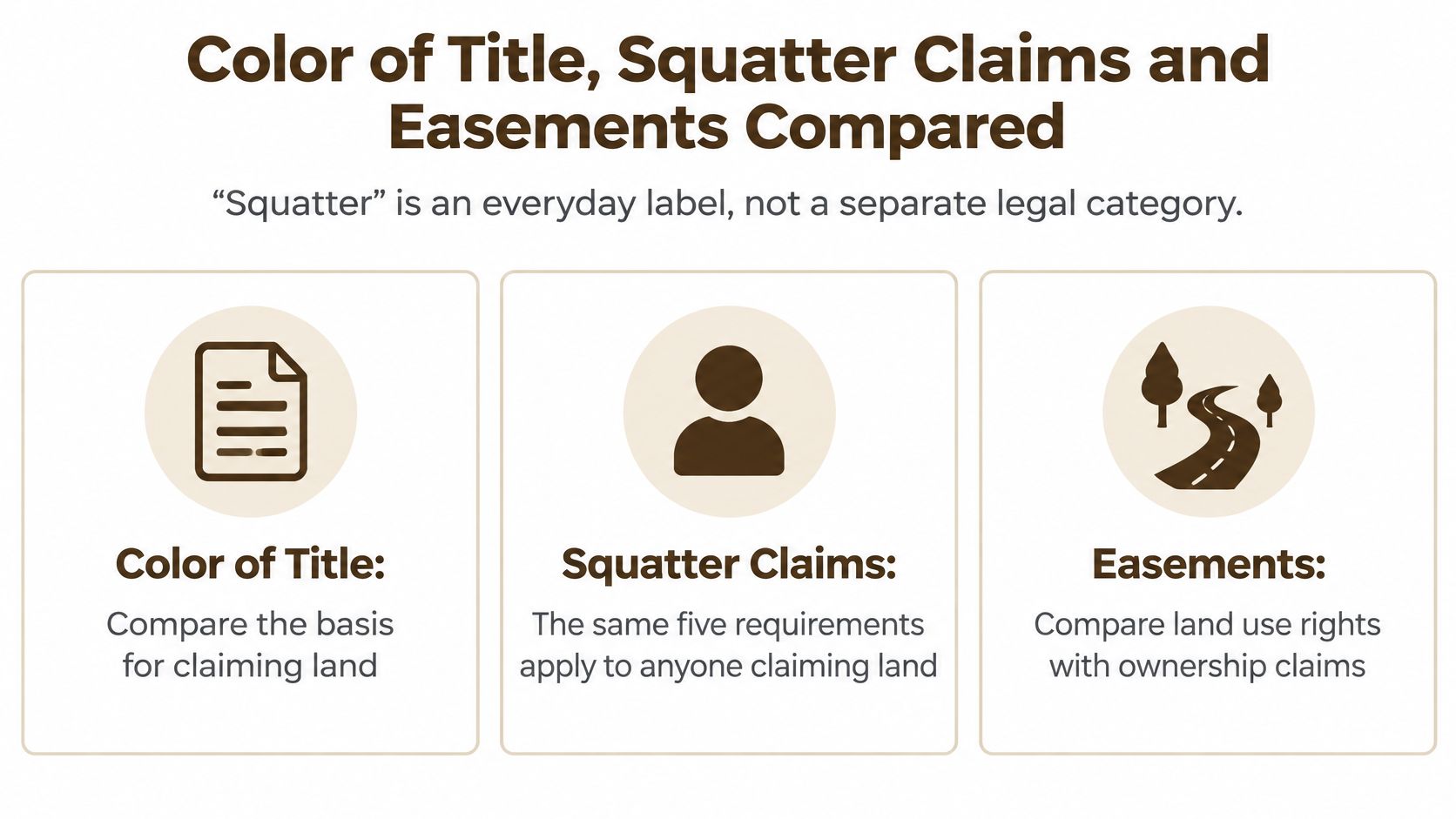
"Squatter" is an everyday label, not a separate California category. Anyone seeking title still has to meet the same statutory requirements. The routes people use differ based on what they want and what paperwork they hold.
| Theory | What the Claimant Seeks | Basis | Tax Payment Required | Typical Case |
|---|---|---|---|---|
| Adverse possession with color of title | Full ownership of the described parcel | A defective written deed or instrument that appears to convey the land | Yes | Inherited home with a flawed deed |
| Adverse possession under claim of right | Full ownership of land occupied | Honest belief that the land is yours, with no document | Yes | Long-occupied lot beside yours |
| Occupation with no claim | Ownership by occupation alone | No document or claim of right | Yes, and generally a weak position | Vacant property occupied without any claim |
| Prescriptive easement | A right to use a path or driveway, not ownership | Open, continuous, hostile use under a claim of right | Generally not required | Shared driveway or access route |
Color of title means a written instrument, judgment, or decree that looks like it conveys the land, even if the document is flawed. A claim of right is the belief that the land is yours without that paper. Occupation with no claim at all is the weakest posture, because California still expects a claim of right or color of title alongside the tax element.
Use of a Path Isn't Ownership of the Lot
A prescriptive easement is a right to keep using land in a specific way, not a deed to the parcel. California Supreme Court authority treats open and notorious use, continuity, hostility, and a claim of right as shared ideas. Tax payment is generally required for title by adverse possession. It isn't automatically required for a prescriptive easement when the owner hasn't shown that taxes were separately assessed on the easement.
Picture two neighbors. One has driven across your lot to reach a garage for many years. That dispute is usually about a right of access. The other fenced the strip, kept everyone else out, and farmed it. That dispute is about ownership. Pick the theory before you ask a court for title relief. Asking for the whole parcel when the facts only support a driveway right invites the wrong fight.
Timelines, Tacking and Who Can Count Toward Five Years
Think of the five-year count as a relay. Each possessor carries the baton, and tacking lets a later possessor add a predecessor's time. Tacking works only when possession stays continuous and passes through a documented link, typically a deed, will, probate transfer, or written agreement. The tax obligation has to be met across the whole chain, not just the years you personally lived there.
| Scenario | Years Counted | Tacking Allowed | Proof Needed |
|---|---|---|---|
| Your own continuous use | Full five years | Not needed | Dated records for every year |
| Heir moves in after a death | Decedent's years plus yours, if continuous | Yes, if the transfer is documented | Probate or succession records, tax bills |
| Bought from a seller who already occupied the land | Seller's years plus yours | Yes, if linked by deed or written agreement | Deed, purchase records, seller's tax history |
| Gap of several months in occupation | Clock generally restarts | No | Records showing the gap and its length |
| Use ended by owner permission or a lawsuit | Clock stops or restarts | No | Court filings, letters, messages |
What Breaks the Chain
An interruption generally breaks continuity, so the count starts over. Permission is a different problem. If the record owner allowed the use, the hostile element may never have started, even if the calendar looks long.
Estates and Family Transfers
For a probate family, the decedent's years may count, but only if succession papers show how possession passed. An heir who "took over the house" without a documented transfer has a story, not tacking. Build a year-by-year timeline before you rely on anyone else's time. Mark who lived there, who paid which bill, and whether any month sits empty.
A gap you can explain in conversation is still a gap if the file has no date on it.
Evidence Checklist and the Tax Audit
A quiet title case, the lawsuit that asks a court to declare who owns the land, lives or dies on a file you can hand to a judge. Gather these before you choose a strategy:
- Dated photographs: One set for each year of the five-year period, showing fences, crops, buildings, and who was kept out.
- Licensed survey and legal description: The claim has to match identifiable boundaries, not a backyard estimate.
- Permits and improvements: Fence, gate, and building permits, plus receipts for repairs, landscaping, and maintenance.
- Utility accounts: Bills in your name at the property address, which help show continuous, exclusive use.
- Neighbor statements: Written accounts from people who saw the use and can date it.
- Deed chain and probate papers: The complete chain, plus transfer documents if the land came through an estate.
- Certified county tax histories: Not screen printouts, and not a single recent bill.

The Tax Audit Most Families Skip
The overlooked failure isn't "we weren't there long enough." It's a missing tax record. In Romero v. Shih, the California Supreme Court reversed because the defendants failed to establish the required tax-payment element under Code of Civil Procedure section 325. The occupation wasn't the point that decided the appeal. A documentary omission was. That opinion is a direct answer to the idea that adverse possession is a race to occupy abandoned property.
Run the audit in order. Pull each assessed bill for all five years. Confirm the parcel number is the land you claim. Identify who paid, including a predecessor, an estate, or another co-owner. Order certified copies. Payments under the wrong parcel number, or by someone whose role you can't explain, need extra documentation. Jury guidance allows predecessor and grantor payments to matter, but you still have to prove the complete statutory case. An executor, trustee, or heir should finish this audit before assuming a quiet title or partition case will be straightforward.
Quiet Title Steps From Filing to Judgment
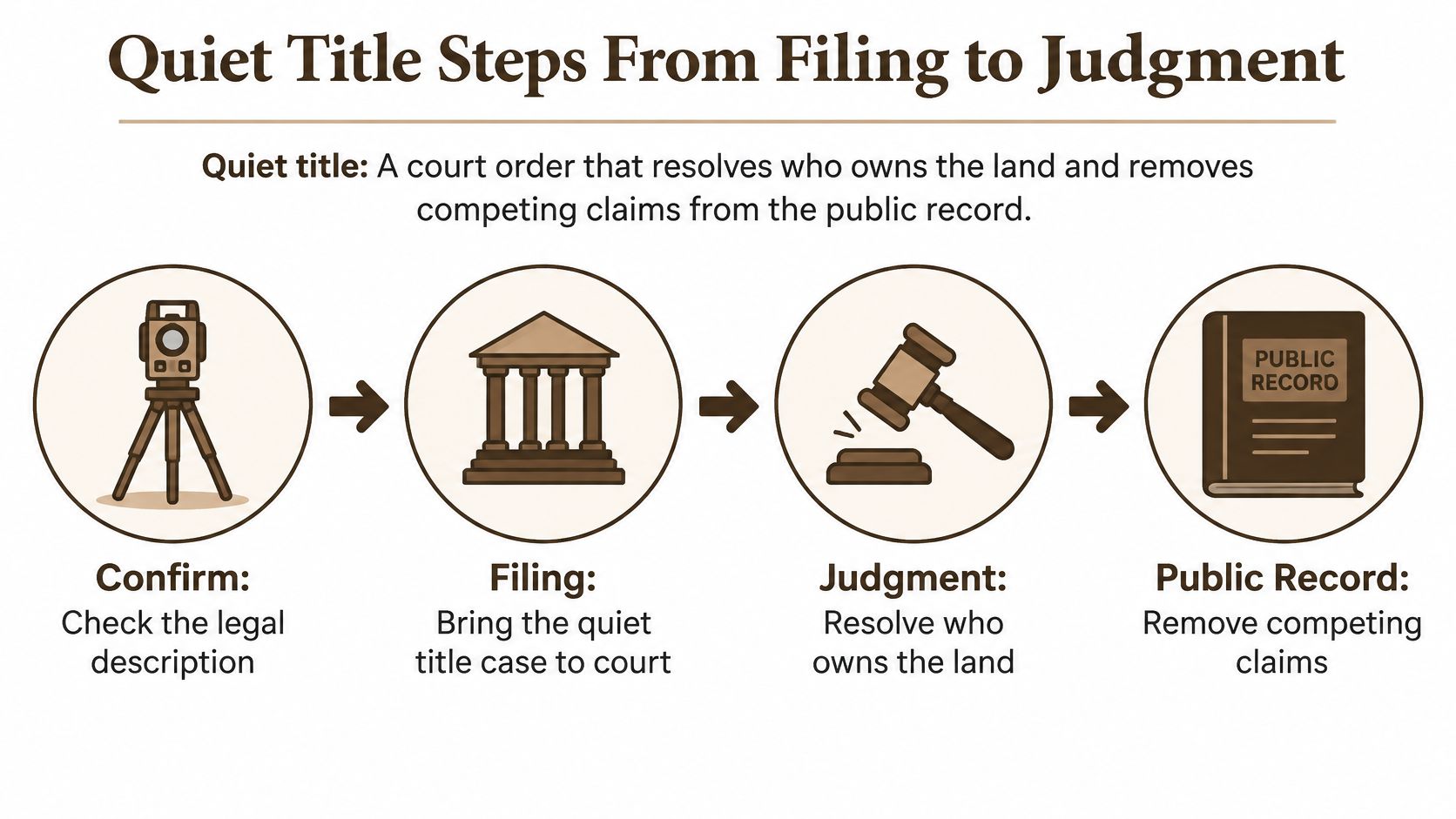
Quiet title is a court order that decides who owns the land and clears competing claims from the public record. Adverse possession doesn't rewrite the deed by itself. You typically plead the specific facts in a quiet title action.
Code of Civil Procedure § 761.020 requires the complaint to state the facts that constitute adverse possession. Section 321 adds a presumption you should respect before you draft anything: occupation by someone other than the titleholder is presumed subordinate to legal title unless the land was held adversely for five years before the recovery action began. Filing too early can hand the owner that presumption.
- Confirm the theory and close evidence gaps. Match the checklist to ownership or to a use right so you don't plead the wrong claim.
- Order a survey and lock the legal description. The judgment has to describe the land the evidence covers.
- Run a title search. Identify the record owner, lienholders, and unknown claimants. A missed party can leave the cloud in place.
- Draft the complaint with specific facts. Generalized claims of "long use" don't satisfy section 761.020. Organize proof around the whole period and the surveyed lines.
- Record a lis pendens. That is a public notice that the land is in litigation, so later buyers aren't surprised.
- Serve every named party. That includes the record owner and lienholders, not only the neighbor you argue with.
- Answer defenses and prepare for proof. Expect discovery, depositions, and sometimes mediation. Use under a written instrument or judgment can get distinct treatment under section 322, but possession of one lot in a tract doesn't prove possession of the lots next door.
- Record the judgment. A decree that never reaches the county recorder doesn't clear the public chain.
Orange County and Los Angeles Superior Courts hear these cases, as do courts in Riverside and San Bernardino. Tanner Law litigates quiet title actions in those courts for families whose title is clouded by long use, a defective deed, or an estate transfer.
A short walkthrough of how these disputes reach a courtroom is here.
Common Owner Defenses and How to Answer Them
Many contested files turn on how the claimant answers the owner's defenses, not on how long someone remembers living there. The permission argument is the one that surprises families most. A single written request to "use the side yard" can undercut hostility for the years that follow.
| Owner Defense | What the Owner Argues | Claimant's Response | Supporting Evidence |
|---|---|---|---|
| Permission | You used the land with my okay | Show use continued after any permission ended, or that permission was never granted | Letters, texts, witness statements |
| Interruption | You left or were pushed out | Show continuous occupation or a brief, insignificant gap | Utility records, dated photographs |
| Taxes not paid | Taxes were missed during the period | Prove each payment through certified county records | Certified tax history |
| Not open or notorious | The use was secret or hidden | Show visible fences, improvements, and neighbor awareness | Photographs, surveys, permits |
| Wrong parcel | Payments or use covered a different lot | Match parcel numbers and boundaries precisely | Survey, assessor parcel map |
| Record title presumption | Occupation is presumed subordinate to the owner's title | Prove five years of hostile possession before suit | Full-period evidence file |
How to Keep the File From Collapsing
Keep every message with the owner. A friendly text can become the permission defense. If there was a break in use, write down whether it lasted days or months, and tie that note to a bill or a photo. The section 321 presumption favors the titleholder, so the hostile period has to be proved with records, not with testimony standing alone.
Appellate activity also shows that procedural defaults and title claims stay contested even after years of alleged possession. A late filing, a vague complaint, or a missed party can hurt as much as a thin fact. A strong defense shifts the work back to the claimant. Each element needs a document, and a judge will notice which rows of your file are only memories.
When to Call Tanner Law for a Free Consultation
Three situations usually tell you what to do next under California law.
Your five-year file is clean. Dated use and certified tax records line up with the surveyed land. A quiet title filing may be realistic, and the work is pleading and proof rather than a hunt for missing years.
The tax history or the possession story has holes. An audit and targeted gathering come first. Filing on a gap you hope nobody notices is how Romero-style cases get reversed.
Someone is already in court, or the land sits in a probate estate or among co-owners. Timing and procedure can decide the outcome before the judge reaches the yard. An executor or heir shouldn't assume partition or quiet title is routine.
William T. Tanner is an attorney and licensed real estate broker who has served clients since 1994, including quiet title actions and partition suits in Orange County, Los Angeles, Riverside, and San Bernardino courts. Bring the deed, tax bills, photographs, a survey if you have one, neighbor correspondence, and any probate papers. You can call or email, or visit the office at 1913 E. 17th Street, Suite 212, Santa Ana, CA 92705, through tannerlaw.org. This article is general information, not legal advice for your file.
Tanner Law helps Orange County and Los Angeles families sort adverse possession, quiet title, and probate-related property disputes by auditing the five-year record before anyone files. If a fence, a flawed deed, or an estate transfer has clouded your title, schedule a free consultation and bring the tax bills with the photos. Visit Tanner Law to set a time by phone or email.